


 Abhyank Srinet
Table of Contents
- What Are the Quick Facts About Masters in Management in Australia?
- Introduction
- Which Are the Best Universities for Masters in Management in Australia in 2027?
- How Much Does a Masters in Management in Australia Cost in 2027?
- What Are the Eligibility Requirements for Masters in Management in Australia?
- How Can Indian Students Apply for Masters in Management in Australia in 2027?
- Are Scholarships Available for Masters in Management in Australia?
- What Jobs Can You Get After a Masters in Management in Australia?
A Masters in Management in Australia is a great option for Indian students looking to build a career in business and management without pursuing an MBA. Top universities include the University of Sydney, University of Melbourne, Australian National University (ANU) and UTS. Most programmes last 1–2 years and cover business strategy, leadership, finance, marketing and analytics. Students can apply without extensive work experience, while GMAT/GRE requirements vary by university. Graduates can explore career opportunities in consulting, business analysis, marketing, operations and project management.
Introduction
A Masters in Management in Australia helps graduates build skills in business strategy, marketing, finance, operations and leadership. Unlike many MBA programmes, several management master's degrees welcome applicants with limited or no full-time professional experience. Universities also offer different study durations and subject choices, allowing students to select a course that fits their background.
For Indian students planning the 2027 intake, the main questions are which university to choose, how much the programme will cost and what career opportunities may follow. This guide compares Australian management master's programmes using official university information, with practical advice on admissions, fees, scholarships, employment and visa preparation.
What Are the Quick Facts About Masters in Management in Australia?
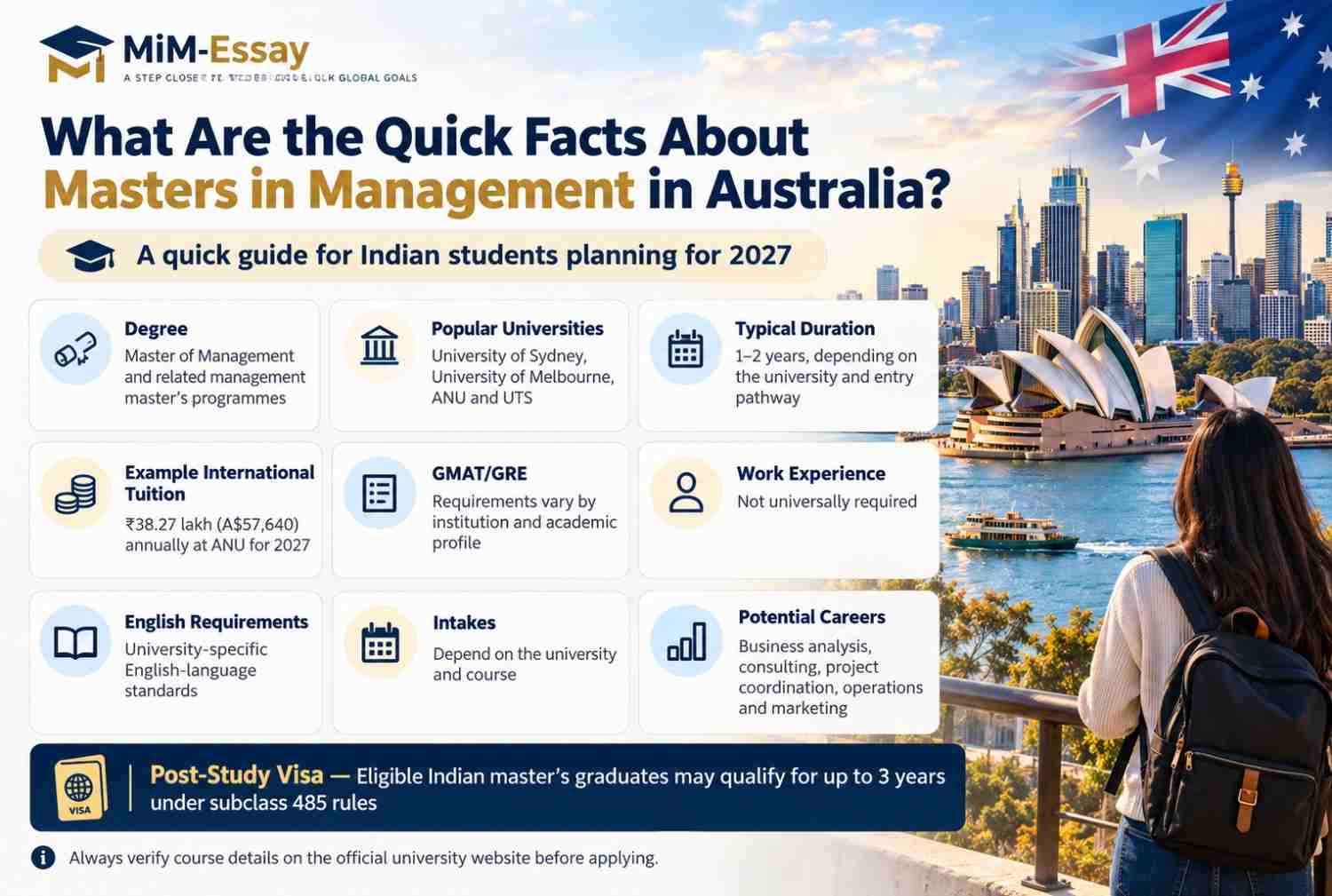
| Factor | 2027 Information |
|---|---|
| Degree | Master of Management and related management master's programmes |
| Popular Universities | University of Sydney, University of Melbourne, ANU and UTS |
| Typical Duration | 1–2 years, depending on the university and entry pathway |
| Example International Tuition | ₹38.27 lakh (A$57,640) annually at ANU for 2027 |
| GMAT/GRE | Requirements vary by institution and academic profile |
| Work Experience | Not universally required |
| English Requirements | University-specific English-language standards |
| Intakes | Depend on the university and course |
| Potential Careers | Business analysis, consulting, project coordination, operations and marketing |
| Post-Study Visa | Eligible Indian master's graduates may qualify for up to 3 years under subclass 485 rules |
Which Are the Best Universities for Masters in Management in Australia in 2027?
The best university depends on whether you want a general management degree, international business exposure, a shorter course or a programme with specialised subjects. It is important to compare the actual degree rather than relying only on the overall university ranking.
| University | Official Programme | Study Duration | Key Feature |
|---|---|---|---|
| University of Sydney | Master of Management | 15 months full-time | Industry-linked projects and business management foundations |
| University of Sydney | Master of Management (CEMS) | 1.5 years full-time | International exchange and CEMS management qualification |
| University of Melbourne | Master of Management | 2 years, or 1.5 years with qualifying prior study | Management foundations, electives and capstone subjects |
| Australian National University | Master of Management | Check the applicable 2027 study plan | Management and organisational decision-making |
| Australian National University | Master of International Management | Up to 2 years, with possible credit arrangements | International business and cross-border management |
| University of Technology Sydney | Master of Management | 1.5 years full-time | Leadership, responsible management and applied business skills |
These are selected management degrees, not a ranking of every Australian business school. Programme structures and entry pathways can change for individual students.
University of Sydney
The University of Sydney offers a Master of Management designed for recent graduates from different academic backgrounds. The programme combines subjects such as leadership, strategy, financial management and digital transformation with practical business learning.
The university reports that its Master of Management is ranked #20 worldwide and #1 in Australia in the QS Business Master's Rankings 2027.
Its standard programme lasts 15 months full-time, and prior professional experience is not required for admission. Applicants should also examine the separate CEMS pathway if they want international exchange opportunities.
University of Melbourne
The University of Melbourne offers a Master of Management that develops skills in business analysis, strategy and organisational management. The standard full-time course lasts two years.
Students with relevant previous qualifications may qualify for a shorter 1.5-year pathway. The university's curriculum includes foundation subjects, core management study, electives and capstone subjects.
Applicants should verify the entry pathway applicable to their undergraduate degree before calculating total tuition.
Australian National University
ANU offers both a Master of Management and a Master of International Management. These are separate programmes and should be compared according to course content, admission rules and career objectives.
The Master of International Management is particularly relevant to students interested in international business and management across different markets.
ANU's 2027 programme information also explains that qualifying previous study may lead to credit for relevant coursework, potentially affecting the amount of study required.
University of Technology Sydney
UTS offers a Master of Management focused on leadership, responsible management, problem-solving and organisational decision-making.
The programme lasts 1.5 years full-time and is offered through UTS Business School. Its subjects cover areas such as managing change, organisational sustainability and strategic management.
Students should check the international student tuition option rather than using domestic fees displayed on parts of the university website.
How Much Does a Masters in Management in Australia Cost in 2027?
The cost of a Masters in Management in Australia depends on the university, programme duration, international student fee and any credit granted for previous study. Applicants should distinguish annual fees from total course tuition.
Official Tuition Fee Comparison
| University | Programme | 2027 International Fee Status |
|---|---|---|
| ANU | Master of Management | ₹38.27 lakh (A$57,640) annual indicative fee |
| ANU | Master of International Management | ₹38.27 lakh (A$57,640) annual indicative fee |
| University of Sydney | Master of Management | Check the 2027 international fee selection on the official course page |
| University of Melbourne | Master of Management | Check the 2027 international fee and applicable study duration |
| UTS | Master of Management | International tuition must be confirmed; domestic fee figures should not be used |
Important: ANU's fee is an annual indicative amount, not the complete tuition cost for every student. Fees may change with course selection, future annual increases and credit arrangements. Figures not independently confirmed for international students have deliberately been left unestimated.
Official sources: ANU Master of Management 2027, University of Sydney Master of Management and University of Melbourne Master of Management.
What Other Expenses Should Indian Students Budget For?
Tuition is only one part of the total investment. Students should also prepare for living expenses, mandatory insurance, visa charges, travel and course-related costs.
- Accommodation: Rent varies by city, property type and whether accommodation is shared.
- Food and Transport: Budget for groceries, occasional meals out and public transport.
- Overseas Student Health Cover: Eligible international students generally need approved health insurance for their stay.
- Visa and Application Charges: Check the current government and university fees before paying.
- Travel and Setup Costs: Include flights, accommodation deposits and other arrival expenses.
- Currency Changes: Exchange-rate movements can change the final amount paid in INR.
For broader cost comparisons across postgraduate programmes, read our Masters in Australia guide.
What Are the Eligibility Requirements for Masters in Management in Australia?

Most Australian management master's programmes require a recognised undergraduate qualification, but academic thresholds and additional requirements differ by university.
Academic Qualifications
The University of Sydney normally requires a bachelor's degree with a credit average equivalent to 65%. It also provides an alternative admissions route for some applicants with lower academic results who demonstrate satisfactory performance in an approved admissions test.
At Melbourne and ANU, eligibility depends on the selected course, academic background and applicable entry pathway.
GMAT and GRE Requirements
GMAT is not universally compulsory for Masters in Management in Australia. However, students should not assume every university admits applicants without entrance testing.
For example, Sydney's standard Master of Management allows certain applicants with lower academic averages to demonstrate additional readiness through the GMAT or an approved alternative test.
The appropriate test strategy therefore depends on your university shortlist and academic results.
Read our MiM Without GMAT guide to understand how testing requirements differ across management master's programmes.
English-Language Requirements
International applicants must meet the university's English-language proficiency standard. Universities may accept IELTS, TOEFL, PTE Academic or other approved evidence.
Exemptions are not automatic for every student whose undergraduate education was taught in English. Confirm the relevant policy before booking or skipping a test.
Work Experience Requirements
Professional work experience is not compulsory for all management master's programmes. Sydney explicitly welcomes recent graduates without prior work experience.
Applicants can still use internships, academic projects, volunteering and extracurricular activities to demonstrate leadership, teamwork and career motivation.
Our MiM Eligibility and Requirements guide explains the broader admission factors students should assess.
How Can Indian Students Apply for Masters in Management in Australia in 2027?
Indian applicants should begin by comparing official programme requirements, then prepare documents and apply before the university's relevant intake deadline. Application calendars are not identical across institutions.
- Shortlist Universities: Compare course titles, curriculum, duration, tuition and career relevance.
- Confirm Academic Eligibility: Check how the university evaluates Indian undergraduate qualifications.
- Review Test Requirements: Determine whether GMAT, GRE or English-language evidence is required.
- Prepare Documents: Gather transcripts, degree records, passport details and the required CV.
- Write the Motivation Statement: Explain your career goals, relevant experiences and interest in the programme.
- Submit the Application: Follow the institution's official online process and deadline.
- Review Your Offer: Check academic conditions, fee payments and scholarship decisions.
- Prepare the Visa Application: Arrange the required enrolment, financial, health insurance and immigration documents.
Application Documents Checklist
| Document | Why It Matters |
|---|---|
| Academic transcripts | Establish educational background and academic performance |
| Degree certificate | Confirms completion of the required qualification |
| CV or resume | Summarises academic, internship and professional experience |
| Statement of motivation | Explains career goals and programme fit |
| English test results | Demonstrates language proficiency where required |
| GMAT or other test | Supports eligibility where the school requires or accepts it |
| Supporting documents | May include references or other programme-specific materials |
At the University of Sydney, applicants prepare a CV, academic transcript and motivation statement, with selected candidates potentially completing a motivational video.
Are Scholarships Available for Masters in Management in Australia?

Yes, Australian universities offer scholarship opportunities for eligible international students, although availability and award amounts vary by university, citizenship, academic results and programme.
University Merit Scholarships
Some universities provide international merit scholarships based on academic performance. Students should check whether consideration is automatic or requires a separate application.
Faculty and Business School Funding
Business schools may publish scholarships for selected postgraduate coursework degrees. The award might be a fee reduction rather than a full scholarship.
How to Compare Scholarship Offers
Applicants should confirm:
- Whether the award is available to Indian students.
- Whether the selected management programme qualifies.
- The amount of tuition covered.
- Any academic conditions for retaining the scholarship.
- Whether a separate application deadline applies.
Do not assume that a university-wide scholarship is automatically open to every management master's student.
What Jobs Can You Get After a Masters in Management in Australia?
Management master's graduates may pursue roles in business analysis, consulting, operations, project coordination, marketing and other business functions. Actual opportunities depend on previous experience, technical skills, employer requirements and the Australian labour market.
| Career Area | Examples of Potential Entry-Level Roles | Useful Skills |
|---|---|---|
| Consulting | Graduate consultant, business analyst | Research, problem-solving and presentation |
| Operations | Operations analyst, operations coordinator | Process improvement and data analysis |
| Marketing | Marketing analyst, marketing coordinator | Customer insights and campaign analysis |
| Finance and Business | Business analyst, junior financial analyst | Financial literacy and analytical skills |
| Project Management | Project coordinator, project support officer | Planning, communication and reporting |
| Human Resources | HR coordinator, people operations associate | Organisational behaviour and communication |
What Is the Average Salary After MiM in Australia?
There is no single verified average starting salary covering all Masters in Management programmes in Australia. Universities use different reporting methods, and many do not publish programme-specific salary data for a recent graduating class.
Students should therefore avoid treating broad Australian management salaries as guaranteed earnings for fresh MiM graduates. Mid-career manager salaries are not appropriate substitutes for entry-level graduate salaries.
Review our Master in Management Salary guide for an explanation of how graduate salary figures should be interpreted.
How Can Graduates Improve Their Employment Prospects?
Students can improve their preparation by developing practical analytical skills, using university career services, participating in industry projects and applying for suitable graduate roles early.
International applicants should also review whether employers accept their visa status and whether a role requires Australian work experience, professional registration or other qualifications.