



 Abhyank Srinet
 | 📌 Fact | 📈 Details |
|---|---|
| Duration | 2 years (Full-time MBA) |
| Tuition Fees | $84,250 per year |
| GMAT/GRE Requirement | GMAT Focus or GRE accepted |
| Acceptance Rate | Highly competitive (official rate not published) |
| Average Salary Post-Graduation | $175,000 USD (median base salary – Class of 2025) |
| Class Size | 304 students |
| Global Ranking | QS Global MBA Ranking: #62 |
| Location | Hanover, New Hampshire, United States |
📊 Quick Facts – Tuck MBA 2026
What is Dartmouth Tuck MBA
The Tuck School of Business at Dartmouth MBA is a full-time program based in Hanover, New Hampshire, and it stands out for one reason — its tight-knit, highly collaborative community. Unlike larger MBA programs, Tuck keeps its class size small, which creates a more personal learning experience and stronger relationships with peers, professors, and alumni. The program follows a structured first year with core courses, followed by a flexible second year where you can choose electives based on your career goals. Being part of Dartmouth College also gives it strong global recognition.
The program is best suited for people who value community, leadership development, and careers in consulting or general management. If you are targeting firms like McKinsey & Company, Boston Consulting Group, or Bain & Company, Tuck consistently places a large percentage of its class into these roles. If you prefer a big-city campus experience or want heavy exposure to finance hubs like New York on a daily basis, this may feel different since Tuck is based in a smaller, more focused academic environment.
Want to compare Tuck MBA vs other top MBA programs? → Tuck MIM Review
Tuck MBA Class Profile
.jpg)
The Tuck MBA class profile shows the academic strength, work experience, and diversity of the incoming class. It includes details like class size, industry background, test scores, and student demographics. These numbers help applicants understand how competitive the program is and whether their profile aligns with what the school looks for.
Check- Tuck MBA GMAT Score & Class Profile
Tuck MBA Class Profile – Class of 2025
| Profile Metric | Details |
|---|---|
| Average GMAT | 727/ 671(FE) |
| Average GRE | 162 Verbal / 160 Quant |
| Average GPA | 3.6 |
| Average Work Experience | 5.8 years |
| Average Age | NA |
| Pre-MBA Industry (MBA 2025) | Consulting, Finance, Technology, Manufacturing, Healthcare |
| Pre-MBA Location (MBA 2025) | United States and International (multiple global regions) |
| Class Size (MBA 2025) | 304 students |
| Women (MBA 2025) | 44% |
| Countries Represented (MBA 2025) | 46 countries |
Source: Tuck MBA Official Class Profile
Tuck MBA for Indian Applicants
Students from India are an important part of the Tuck School of Business at Dartmouth community. Because the class size is small, you get to build close relationships with classmates, professors, and alumni. The cost is not just tuition. Tuition is about $82,000–$84,000 per year, and when you add living costs in Hanover, insurance, and other expenses, the total comes to around $200,000–$220,000 (₹1.6–1.8 Cr approx.) for the full 2-year program.
Most students who get into Tuck have around 4–6 years of work experience. Many come from consulting, finance, or tech roles. Tuck accepts both GMAT and GRE. There is no fixed cutoff, but strong academics, clear goals, and leadership experience are important. The program focuses a lot on teamwork, leadership, and practical learning, so your overall profile matters more than just your test score.
After the MBA, many graduates choose to work in the US, mainly in consulting, general management, and tech roles. Top companies like McKinsey & Company, Boston Consulting Group, Bain & Company, Amazon, and Microsoft regularly hire from Tuck. The program does not have a STEM designation, but it still shows strong placement numbers and high salaries, which makes it a good option if you are looking for solid career growth after your MBA.
The Tuck Experience
Tuck MBA Admission Requirements
The Tuck School of Business at Dartmouth looks for candidates who can contribute actively to a close-knit and collaborative classroom. The admissions team evaluates your academics, professional experience, leadership ability, and clarity of goals rather than relying on any single factor.
- GMAT / GRE: Applicants must submit a valid GMAT Focus Edition or GRE score. Tuck does not have a minimum cutoff, but competitive scores strengthen your application.
- Academic Record: A bachelor’s degree from an accredited institution is required. Tuck does not publish a minimum GPA, but strong academic consistency is important.
- Work Experience: Most admitted students have meaningful full-time work experience. Tuck values impact, leadership, teamwork, and career progression over job titles.
- English Language Test: Required if your undergraduate degree was not taught entirely in English. TOEFL, IELTS, or Duolingo English Test scores are accepted.
- Resume: A one-page professional resume highlighting your roles, responsibilities, achievements, leadership experience, and growth.
- Essays: Required essays that focus on your career goals, values, leadership experiences, and fit with Tuck’s collaborative culture.
- Letters of Recommendation: Two professional recommendations from supervisors or senior colleagues who can speak about your performance, leadership, and potential.
⭐ Ideal Candidate
The ideal candidate for the Tuck MBA is someone who values teamwork, community, and active class participation. Tuck looks for professionals with strong academics, meaningful work experience, and clear career goals. Applicants with 4–8 years of experience, leadership exposure, and a collaborative mindset tend to fit well. A genuine interest in contributing to campus life and learning in a close-knit environment is especially important at Tuck.
Dartmouth Tuck MBA Acceptance Rate
The acceptance rate for the Dartmouth Tuck MBA is estimated to be around 23–25%, as the school does not publish an official figure each year. This shows that Tuck is a selective MBA program with a strong focus on fit. Admissions decisions are based on academics, work experience, leadership potential, and how well an applicant aligns with Tuck’s close-knit and collaborative culture.
Your Chances of Getting Into Dartmouth Tuck MBA
Here is a simplified view of how your profile may align with Tuck MBA expectations:
- High Chance: Strong academics, 4–8 years of solid work experience, competitive GMAT/GRE scores, clear post-MBA goals, leadership exposure, and essays that show strong fit with Tuck’s community-driven culture.
- Moderate Chance: Average academics, 3–6 years of experience, slightly below-average test scores, steady career growth, and clear goals supported by good recommendations.
- Low Chance: Weak academic record, very low test scores, limited leadership or teamwork exposure, unclear career goals, or essays that do not show alignment with Tuck’s values.
Dartmouth Tuck MBA Ranking and Global Reputation
The Dartmouth Tuck MBA is widely respected for its strong academic quality, close-knit community, and consistent career outcomes. While global rankings vary by source, Tuck is known for its focus on leadership, collaboration, and long-term impact. Its reputation is built on alumni success, strong employer trust, and a clear emphasis on values-driven management.
| Rankings | Position |
| Financial Times’ 2025 Global MBA | 20 |
| U.S. News & World Report ranking 2025 Full Time MBA | 6 |
| QS Global MBA Rankings 2026 | 62 |
| POETS&QUANTS | 6 |
Dartmouth Tuck MBA Program & Curriculum

You can become a better leader in the corporate world if you pursue an MBA. You will be provided with the analytical abilities to create and support arguments as well as the functional competence at the core of strategic thinking and management. The Dartmouth Tuck MBA required curriculum comprises a variety of core classes and electives taught by knowledgeable academics. For you to be able to manage large projects as a leader in the real world, the curriculum also includes projects and a leadership development course.
- Summer (August – October) - Analytics,Financial Accounting, Management Communication, Managerial Economics, Managing People.
- Fall (October – December) - Analytics II, Capital Markets, Crafting Strategy, Marketing.
- Winter (January – March) - Corporate Finance, Global Economics for Managers, Electives.
- Spring (March – May) - First-Year Project, Managing Organizations, Operations Management, Electives.
Tuck's integrated core curriculum provides rigorous coverage of key functional areas and disciplines with courses that build on and complement each other: analytics, corporate finance, and capital markets, managerial and global economics, marketing, organizational behavior, strategy, communications, and operations.
Electives
Tuck MBA elective offerings are changed on an annual basis. With over 100 electives and 16 core courses, students can adapt their education to best suit their job ambitions. (Faculty and programme materials may vary.)
- Accounting
- Communication
- Economics
- Entrepreneurship
- Ethics and Social Responsibility
- Finance
- Health Care
Experiential learning programs
- First-Year Project:: Tuck offers an educational opportunity where teams of five students apply their classroom knowledge to tackle complex, real-world business challenges for various clients.
-
Global Insight Expeditions:Tuck provides half-term elective courses known as Global Insight Expeditions (GIXs) to various selected countries. Led by faculty, these trips offer students unique opportunities to engage with key individuals and organizations influencing the global business landscape.
-
Center for Business, Government & Society: The Center for Business, Government & Society leverages business expertise to address community needs and global challenges. It collaborates across various sectors to create innovative solutions, offering boundless opportunities.
- Tuck Community Consulting: Tuck Community Consulting links students with local enterprises and non-profit projects, offering practical consulting experience, the chance to utilize business skills, and opportunities for community volunteering.
Research centers
Dartmouth Tuck provides six research centers and institutes: The Revers Center for Energy, Tuck Center For Digital Strategies, The Center for Private Equity and Venture Capital, The Center for Entrepreneurship, The Center for Health Care.
The Tuck MBA: Be Here
Fees & Financing for the Dartmouth Tuck MBA
The total cost of the Dartmouth Tuck MBA includes tuition, program fees, and living expenses in Hanover. Understanding the full cost helps students plan finances better and evaluate the return on investment. Below is a clear breakdown of the official cost of attendance for the latest academic year.
2025–2026 Fee Breakdown for the Dartmouth Tuck MBA
| Fee Component | Amount (USD) |
|---|---|
| Tuition Fee | $84,250 |
| Program Fee | $5,843 |
| Housing (On-campus estimate) | $15,910 |
| Books, Course Materials & Supplies | $1,500 |
| Food Allowance | $10,572 |
| Miscellaneous Personal Expenses | $7,305 – $8,430 |
| Health Insurance | $4,556 |
What Each Fee Covers
Tuition covers academic instruction, classroom learning, faculty access, and core MBA coursework. The program fee includes student activities, transcripts, IT services, infrastructure support, and administrative services. Living expenses are estimated based on student costs in Hanover and may vary depending on housing and lifestyle choices.
Estimated Living Expenses in Hanover
Hanover has a lower cost of living compared to major cities. Based on official estimates, MBA students should plan for:
- Housing: $1,300–$1,700 per month (on-campus or nearby)
- Food: ~$880 per month
- Health insurance: ~$4,556 per year
- Books and supplies: ~$1,500 per year
- Personal expenses: Varies by lifestyle
Total Estimated Cost for International Students
When tuition, program fees, housing, and living expenses are combined, the total estimated cost for one academic year of the Dartmouth Tuck MBA ranges between $129,000 and $135,000 USD, depending on housing choice.
Financing Options for the Dartmouth Tuck MBA
Students typically finance the Tuck MBA through a mix of scholarships, education loans, and personal savings. Common financing options include:
1. Education Loans
- U.S. federal and private student loans (for eligible students)
- International education loans through approved lenders
- Private financing options with or without a U.S. co-signer
2. Dartmouth Tuck MBA Scholarships
- Merit-based scholarships awarded at admission
- Need-based financial aid for eligible students
- No separate scholarship application required in most cases
3. On-Campus Employment
- Part-time campus jobs subject to visa regulations
- Research or administrative roles when available
Is the Dartmouth Tuck MBA Worth the Cost? (ROI Snapshot)
The Dartmouth Tuck MBA offers strong return on investment due to high post-MBA salaries, strong consulting and leadership placements, and a powerful alumni network. Despite the upfront cost, many graduates recover their investment within a few years through high-paying roles in consulting, finance, and general management.
Scholarships for the Dartmouth Tuck MBA
Dartmouth Tuck offers generous financial support to MBA students through a mix of merit-based scholarships and need-based aid. Most scholarships do not require a separate application. All admitted students are automatically considered for funding during the admissions process. Tuck’s goal is to make the MBA accessible while attracting strong, diverse candidates.
Below are the main scholarship and financial aid options available for Tuck MBA students:
Tuck Merit-Based Scholarships
- Amount: Varies and can cover a significant portion of tuition
- Eligibility: Strong academic background, leadership potential, and professional impact
- Who usually gets it: High-performing applicants across industries and geographies
- How to apply: Automatic consideration with the MBA application
Tuck Need-Based Financial Aid
- Amount: Varies based on financial need
- Eligibility: Students who demonstrate financial need through Tuck’s aid assessment
- Who usually gets it: Admitted students with strong profiles who need financial support
- How to apply: Financial information submitted after admission
Named and Donor-Funded Scholarships
- Amount: Varies by scholarship
- Eligibility: May be linked to leadership, background, career goals, or personal values
- Who usually gets it: Students who align with the intent of specific donor awards
External Scholarships
- Students are encouraged to explore external and country-specific scholarships
- These awards can be combined with Tuck-provided financial aid
Important note: Because most Tuck MBA scholarships are decided during the admissions process, the overall strength of your application plays a major role. Clear career goals, strong essays, leadership examples, and alignment with Tuck’s values can directly improve your chances of receiving funding.
Tuck MBA vs Alternatives
| Program | Best For |
|---|---|
| Tuck School of Business MBA | Consulting, general management, strong alumni support, close-knit community |
| Harvard Business School MBA | Leadership roles, global brand value, wide career options |
| Stanford GSB MBA | Startups, venture capital, innovation-focused careers |
If you want a career in consulting or general management, the Tuck MBA is a strong choice. A large number of students go into consulting every year, and top firms like McKinsey, BCG, and Bain regularly hire from Tuck. The small class size also helps you build strong relationships, which is useful during placements.
Harvard Business School is better if you want more flexibility across different industries like consulting, finance, tech, or even startups. It also has a very strong global brand and a large alumni network.
Stanford GSB is the best fit if your goal is startups or venture capital. Being close to Silicon Valley gives you better access to startup opportunities and investors.
Overall, the Tuck MBA is best if you want a supportive community and strong consulting outcomes, while Harvard and Stanford are better for broader or startup-focused career paths.
Tuck MBA Career Outcomes and Salary

Tuck MBA graduates see strong career outcomes across consulting, financial services, and technology roles. The school’s close ties with employers, strong alumni support, and focused career coaching help students prepare well for recruitment. Many graduates receive job offers within three months of graduation, reflecting the program’s strong placement record. These outcomes make the Tuck MBA a solid choice for professionals aiming for leadership roles and long-term career growth.
| Category | Details |
|---|---|
| Average Salary | $175,000 USD (Median base salary – Tuck MBA Class of 2025) |
| Top Recruiters | McKinsey & Company, Boston Consulting Group (BCG), Bain & Company, Deloitte, Barclays, Oliver Wyman, L.E.K. Consulting, Amazon, Bank of America, Morgan Stanley, Kearney, EY-Parthenon |
| Popular Industries | Consulting, financial services, technology, healthcare/pharma/biotech, consumer goods/retail |
| Common Job Roles | Management Consultant, Strategy Consultant, Investment Banking Associate, Product Manager, Finance Manager |
- Average Salary: Tuck MBA graduates report a median base salary of $175,000 USD, with consulting roles among the highest-paid.
- Top Recruiters: McKinsey, BCG, Bain, and other global firms consistently hire Tuck MBA graduates.
- Popular Industries: Consulting is the top hiring industry, followed by financial services and technology.
Common Job Roles:
- Management Consultant
- Strategy Consultant
- Investment Banking Associate
- Product Manager
- Finance Manager
Know more at: Employment Statistics | Tuck School of Business
Know more at: CAREER | Dartmouth Tuck
Tuck MBA Application: Essay & Interview
There are a total of 4 essays in the Dartmouth Tuck MBA program, one of which is optional. Your capacity to reflect on your encounters is evaluated by the college. Your strengths are questioned to understand who you are and what you are capable of.
Essays
The Dartmouth Tuck MBA essays are an important part of the admissions process and can make a big difference in your chances of getting accepted into the Tuck MBA program.
Essay 1
Tuck students can articulate how the distinctive Tuck MBA will advance their aspirations. Why are you pursuing an MBA and why Tuck? (300 words)
Essay 2
Tuck students recognize how their individuality adds to the fabric of Tuck. Tell us who you are. (300 words)
Essay 3
Tuck students are encouraging, collaborative, and empathetic, even when it is not convenient or easy. Describe a meaningful experience in which you exemplified one or more of these attributes. (300 words)
Optional
Please provide any additional insight or information that you have not addressed elsewhere (e.g., atypical choice of evaluators, factors affecting academic performance, unexplained job gaps or changes). Complete this question only if you feel your candidacy is not fully represented by this application. (300 words)
Interview Questions
The Dartmouth Tuck MBA interview is your chance to highlight your distinct experiences, abilities, and ambitions that resonate with the core values of Tuck School of Business and its goals. Tackle each question with sincerity and a proactive approach, underscoring your potential contributions to the vibrant Tuck community.
Is Tuck MBA worth it?
Worth it if: You are targeting consulting, general management, or leadership roles in the US. The Tuck School of Business at Dartmouth has a strong track record in consulting placements, with a large percentage of the class going into firms like McKinsey & Company, Boston Consulting Group, and Bain & Company. You value a close-knit, collaborative environment where you can build strong relationships with peers and alumni. The program offers a full 2-year MBA with a structured first year and flexible electives in the second year, along with strong leadership development and consistent employment outcomes, making it a solid choice for long-term career growth.
Think twice if: Your primary goal is to work outside the US immediately after graduation, as most placements are US-focused. Your budget is tight, since the total investment is around $200,000–$220,000 (₹1.6–1.8 Cr approx.) including living costs. You prefer a large, city-based campus experience, as Tuck is located in Hanover, which is a smaller, quieter town. You are not targeting consulting or leadership roles, or you prefer industries where other MBA programs may have stronger specialization.
👉 Want a detailed answer before deciding? Check our full analysis is Tuck MBA worth it?.
What Makes Dartmouth Tuck MBA Unique
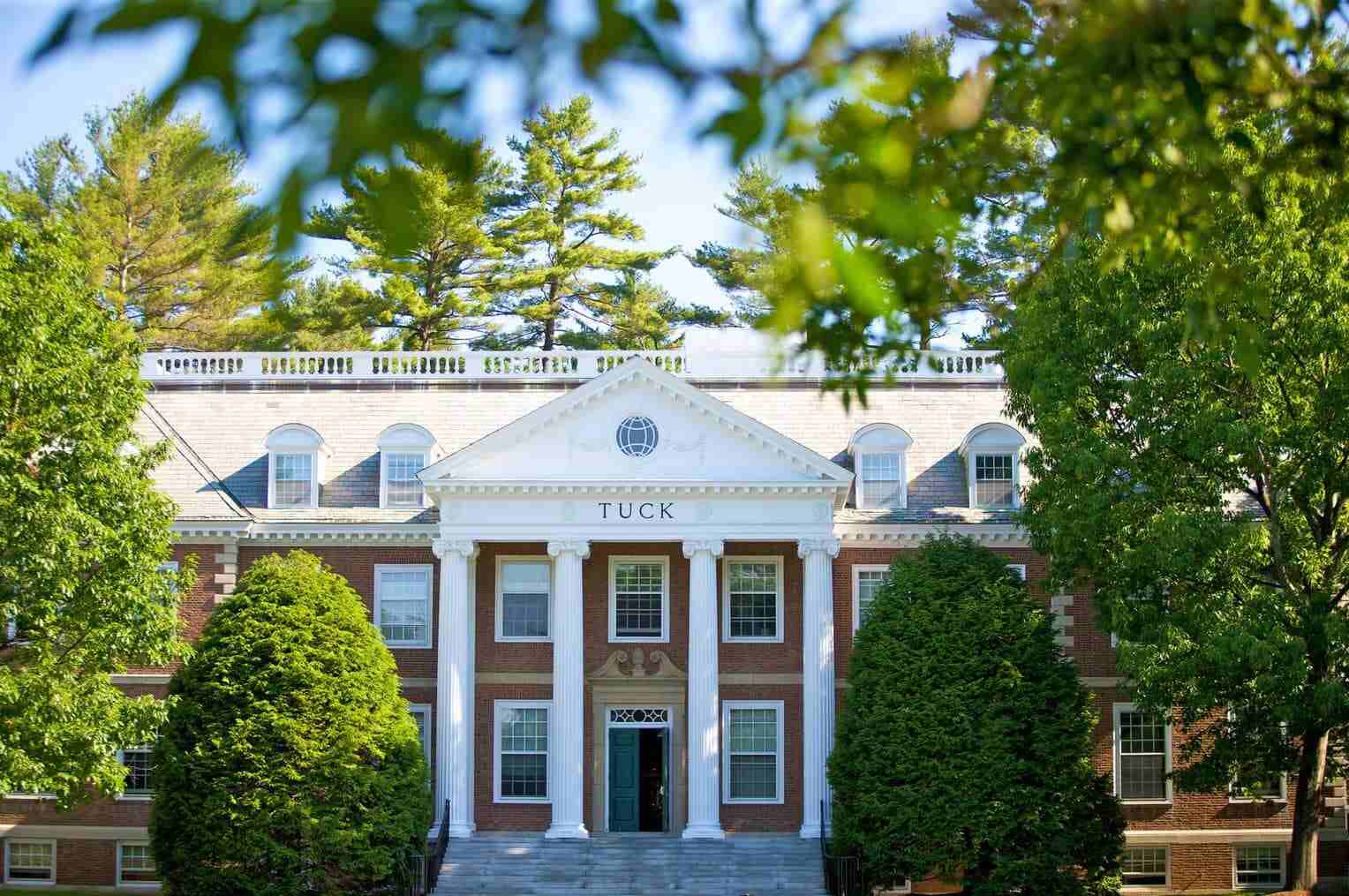
Is Dartmouth Tuck MBA worth it?
The Tuck MBA offers a very different MBA experience compared to large business schools. It combines strong academics with a deeply connected community and one of the most supportive alumni networks in global MBA education.
- Close-knit community: Tuck has one of the smallest MBA class sizes among top U.S. schools, which leads to strong peer connections and high classroom engagement.
- Collaborative learning culture: The curriculum emphasizes teamwork, discussion-based learning, and leadership development rather than competition.
- Strong consulting focus: Tuck is widely known for its consistent strength in consulting placements and recruiter trust.
Highly engaged alumni network: Tuck alumni are known for actively mentoring students and supporting career transitions. - Unique location: Located in Hanover, Tuck offers a focused campus environment that helps students build deep relationships without urban distractions.
MiM-Essay Tuck MBA Admits
We have helped multiple applicants secure admits at the Tuck School of Business at Dartmouth by focusing on one thing — clear positioning. Tuck is not just looking for strong academics; it looks for candidates who show leadership, teamwork, and a clear reason why Tuck fits their goals. The program strongly values collaboration and community, so applicants who highlight impact, leadership, and real-world experience stand out the most.
- Average GMAT of our admits: 690–740
- Most common backgrounds: consulting, finance, technology, and engineering
- Most common nationalities: Indian, US, and other international applicants
One example: 710 GMAT, 5 years in a consulting firm, admitted in Round 1. Career goal: move into strategy consulting. The application focused on one major project where the candidate led a cross-functional team and showed strong leadership impact. Instead of covering everything, the essays went deep on teamwork and leadership, aligning well with Tuck’s collaborative culture.
This section is what actually separates your profile from generic MBA applications. Focus on clear career goals, strong leadership stories, and why Tuck is the right fit for you. Updating this with real admit trends and outcomes helps build trust and improves your chances of getting shortlisted.
Useful Links
| Eligibility & Admission Process | Application Requirements |
| Program deadlines | APPLICATION DEADLINES |
| Costs & finance | Full-Time MBA | Tuition & Expenses Information |
| Dartmouth Tuck Alumni | Home - Alumni,| Dartmouth Tuck University |
| Contact | Dartmouth Tuck MBA Program tuck.admissions@tuck.dartmouth.edu 603-646-3162 |
Conclusion
The Tuck MBA isn’t just about earning a degree — it’s about joining a community that helps you grow personally and professionally. From day one, you’ll be surrounded by supportive classmates, inspiring professors, and a network that truly cares. The program combines solid academics with real-world learning, helping you build confidence and leadership skills for any career path. If you’re looking for a transformative MBA experience where you feel valued and challenged, the Tuck MBA is the place to be.


