
 Abhyank Srinet


Table of Contents
Key Takeaways
• GRE test analytical writing checks your essay and thinking skills in 30 minutes
• Scored by both humans and computer for fairness and accuracy
• No special subject knowledge is needed to attempt the task
• Writing clearly with good structure helps you get a higher score
The GRE Analytical Writing section is the first part of the GRE exam. In this task, you need to write an essay where you share your opinion on a given topic. It checks how well you can explain your thoughts, build strong arguments, and write clearly—skills that are important for any master’s degree.
Many students focus more on the Verbal and Quant sections, but the gre test analytical writing section is just as important. It shows universities how ready you are for writing tasks like research papers or assignments during your graduate studies. Doing well here can give your application an extra edge.
What is GRE Test Analytical Writing?

GRE test analytical writing is a section of the GRE (Graduate Record Examination) test is show well you express your thoughts and support them with logic. It has one task: “Analyze an Issue,” where you give your opinion on a general topic and support it with examples.
- Analyze an Issue task: You are presented with an opinion on a general topic and must analyze the issue by taking a position and providing reasons and examples to support your view, regardless of whether you agree or disagree with the given opinion.
- Analyze an Argument task: You are presented with an argument and must analyze the reasoning behind it, evaluating the strength and weaknesses of the argument rather than agreeing or disagreeing with the position.
Your essay is scored from 0 to 6 by both a human and a computer. If scores differ too much, another human will check it. This section checks your writing, reasoning, and thinking skills needed for a master’s degree.
Remember, GRE graders want clear logic, not fancy words. Write in simple language and make sure your main point is easy to understand.
Importance of GRE Analytical Writing for Admissions
GRE writing scores aren’t the most important part of your application, but they do matter. A very low score may raise doubts about your writing skills. This could make universities check your SOP and recommendation letters more closely.
So while it won’t make or break your chances alone, a good writing score supports a strong application—especially for research-based programs.
For more information about GRE Exam, click here: GRE Exam Syllabus
GRE Test Analytical Writing: Timing and Format
.jpg)
Timing
You'll have 30 minutes for the GRE test analytical writing assessment, encompassing brainstorming, outlining, and revising. Given this limited time frame, it's essential to have background knowledge of the tasks and practice writing essays.
The assessment comprises two tasks: "Analyse an Issue" and "Analyse an Argument," each with a 30-minute duration. The former evaluates your understanding and interpretation of an issue with reasons, while the latter analyzes given arguments using logical reasoning.
Template Format
First of all, we need to understand the essay format using AWA template GRE Preparation. The task is to time yourself properly so as to read, comprehend, compose and answer within 30 minutes. The basic GRE analytical writing template must comprise 5-paragraphs while some of you may prefer to have 4 or 6 paragraphs depending on how you divide the body of the essay. Here is what the basic 5-paragraph GRE AWA template must include:
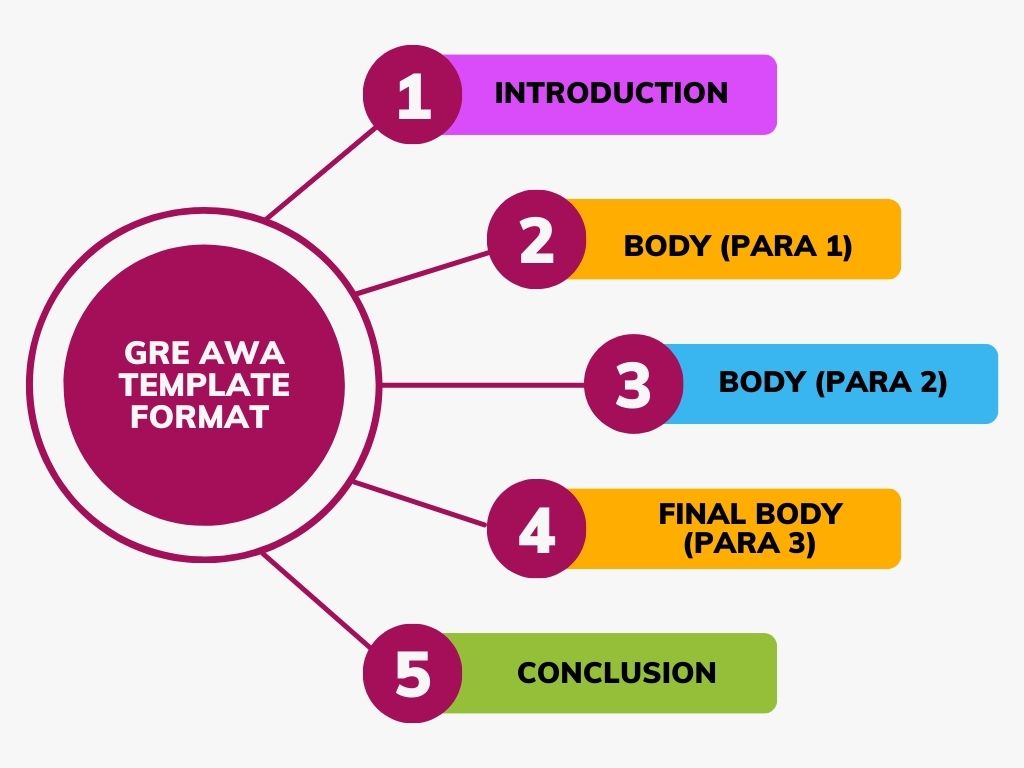
Introduction: Begin your essay by clearly stating the given issue or topic and providing a brief explanation in your own words. In the final sentences of your introduction, preview what will be discussed next to maintain the reader's interest. Keep the introduction concise and specific, demonstrating a clear understanding of the topic's central idea.
- Body (Para 1): This is the section where you showcase your strongest argument or example. It should be relevant and well-aligned with your position in the essay. Examples can be drawn from various fields such as social, political, cultural, or historical contexts, as long as they support your stance effectively.
- Body (Para 2): As you enter the third paragraph of your essay, ensure a seamless transition from the preceding section. Here, maintain the pattern of providing a well-explained example that reinforces your thesis. If you opt for a four-paragraph essay structure, this will serve as your final body paragraph before transitioning to the conclusion.
- Final Body (Para 3): Transitioning to another example, consider a different perspective or scenario than those mentioned earlier. This example will help solidify your argument further. As you wrap up this discussion, subtly direct your focus toward the impending conclusion.
- Conclusion: The conclusion of the GRE AWA essay is as significant as its other sections. Avoid rushing to meet the word limit by adding generic sentences at the end. Use this section to summarize the entire essay concisely, refute opposing viewpoints, and include analytical statements for added impact.
Easy Steps to Crack GRE Analytical Writing
.jpg)
To do well in the GRE Test Analytical Writing section, you need to follow a simple and smart plan. This section checks how well you can understand a topic, give your opinion, and explain it clearly. Here's an easy way to prepare:
Step-by-Step Strategy
- Understand the Structure: You will get one task called “Analyze an Issue.” You’ll have 30 minutes to read, plan, write, and edit your essay. So managing time is very important.
- Practice Regularly: Try writing at least 2–3 essays every week. This will help you get better at writing quickly and clearly within the time limit.
- Use a Template: A 5-paragraph essay structure is effective for both tasks. Begin with an introduction that clearly states your position, followed by three body paragraphs that present your strongest points, and conclude with a summary that reinforces your argument. This structure ensures your essay is organized and easy to follow.
- Develop Your Argument: Focus on creating strong, logical arguments supported by specific examples. Whether you draw from history, personal experiences, or current events, make sure your examples are relevant and directly support your thesis.
- Manage Your Time: Allocate your time wisely in the GRE Test Analytical Writing section: 5 minutes for planning, 20 minutes for writing, and 5 minutes for revising. This balance allows you to produce a well-rounded essay without running out of time.
| Task | Time Allocation (Minutes) |
|---|---|
| Brainstorming & Planning | 5 |
| Writing the Essay | 20 |
| Revising & Editing | 5 |
Resources for GRE Analytical Writing
When preparing for the GRE Test Analytical Writing (AWA) section, having access to the right resources is essential for success. From practice prompts and sample essays to expert tips and writing guides, there is a wide array of resources available to help you hone your analytical writing skills.
In this section, we'll explore various resources that can assist you in preparing effectively for the AWA section of the GRE, ensuring you are well-equipped to tackle the essay tasks with confidence.
The ETS Website: The ETS website serves as the primary and authoritative resource for GRE Analytical Writing preparation, offering:
- Detailed explanations of the Analyze an Issue and Analyze an Argument tasks
- Scoring guides and rubrics for assessment
- Sample essays across various score levels accompanied by reader commentary
- Access to the complete pool of potential essay prompts for both tasks
Scoreitnow!: ETS provides a paid service called "Scoreitnow!" where you can submit practice essays to receive computer-generated scores and feedback. This service aids in evaluating your performance and pinpointing areas for enhancement.
Dedicated GRE AWA Books:
- GRE Analytical Writing: Real Essay Topics - Book 1" from Vibrant Publications
- Analytical Writing II: Relevant Issue Topics" by Monica Chang
- Official GRE Super Power Pack" by ETS
MiM Essay GRE Test Prep: MiM Essay GRE Test Prep is an excellent tool for GRE preparation. With comprehensive guidance, practice prompts, and expert strategies, it equips you with the necessary skills to excel in the AWA section. Whether you're a first-time test-taker or aiming to improve your score,
These resources offer sample essays, tactics, and practice prompts for the AWA section.
Related Blogs:
Conclusion
Mastering the GRE Test Analytical Writing section is an important step in your academic journey. It helps you develop the skills needed for success in graduate school. By improving your ability to analyze, explain, and argue your points clearly, you'll do well on the GRE and be better prepared for future challenges. Use the available resources, practice regularly, and stay focused. The GRE is not just a test. It's a way to open doors to your dreams and goals.


