
 Abhyank Srinet
  (1).jpg)


Table of Contents
The ISB MBA can be worth it for professionals seeking a major career switch or faster progression in consulting, technology, BFSI, product and strategy roles. ISB's one-year PGP reported an average compensation of ₹37.29 LPA for the Class of 2027, while the official 2027–28 fee totals ₹40.47 lakh with shared accommodation under the single-instalment option. However, ROI depends heavily on your current salary, lost income during the programme, scholarships, loan interest and post-ISB role, so there is no universal payback period.
Introduction
The Indian School of Business is one of the most sought-after business schools in India, but with total programme costs crossing ₹40 lakh, the bigger question is whether the investment actually pays off. ISB’s flagship 12-month Post Graduate Programme in Management is designed for professionals with at least two years of work experience who want to accelerate their careers, switch industries or move into consulting, technology, BFSI, product and strategy roles.
For the Class of 2027, ISB reported an average compensation of ₹37.29 LPA, 1,117 job offers for 808 graduates, 67% industry switches and 69% function switches. At the same time, the 2027–28 shared-accommodation programme fee is ₹40.47 lakh before additional personal and campus expenses.
Is ISB MBA Worth It for Indian Applicants?
Yes, the ISB MBA can be worth it for Indian professionals who want to accelerate their careers without spending two years outside the workforce. The strongest value usually comes for applicants targeting career switches into consulting, technology, BFSI, product, strategy or management roles where the programme can create a meaningful jump from their current career trajectory.
For 2027–28, ISB lists the programme fee at ₹34.48 lakh + GST for shared accommodation, with a refundable ₹20,000 security deposit. Indian applicants should evaluate this cost along with one year of lost salary, loan interest and other personal expenses.
The table below highlights the main ROI factors Indian applicants should evaluate before deciding.
What Sets ISB Apart?

In this article, we’ll explore the key factors that contribute to the value of an ISB MBA, including career prospects, return on investment, and the overall impact on personal and professional growth.
Specialised Programs
ISB distinguishes itself with a diverse range of specialized programs, particularly its Executive Education offerings. These programs are meticulously crafted to give executives the requisite skills, mindsets, and networks crucial for navigating intricate business landscapes and attaining their objectives.
| Program Category | Program Details | Delivery Methods |
|---|---|---|
| Executive Education | Combines lectures from distinguished faculty, case studies, simulations, and group discussions. Participants receive an official certificate upon completion. | On-campus |
| Leadership Development | Focuses on enhancing leadership and management skills to create a significant organizational impact. | On-campus |
| Topic-Focused Programs | Short-term programs addressing specific learning goals and topics, from industry innovations to role preparation. | On-campus, live virtual |
| Custom Programs | Tailored to the specific needs of organizations to address unique challenges and develop future-ready leaders. | Customized as per the organization |
| Online and Blended | Offers flexibility for executives through live virtual, on-campus, and blended learning experiences. | Online, blended, on-campus |
Ranking and Accreditation
ISB's prestige is further underscored by its triple accreditation, which denotes an exceptional standard of accomplishment in business education. This accreditation underscores the institution's unwavering commitment to excellence in teaching, research, and overall educational quality. Such recognition solidifies ISB's position as a trailblazer in the educational landscape, attracting top talent worldwide.
Engagement Opportunities
ISB's Executive Education programme participants gain access to an extensive network of over 50,000 senior executives and entrepreneurs globally. This community fosters collaboration, knowledge exchange, and professional advancement, enriching participants' learning experiences and expanding their horizons.
ISB MBA ROI Breakdown (2027)
The ISB MBA ROI in 2027 depends on more than just comparing tuition fees with your first salary after graduation. A proper ROI calculation should consider the total programme cost, salary growth, career progression, time away from work, and the opportunities you gain through ISB’s recruiter and alumni network. Since ISB’s flagship PGP is a one-year programme, the shorter duration can also reduce the opportunity cost compared with many two-year MBA programmes.
For most applicants, the real question is whether the investment helps them reach a better role, industry, salary level, or career path faster. That makes career outcomes and long-term earning potential just as important as the upfront cost.
Not sure if ISB MBA ROI is worth it for you?
Get a personalised ROI analysis based on your current salary, post-MBA goals, and expected career growth.
What are the Opportunities for ISB MBA Graduates?
The Indian School of Business (ISB) shines brightly in management education, offering a gateway to diverse opportunities across various sectors. As we delve into the sector-wise landscape of ISB MBA placements, a rich array of promising career trajectories and rewarding prospects unfolds.
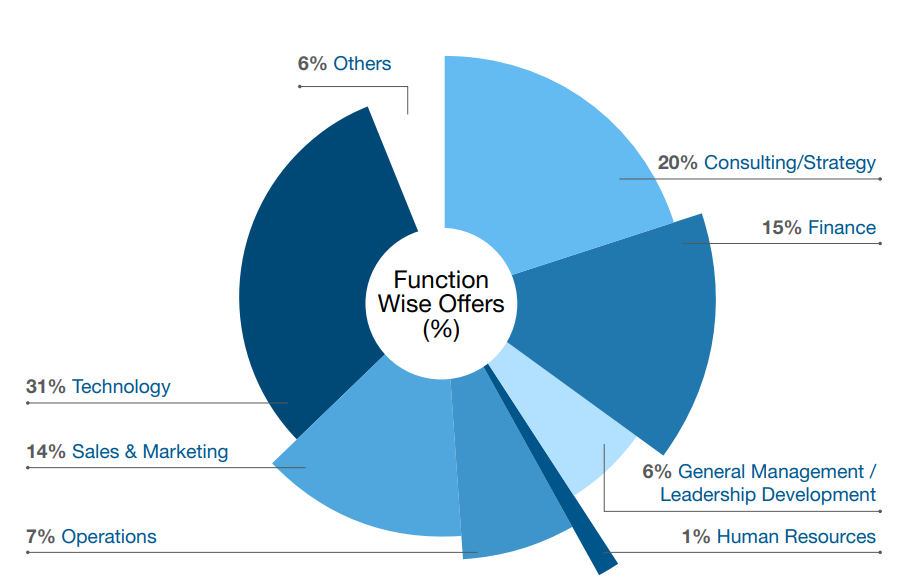
Let's journey through the sector-wise opportunities and earnings that define the ISB MBA experience.
| Sector | Earnings | Top Recruiters | Job Roles |
|---|---|---|---|
| Consulting | Rs. 3,348,655 - Rs. 3,664,800 |
|
|
| Technology | Rs. 28,00,00 - Rs. 35,00,000 |
|
|
| Finance | Rs. 29,34,152 t0 Rs.29,72,614 |
|
|
| Human Resource | Rs. 24,00,000 - Rs. 26,00,00 |
|
|
| Marketing | Rs. 25,00,00 - Rs. 32,00,000 |
|
|
| General Management / Leadership Development | Variable - Potential equity ownership |
|
|
| Operations | Rs. 27,00,00 - Rs. 33,00,000 |
|
|
Source: ISB PGP Career Advancement
Acceptance Rate for ISB MBA
The Indian School of Business (ISB) is a highly selective business school that receives a large number of applications each year. While the exact acceptance rate is not publicly disclosed, it's estimated to be around 20-25%.
The ISB Young Leaders Program, which is designed for exceptional undergraduate students, is even more competitive, with an acceptance rate of around 3-5%. The university also aims to create a diverse cohort of students from different backgrounds and experiences. Overall, getting into the ISB Young Leaders program is a significant achievement and requires strong application and preparation.
Acceptance Rate- 3%
ISB MBA Program & Curriculum

The Learning and Assessment modules in the ISB Young Leaders Program are designed to make the students stand out as Young Leaders in their professional stints. Learning weekends are organized and must be attended by all the selected students. This helps them understand the whole ISB experience and learn from the ISB’s world-class facility. It is also a factor that contributes to analysing whether ISB MBA worth it.
The ISB Young Leaders Program sessions focus on comprehending and enhancing the leadership quotient, understanding the importance of a B-school education, and exposing the students to diverse opportunities and career options. It also includes Personality and career assessment tests and the development of their communication, problem-solving, and relationship management skills.
Core Courses in the Curriculum
Core courses of the ISB Young Leaders program are given below:
| Financial accounting and decision-making | Focuses on the preparation and interpretation of financial statements to assist in decision-making. |
| Managerial Economics | It applies economic concepts and methodologies to solve managerial issues, including demand analysis, production and cost functions, and market structure analysis. |
| Decision Models And Optimisation | This includes modelling complex systems, predicting future outcomes, and optimizing decisions for efficiency and effectiveness using various mathematical and statistical methods. |
| Global Economics | Examines the principles of economic theory with a focus on global economic issues and policies. |
| Responsible Leadership | Explores the role of ethics in leadership and the importance of leading in a manner that is socially responsible and sustainable. |
| Corporate Finance II | Advanced study of corporate finance, building on basic principles to explore topics such as capital structure, corporate valuation, risk management, financial derivatives, and mergers and acquisitions. |
| Strategies For The Digital Economy | It covers how companies can leverage digital technologies to create value, enhance competitive advantage, and transform traditional business models. |
Exploring Elective Courses
Electives of ISB Young Leaders program are given below:
| Corporate Development: Mergers And Acquisitions | Involves strategies and processes used by corporations to buy, sell, divide, and combine different companies or similar entities to facilitate growth |
| Logistics And Supply Chain Management | The management of the flow of goods and services, including all processes that transform raw materials into final products. |
| Marketing Research | The process of gathering, analyzing, and interpreting information about a market, including information about the target market, competition, and the industry as a whole. |
| Portfolio Management And Trading Strategies | The science and art of making decisions about investment mix and policy, matching investments to objectives, asset allocation for individuals and institutions, and balancing risk against performance |
| Entrepreneurship | Focuses on the structures and processes for managing and controlling corporations, particularly with regard to changes in corporate structure through mergers and acquisitions. |
| Human Resource Management In A Global Environment | The act of creating a business or business while building and scaling it to generate a profit. However, it is more than just starting a business. |
| The Indian Health Care Services System | Addresses the strategic and coherent approach to the management of an organization's most valued assets - the people working there who individually and collectively contribute to the achievement of its objectives. |
| Logistics And Supply Chain Management | An overview of the health care system in India, including its structure, challenges, and the various stakeholders involved. |
ISB PGP Class of 2027 begins its transformational journey
Evaluating ISB MBA Rankings

The first step in evaluating the worth of an ISB MBA is to examine its rankings. The institution's standing in the educational landscape can provide insights into the quality of education and its reputation. According to prominent rankings such as the Financial Times Global MBA Ranking and the QS Global MBA Ranking, ISB consistently secures a position among the top MBA programs globally. This recognition highlights the program's excellence and suggests that an ISB MBA could be a worthwhile investment for prospective students aiming for high-calibre educational and professional outcomes.
| Source | Ranking |
| Financial Times Global (MBA) Ranking 2027 | #1 in India, #6th in Asia |
| QS Global MBA Ranking | #78 |
ISB vs MBA Abroad: Which Is Worth It for You?
Choosing between ISB and an MBA abroad depends mainly on your career goals, budget, preferred job market, and how much international exposure you want. ISB can be a strong choice for professionals who want to build or accelerate their career in India, access a well-established recruiter network, and complete a one-year management programme with a relatively lower opportunity cost. An MBA abroad may be more suitable for applicants who want global career mobility, international work experience, or access to employers and industries outside India.
There is no single option that is better for everyone. The right choice comes down to where you want to work after graduation, how much you are comfortable investing, and whether your long-term goals are more India-focused or international.
- Choose ISB if you want to build your career mainly in India.
- Choose ISB if you prefer a one-year programme with less time away from work.
- Consider an MBA abroad if international career exposure is a major priority.
- Consider an MBA abroad if you want to work in markets such as the US, UK, Europe, or Singapore.
- Compare the total investment, salary potential, recruiter access, and long-term career goals before making your decision.
Related Blogs
- ISB MBA GMAT Score
- ISB MBA Fees
- ISB MBA Salary
- ISB MBA Scholarships
- ISB MBA Interview Questions
- ISB MBA Essays
Conclusion
So, is ISB MBA worth it? The answer depends on you. If you have 2–5 years of experience, want high-paying roles in consulting or product, and are ready to invest ₹40–50 lakhs, ISB can give you a strong salary jump and help you recover your investment in around 1–2 years. For the right profile, it can fast-track your career much faster than staying in your current path. But if your goals are unclear, you’re aiming for niche roles, or you want to settle abroad (especially in the USA), ISB may not give the same return. In simple terms, ISB MBA is worth it for the right candidate, but not for everyone. The best decision is to evaluate your own profile and career goals before committing.