
 Abhyank Srinet


Table of Contents
- What Are the Latest MBA Colleges in India Ranking Facts?
- Introduction
- What Is the Latest MBA Colleges in India Ranking?
- Which Are the Top 10 MBA Colleges in India by NIRF?
- How Does NIRF Rank MBA Colleges in India?
- Which Government MBA Colleges Rank Highest in India?
- Which Private MBA Colleges Rank Highest in India?
- Why Do Different MBA College Rankings in India Give Different Results?
- Is ISB Included in the NIRF MBA Ranking?
- How Should You Compare MBA Rankings With Fees and Placements?
- Which Entrance Exams Matter for Top-Ranked MBA Colleges?
- What Should Indian Applicants Know About MBA Colleges in India Ranking?
- How Should You Build an MBA College Shortlist From Rankings?
According to the latest verified NIRF Management ranking, IIM Ahmedabad ranks #1 in India with a score of 83.29, followed by IIM Bangalore at #2, IIM Kozhikode at #3, IIT Delhi at #4 and IIM Lucknow at #5. Other institutions in the top ten include IIM Mumbai, IIM Calcutta, IIM Indore, MDI Gurgaon and XLRI Jamshedpur. The MBA colleges in India ranking should be interpreted according to its official ranking year. The list below uses the Government of India's NIRF Management 2025 results for students researching MBA admission in 2026–2027.
Introduction
The MBA colleges in India ranking helps students compare leading management institutions based on academic resources, research, graduate outcomes and reputation. However, rankings from NIRF and other organisations use different methodologies, so their results should not be treated as interchangeable.
For Indian applicants, choosing a business school requires more than checking its rank. Programme structure, admission requirements, tuition, scholarships, career outcomes and total return on investment can influence the final decision. This guide explains the latest verified official ranking, leading institutions, ranking methodology and how to build a practical MBA shortlist.
What Are the Latest MBA Colleges in India Ranking Facts?
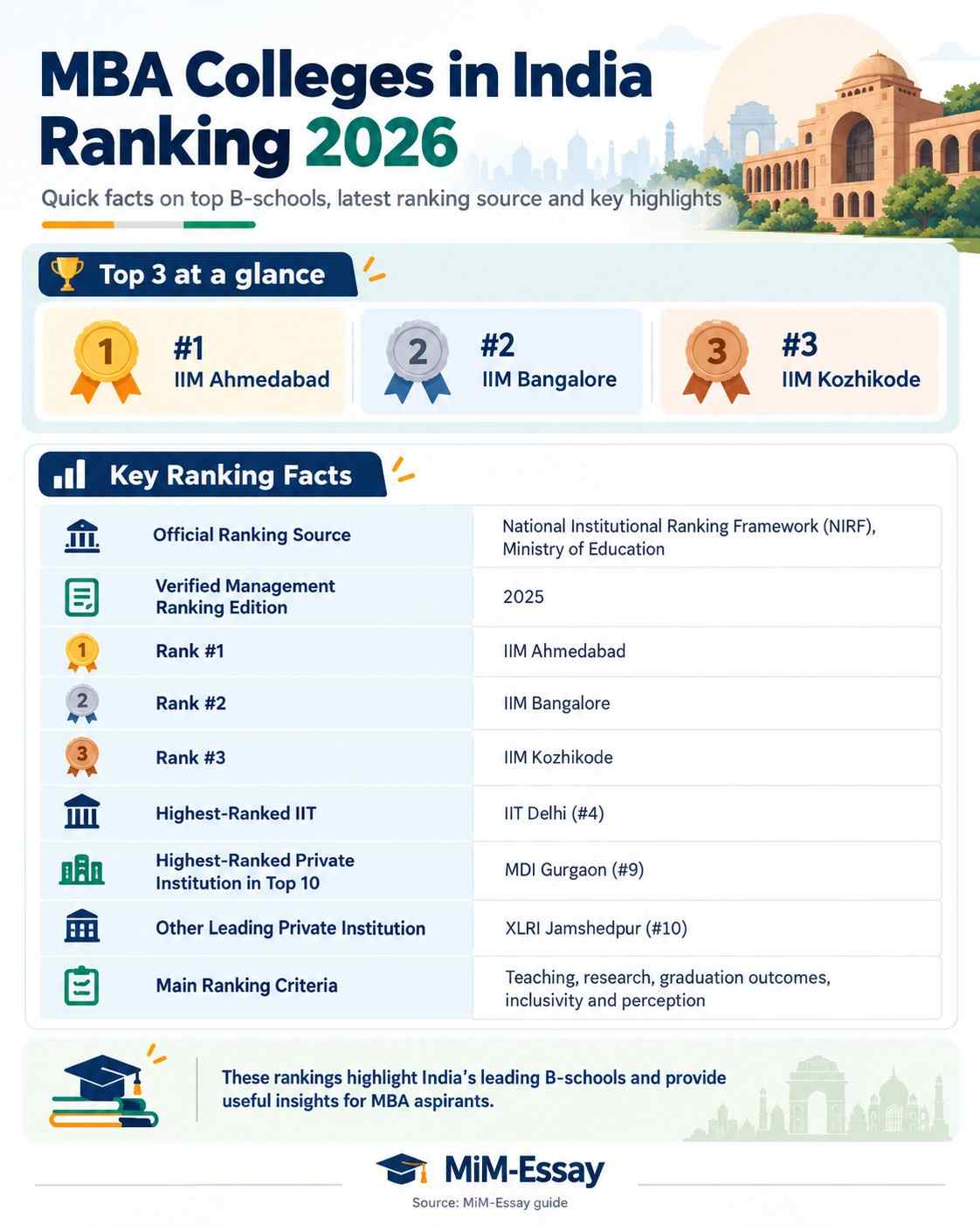
| Ranking Factor | Latest Verified Information |
|---|---|
| Official Ranking Source | National Institutional Ranking Framework (NIRF), Ministry of Education |
| Verified Management Ranking Edition | 2025 |
| Rank #1 | IIM Ahmedabad |
| Rank #2 | IIM Bangalore |
| Rank #3 | IIM Kozhikode |
| Highest-Ranked IIT | IIT Delhi, #4 |
| Highest-Ranked Private Institution in Top 10 | MDI Gurgaon, #9 |
| Other Leading Private Institution | XLRI Jamshedpur, #10 |
| Main Ranking Criteria | Teaching, research, graduation outcomes, inclusivity and perception |
| Admission Reference Period | 2026–2027 applicants |
What Is the Latest MBA Colleges in India Ranking?
The latest verified official NIRF Management ranking places IIM Ahmedabad first, followed by IIM Bangalore and IIM Kozhikode. IIT Delhi ranks fourth, making it the highest-ranked IIT in the Management category.
The following table presents the top 20 institutions from NIRF Management 2025. It is important to distinguish the official ranking edition from the year in which students intend to apply.
| NIRF Rank | Management Institution | City | NIRF Score |
|---|---|---|---|
| 1 | IIM Ahmedabad | Ahmedabad | 83.29 |
| 2 | IIM Bangalore | Bengaluru | 81.56 |
| 3 | IIM Kozhikode | Kozhikode | 79.85 |
| 4 | IIT Delhi | New Delhi | 78.94 |
| 5 | IIM Lucknow | Lucknow | 77.97 |
| 6 | IIM Mumbai | Mumbai | 77.58 |
| 7 | IIM Calcutta | Kolkata | 77.34 |
| 8 | IIM Indore | Indore | 75.68 |
| 9 | Management Development Institute (MDI) | Gurugram | 71.96 |
| 10 | XLRI – Xavier School of Management | Jamshedpur | 70.63 |
| 11 | Symbiosis Institute of Business Management | Pune | 67.90 |
| 12 | IIT Kharagpur | Kharagpur | 66.97 |
| 13 | IIT Madras | Chennai | 66.50 |
| 14 | IIT Bombay | Mumbai | 65.82 |
| 15 | IIM Raipur | Raipur | 65.03 |
| 16 | IIM Tiruchirappalli | Tiruchirappalli | 64.95 |
| 17 | Indian Institute of Foreign Trade | New Delhi | 62.93 |
| 18 | IIM Ranchi | Ranchi | 62.77 |
| 19 | IIM Rohtak | Rohtak | 62.60 |
| 20 | SPJIMR | Mumbai | 62.06 |
Source: Ministry of Education – NIRF Management Rankings 2025.
These are rankings of participating management institutions. They should not be interpreted as a separate ranking of every MBA, PGDM, one-year or executive programme offered by each institution.
Which Are the Top 10 MBA Colleges in India by NIRF?
The NIRF Management top ten includes seven IIMs, IIT Delhi, MDI Gurgaon and XLRI Jamshedpur. IIM Ahmedabad leads the ranking, while IIM Lucknow and MDI Gurgaon improved their positions compared with 2024.
| Institution | Rank |
|---|---|
| IIM Ahmedabad | 1 |
| IIM Bangalore | 2 |
| IIM Kozhikode | 3 |
| IIT Delhi | 4 |
| IIM Lucknow | 5 |
| IIM Mumbai | 6 |
| IIM Calcutta | 7 |
| IIM Indore | 8 |
| MDI Gurgaon | 9 |
| XLRI Jamshedpur | 10 |
The ranking movements show changes in relative positions, not necessarily major improvements or declines in teaching quality or graduate employment. Applicants should examine individual programme outcomes before drawing conclusions from small ranking changes.
How Does NIRF Rank MBA Colleges in India?

NIRF evaluates management institutions using five broad categories: Teaching, Learning and Resources; Research and Professional Practice; Graduation Outcomes; Outreach and Inclusivity; and Perception.
The framework considers more than employment outcomes. Research quality, academic resources and institutional perception also influence an institution's final ranking.
| NIRF Parameter | Weight | What It Evaluates |
|---|---|---|
| Teaching, Learning and Resources | 30% | Student strength, faculty, qualifications and financial resources |
| Research and Professional Practice | 30% | Research output, publication quality and professional activities |
| Graduation Outcomes | 20% | Graduation, placements, higher studies and salary-related indicators |
| Outreach and Inclusivity | 10% | Diversity, accessibility and inclusion |
| Perception | 10% | Institutional reputation among relevant stakeholders |
Applicants should read the official NIRF Management methodology documents before comparing changes across ranking editions.
Which Government MBA Colleges Rank Highest in India?
IIM Ahmedabad, IIM Bangalore, IIM Kozhikode, IIT Delhi and IIM Lucknow are the five highest-ranked public institutions in the verified NIRF Management 2025 table. Other leading public institutions include IIM Mumbai, IIM Calcutta, IIM Indore and several IIT management schools.
Indian Institutes of Management
The IIMs feature prominently in the NIRF Management ranking. However, applicants should compare individual programmes because the same institution may offer different formats for recent graduates and experienced professionals.
Programme length, work-experience requirements, tuition and placement arrangements can differ even within the same business school.
Management Programmes at IITs
IIT Delhi ranks fourth in NIRF Management 2025, followed by other IIT institutions further down the table. Their management programmes can be relevant to applicants interested in technology, operations, analytics, consulting and other business functions.
However, an IIT's overall engineering reputation should not replace an assessment of its specific management programme and recruitment outcomes.
Which Private MBA Colleges Rank Highest in India?
MDI Gurgaon, XLRI Jamshedpur and SIBM Pune are the three highest-ranked private institutions in the verified NIRF Management 2025 table. SPJIMR Mumbai also appears within the top twenty.
| Institution | NIRF Management 2025 Rank | Location |
|---|---|---|
| MDI Gurgaon | 9 | Gurugram |
| XLRI Jamshedpur | 10 | Jamshedpur |
| SIBM Pune | 11 | Pune |
| SPJIMR Mumbai | 20 | Mumbai |
This table extracts private institutions from the overall NIRF Management ranking. It is not a separately published official NIRF private-business-school league table.
Applicants should compare each institution's academic programme, admission process, total cost and official placement report before shortlisting it.
Why Do Different MBA College Rankings in India Give Different Results?
Different ranking agencies evaluate institutions using different methods. NIRF uses a government-defined framework covering academic resources, research, outcomes, inclusivity and perception. Other business-school rankings may place different emphasis on placements, industry interaction or institutional reputation.
This means a business school may rank differently across NIRF, IIRF and other publications. Those differences do not necessarily mean one ranking is incorrect.
Differences in Ranking Parameters
Ranking providers may use different weights for employment, salaries, research, academic resources and reputation. A university with strong research outcomes may perform differently under a ranking focused more heavily on industry or career factors.
Differences in Eligible Institutions
Not every ranking assesses the same institutions or programmes. Some compare universities, while others focus on specific business-school categories or programme formats.
Differences in Reporting Periods
Employment, faculty and research data may come from different reporting periods. Applicants should always check the publication year and data definitions before comparing results.
Is ISB Included in the NIRF MBA Ranking?
ISB Hyderabad should not be assigned an invented position in the NIRF Management top twenty. The institution does not appear in the official 2025 top-twenty ranking table presented here.
However, absence from that table does not automatically indicate that a business school's programmes are of lower quality. Rankings differ in participation, eligibility, methodology and institutional coverage.
Applicants considering ISB should evaluate its official programme structure, eligibility requirements, employment outcomes and relevant international rankings separately.
How Should You Compare MBA Rankings With Fees and Placements?

Rankings are useful for identifying institutions, but they do not directly establish which programme offers the best financial return. Applicants should compare total fees, placement outcomes and opportunity costs using the same reporting definitions.
Total Programme Fees
Calculate tuition, accommodation, compulsory charges, learning materials, travel and other relevant expenses. Some schools publish separate amounts for academic fees and campus-related costs.
Placement Reports
Use official placement reports for the specific graduating class and programme. Compare reported median salaries, average salaries, compensation definitions and the number of students included in employment reporting.
Return on Investment
ROI depends on the cost of the programme, financing, previous earnings and likely post-MBA opportunities. Applicants should not assume that a higher-ranked institution automatically delivers the highest ROI.
Programme Suitability
Compare curriculum, cohort experience, internships, recruiting industries and geographic opportunities. A programme closely aligned with your preferred career may be more suitable than another institution ranked marginally higher.
Which Entrance Exams Matter for Top-Ranked MBA Colleges?
Entrance requirements differ by institution and programme. Indian management schools may use CAT, XAT, SNAP, GMAT, other accepted assessments or programme-specific selection processes.
| Entrance Exam | Examples of Relevant Institutions | Important Consideration |
|---|---|---|
| CAT | Many IIMs, IIT management departments and other participating schools | Selection also considers the institution's other eligibility criteria |
| XAT | XLRI and other participating institutes | Check the current programme admission requirements |
| SNAP | SIBM Pune and other relevant Symbiosis institutes | Programme-specific selection requirements apply |
| GMAT | Selected management programmes and applicant categories | Acceptance varies by school and programme |
Exam acceptance does not mean every programme at an institution uses the same test. Applicants should check the official admission criteria for the relevant intake.
What Should Indian Applicants Know About MBA Colleges in India Ranking?

Indian applicants should use MBA rankings as an initial shortlist tool and then evaluate admission eligibility, programme cost, career outcomes and personal goals. A strong ranking is helpful, but it should not replace programme-level research.
- Check Your Entrance Exam: Shortlist institutions that accept the exam you plan to take and review their current selection requirements.
- Compare Programme Formats: Distinguish between two-year MBA or PGP programmes, PGDM courses, one-year management programmes and executive formats.
- Review Tuition and Funding: Calculate the full investment and evaluate scholarships, education loans and repayment obligations.
- Read Official Placement Reports: Compare the same salary metrics and graduating periods instead of relying on promotional placement claims.
- Consider Career Goals: Check whether recruiters and curriculum strengths align with your preferred industry or function.
- Do Not Overreact to Small Rank Changes: One or two ranking positions may not materially change programme suitability.
- Check Recognition: Verify programme approvals, awarding qualifications and any relevant accreditation requirements.
For a broader overview of admission, costs and career opportunities, read our MBA in India guide.
How Should You Build an MBA College Shortlist From Rankings?
A practical shortlist should combine ranking information with realistic admission chances, financial planning and career priorities. Instead of choosing schools solely by their ranking positions, group them according to fit and admission requirements.
- Set Your Career Goal: Decide whether you want consulting, finance, marketing, technology, operations or general management opportunities.
- Identify Relevant Schools: Begin with recognised ranking sources and examine the institutions that fit your preferred location and programme format.
- Evaluate Admission Fit: Review examination requirements, academic criteria, work experience and selection procedures.
- Compare Costs: Assess tuition, living expenses, scholarships and the affordability of education-loan repayments.
- Check Employment Outcomes: Compare official programme-specific placement information and recruiter participation.
- Review Rankings Critically: Use multiple years and understand the ranking methodology before drawing conclusions.
Applicants comparing domestic and overseas education can also review our global MBA colleges ranking guide.
Related Blogs
- MBA in India: Top Colleges, Fees and Career Opportunities
- MBA Colleges Ranking: Top Global Business Schools
- Types of MBA: Courses, Duration and Eligibility
- MBA Specialisations: Popular Courses and Career Options
Conclusion
The MBA colleges in India ranking provides a useful starting point for comparing leading management institutions, but it should not determine your final decision. Official rankings reflect several academic and institutional factors, while individual career outcomes depend on programme choice, experience and personal goals. Use verified ranking information alongside admission requirements, fees, placements and curriculum fit to build an MBA shortlist that supports your future plans.