
 Abhyank Srinet


Table of Contents
- Quick Answer: What Is the MBA Syllabus in USA?
- Introduction
- What Are the Quick Facts About MBA Syllabus in USA?
- What Are the Core Subjects in the MBA Syllabus in USA?
- How Is the MBA Syllabus in USA Structured Year-Wise?
- How Does the MBA Curriculum Differ Across Top US Business Schools?
- Which MBA Specialisations Are Available in the USA?
- Does the MBA Syllabus in USA Include AI and Business Analytics?
- Is Mathematics Compulsory in the MBA Syllabus in USA?
- How Are MBA Subjects Taught in US Business Schools?
- Does the MBA Syllabus Differ Between One-Year and Two-Year Programmes?
- What Career Skills Does the MBA Curriculum Develop?
- How Should Indian Applicants Prepare for the MBA Syllabus in USA?
- How Should You Choose the Right MBA Curriculum?
- Related Blogs
- Conclusion
The MBA syllabus in USA generally covers accounting, finance, marketing, economics, operations management, strategy, leadership and business analytics. Students usually complete compulsory core courses and then choose electives or majors that support career goals in areas such as consulting, finance, technology, marketing or entrepreneurship.There is no single MBA syllabus followed by every US university.
Introduction
The MBA syllabus in USA is designed to develop business knowledge, analytical thinking and leadership skills. Leading US business schools combine subjects such as finance, marketing, strategy and economics with practical learning. However, course requirements, electives and teaching methods vary between universities.
For Indian applicants planning to study abroad, understanding the MBA curriculum is an important part of choosing a business school. Some programmes emphasise structured general management education, while others offer greater flexibility in analytics, finance or technology. This guide explains common MBA subjects, year-wise course structures, university-specific curricula and how to select courses that match your career goals.
What Are the Quick Facts About MBA Syllabus in USA?
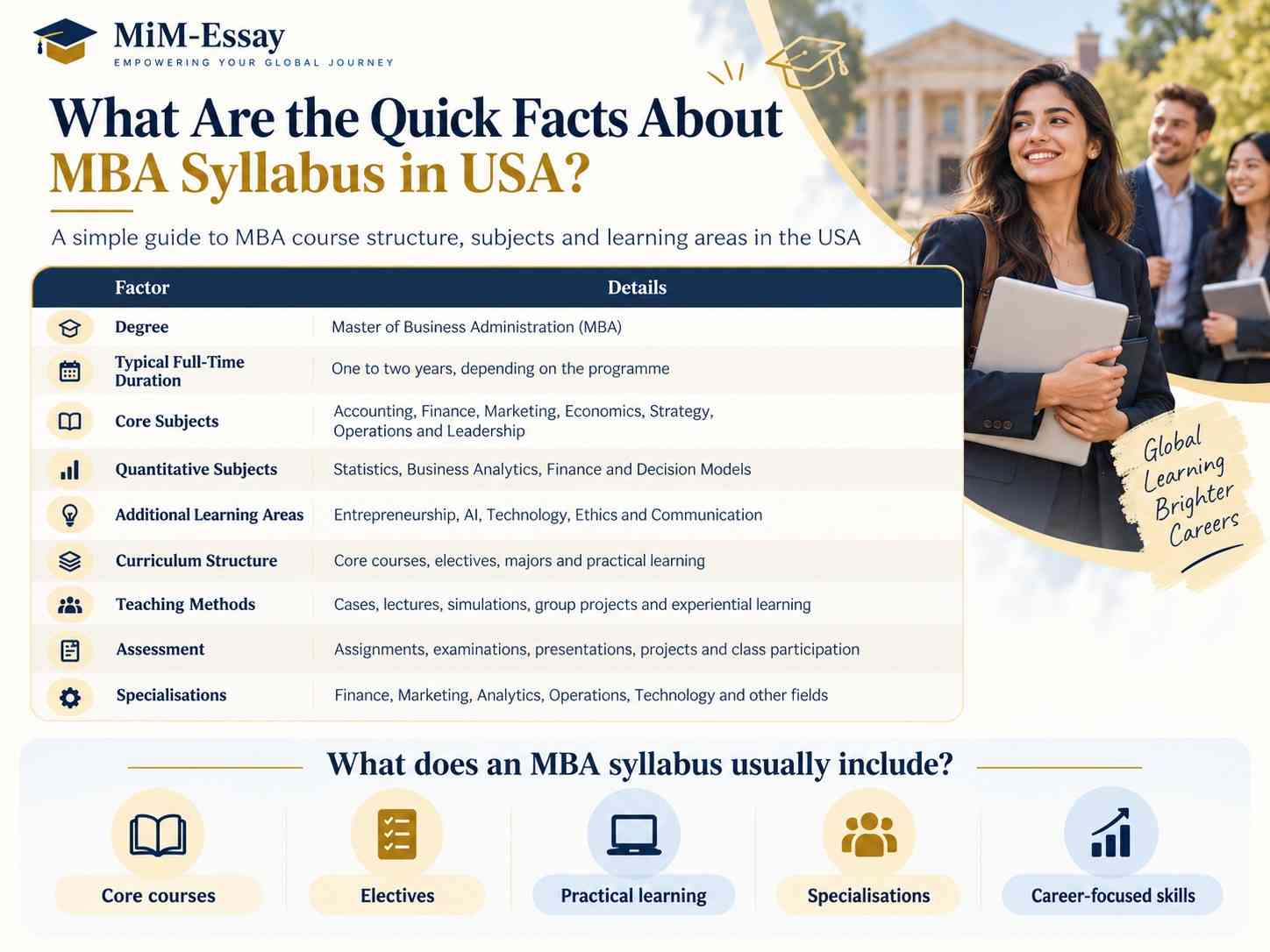
| Factor | Details |
|---|---|
| Degree | Master of Business Administration (MBA) |
| Typical Full-Time Duration | One to two years, depending on the programme |
| Core Subjects | Accounting, Finance, Marketing, Economics, Strategy, Operations and Leadership |
| Quantitative Subjects | Statistics, Business Analytics, Finance and Decision Models |
| Additional Learning Areas | Entrepreneurship, AI, Technology, Ethics and Communication |
| Curriculum Structure | Core courses, electives, majors and practical learning |
| Teaching Methods | Cases, lectures, simulations, group projects and experiential learning |
| Assessment | Assignments, examinations, presentations, projects and class participation |
| Specialisations | Finance, Marketing, Analytics, Operations, Technology and other fields |
What Are the Core Subjects in the MBA Syllabus in USA?
The core MBA syllabus in USA builds a foundation in major business functions. Although course names and requirements differ, leading US MBA programmes commonly include accounting, finance, economics, marketing, operations, leadership and analytical decision-making.
| Core Subject | What Students Learn | Practical Application |
|---|---|---|
| Financial Accounting | Financial statements, reporting and financial performance | Evaluating company financial health |
| Corporate Finance | Capital allocation, valuation and investment decisions | Assessing business investments |
| Marketing Management | Consumer behaviour, market research and marketing strategy | Developing market and product strategies |
| Managerial Economics | Pricing, competition, supply and demand | Making decisions under market constraints |
| Operations Management | Processes, productivity, quality and resource planning | Improving business operations |
| Business Strategy | Competitive advantage and organisational decisions | Planning long-term business growth |
| Leadership and Organisational Behaviour | Team management, motivation and organisational dynamics | Leading teams and managing change |
| Business Analytics | Statistics, data analysis and quantitative decision-making | Using data to solve business problems |
| Business Communication | Presentations, negotiation and professional communication | Communicating business decisions |
| Business Ethics | Corporate responsibility, governance and ethical decisions | Managing business and stakeholder responsibilities |
Accounting and Finance
Accounting courses teach students to interpret financial statements, assess profitability and understand how business transactions are recorded. Finance courses focus on investment decisions, valuation, capital budgeting and managing financial resources.
These subjects are useful for students from both business and non-business backgrounds. However, students without prior accounting or finance experience may need additional preparation before the programme begins.
Marketing and Strategy
Marketing subjects examine customer needs, branding, pricing and market research. Strategy courses focus on competition, organisational positioning and long-term business decisions.
These courses help students understand how organisations attract customers, compete in markets and allocate resources to achieve business goals.
Operations and Leadership
Operations management covers process improvement, resource planning and productivity. Leadership and organisational behaviour examine how individuals and teams work within organisations.
Students often apply these concepts through team assignments, classroom discussions and business simulations.
Economics and Business Analytics
Economics examines how businesses respond to markets, competition and economic conditions. Analytics courses introduce statistical techniques, models and data-driven decision-making.
At MIT Sloan, the required course Data, Models, and Decisions introduces quantitative approaches to business problems, including statistics, regression, simulation and optimisation.
How Is the MBA Syllabus in USA Structured Year-Wise?
Many two-year MBA programmes in the USA begin with foundational management subjects and provide greater elective flexibility later. However, not every university follows the same four-semester structure, and some permit elective choices during the first year.
First-Year MBA Syllabus
The first-year MBA curriculum generally introduces students to the core functions of business management. It builds the foundation needed for advanced electives, internships and practical business projects.
| Learning Area | Common Subjects | Purpose |
|---|---|---|
| Finance | Financial Accounting, Corporate Finance | Understand financial decisions |
| Marketing | Marketing Management, Consumer Behaviour | Understand customers and markets |
| Economics | Managerial Economics, Business Economics | Analyse business environments |
| Management | Leadership, Organisational Behaviour | Develop management capabilities |
| Analytics | Statistics, Decision Models | Strengthen analytical thinking |
| Operations | Operations Management | Improve organisational processes |
| Strategy | Competitive Strategy | Evaluate business decisions |
This is an illustrative subject grouping, not a universal semester-by-semester syllabus. Actual course sequencing depends on the business school.
Second-Year MBA Syllabus
The second year of many full-time US MBA programmes provides greater flexibility through electives, majors, projects and independent study options. Students can develop deeper knowledge in subjects connected to their preferred industries and career functions.
| Elective Area | Example Topics | Career Relevance |
|---|---|---|
| Finance | Valuation, Investment Management | Finance and investment careers |
| Consulting | Strategy, Organisational Change | Consulting and corporate strategy |
| Marketing | Brand Strategy, Marketing Analytics | Marketing and commercial roles |
| Technology | Technology Strategy, Product Management | Technology and product careers |
| Entrepreneurship | Venture Creation, Entrepreneurial Finance | Startups and entrepreneurship |
| Operations | Supply Chain Strategy, Operations Analytics | Operations and supply chain careers |
These examples describe common elective areas. Specific courses may have different names or prerequisites, and universities may change their elective catalogues between academic years.
How Does the MBA Curriculum Differ Across Top US Business Schools?

Harvard, Wharton and MIT Sloan cover similar business fundamentals but organise their programmes differently. Harvard emphasises a structured first year, Wharton combines core courses with majors, and MIT Sloan allows extensive customisation after the first semester.
| Business School | Core Structure | Elective Structure | Key Difference |
|---|---|---|---|
| Harvard Business School | Required first-year curriculum | Second-year elective curriculum | Structured general management education |
| Wharton School | Fixed and flexible core | Majors and electives | Broad academic customisation |
| MIT Sloan | First-semester core | Electives across later semesters | Early flexibility and action learning |
Harvard Business School
Harvard Business School follows a two-year MBA structure. Students complete a Required Curriculum during the first year and an Elective Curriculum during the second year.
The official Required Curriculum for the Class of 2028 includes Finance 1, Financial Reporting and Control, Leadership and Organizational Behavior, Marketing, Strategy, Technology and Operations Management, Finance 2, and Data Science and AI for Leaders.
The degree requirements also include 30 elective curriculum credits. This structure provides broad management knowledge before students select more specialised courses.
See the official Harvard MBA degree requirements for the Class of 2028.
Wharton School
Wharton's MBA curriculum requires 19 credit units, divided into 9 core credit units, 5 major requirement units and 5 elective units.
Its curriculum includes fixed and flexible core requirements. Core areas include leadership, accounting, corporate finance, marketing, management, economics and legal or ethical responsibilities.
Wharton also publishes 22 MBA concentrations, allowing students to develop expertise in selected disciplines. Students may pursue more than one major when they satisfy the relevant academic requirements.
Review the official Wharton MBA curriculum for the current degree structure.
MIT Sloan School of Management
MIT Sloan's two-year MBA begins with a first-semester core consisting of six required courses, one core elective and an optional proseminar.
The required courses include Leadership Challenges for an Inclusive World, Economic Analysis for Business Decisions, Data, Models, and Decisions, Communication for Leaders, Organizational Processes and Financial Accounting.
Core elective options include Managerial Finance, Introduction to Operations Management, Competitive Strategy and Marketing Innovation.
After the first semester, students can choose from electives and hands-on learning opportunities. The curriculum also offers optional pathways that allow students to focus on particular interests.
Check the official MIT Sloan MBA curriculum for course requirements.
Which MBA Specialisations Are Available in the USA?
The MBA syllabus in USA can often be customised through electives, majors or concentration pathways. Popular subjects include finance, marketing, business analytics, operations, entrepreneurship and technology management.
However, not every business school offers formal specialisations. Some allow students to build their own academic focus through electives instead.
| Specialisation | Subjects Commonly Studied | Potential Career Direction |
|---|---|---|
| Finance | Corporate Finance, Valuation, Investment Analysis | Investment Banking, Corporate Finance |
| Marketing | Consumer Behaviour, Branding, Marketing Analytics | Marketing, Brand Management |
| Business Analytics | Statistics, Predictive Modelling, Data Analysis | Analytics, Business Intelligence |
| Operations | Supply Chain, Process Improvement, Operations Strategy | Operations, Supply Chain Management |
| Entrepreneurship | Business Models, Venture Finance, Innovation | Startups, Venture Development |
| Technology Management | Technology Strategy, Product Management, Innovation | Product Management, Technology Consulting |
Applicants can compare these pathways through our MBA specialisations guide.
Does the MBA Syllabus in USA Include AI and Business Analytics?
Yes, leading US business schools increasingly offer subjects related to artificial intelligence, statistics and analytical decision-making. However, whether AI is compulsory or optional depends on the university.
AI in Business Education
Harvard's Class of 2028 Required Curriculum includes Data Science and AI for Leaders. This places AI-related business education within its compulsory MBA curriculum rather than restricting it entirely to electives.
Wharton offers an Artificial Intelligence for Business major, allowing eligible students to focus more deeply on technical, managerial and ethical questions associated with AI.
Business Analytics and Decision Models
MIT Sloan's Data, Models, and Decisions course provides a foundation in quantitative business analysis. Students study methods used to interpret information and support complex business decisions.
Applicants interested in AI, product strategy and technology-focused careers can also explore our Tech MBA in USA guide.
Is Mathematics Compulsory in the MBA Syllabus in USA?

Quantitative subjects are common in US MBA programmes, although the level of mathematical difficulty varies. Students may use algebra, statistics, probability, financial calculations and analytical models in courses such as accounting, economics, finance and operations.
Statistics and Quantitative Analysis
Statistics helps students interpret business information, evaluate uncertainty and analyse relationships between variables. Quantitative decision-making courses may involve probability, regression and optimisation.
Financial Calculations
Finance courses may require students to calculate investment returns, evaluate cash flows and analyse financial decisions. These subjects focus on applying quantitative concepts to business problems.
Preparation for Non-Quantitative Graduates
Students from humanities, arts or other non-quantitative backgrounds can prepare by reviewing basic algebra, percentages, statistics, spreadsheets and financial accounting before starting their MBA.
Applicants do not necessarily need an undergraduate mathematics degree, but they should check academic prerequisites and available pre-MBA learning resources.
How Are MBA Subjects Taught in US Business Schools?
The MBA syllabus in USA is delivered through different teaching methods, including case discussions, lectures, simulations, group projects and experiential learning. The emphasis varies across institutions and individual courses.
Case-Based Learning
Case discussions ask students to analyse business situations, consider alternatives and defend their recommendations. Harvard is particularly associated with this approach, although it is also used at other schools.
Team Projects
Students often complete assignments in groups with classmates from different academic, professional and cultural backgrounds. These projects develop collaboration, communication and problem-solving abilities.
Business Simulations
Simulations allow students to practise decisions involving pricing, competition, strategy, operations or organisational management in a structured learning environment.
Experiential Learning
Experiential courses can involve business projects, consulting engagements, startup work or other practical assignments. Some programmes also provide opportunities for international projects or independent study.
Internships are common in many two-year US MBA programmes, but they are not compulsory in every MBA curriculum.
Does the MBA Syllabus Differ Between One-Year and Two-Year Programmes?
One-year and two-year MBAs generally cover similar management disciplines, but they differ in academic pace and opportunities for electives, internships and career exploration.
| Factor | One-Year MBA | Two-Year MBA |
|---|---|---|
| Study Pace | Accelerated | More extended |
| Core Subjects | Condensed management foundation | Usually spread across early terms |
| Electives | Programme-dependent flexibility | Often more time for elective exploration |
| Internships | May offer limited time for internships | Often includes a summer internship opportunity |
| Career Switching | Can suit applicants with defined career goals | May provide additional time for career exploration |
The right programme depends on academic preferences and career needs. Students should not assume that a shorter curriculum is less academically demanding.
For a broader explanation of programme formats, read our types of MBA programmes guide.
What Career Skills Does the MBA Curriculum Develop?
The MBA curriculum develops transferable business capabilities rather than preparing every student for one fixed occupation. Different combinations of core subjects and electives can support careers in consulting, finance, marketing, technology, operations and entrepreneurship.
| Career Area | Useful MBA Subjects | Skills Developed |
|---|---|---|
| Consulting | Strategy, Economics, Analytics | Problem-solving and business analysis |
| Finance | Accounting, Corporate Finance, Valuation | Financial analysis and investment decisions |
| Technology | Analytics, Strategy, Operations | Product and technology-related decision-making |
| Marketing | Marketing, Consumer Behaviour, Analytics | Customer analysis and market strategy |
| Operations | Operations, Supply Chain, Analytics | Process and resource management |
| Entrepreneurship | Finance, Strategy, Innovation | Business planning and venture development |
These are possible skill applications, not guaranteed job outcomes. Applicants should review the official employment reports of individual business schools when evaluating career opportunities.
How Should Indian Applicants Prepare for the MBA Syllabus in USA?

Indian applicants should prepare for the analytical, academic and communication demands of a US MBA before enrolment. This is especially useful for students moving from engineering, technology, humanities or other specialist backgrounds into general management education.
- Review Accounting Basics: Learn how to read income statements, balance sheets and cash-flow statements.
- Strengthen Quantitative Skills: Revise statistics, percentages, basic algebra and spreadsheet analysis.
- Improve Business Communication: Practise presentations, structured writing, group discussions and professional communication.
- Explore Business Cases: Read business situations and practise explaining decisions with supporting evidence.
- Compare School Curricula: Check whether your preferred university emphasises general management, analytics, entrepreneurship or elective flexibility.
- Evaluate Specialisations: Choose electives based on your intended career rather than selecting subjects only because they appear popular.
- Review Academic Requirements: Check whether the university offers or requires pre-MBA courses in accounting, mathematics or other foundational subjects.
For a wider comparison of schools, tuition, programme formats and employment opportunities, explore our best MBA colleges in USA guide.
How Should You Choose the Right MBA Curriculum?
Choose an MBA curriculum by comparing its required courses, elective flexibility, teaching methods and practical learning opportunities with your career goals. A strong curriculum fit can be more useful than choosing a business school solely because of its reputation.
- Check Core Subjects: Ensure the programme provides the business foundation you need.
- Compare Electives: Review whether the university offers advanced courses relevant to your target industry.
- Understand Academic Flexibility: Find out when students can begin taking electives and whether formal majors are offered.
- Review Teaching Methods: Consider your preference for case discussions, analytical coursework, simulations and practical projects.
- Assess Quantitative Requirements: Evaluate whether you need additional preparation in mathematics, accounting or data analysis.
- Consider Career Alignment: Compare the curriculum with the skills required for your intended post-MBA role.
Related Blogs
- MBA in USA: Colleges, Fees, Eligibility and Career Opportunities
- Types of MBA: Courses, Duration and Eligibility
- Best MBA Specialisations for Career Growth
- Tech MBA in USA: Schools, Subjects and Career Options
- Best MBA Colleges in USA: Rankings, Fees and Programmes
Conclusion
The MBA syllabus in USA combines essential business subjects with opportunities for specialisation and practical learning. However, each business school offers a different balance of core courses, electives and teaching methods. Applicants should compare official curricula with their academic background and career goals before choosing a programme. The right MBA syllabus is one that helps develop the knowledge and skills needed for their preferred professional direction.