
 Abhyank Srinet


Table of Contents
- Introduction
- What Are the Quick Facts About MBA Types?
- What Are the Main Types of MBA Programmes?
- What Is the Difference Between MBA Types and MBA Specialisations?
- Which MBA Type Is Best for Your Career Stage?
- How Do MBA Types Differ in Cost and Duration?
- Which MBA Types Are Best for Indian Applicants?
- What Are the Advantages and Disadvantages of Different MBA Types?
- How Should You Choose the Right MBA Type?
- Which MBA Type Is Worth It?
- Related Blogs
- Conclusion
The main types of MBA programmes include full-time MBA, one-year MBA, part-time MBA, Executive MBA (EMBA), online MBA, hybrid MBA, integrated MBA and dual-degree MBA. Each format differs in duration, learning structure, work-experience requirements and career opportunities. Students can also choose specialised MBA pathways in finance, marketing, business analytics or other management areas.
Introduction
Choosing an MBA involves more than selecting a business school. The different types of MBA programmes are designed around different career stages, learning preferences and professional commitments. Some allow students to focus entirely on campus study, while others offer flexible schedules so professionals can continue working.
Understanding these differences can help you avoid choosing a programme that does not match your goals. This guide explains the major MBA types in 2026, including duration, eligibility, career benefits, costs and suitable options for Indian applicants planning to study abroad.
What Are the Quick Facts About MBA Types?
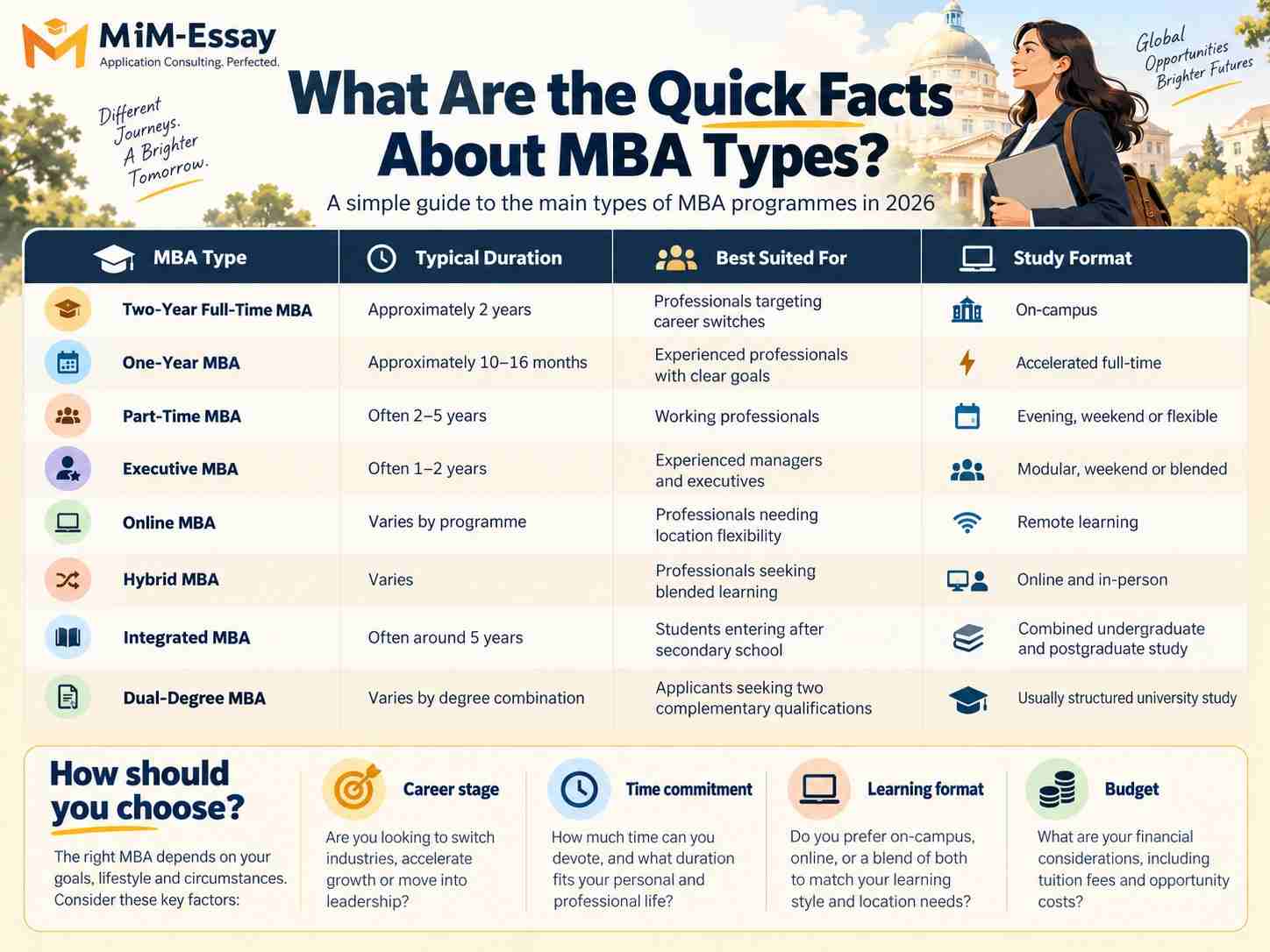
| MBA Type | Typical Duration | Best Suited For | Study Format |
|---|---|---|---|
| Two-Year Full-Time MBA | Approximately 2 years | Professionals targeting career switches | On-campus |
| One-Year MBA | Approximately 10–16 months | Experienced professionals with clear goals | Accelerated full-time |
| Part-Time MBA | Often 2–5 years | Working professionals | Evening, weekend or flexible |
| Executive MBA | Often 1–2 years | Experienced managers and executives | Modular, weekend or blended |
| Online MBA | Varies by programme | Professionals needing location flexibility | Remote learning |
| Hybrid MBA | Varies | Professionals seeking blended learning | Online and in-person |
| Integrated MBA | Often around 5 years | Students entering after secondary school | Combined undergraduate and postgraduate study |
| Dual-Degree MBA | Varies by degree combination | Applicants seeking two complementary qualifications | Usually structured university study |
Note: These are indicative programme durations, not universal admission requirements. Individual universities may offer different schedules and completion options.
What Are the Main Types of MBA Programmes?
The most common MBA types are full-time, one-year, part-time, Executive and online MBAs. Universities also offer hybrid, integrated and dual-degree options. Although these programmes teach business fundamentals, their study structures and recruitment opportunities can differ substantially.
1. Two-Year Full-Time MBA
A two-year full-time MBA is an immersive programme in which students generally leave full-time employment to study on campus. It combines core business subjects, electives, career development, networking and practical learning experiences.
This format is particularly relevant for professionals seeking a major career change. The longer duration can provide more time for internships, employer networking, recruiting preparation and exploring different career paths.
Harvard Business School, for example, offers a two-year, full-time residential MBA. Its programme combines management education with real-world learning and leadership development.
Applicants can review the official Harvard Business School website for current programme details.
2. One-Year MBA
A one-year MBA is an accelerated full-time programme designed to cover management education within a shorter period. These programmes commonly suit professionals who already have relevant work experience and a clear post-MBA career direction.
One-year MBAs can reduce the time spent outside employment. However, a condensed academic schedule may provide less time for internships and career exploration compared with a two-year programme.
INSEAD offers a well-known accelerated MBA. Its August intake runs for ten consecutive months, while its January intake includes a summer break that students may use for an internship or other activities.
Students can confirm these differences through INSEAD's official MBA programme FAQs.
3. Part-Time MBA
A part-time MBA allows professionals to continue working while studying management subjects. Classes may be scheduled during evenings, weekends or other flexible periods, depending on the university.
Part-time programmes often take longer than full-time MBAs because students study alongside professional commitments. This format can be suitable for candidates looking to develop management skills and advance within their current organisation or industry.
Applicants should confirm whether a particular part-time MBA accepts international students and whether it requires regular campus attendance.
4. Executive MBA (EMBA)
An Executive MBA is designed for experienced professionals, managers and business leaders. It usually combines advanced management education with peer learning, leadership development and practical application to existing professional responsibilities.
Many EMBAs use weekend, modular or blended teaching schedules. Students often continue working, although programmes can require significant time for classes, group projects and travel.
Executive MBA admissions requirements vary by university. Some schools expect substantial management experience, while others evaluate applicants based on leadership responsibility and overall professional background.
5. Online MBA
An online MBA delivers management education primarily through digital learning platforms. Students may attend live classes, access recorded lectures, participate in virtual group projects and complete online assessments.
This format is particularly useful for working professionals who cannot relocate or attend regular on-campus classes. However, access to internships, campus recruiting and in-person networking can differ from traditional full-time MBA programmes.
Boston University's Questrom School of Business offers a fully online MBA. Its published tuition for students starting in Fall 2026 is approximately ₹24.19 lakh (US$25,000), excluding books and certain additional expenses.
The university provides the current pricing and programme structure on its official Online MBA page.
For more programme comparisons, explore our online MBA abroad guide.
6. Hybrid or Blended MBA
A hybrid MBA combines online study with scheduled in-person classes, workshops or residential sessions. It offers some of the flexibility of online education while retaining opportunities for face-to-face networking.
The amount of campus attendance varies considerably. Some programmes require occasional residential visits, while others have regular in-person classes alongside online coursework.
This format can suit professionals who want flexibility but still value direct interaction with faculty and classmates. International applicants should consider travel requirements before applying.
7. Integrated MBA
An integrated MBA combines undergraduate and postgraduate management education into a structured programme. In India, integrated management programmes may admit students after Class 12 and often run for approximately five years.
These programmes can be suitable for students who want to pursue management education early. However, an integrated MBA should not be confused with a conventional postgraduate MBA intended for graduates with professional experience.
8. Dual-Degree MBA
A dual-degree MBA allows students to pursue an MBA alongside another academic qualification. Common combinations include MBA with engineering, law, public policy or other specialised disciplines.
These programmes are useful when a career requires both broad management capabilities and deeper expertise in another subject. Students should compare the additional academic workload, duration, total tuition and admission requirements.
What Is the Difference Between MBA Types and MBA Specialisations?
MBA types describe how a programme is structured, including its duration, delivery format and target student group. MBA specialisations describe the subject area students study in greater depth, such as finance, marketing or business analytics.
| Factor | MBA Type | MBA Specialisation |
|---|---|---|
| Meaning | Programme format or structure | Subject concentration |
| Examples | Full-time, part-time, online, Executive MBA | Finance, marketing, analytics, operations |
| Main Decision | How and when you study | What management area you focus on |
| Career Relevance | Affects recruitment access and study flexibility | Helps align learning with particular functions |
Finance and Accounting
An MBA concentration in finance may cover corporate finance, financial analysis, investment management and related subjects. It can suit applicants interested in finance-focused careers.
Marketing and Brand Management
Marketing concentrations commonly include consumer behaviour, brand strategy, market research and digital marketing. These subjects can support careers in marketing and commercial management.
Business Analytics and Technology
Business analytics pathways may cover data analysis, decision-making, business intelligence and technology strategy. They can be relevant for professionals working at the intersection of data and management.
Operations and Supply Chain
Operations-related concentrations focus on business processes, logistics, production systems and supply chain management. They are relevant for professionals targeting operational and project leadership roles.
Explore our MBA specialisations guide for more detailed subject comparisons.
Which MBA Type Is Best for Your Career Stage?
.jpeg)
The right MBA format depends on your professional experience, career direction and available time. Applicants seeking a major career switch may benefit from full-time campus recruitment, while established professionals often prefer programmes that allow them to continue working.
| Career Stage | Potential MBA Type | Reason |
|---|---|---|
| Recent Graduate | Selected full-time or integrated pathways | Eligibility depends on the institution; many leading MBAs prefer experience |
| Early-Career Professional | Full-time MBA | Can support career development and structured recruitment |
| Professional Seeking a Career Switch | Two-year full-time MBA | May provide more time for internships and recruiting |
| Professional With a Clear Career Goal | One-year MBA | Accelerated study and shorter employment interruption |
| Working Professional | Part-time, online or hybrid MBA | Allows continued employment in many cases |
| Senior Manager or Executive | Executive MBA | Advanced leadership and management development |
These are general suitability guidelines rather than fixed work-experience rules. Always check the target programme's official eligibility requirements.
How Do MBA Types Differ in Cost and Duration?

MBA costs depend on the university, country, programme length and delivery format. A shorter programme may reduce lost income and living expenses, while part-time or online study can allow students to continue earning during their degree.
| MBA Format | Main Cost Factors | Opportunity Cost |
|---|---|---|
| Two-Year Full-Time | Tuition, living expenses, insurance and travel | Potentially substantial because of longer career interruption |
| One-Year Full-Time | Tuition and shorter period of living expenses | Usually shorter interruption than a two-year programme |
| Part-Time MBA | Tuition and local study-related expenses | May be lower when employment continues |
| Executive MBA | Tuition, residential sessions and possible travel | May be reduced through continued employment |
| Online MBA | Tuition, technology and learning resources | May be lower when employment continues |
| Hybrid MBA | Tuition plus required campus visits | Depends on working arrangements and travel |
The published Boston University Online MBA tuition of approximately ₹24.19 lakh (US$25,000) is one example of why applicants should compare actual university prices instead of assuming that every online programme is inexpensive.
Students should request the latest official fee schedule before applying. For international programmes, INR estimates also change with exchange rates, bank charges and additional university costs.
Which MBA Types Are Best for Indian Applicants?

Indian applicants should compare MBA types based on work experience, international career goals, total investment and eligibility to study or work in their preferred destination. The most suitable format for an applicant targeting overseas recruitment may differ from the best option for someone planning to advance within India.
- For International Career Switching: Consider full-time MBA programmes with established internship and recruitment opportunities in your target industry.
- For Experienced Professionals: Evaluate one-year MBA programmes if you already have a clear career direction and want to limit time away from employment.
- For Senior Managers: Compare Executive MBA programmes based on work-experience requirements, leadership curriculum and travel commitments.
- For Professionals Staying in India: Online, part-time and hybrid MBA formats may offer flexibility, subject to programme eligibility and recognition.
- For Budget Planning: Calculate tuition, living expenses, travel, insurance, education-loan interest and lost salary in INR.
- For Overseas Work Opportunities: Verify immigration rules and career services. Completing a foreign online MBA from India does not automatically provide post-study work rights abroad.
- For Admissions: Check degree requirements, professional experience, GMAT or GRE policies, essays, references and English-language requirements for each university.
For a broader overview of international programmes and application planning, read our MBA abroad for Indian students guide.
What Are the Advantages and Disadvantages of Different MBA Types?
Every MBA format has trade-offs. Full-time programmes can provide more immersive recruitment and networking experiences, while flexible formats can reduce employment interruption. Applicants should assess these trade-offs rather than assuming one MBA type is best for everyone.
| MBA Type | Key Advantage | Main Limitation |
|---|---|---|
| Full-Time MBA | Immersive learning and campus recruitment | Career break and living expenses |
| One-Year MBA | Faster completion | Less time for career exploration |
| Part-Time MBA | Study alongside employment | Longer duration and scheduling pressure |
| Executive MBA | Experienced peer network | Demanding workload and potentially high tuition |
| Online MBA | Location flexibility | Programme-dependent access to campus recruitment |
| Hybrid MBA | Combines remote and in-person learning | May require travel and fixed attendance |
| Dual-Degree MBA | Combines complementary qualifications | Potential additional academic and financial commitments |
How Should You Choose the Right MBA Type?
Choosing an MBA type starts with defining the career outcome you want. Compare programme structure, admissions requirements, recruiting access and total costs rather than selecting a format simply because it is popular or highly ranked.
- Identify Your Career Goal: Decide whether you want a promotion, career switch, international opportunity, entrepreneurship or stronger leadership skills.
- Evaluate Your Work Experience: Check whether the programme targets early-career professionals, experienced managers or senior executives.
- Consider Study Flexibility: Determine whether you can leave employment or need an evening, weekend, online or blended schedule.
- Review Recruitment Opportunities: Examine official employment reports, internship access, employer relationships and career-service eligibility.
- Calculate the Complete Investment: Include tuition, living expenses, loan interest, travel and potential income loss.
- Check Accreditation and Recognition: Verify the awarding institution and any applicable programme recognition or professional requirements.
- Compare Curriculum and Specialisations: Choose courses that support your target industry rather than relying only on reputation.
Which MBA Type Is Worth It?
Worth it if... the MBA format matches your work experience, career objectives, financial capacity and preferred learning style. A full-time MBA can make sense for a structured career change, while an Executive, part-time or online MBA may offer better flexibility for professionals who want to continue working.
Think twice if... you choose a programme based only on rankings, advertisements or the assumption that every MBA offers the same placement opportunities. Compare actual admissions requirements, recruiter access, qualification recognition and complete costs before committing.
Related Blogs
- MBA Abroad for Indian Students: Colleges, Fees & ROI
- Online MBA Abroad: Programs, Fees & Career Opportunities
- Online MBA vs Full-Time MBA: Which Is Better?
- Best MBA Specialisations for Career Growth
Conclusion
The different types of MBA programmes provide several ways to develop management skills and pursue career growth. Full-time and one-year MBAs may suit applicants seeking an immersive experience, while part-time, online and Executive MBAs offer alternatives for professionals balancing education with work. The right choice depends on your experience, career goals, budget and preferred learning format. Compare official university information carefully before choosing the MBA that fits your plans.