
 Abhyank Srinet


The eligibility criteria for MiM usually include a recognised bachelor's degree, a suitable academic record and little or no full-time work experience. Some business schools require GMAT or GRE scores, English proficiency proof, essays and recommendations. There is no universal minimum GPA, GMAT score or work-experience limit. Each university sets its own admission rules.
Introduction
The eligibility criteria for MiM are designed mainly for recent graduates who want to start a career in management. A Master in Management (MiM) is a postgraduate business degree that develops skills in finance, marketing, strategy, operations and leadership. Unlike many MBA programmes, MiM courses generally do not require extensive professional experience. Students from commerce, engineering, science, arts and other backgrounds may qualify, depending on the university.
Before applying, check the degree, academic, test and language requirements for each school. You can also read our Master in Management guide to understand the degree and its career pathways.
What Are the Eligibility Criteria for MiM in 2027?
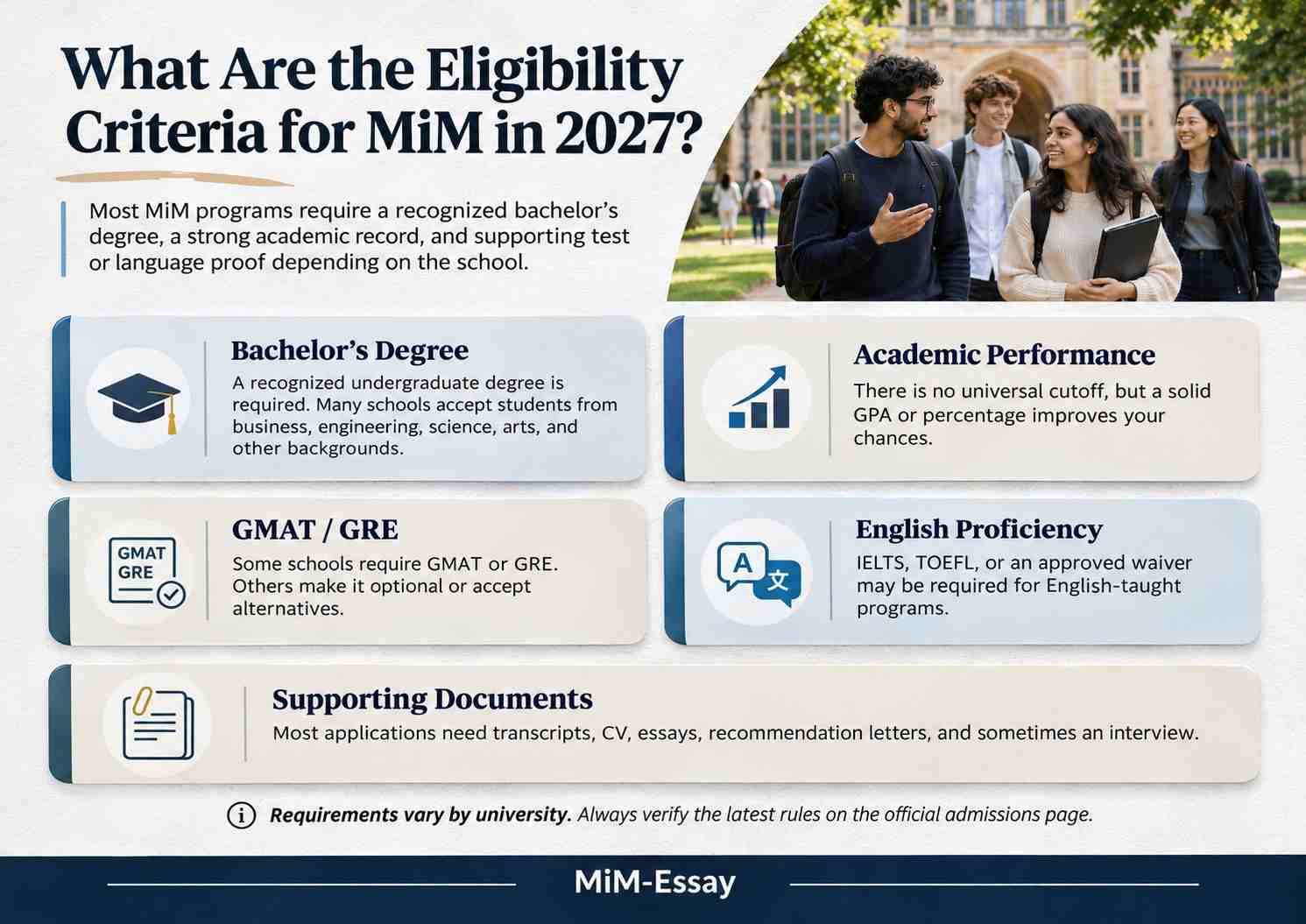
Most MiM programmes evaluate academic qualifications, test performance, communication skills and career motivation. However, admission requirements are not identical across universities. Meeting the basic criteria allows you to apply but does not guarantee admission.
MiM Admission Requirements at a Glance
| Requirement | Typical Eligibility |
|---|---|
| Academic qualification | Recognised bachelor's degree or equivalent |
| Academic background | Many schools accept graduates from different disciplines |
| GPA or percentage | Depends on the university; no universal cutoff |
| Work experience | Usually little or no full-time experience |
| GMAT/GRE | Required, recommended or optional depending on the programme |
| English proficiency | Accepted English test or qualifying waiver |
| Application documents | Transcripts, CV, essays and recommendations as required |
| Interview | May be required during the selection process |
Use this table as a starting point. Always compare the requirements with the admissions policy for your intended intake.
What Academic Qualifications Are Required for MiM?
A recognised undergraduate degree is the main academic requirement for most MiM programmes. Universities also consider academic performance and whether your previous education prepares you for postgraduate management study.
Bachelor's Degree Requirements
Many leading MiM programmes accept a bachelor's degree in any discipline. HEC Paris, for example, accepts applicants holding at least a three-year bachelor's degree in any field. Students in their final year may also apply, subject to providing proof of completion. Some specialised programmes have additional subject or coursework requirements. Check these before shortlisting a university.
Minimum GPA and Academic Percentage
There is no single minimum GPA that applies to every MiM programme. Some schools publish an academic threshold, while others evaluate grades in the context of the applicant's university and overall profile. London Business School states that it accepts strong undergraduate degrees equivalent to a UK First or 2:1, or a GPA of 3.3 and above. This is an LBS-specific benchmark, not a universal MiM eligibility rule. If your grades are below a published requirement, contact the admissions office before applying rather than assuming that a higher test score will automatically compensate.
Eligibility for Non-Business Graduates
Commerce and business degrees are not compulsory for many general MiM programmes. Engineering, science, humanities and other graduates can also apply. Applicants without formal business education can demonstrate analytical ability through coursework, internships, projects or relevant extracurricular activities.
Is Work Experience Required for MiM Admission?
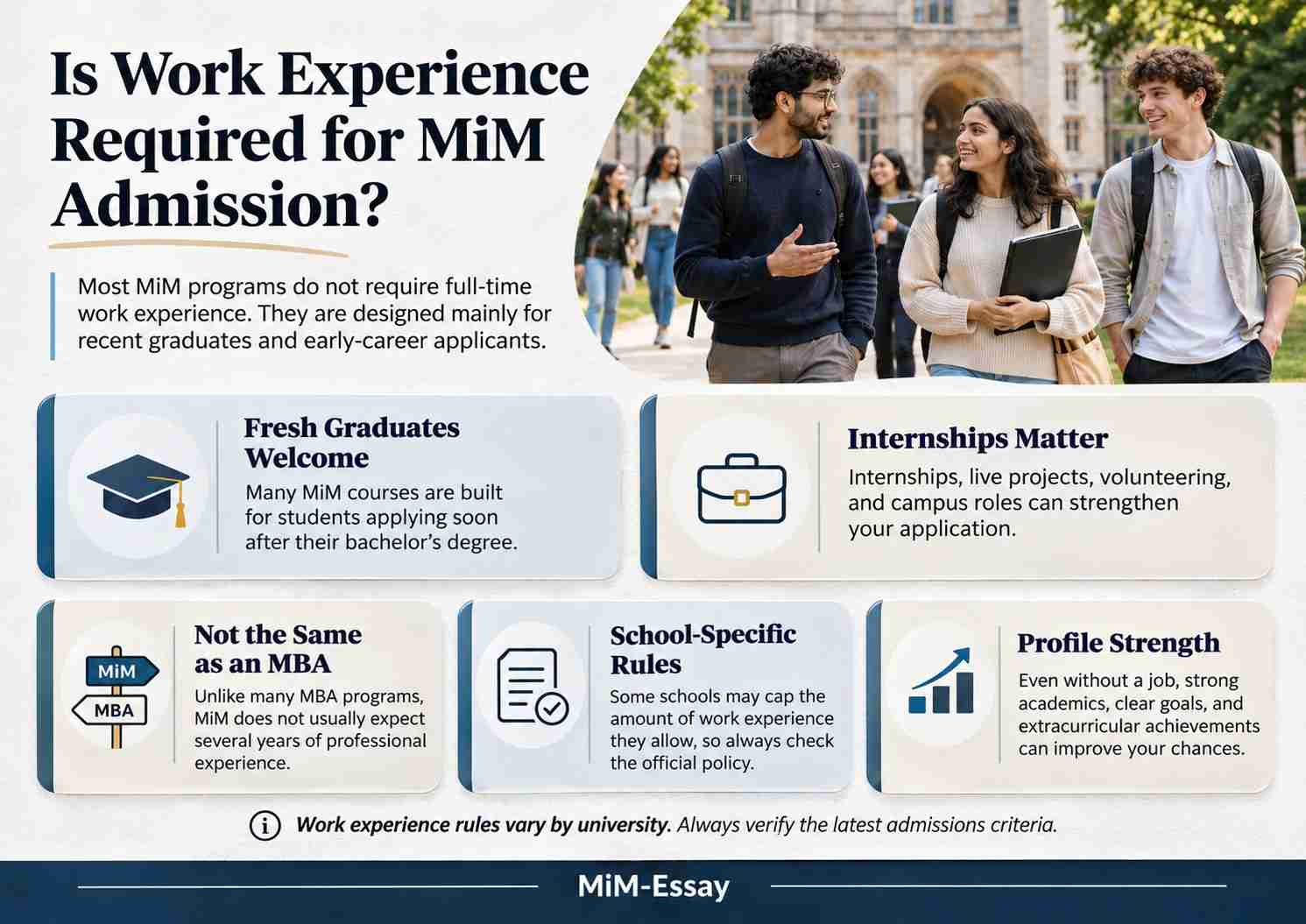
No, full-time work experience is not mandatory for many MiM programmes. These degrees are generally designed for recent graduates. However, universities may restrict how many years of professional experience applicants can have.
Work Experience Limits at Different Schools
Work-experience eligibility depends on the programme. For example:
- HEC Paris: Applicants should have little or no professional experience by the programme's start.
- INSEAD: Full-time professional experience is not required.
- Georgetown: Applicants must have zero to three years of postgraduate professional experience.
- Kellogg: The 2027 intake has specific graduation-date and work-experience eligibility restrictions.
These examples show why you should not apply a universal two-year work-experience limit to every school.
Internships and Practical Experience
Internships, volunteering, research projects, entrepreneurial work and student leadership can strengthen a MiM application. They help demonstrate teamwork, initiative and professional interests. Having no internship does not automatically make you ineligible, but meaningful experience can help explain your career goals.
Is the GMAT or GRE compulsory for MiM?
No, GMAT or GRE is not compulsory for every MiM programme. Some universities require one of these exams, while others accept alternative tests or consider applications without them. The test policy must be checked individually.
GMAT and GRE Requirements
INSEAD and London Business School require applicants to submit GMAT or GRE scores. Other schools may take a different approach. For example, Imperial College Business School strongly recommends GMAT or GRE but does not make these tests obligatory when applicants can demonstrate strong quantitative achievement.
Do not confuse old GMAT scores with current GMAT Exam scores. The scoring scales differ, so older benchmarks should not be presented as current cutoffs.
Alternative Management Admission Tests
Some European business schools accept tests beyond GMAT and GRE. ESSEC accepts CAT for Indian applicants, along with other recognised management tests. This can benefit Indian students who have already prepared for CAT. However, an accepted test at one university may not be accepted at another.
MiM Admission Without GMAT
Students seeking MiM programmes without GMAT should shortlist schools where the exam is optional, where a waiver is available or where another approved assessment is accepted. For school-specific GMAT preparation and requirements, explore our LBS MiM GMAT guide.
What Are the English Language Requirements for MiM?
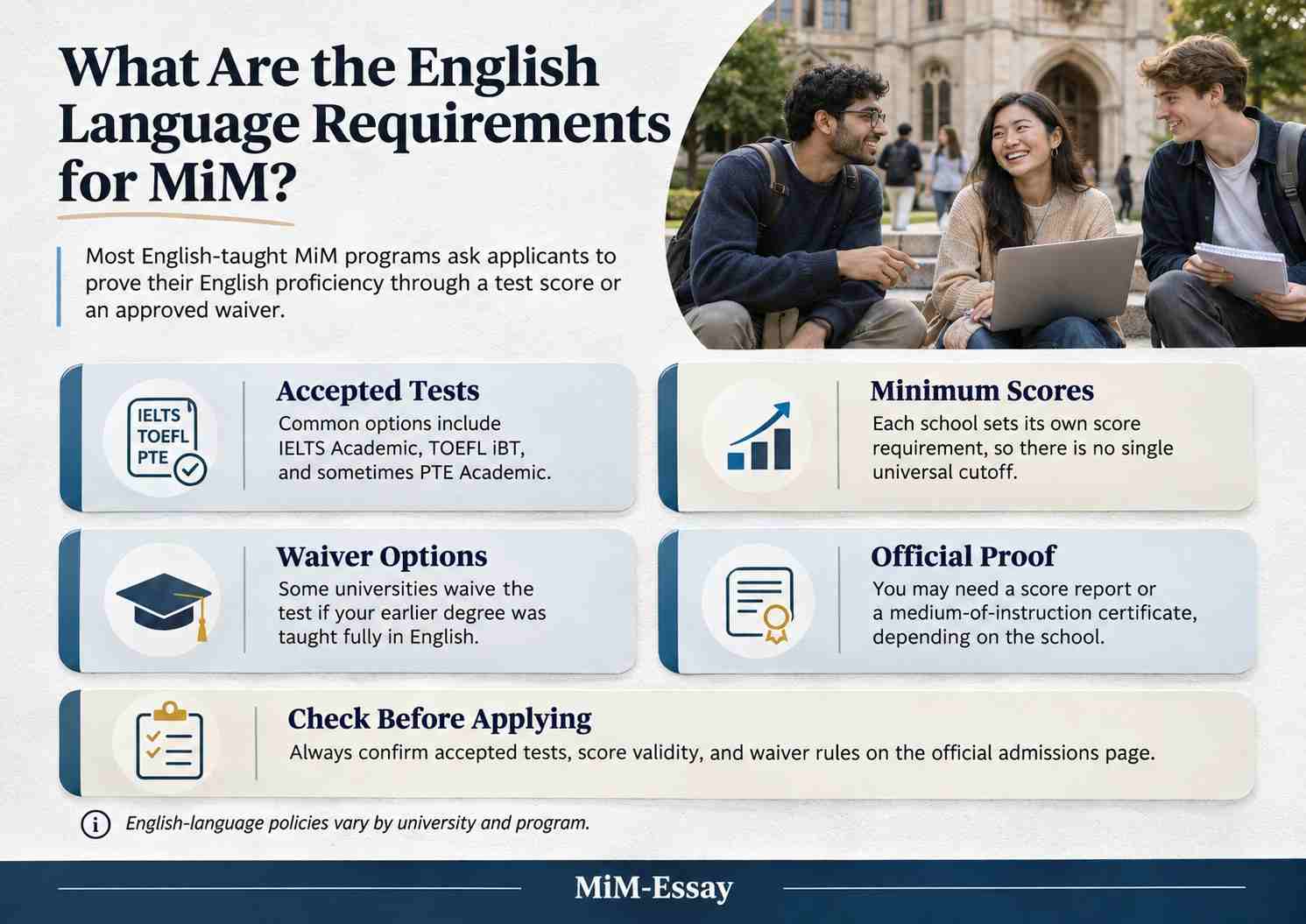
Applicants must demonstrate sufficient English proficiency for programmes taught in English. Schools commonly accept IELTS Academic, TOEFL iBT or other approved tests. Some applicants may qualify for a waiver based on previous education.
IELTS, TOEFL and Other Accepted Tests
English test requirements differ by institution. ESSEC's international-degree admission route currently lists IELTS Academic 6.5 as a minimum. EDHEC also lists IELTS 6.5 for its standard MiM English-language requirement.
These scores should not be treated as minimum requirements for every MiM university.
English-Language Test Waivers
Some schools accept a degree taught entirely in English as evidence of language proficiency. INSEAD, for example, accepts a qualifying university degree taught exclusively in English instead of an English test. ESSEC also provides an exemption for applicants who completed at least three years of higher education entirely in English, supported by an official medium-of-instruction certificate. Check the university's policy before deciding whether to take IELTS, TOEFL or another English test.
How Do MiM Requirements Differ Across Top Business Schools?
MiM eligibility requirements vary considerably among leading universities. The following comparison highlights selected official admissions policies relevant to students applying for 2027 entry.
Business School Eligibility Comparison
| Business School | Academic Eligibility | Management Test Policy | Work Experience |
|---|---|---|---|
| HEC Paris | At least a three-year bachelor's degree in any field | Check the current admissions requirements | Little or none |
| London Business School | Strong undergraduate degree; published GPA guidance of 3.3+ | GMAT or GRE required | Designed for early-career applicants |
| INSEAD | Recognised bachelor's degree or equivalent | GMAT or GRE required | Full-time experience not required |
| ESSEC | Qualifying international higher-education degree | Approved management test required; CAT accepted for Indian applicants | Check the selected admission route |
| EDHEC | At least a three-year bachelor's degree | GMAT, GRE, TAGE MAGE or CAT accepted | Professional experience not mandatory |
| Imperial College Business School | First or upper second-class degree, or equivalent | GMAT/GRE strongly recommended, not always obligatory | Designed for recent graduates |
| Georgetown University | Accredited bachelor's degree or international equivalent | Check the current test requirements | Zero to three years of postgraduate experience |
Important: Admission eligibility does not equal guaranteed admission. Schools also consider motivation, academic potential and the overall application.
Verify current details through the official admissions pages of London Business School, INSEAD and ESSEC Business School.
How Do MiM Eligibility Requirements Vary by Country?
Country choice affects degree recognition, application timelines and English-language requirements. However, each university decides its own admission criteria, so national averages should not replace programme-specific information.
MiM Eligibility in the USA
US management programmes generally expect a recognised undergraduate degree. Work-experience limits and test requirements vary. Georgetown accepts applicants with zero to three years of postgraduate experience, while other schools may use narrower criteria.
MiM Eligibility in the UK
UK business schools commonly assess undergraduate degree classifications or equivalent international qualifications. London Business School requires GMAT or GRE, while Imperial's MSc in Management follows a different test policy.
Explore our guide to MiM colleges in the UK for further programme comparisons.
MiM Eligibility in France
French business schools such as HEC Paris, INSEAD, ESSEC and EDHEC offer MiM programmes with different degree, management-test and language requirements. Many accept applicants from non-business academic backgrounds.
MiM Eligibility in Germany
German management programmes can have specific academic prerequisites. Some programmes require particular undergraduate subjects, credits or quantitative preparation. Applicants should examine subject eligibility before applying.
MiM Eligibility in Canada
Canadian management master's programmes may require a recognised bachelor's degree, evidence of academic ability and English proficiency. Degree-equivalency and test requirements vary between institutions.
MiM Eligibility in Australia
Australian Master of Management programmes evaluate recognised qualifications, academic results and English proficiency. The University of Melbourne, for example, assesses international qualifications against its admission standards.
What Are the MiM Eligibility Requirements for Indian Students?
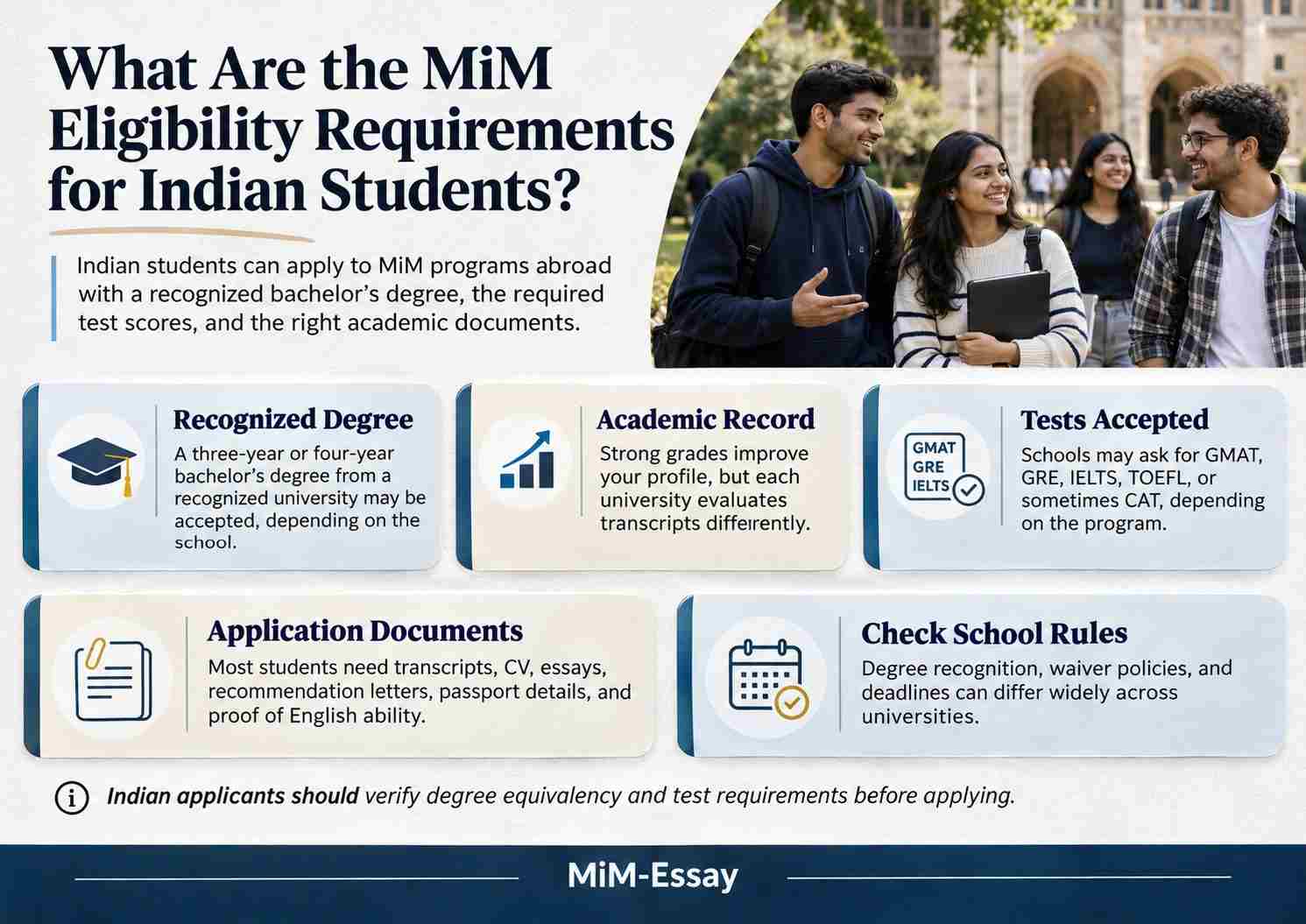
Indian students can apply for MiM programmes abroad with a recognised undergraduate qualification, provided they meet the university's specific requirements. A BCom, BBA, BA, BSc or engineering degree may be suitable for many general management programmes.
Acceptance of Three-Year Indian Degrees
A three-year Indian bachelor's degree can qualify for several leading MiM programmes. HEC Paris and EDHEC, for example, accept qualifying three-year degrees. However, recognition is not universal. Universities may review degree equivalency, grades, institution status and academic coursework before making an admission decision.
Eligibility After BCom, BBA or Engineering
BCom and BBA graduates can often use their business-related academic background when preparing applications. Engineering and science graduates may demonstrate quantitative skills and problem-solving ability.
For a more detailed explanation, read our MiM after BCom guide.
CAT Scores for Indian Applicants
Some European business schools accept CAT scores from Indian applicants. ESSEC and EDHEC are examples. This option may reduce the need to sit another management entrance exam when the student's chosen universities accept CAT.
Before selecting CAT as your admission test, verify score validity, accepted test years and programme-specific rules.
English-Medium Education and Language Waivers
Indian applicants who completed their degree entirely in English may qualify for an English-language test exemption at certain universities.
A medium-of-instruction certificate can help demonstrate previous English-language education, but it is accepted only where the university's official waiver policy allows it.
Visa and Financial Preparation
Meeting MiM admission requirements is separate from obtaining a student visa. After admission, Indian students should review the destination country's current visa rules, financial evidence requirements and processing timelines.
Prepare education-loan documents, scholarship applications and funding evidence early. The required amount and documentation depend on your programme and destination.
Which Documents Are Required for MiM Admission?
Most MiM applications require documents that demonstrate academic qualifications, career interests and readiness for management education. The exact checklist varies by university.
MiM Application Document Checklist
| Document | Purpose |
|---|---|
| Academic transcripts | Show completed courses and academic performance |
| Degree certificate | Confirms the academic qualification when already completed |
| GMAT/GRE or accepted alternative | Demonstrates academic aptitude where required |
| English proficiency evidence | Confirms language eligibility or an approved exemption |
| CV or resume | Summarises education, internships, projects and activities |
| Essays or motivation statement | Explains career goals and programme fit |
| Recommendation letters | Provide evidence of academic or professional potential |
| Identity documents | Support personal and application verification |
Some universities may also request interviews, video assessments, certified translations or additional forms.
Essays and Recommendations
Strong application essays explain why you want to study management, what you have learned from your experiences and how the programme supports your future plans.
Recommendations should come from people who can describe your abilities with specific examples. Follow each school's instructions on whether academic or professional references are preferred.
How Can You Apply for MiM in 2027?
Start by checking programme eligibility and application deadlines. Build a shortlist based on your academic record, test options, career goals and preferred study destination.
Step-by-Step MiM Application Process
- Check academic eligibility: Confirm your degree is accepted and meets any grade or subject requirements.
- Review work-experience rules: Make sure your graduation date and professional experience fit the programme.
- Select your admission test: Check whether GMAT, GRE, CAT or another assessment is required.
- Confirm English requirements: Book an accepted test or prepare waiver evidence.
- Prepare documents: Organise transcripts, your resume, essays and recommendation letters.
- Submit before the deadline: Complete the application and any required fee payment.
- Prepare for interviews: Be ready to discuss your motivation, academic experience and career goals.
- Plan the next steps: If admitted, review enrolment conditions, financing and student visa requirements.
Students targeting early admission rounds should prepare tests and recommendations well ahead of the relevant deadline.
Related Blogs
Explore our related guides on MiM programmes, degree requirements and business-school admissions:
- Master in Management: Complete Degree Guide
- MiM After BCom: Eligibility and Admission Guide
- Top MiM Colleges in the UK
- LBS MiM GMAT Requirements
Conclusion
Understanding the eligibility criteria for MiM is the first step towards choosing the right business school. Compare academic qualifications, entrance tests, language requirements and application documents before applying. Focus on universities where your background meets the published criteria and your career goals match the programme.