
 Abhyank Srinet


Table of Contents
- Introduction
- What are the Nanyang MBA deadlines for 2026?
- Which Nanyang MBA round is best for Indian applicants?
- What is the Nanyang MBA application timeline for Indian students?
- What are the Nanyang MBA admission requirements?
- What documents are needed by the Nanyang MBA deadline?
- What are the Nanyang MBA scholarship deadlines?
- What is the Nanyang MBA fee for the 2026 intake?
- What happens if you miss the Nanyang MBA deadline?
Nanyang MBA has 3 application rounds for the July intake. Round 1 closes on 1 November, Round 2 closes on 31 January, and Round 3 closes on 31 March. Interview decisions are released on 2 December, 28 February, and 24 April. Final decisions come on 3 January, 18 March, and 15 May. Indian applicants should target Round 1 or Round 2.
Introduction
The Nanyang MBA deadlines are important to know if you are planning to apply for the MBA at Nanyang Business School, Singapore. For the July intake, the programme has three application rounds: Round 1 closes on 1 November, Round 2 closes on 31 January, and Round 3 closes on 31 March. Choosing the right round matters because it gives you enough time to prepare your GMAT Focus or GRE, essays, recommendation letters, scholarships, funding, Student’s Pass, and relocation to Singapore.
In this blog, we will explain the official Nanyang MBA deadlines, round-wise decision dates, the best round to apply, scholarship planning, and a simple timeline to help you submit your application without last-minute stress.
What are the Nanyang MBA deadlines for 2026?
![the Nanyang MBA deadlines for 2026]()
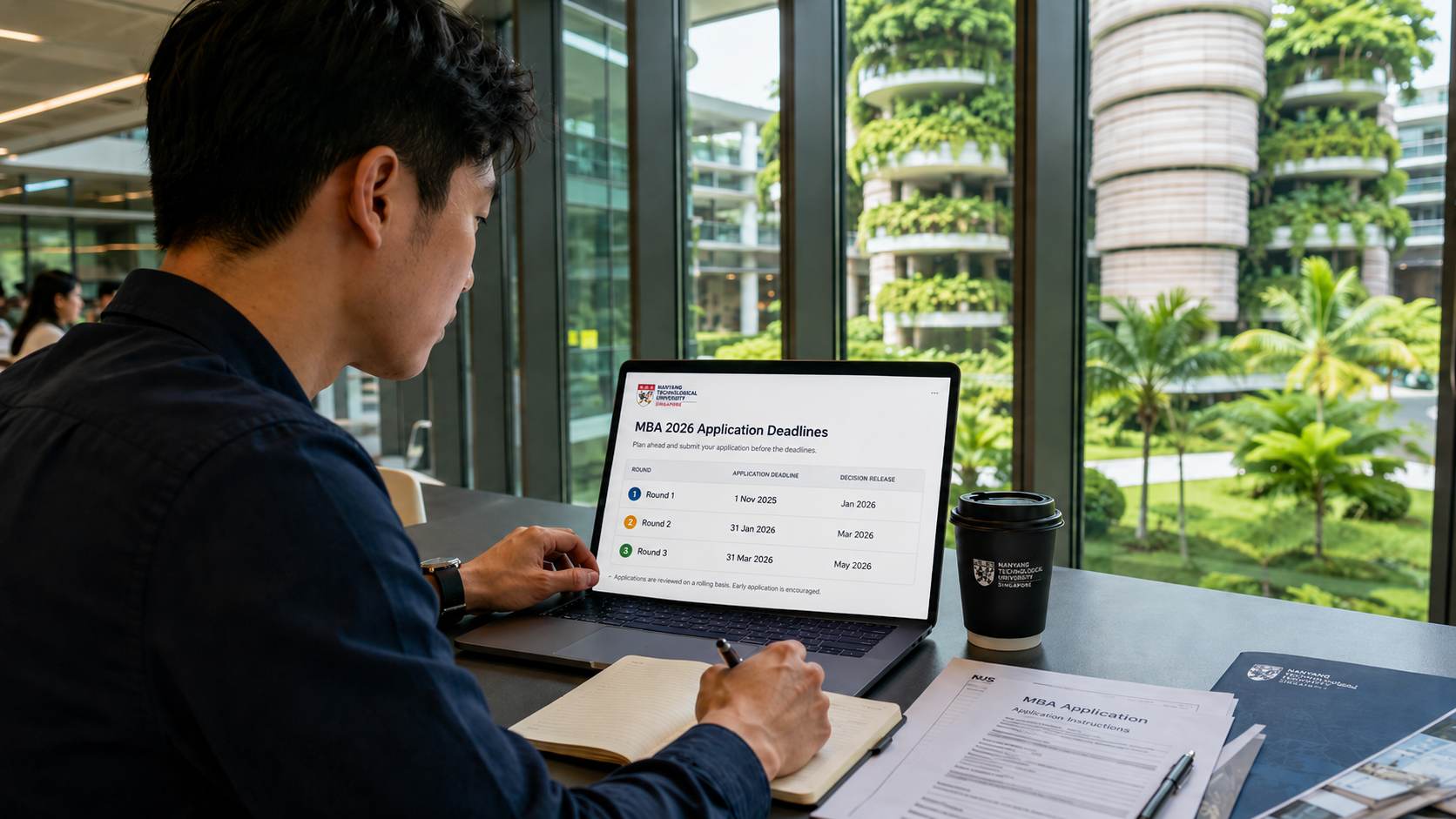
The Nanyang MBA deadlines for the July intake are divided into three application rounds. NTU’s official admissions page lists Round 1, Round 2, and Round 3, with separate dates for application submission, interview decision, and final decision.
Nanyang MBA deadline table
| Round | Application Deadline | Interview Decision | Final Decision | Best For Indian Applicants |
|---|---|---|---|---|
| Round 1 | 1 November | 2 December | 3 January | Best for early planning, scholarships, and relocation |
| Round 2 | 31 January | 28 February | 18 March | Good fallback if GMAT Focus, essays, or recommendations need more time |
| Round 3 | 31 March | 24 April | 15 May | Final round; tighter timeline for visa, funding, and relocation |
Key deadline notes
Indian applicants should not look at the application deadline alone. The final decision date is equally important because it affects how much time you have for funding, scholarships, Student’s Pass planning, accommodation, and relocation to Singapore.
Important points:
- Round 1 gives the longest post-admit preparation window.
- Round 2 is still practical for Indian applicants.
- Round 3 is possible but creates a compressed timeline.
- Scholarship-focused applicants should apply before the scholarship deadline, not just the MBA application deadline.
Which Nanyang MBA round is best for Indian applicants?
For Indian applicants, Round 1 is the strongest choice for the Nanyang MBA, while Round 2 is a reliable fallback. Round 3 should be used only if your application is complete and you are comfortable with a tighter scholarship, visa, and relocation timeline.
Why Round 1 is the best option
Round 1 gives you the earliest final decision, which is released on 3 January. This gives Indian applicants more time to arrange finances, compare scholarship options, prepare immigration documents, and plan their move to Singapore.
Round 1 is best if:
- Your GMAT Focus or GRE score is ready.
- Your essays and CV are already strong.
- Your recommenders can submit on time.
- You want more time for funding and relocation.
- You want to avoid last-minute Student’s Pass pressure.
When Round 2 makes sense
Round 2 is a good option if you need more time to improve your application. Since the Round 2 final decision is released on 18 March, Indian applicants still have a reasonable window before the July intake.
Round 2 works well if:
- You need one more GMAT Focus or GRE attempt.
- Your essays need more polishing.
- Your recommenders need extra time.
- Your profile has improved after Round 1.
- You are still comparing MBA options in Singapore.
Why Round 3 is risky
Round 3 is the final listed application round for the Nanyang MBA. The application deadline is 31 March, and the final decision is released on 15 May. This leaves less time for scholarships, funding, Student’s Pass steps, accommodation, and relocation.
Round 3 should be considered only if:
- Your application is fully ready.
- You are not highly dependent on scholarships.
- Your finances are already planned.
- You can act quickly after admission.
- You are comfortable with a shorter relocation window.
What is the Nanyang MBA application timeline for Indian students?
![Nanyang MBA application timeline for Indian students]()

Indian applicants should start preparing 6–9 months before their target Nanyang MBA deadline. This gives enough time for test preparation, essays, recommendations, transcript collection, and final application review.
Timeline for Round 1 applicants
| Timeline | What to Do |
|---|---|
| 8–9 months before deadline | Start GMAT Focus or GRE preparation and research the Nanyang MBA. |
| 6–7 months before deadline | Shortlist recommenders and begin collecting transcripts. |
| 5–6 months before deadline | Take your first GMAT Focus or GRE attempt. |
| 4–5 months before deadline | Start essays, update CV, and build your application story. |
| 3 months before deadline | Finalise school research and attend official NTU/NBS events if possible. |
| 2 months before deadline | Complete essay drafts and confirm referee availability. |
| 4–6 weeks before deadline | Send official test scores using the correct NTU institution codes. |
| 2 weeks before deadline | Submit the application and pay the S$100 application fee. |
| After interview invite | Prepare for the Nanyang MBA interview with school-specific examples. |
| After admission | Start scholarship, funding, Student’s Pass, and relocation planning. |
GMAT Focus and GRE planning
Indian applicants should ideally complete GMAT Focus or GRE at least 4–6 weeks before their target deadline. This gives you time for a retake, score reporting, and final application checks.
Use this planning rule:
- For Round 1: finish your test by September or early October.
- For Round 2: finish your test by December.
- For Round 3: finish your test before March.
NTU lists the GMAT institution code as V24-ZV-13 and the GRE code as 3802.
What are the Nanyang MBA admission requirements?
The Nanyang MBA requires a bachelor’s degree, at least 2 years of work experience, a competitive GMAT/GMAT Focus or GRE score, and English proficiency scores if your undergraduate degree was not taught in English.
Core eligibility requirements
| Requirement | Official Requirement |
|---|---|
| Degree | Bachelor’s degree |
| Work experience | Minimum 2 years |
| Test score | Competitive GMAT/GMAT Focus or GRE |
| English test | TOEFL or IELTS, if required |
| Application fee | S$100 |
English language requirement
Applicants may need to submit TOEFL or IELTS scores if English was not the medium of instruction during undergraduate study.
Accepted scores include:
- TOEFL iBT: 100 or above
- IELTS: 6.5 or above
Important note for Indian applicants
Meeting the minimum requirements does not guarantee admission. Indian applicants should also show strong career progression, leadership potential, clear post-MBA goals, and a strong reason for choosing the Nanyang MBA in Singapore.
What documents are needed by the Nanyang MBA deadline?
![documents needed by the Nanyang MBA deadline]()

Your Nanyang MBA application should be complete before your chosen deadline. NTU states that only completed applications are assessed, so missing documents can delay or weaken your application.
Application documents checklist
Prepare the following before submission:
- Online application form
- Updated CV or resume
- Degree certificate
- Academic transcripts
- Passport copy
- Passport-size photograph
- GMAT Focus, GMAT, or GRE score
- TOEFL or IELTS score, if required
- Two referee nominations
- Essays
- Scholarship essay, if applying
- S$100 application fee
Referee planning for Indian applicants
Indian applicants should contact recommenders at least 6–8 weeks before the deadline. This is especially important if your recommenders are senior managers, founders, partners, or business heads with busy schedules.
To avoid delays:
- Confirm referee availability early.
- Share your CV and career goals.
- Explain why you are applying to Nanyang MBA.
- Give them enough time before the deadline.
- Follow up politely before submission week.
What are the Nanyang MBA scholarship deadlines?
Nanyang Business School offers several MBA scholarships, and many NBS-administered scholarship applications close on 30 March each year. The APEC scholarship deadline is listed as 31 March. Scholarship applications are made through the online MBA application form, and applicants must complete the scholarship essay requirement.
Scholarship planning by round
| Round | Scholarship Planning |
|---|---|
| Round 1 | Safest round for scholarship-focused applicants |
| Round 2 | Still possible, but check scholarship deadlines carefully |
| Round 3 | Risky because many scholarship deadlines fall around 30–31 March |
What Indian applicants should know
If scholarship support is important, do not wait for Round 3. Even though the Round 3 MBA deadline is 31 March, many scholarship deadlines close around the same time. Applying earlier gives you more time to prepare the scholarship essay and avoid last-minute errors.
Indian applicants should prepare:
- Main MBA essays
- Scholarship essay
- Updated CV
- Clear financial need or merit story
- Strong leadership examples
- Post-MBA career goals
What is the Nanyang MBA fee for the 2026 intake?
The Nanyang MBA programme fee for the 2026 intake is S$89,380, inclusive of 9% GST. The application fee is S$100.
Why fee planning matters before the deadline
Indian applicants should plan funding before submitting the application. This is because scholarship deadlines, loan processing, deposit planning, and relocation expenses can overlap after admission.
Before applying, prepare:
- Tuition funding plan
- Scholarship shortlist
- Loan documentation
- Proof of savings, if required
- Living cost estimate for Singapore
- Emergency relocation buffer
Source: Nanyang MBA Deadlines
What happens if you miss the Nanyang MBA deadline?
![if you miss the Nanyang MBA deadline]()

If you miss a Nanyang MBA deadline, apply in the next available round if one is still open. If you miss Round 3, you should prepare for the next intake instead of submitting a rushed or incomplete application.
If you miss Round 1
You can still apply in Round 2. Use the extra time to improve your essays, retake GMAT Focus or GRE if needed, and prepare stronger recommendations.
If you miss Round 2
You can apply in Round 3, but you should be ready for a tighter post-admission timeline. Scholarship and relocation planning may become more difficult.
If you miss Round 3
You should prepare for the next application cycle. Use the time to strengthen your profile, improve your test score, gain leadership experience, and build a stronger MBA story.
Related Blogs
- Nanyang Business School MBA GMAT
- Nanyang Business School MBA salary
- Nanyang Business School MBA essays
- Nanyang Business School MBA interview questions
- Is Nanyang Business School MBA worth it?
- Nanyang Business School MBA Fees
Conclusion
The Nanyang MBA deadlines for the July intake are 1 November, 31 January, and 31 March. For Indian applicants, Round 1 is the best option because it gives the most time for scholarships, funding, Student’s Pass planning, and relocation. Round 2 is a strong fallback, while Round 3 should be used only if your application is already complete and competitive.
A strong Nanyang MBA application is not just about submitting before the deadline. It is about choosing the right round, preparing your GMAT Focus or GRE early, writing clear essays, managing recommendations, and keeping enough time for post-admission planning.