
 Abhyank Srinet


Table of Contents
- Introduction
- What Are the Key Study in France Facts for 2027?
- Why Should International Students Study in France?
- Which Are the Top Universities to Study in France in 2027?
- What Are the Most Popular Courses to Study in France?
- Can You Study in France in English?
- Is French Required to Study in France?
- What Are the Requirements to Study in France?
- How Does the Campus France Process Work for Indian Students?
- When Should You Apply to Study in France for 2027?
- What Are the Main Intakes to Study in France?
- How Much Does It Cost to Study in France?
- How Do You Get a France Student Visa?
- Can International Students Work While Studying in France?
- Can Indian Students Stay in France After Graduation?
- Which Scholarships Are Available to Study in France?
- How Can You Check Whether a French University or Private School Is Recognised?
- What Should Indian Applicants Know Before They Study in France?
- Is It Worth It to Study in France for Indian Students?
- Conclusion
Choosing to study in France in 2027 gives international students access to globally ranked universities, Grandes Écoles, relatively affordable public higher education and more than 1,600 programmes taught in English. For non-EU students, current 2026–27 public tuition is approximately ₹3.14 lakh (€2,902) per year for a Licence and ₹4.27 lakh (€3,950) for a Master's, although exemptions and institution-specific fees can apply. Indian applicants normally use the Études en France process before the student-visa stage. From August 2026, Campus France India requires proof of financial resources of at least approximately ₹94,900 (€877.50) per month, while foreign students can generally work up to 964 hours per year during their studies.
Introduction
Students who study in France can choose from public universities, engineering schools, Grandes Écoles, business schools and specialist institutions covering areas such as management, technology, science, design, luxury, fashion, economics and the humanities. France also has a growing number of degrees delivered partly or entirely in English.
For Indian students, the decision involves more than selecting a university. Tuition structure, programme recognition, Campus France procedures, proof of funds, language requirements, living costs and post-study options all need to be checked before applying. This guide covers the latest information for students planning a 2027 intake.
What Are the Key Study in France Facts for 2027?
France combines public universities, Grandes Écoles, engineering schools, business schools and specialist institutions within one higher-education system. The latest official figures below give students a clearer picture of the current study environment.
| Study in France Fact | Latest Verified Information |
|---|---|
| Foreign Students in Higher Education | 443,500 in 2024–25 |
| Foreign Share of Student Population | About 15% |
| English-Taught Programmes | 1,600+ |
| Top French University in QS 2027 | Université PSL at #34 globally |
| 2026–27 Non-EU Licence Tuition | Approx. ₹3.14 lakh (€2,902) per year at applicable public institutions |
| 2026–27 Non-EU Master's Tuition | Approx. ₹4.27 lakh (€3,950) per year at applicable public institutions |
| Visa Financial-Resource Requirement | Approx. ₹94,900 (€877.50) per month |
| Études en France Fee in India | ₹20,000 |
| Student Work Allowance | Up to 964 hours per year |
| Main Intake | September–October |
Why Should International Students Study in France?
France can be attractive for students who want a combination of globally recognised institutions, relatively affordable public education and access to both French- and English-taught programmes.
Public Higher Education Is Heavily Subsidised
The French government covers a substantial part of the actual cost of education at public institutions. This means eligible public-university tuition can be significantly lower than tuition at many private institutions or study destinations such as the UK and USA.
More Than 1,600 Programmes Are Taught in English
Students do not necessarily need fluent French to begin studying in France. Campus France currently lists more than 1,600 programmes taught partly or completely in English, with a particularly large selection at Master's level.
Strong Research and Specialist Institutions
France has universities as well as specialist engineering, business, political-science, design, art and architecture institutions. This allows students to choose between traditional university education and more specialised professional pathways.
International Student Community
France hosted 443,500 foreign students in higher education in 2024–25, representing around 15% of the national student population. This creates a substantial international community across French campuses.
Which Are the Top Universities to Study in France in 2027?

Université PSL is currently the highest-ranked French institution in the QS World University Rankings 2027 at #34 globally. Institut Polytechnique de Paris, Sorbonne University and Université Paris-Saclay also appear within the global top 100.
| French Institution | QS World University Ranking 2027 | Location |
|---|---|---|
| Université PSL | #34 | Paris |
| Institut Polytechnique de Paris | =#43 | Paris Region |
| Sorbonne University | #73 | Paris |
| Université Paris-Saclay | #76 | Paris Region |
| Université Paris 1 Panthéon-Sorbonne | =#246 | Paris |
| Université Paris Cité | =#303 | Paris |
| Sciences Po | =#354 | Paris and regional campuses |
You can review the latest positions through the QS ranking of universities in France.
Overall ranking should only be an initial filter. Applicants should also compare the specific faculty, curriculum, programme recognition, tuition, location and career opportunities relevant to their degree.
What Are the Most Popular Courses to Study in France?
France offers strong options across management, engineering, computer science, finance, luxury, design, fashion, sciences and social sciences. The right course depends on your academic background and intended career.
| Study Area | Common Programme Types | Why Students Consider France |
|---|---|---|
| Business & Management | MiM, MBA, MSc, Finance, Marketing | Large Grandes Écoles and business-school ecosystem |
| Engineering | Engineering degrees, MSc, specialised Master's | Strong engineering-school and research system |
| Computer Science & AI | MSc, Master's, engineering programmes | Research and technology-focused universities |
| Finance & Economics | MSc Finance, economics and quantitative programmes | Access to Paris and European financial markets |
| Fashion & Luxury | Fashion, luxury management, design | Strong industry ecosystem and specialist institutions |
| Political Science & International Affairs | Master's and undergraduate programmes | Specialised institutions and international environment |
Can You Study in France in English?
Yes. France currently offers more than 1,600 degree programmes taught partly or entirely in English. Most English-taught options are available at postgraduate level, although undergraduate choices also exist.
An English-taught programme does not automatically mean that every university has the same language requirement. Institutions may ask for IELTS, TOEFL or another recognised proof of English, while some may accept alternative evidence.
Learning French is still useful even when your course is fully in English. It can make everyday life easier and expand internship, part-time work and full-time employment opportunities.
Is French Required to Study in France?
French is not universally required if your programme is taught in English. French-taught programmes, however, may require DELF, DALF, TCF or another approved form of language evidence depending on the university.
Always check the programme's stated language of instruction rather than assuming that one national rule applies to every course.
What Are the Requirements to Study in France?
There is no single admission requirement for every French institution. Requirements depend on the degree level, institution, programme and language of instruction.
| Requirement | What Applicants Should Check |
|---|---|
| Academic Qualification | Class 12, bachelor's degree or other qualification appropriate to the study level |
| Academic Grades | Programme-specific percentage, CGPA or grade requirements |
| English | IELTS, TOEFL or another accepted route for applicable English-taught programmes |
| French | DELF, DALF, TCF or another accepted test for applicable French-taught courses |
| Management Tests | GMAT, GRE or other tests only where the specific programme requires them |
| Statement / Motivation Letter | Common for many university and school applications |
| CV | Common for postgraduate and professional programmes |
| Recommendations | Programme specific |
Indian applicants should verify the precise programme page because French universities and Grandes Écoles control their own selection standards.
How Does the Campus France Process Work for Indian Students?
India is covered by the Études en France procedure, which forms an important part of the study and visa process for Indian applicants.
- Choose your programmes: Check whether your target institutions and courses use Études en France or their own application route.
- Create your Études en France account: Complete the required academic and personal information.
- Upload documents: Provide transcripts, qualifications and other materials required for your chosen application route.
- Complete the Campus France process: Follow any file review or interview steps relevant to your case.
- Pay the EEF fee: Campus France India currently charges ₹20,000, effective from 1 August 2026.
- Complete the institution process: Some institutions may also require a direct application through their own portal.
- Move to the visa stage after admission: Complete the France-Visas process once you have the required admission documentation.
Do not pay an Études en France fee through an unofficial payment link. Campus France India states that payment should only be made after the file has been validated and the official payment link has been issued.
When Should You Apply to Study in France for 2027?

The 2027–28 Études en France cycle opened on 1 October 2026. The exact deadline depends on the study level and whether the institution follows the central EEF timetable or operates its own application calendar.
| 2027–28 Stage | Current General EEF Timeline |
|---|---|
| Études en France Opens | 1 October 2026 |
| DAP First-Year Licence Deadline | 15 December 2026 |
| L2/L3/BUT/Master HDAP Deadline | 15 February 2027 under the published general EEF calendar |
| Institution Decisions | By 30 April 2027 for applicable EEF routes |
| Student Decision | By 31 May 2027 for applicable EEF routes |
Some universities, Grandes Écoles and programmes use their own deadlines. Always confirm the date inside your Études en France account and on the institution's official admissions page.
What Are the Main Intakes to Study in France?
September–October is the main higher-education intake in France. Some institutions also offer January, February or other alternative starts, but programme availability is much smaller.
| Intake | Typical Availability |
|---|---|
| September–October | Main intake with the widest course choice |
| January–March | Alternative intake for selected institutions and courses |
Applicants should shortlist by programme first rather than assuming that every French university offers both intakes.
How Much Does It Cost to Study in France?
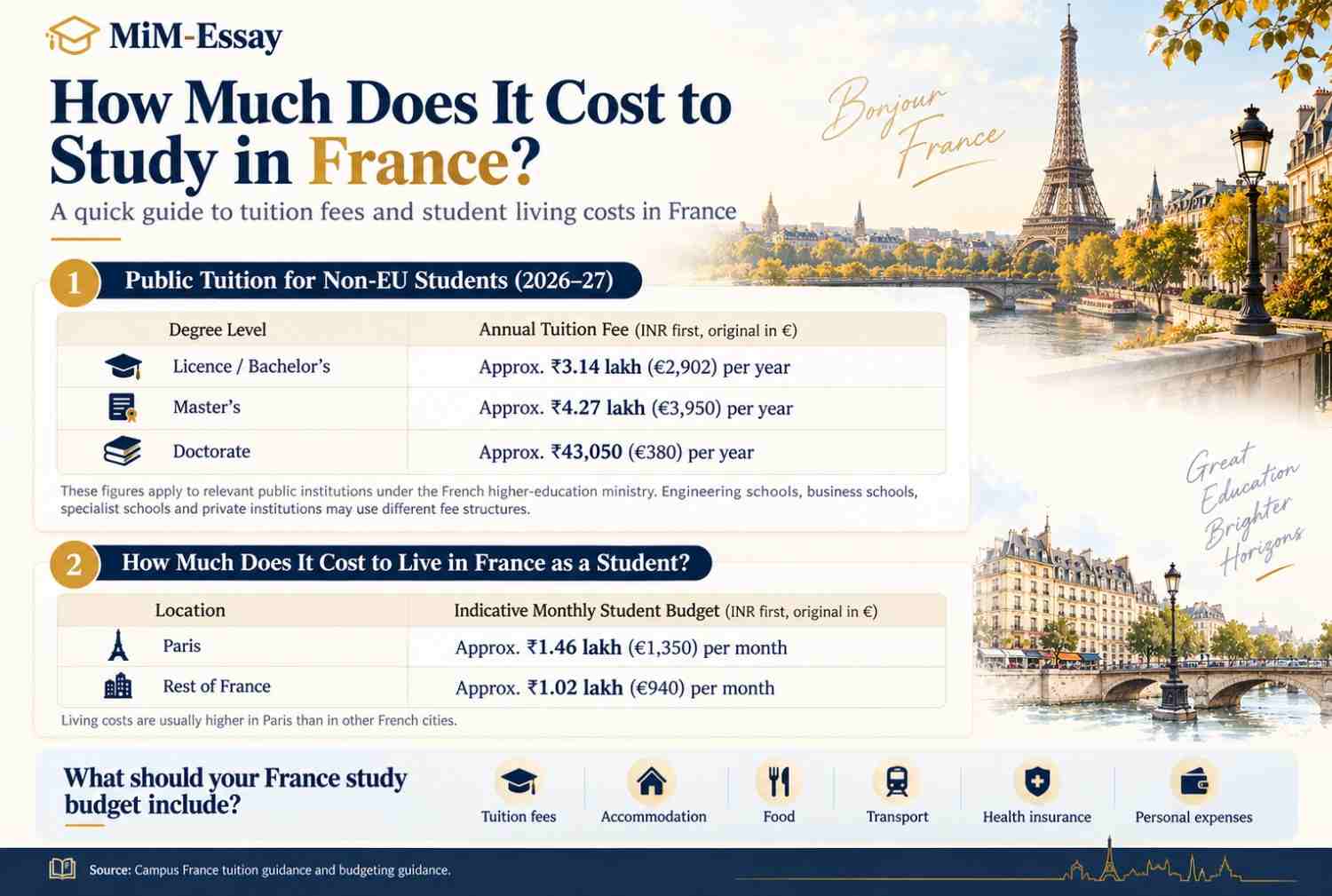
Public-university tuition can be relatively affordable, but the total cost to study in France depends heavily on whether you choose a public institution, private school or Grande École.
| 2026–27 Public Tuition for Applicable Non-EU Students | INR First (Original) |
|---|---|
| Licence / Bachelor's | Approx. ₹3.14 lakh (€2,902) per year |
| Master's | Approx. ₹4.27 lakh (€3,950) per year |
| Doctorate | Approx. ₹43,050 (€398) per year |
These figures apply to the relevant public institutions under the French higher-education ministry. Certain students can qualify for exemptions, while engineering schools, business schools, specialist schools and private institutions may use entirely different tuition structures.
Check the official Campus France tuition guidance before creating your final budget.
How Much Does It Cost to Live in France as a Student?
Living costs are normally higher in Paris than in other French cities. Current Campus France budgeting guidance provides an indicative total of around ₹1.46 lakh (€1,350) per month in Paris and approximately ₹1.02 lakh (€940) in the rest of France.
| Location | Indicative Monthly Student Budget |
|---|---|
| Paris | Approx. ₹1.46 lakh (€1,350) |
| Rest of France | Approx. ₹1.02 lakh (€940) |
Housing is usually the largest expense. CROUS residences can be substantially cheaper than private apartments, but demand is high and accommodation should be arranged early.
How Much Bank Balance Is Required for a France Student Visa?
From 1 August 2026, the minimum financial-resource requirement for a French student visa is approximately ₹94,900 (€877.50) per month.
For 12 months, that is approximately ₹11.39 lakh (€10,530) in minimum financial resources. This should not be confused with your complete study budget because tuition, travel, initial accommodation payments and other costs may also need to be planned separately.
Students should use the exact requirements generated for their personal case through France-Visas rather than relying on older articles that still quote €615 per month.
How Do You Get a France Student Visa?
Indian students studying for more than three months normally need a long-stay student visa, generally the VLS-TS student route. Your exact visa documents depend on your personal circumstances and course.
- Complete the relevant admission/Campus France process: Obtain the required acceptance documentation.
- Create the France-Visas application: Use the official visa process for your situation.
- Prepare proof of funds: The current minimum financial-resource threshold is €877.50 per month.
- Provide accommodation information: Follow the address/accommodation requirements shown for your application.
- Pay the visa charge: France-Visas currently lists an indicative ₹5,410 (€50) visa price for students from countries covered by the EEF procedure, including India.
- Complete biometrics and submission: Follow the instructions generated for your location.
- Validate the VLS-TS after arrival: The student VLS-TS must be validated online within three months of arriving in France.
Check the official France-Visas student guidance before submitting your application because documentation and charges can vary by individual situation.
Can International Students Work While Studying in France?
Yes. Foreign students are generally allowed to work up to 964 hours per year in France. This corresponds to roughly 60% of France's normal annual working time.
Part-time work should be treated as supplementary income rather than the main way to pay tuition and living expenses. France-Visas specifically warns that working part time is not sufficient to cover all student expenses.
French-language ability can also make a major difference to the number of student jobs and internships you can realistically access.
Can Indian Students Stay in France After Graduation?
Yes. Eligible Indian graduates with a French Master's-level qualification can use the post-study job-search/business-creation framework under the France–India mobility agreement.
Official French immigration guidance states that Indian nationals can receive a 12-month authorisation that can be renewed once, potentially giving up to 24 months, subject to the applicable eligibility conditions.
The post-study period should not be confused with automatic permanent residence. Its purpose is to allow eligible graduates to seek suitable employment or develop a qualifying business project before moving to an appropriate professional residence status.
Which Scholarships Are Available to Study in France?
Funding can come from the French government, Campus France programmes, universities, Grandes Écoles and India-specific schemes. Scholarship eligibility differs substantially by degree and institution.
France Excellence Eiffel Scholarship
The Eiffel programme supports selected international Master's and doctoral candidates nominated by French institutions. From January 2026, Master's recipients receive approximately ₹1.30 lakh (€1,200) per month plus specified services such as transport, insurance and housing assistance.
Students do not submit directly to Eiffel. The French higher-education institution must support and submit the application.
France Excellence Charpak
France Excellence Charpak is specifically relevant to Indian applicants. Campus France India runs Master's and exchange scholarship schemes, although each year's application dates and benefits should be checked on the active scholarship page before applying.
University and School Scholarships
French universities and Grandes Écoles can offer merit-based, need-based, country-specific and programme-specific awards. Applicants should check the scholarship deadline separately because it may be earlier than the final programme application date.
How Can You Check Whether a French University or Private School Is Recognised?
Do not assume that every private school or every programme offered by a recognised institution carries the same official recognition. Campus France specifically advises international students to verify the exact qualification before enrolling.
- Check recognition by the French state: Confirm the institution's official status.
- Check the exact degree: Recognition of a school does not automatically mean every course is recognised.
- Look for a diplôme visé: This is particularly relevant for recognised business and management qualifications.
- Check grade de Licence or grade de Master: These indicate recognised academic degree levels where applicable.
- Check RNCP information: Confirm the exact title, level, awarding organisation and validity of the certification where relevant.
- Verify before paying a large deposit: Do not rely only on marketing language such as “international diploma” or “European qualification.”
This check is especially important when considering newer private institutions that are not widely known outside France.
What Should Indian Applicants Know Before They Study in France?

Indian applicants should plan the university, Campus France, funding and visa process together rather than treating them as separate steps.
- India uses Études en France: Check whether your programme is connected to EEF or requires an additional direct application.
- The Campus France India fee is ₹20,000: This increased from 1 August 2026.
- Proof of funds has increased: Plan around at least €877.50 per month rather than the old €615 figure still shown on many websites.
- English programmes are widely available: French is not universally required for admission, but learning it can materially improve daily life and employability.
- Verify private programmes carefully: Check state recognition, diplôme visé, grade de Master/Licence and RNCP information where applicable.
- Budget beyond tuition: Include accommodation, food, transport, Campus France charges, visa costs, travel and initial deposits.
- Do not depend on a student job: The 964-hour work allowance is designed to supplement your resources rather than fully fund your education.
- Understand the Indian post-study route: Eligible Master's graduates may receive a 12-month authorisation renewable once under the bilateral framework.
Is It Worth It to Study in France for Indian Students?
Worth it if you have found a recognised programme that clearly supports your academic or career goals, want access to the French and wider European education environment, and can fund the degree without relying heavily on uncertain part-time work. France can be particularly attractive if you are considering management, engineering, technology, finance, luxury, design or research and value the choice between public universities and specialised Grandes Écoles.
Think twice if you are choosing France only because you assume every university is inexpensive, expect to work entirely in English after graduation, or have not verified the recognition of a private programme before paying a deposit. Tuition at private institutions can be much higher than public-university fees, and French-language ability can significantly affect internships, local employment and everyday life.
Related Blogs
- MiM in France: Top Colleges, Fees & Careers
- Best MBA Schools in France
- MiM Scholarships in France
- ESSEC MiM vs ESCP MiM
Conclusion
Choosing to study in France can provide a strong combination of academic choice, international exposure and access to the European education and employment environment. The best decision comes from verifying the exact programme, understanding its recognition, building a realistic budget and completing the Campus France and visa process early rather than choosing a school only because of ranking, tuition or location.