
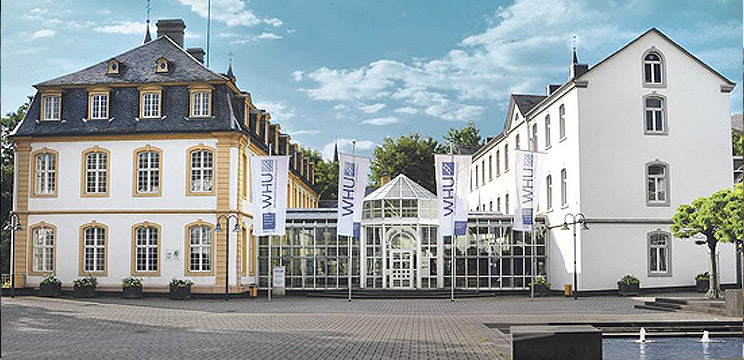


 Abhyank Srinet
 The WHU MBA covered here is the 12-month WHU Full-Time MBA in Düsseldorf, Germany, not the Kellogg-WHU Executive MBA. For Indian applicants, the WHU MBA is strongest if your goal is Germany-based consulting, strategy, technology, industrial, automotive, supply chain, or European business roles after an MBA.
The WHU MBA tuition fee is €49,500, which is approximately ₹54 lakh at July 2026 exchange rates. WHU does not officially publish a fixed GMAT Focus Edition cutoff or India-specific placement report, but the WHU MBA accepts GMAT Focus Edition, GRE, WHU Admissions Test, or CFA Level II as part of its Excellent Fit Assessment. WHU reports a 40–50 student Full-Time MBA class, around 80% international students, and €76,093 average post-MBA salary excluding bonus.
Introduction
The WHU MBA is one of Germany’s strongest MBA options for Indian professionals who want a focused, 12-month MBA in Germany with access to consulting, technology, industrial, automotive, manufacturing, energy, and Mittelstand career opportunities. The WHU Full-Time MBA is taught in English at WHU’s Düsseldorf campus and is designed for professionals who want leadership growth, international exposure, and a clear post-MBA career transition.
For Indian applicants, the WHU MBA is not just a Germany MBA option. It is a compact, career-focused programme for candidates who want personal career coaching, a small international cohort, and a Germany-first job-search strategy. WHU MBA applicants from India should also understand APS documentation, visa timelines, German language preparation, scholarships, and whether their previous work experience fits the German employer market.
This WHU MBA review covers WHU MBA fees, WHU MBA GMAT expectations, WHU MBA admission requirements, WHU MBA scholarships, WHU MBA placement outcomes, WHU MBA deadlines, and the WHU MBA value for Indian applicants. If you are comparing Germany MBA options or planning an MBA in Europe, this guide will help you understand whether WHU MBA fits your profile and career goals.
For broader application support, Indian students can also explore MiM-Essay’s study abroad consulting support for profile evaluation, school shortlisting, essay strategy, scholarship planning, and interview preparation.
WHU MBA at a Glance — Key Numbers 2026

The WHU MBA is a 12-month Full-Time MBA in Düsseldorf. For Indian students, the most important WHU MBA numbers are tuition fee, class size, international student ratio, work experience, salary outcome, scholarship availability, and APS-linked application deadline.
| Metric | WHU MBA 2026 Data | Indian Applicant Note |
|---|---|---|
| Programme Name | WHU Full-Time MBA | This is different from the Kellogg-WHU Executive MBA. |
| Official WHU Page | WHU Full-Time MBA | Use the official WHU MBA page for final verification before applying. |
| Total Programme Fee | €49,500 | Approx. ₹54 lakh at July 2026 EUR-INR rates; living costs are extra. |
| Programme Duration | 12 months | The WHU MBA has lower opportunity cost than many 2-year MBA options. |
| Location | Düsseldorf, Germany | Useful for Germany-based consulting, technology, industrial, and automotive roles. |
| Class Size | 40–50 students | Small cohort; good for personal attention and close peer networking. |
| International Students | Approx. 80% | Strong international exposure for Indian students targeting Germany and Europe-linked roles. |
| Average Work Experience | 5 years | Indian applicants with 4–7 years of strong experience are usually better aligned. |
| Average Age | 29 years | The WHU MBA is better suited to mid-career professionals, not fresh graduates. |
| GMAT Focus Edition | No fixed cutoff officially published | GMAT Focus Edition, GRE, WHU Admissions Test, or CFA Level II can support the Excellent Fit Assessment. |
| Post-MBA Salary | €76,093 average post-MBA salary excluding bonus | Approx. ₹83 lakh; actual outcome depends on role, German language ability, and employer fit. |
| Scholarships | Partial WHU MBA scholarships available | Apply early because seats and WHU MBA scholarships are limited and rolling. |
| India Alumni Network Size | India-specific number not separately published | Ask WHU admissions for India-specific alumni access and use the wider WHU alumni network. |
INR conversions are approximate and based on planning-level EUR-INR rates around July 2026. Indian students should check live exchange rates before final WHU MBA budgeting.
Why WHU MBA's Small Class Size Changes the ROI Calculation
The WHU MBA has a small class size, and that changes the ROI calculation for Indian applicants. A smaller WHU MBA cohort can mean more direct faculty access, closer career support, stronger classroom visibility, and better relationship-building. However, it also means Indian applicants must be very clear about their WHU MBA goals because the cohort is smaller than many larger European MBA programmes.
WHU MBA Class Profile and Cohort Size
- Class size: WHU reports around 40–50 students in the WHU Full-Time MBA class.
- Average age: The WHU MBA class average age is around 29 years.
- Average work experience: WHU reports around 5 years of average professional work experience.
- Female students: WHU reports around 40% female students in the Full-Time MBA class.
- Indian applicant fit: The WHU MBA is stronger for Indian professionals who already have measurable work achievements, leadership examples, and a Germany-focused career plan.
- ROI implication: A small WHU MBA cohort can improve personal attention, but Indian students must network actively from the start because the programme lasts only 12 months.
International Student Ratio
- International exposure: WHU reports around 80% international students in the WHU MBA class.
- Why it matters for Indians: Indian students get a global classroom, but the post-MBA job search still needs a Germany-first strategy.
- Language reality: The WHU MBA is taught in English, but German language skills can improve access to industry, operations, automotive, consulting, and local corporate roles.
- German support: WHU includes German classes during the WHU MBA programme fee, which can help Indian applicants prepare for the German job market.
WHU MBA vs. Kellogg-WHU Executive MBA — Which One Are You Looking At?
Many Indian applicants confuse the WHU MBA with the Kellogg-WHU Executive MBA. This page is focused on the WHU Full-Time MBA, which is a 12-month MBA in Düsseldorf for professionals who want to study full-time and use the programme for a career transition, Germany market entry, or leadership growth.
Key Difference for Indian Applicants
- WHU Full-Time MBA: Best for professionals who can pause work for 12 months and want to use the WHU MBA for career change, Germany market entry, consulting, technology, or leadership roles.
- Kellogg-WHU Executive MBA: A different executive-format programme for senior professionals who usually continue working while studying.
- Application intent: If you are searching for WHU MBA fees, WHU MBA GMAT, WHU MBA placements, WHU MBA scholarships, or WHU MBA for Indian students, you are likely looking for the WHU Full-Time MBA.
- Brand clarity: Do not use Kellogg-WHU Executive MBA rankings, fees, or outcomes to judge the WHU Full-Time MBA.
WHU MBA Fees and Total Cost of Attendance
The WHU MBA fee is €49,500 for the Full-Time MBA. For Indian students, the WHU MBA tuition equals approximately ₹54 lakh at July 2026 exchange rates. This WHU MBA fee does not represent the total cost of attendance because Indian applicants must also plan for living costs, rent, health insurance, flights, APS, visa proof of funds, and personal expenses.
Tuition and Programme Fees
- WHU MBA tuition fee: €49,500, approximately ₹54 lakh.
- Official fee page: WHU Full-Time MBA Fees and Financing
- Included in the WHU MBA fee: WHU lists tuition fees, e-books and materials, accommodation and half-board during international modules, German classes, and a semester ticket for public transport in North Rhine-Westphalia.
- Not included: WHU states that flight and visa costs for international modules are not included in the WHU MBA tuition fee.
- Early bird fee reduction: WHU lists early-bird reductions depending on application timing and document completion.
- Indian applicant note: If you need APS and a German student visa, WHU MBA cost planning must start early because documents and visa timelines can affect your final start date.
Living Costs in Vallendar / Düsseldorf
The WHU MBA is based in Düsseldorf. Indian students should plan WHU MBA living costs separately from tuition. Your total WHU MBA budget should include rent, food, health insurance, mobile plan, public transport, personal expenses, emergency buffer, visa documentation, and travel.
| Cost Item | Estimated Cost | Approx. INR Value | Indian Student Note |
|---|---|---|---|
| WHU MBA Tuition | €49,500 | Approx. ₹54 lakh | Main WHU MBA programme fee; flights and visa costs are extra. |
| Living Costs in Germany | €900–€1,200 per month | Approx. ₹98,000–₹1.31 lakh per month | Plan for rent, food, transport, insurance, phone, and personal expenses. |
| 12-Month Living Budget | €10,800–€14,400 | Approx. ₹11.8 lakh–₹15.7 lakh | Düsseldorf rent can vary; keep a buffer for deposits and setup costs. |
| Total Planning Budget | Approx. €60,300–€63,900+ | Approx. ₹65.7 lakh–₹69.6 lakh+ | Before APS, test fees, visa charges, flights, and personal travel. |
| Visa Proof / Blocked Account | Check latest German student visa requirement | Plan separately in INR | Indian WHU MBA applicants should confirm current proof-of-funds rules before visa filing. |
Scholarships and Financial Aid for Indian Students
- WHU MBA scholarships: WHU grants partial scholarships to talented candidates from all countries, including international applicants.
- Official scholarship page: WHU MBA Scholarships and Financing
- Scholarship process: Only one WHU MBA scholarship application is allowed per person, and the scholarship application requires a WHU Full-Time MBA application.
- Rolling availability: WHU says seats and scholarships are limited and granted on a rolling basis, so early WHU MBA applications are strongly recommended.
- Relevant categories: WHU lists scholarships for developing countries, diversity, entrepreneurship, globalization, social impact, women in business, and e-fellows.net candidates.
- Indian applicant tip: Link your WHU MBA scholarship story to leadership, international exposure, entrepreneurship, social impact, diversity, or Germany-focused career goals.
WHU MBA Admission Requirements and GMAT Expectations

WHU does not publish a fixed WHU MBA GMAT Focus Edition cutoff. Instead, WHU MBA admissions use academic background, professional experience, English-language ability, Excellent Fit Assessment, interview performance, and team-based discussion assessment. For Indian applicants, this means the WHU MBA application must show both academic readiness and career clarity.
GMAT and GRE Score Benchmarks
- Official admissions page: WHU Full-Time MBA Application and Admissions
- GMAT Focus Edition: Accepted as an external certification for the WHU MBA Excellent Fit Assessment.
- GRE: Also accepted for the WHU MBA Excellent Fit Assessment.
- WHU Admissions Test: The WHU Admissions Test can also be used under the WHU MBA Excellent Fit Assessment route.
- CFA Level II: WHU lists CFA Level II as another accepted external certification route.
- No fixed cutoff: WHU does not officially publish a minimum WHU MBA GMAT Focus Edition score or median GMAT score for the Full-Time MBA.
- Indian applicant note: If your undergraduate GPA, college brand, or quantitative profile is average, a strong GMAT Focus Edition or GRE score can help strengthen your WHU MBA application.
Typical GMAT Range for Indian Applicants
- Official position: WHU does not publish an India-specific WHU MBA GMAT range.
- Practical guidance: Indian applicants should aim for a clearly competitive GMAT Focus Edition score, especially if they are applying for WHU MBA scholarships or consulting roles.
- Application balance: WHU MBA admissions evaluate more than scores; work experience, leadership, motivation, interview performance, and team-based assessment also matter.
- Profile risk: A weaker score can be offset only if your WHU MBA profile has strong professional impact, leadership, and Excellent Fit Assessment strength.
Work Experience and Profile Expectations
- Minimum work experience: WHU requires at least 2 years of postgraduate work experience for the WHU MBA.
- Class average: The WHU MBA class has around 5 years of average professional work experience.
- Academic requirement: WHU MBA applicants need an undergraduate degree or equivalent.
- English requirement: WHU lists IELTS 7.0 overall with 6.5 in all sub-sections, or TOEFL iBT requirements, if English proof is required.
- Selection process: WHU MBA admissions include an interview and a team-based discussion assessment after application review.
- India-specific requirement: Applicants from India may need APS documentation, and WHU lists April 30 as the application deadline for applicants requiring APS.
WHU MBA Placement: Germany's Consulting and Automotive Corridor
WHU MBA placement strength is closely linked to Germany’s consulting, industrial, automotive, technology, manufacturing, energy, and Mittelstand economy. For Indian applicants, the WHU MBA can be strong if your career plan is aligned with Germany or the DACH region rather than a generic Europe-wide job search.
Top Recruiters and Industries
- Official career page: WHU MBA Career Center
- Career Center strength: WHU says its MBA Career Center is Germany’s #1 career center in the Financial Times Global MBA Ranking 2026.
- Average post-MBA salary: WHU reports €76,093 average WHU Full-Time MBA salary excluding bonus.
- Salary increase: WHU reports a 101% salary increase for Full-Time MBA graduates.
- Career mobility: WHU reports 77% changed location, 71% changed sector, and 53% changed function.
- Employer examples: WHU lists employers and partners such as Amazon, Henkel, BASF, E.ON Inhouse Consulting, Kraft Heinz, Trivago, and Infosys on its official career page.
- Role types: WHU MBA graduates may enter strategy, consulting, business development, marketing, finance, operations, start-up, and leadership roles depending on profile.
Placement Outcomes for International Students
- Germany focus: WHU advises many non-EU international students to focus their post-MBA search on Germany or their home country because other EU countries have different visa and language rules.
- Work rights during study: WHU notes non-EU students can usually do internships and work up to 140 days a year while enrolled.
- Post-study route: After the WHU MBA, international students can stay in Germany for up to 18 months to look for a job.
- Language factor: WHU recommends improving German language skills as much as possible to prepare for the German job market.
- India placement data: WHU does not officially publish India-specific WHU MBA placement outcomes, so Indian applicants should rely on overall WHU MBA outcomes plus a personal career-fit assessment.
What This Means for Indian Applicants Targeting the EU
- Best-fit Indian profiles: Consulting, IT services, product, analytics, manufacturing, automotive, energy, supply chain, finance, family business, and entrepreneurship backgrounds.
- Germany-first strategy: The strongest WHU MBA route is usually Germany or DACH-region employment, not a generic “Europe-wide” job search.
- Indian IT and consulting profiles: Candidates from technology services, consulting, analytics, product, manufacturing, and engineering backgrounds can position well if they show leadership and business impact.
- Automotive corridor advantage: Germany’s automotive and industrial base can work well for Indian applicants from engineering, manufacturing, supply chain, EV, mobility, analytics, and operations backgrounds.
- Language planning: Start German before joining the WHU MBA if your goal is local consulting, corporate strategy, operations, or industry roles.
- Networking timeline: For a 12-month WHU MBA, the job search begins almost immediately, so Indian students should prepare CV, LinkedIn, German-style applications, and target-company lists before arrival.
WHU MBA Deadlines for Indian Applicants
.jpeg)
Indian applicants should not wait for the final WHU MBA deadline because APS, visa processing, scholarships, and early-bird tuition reductions can affect the real timeline. WHU lists separate WHU MBA deadlines depending on whether applicants need APS or a visa.
Key WHU MBA Application Deadlines
- April 30: WHU MBA deadline for applicants requiring APS, including applicants from India.
- May 31: WHU MBA deadline for applicants requiring a visa.
- July 15: WHU MBA deadline for applicants not requiring a visa.
- Early bird tuition reductions: WHU lists reductions of €6,000, €5,000, €4,000, and €3,000 depending on earlier application cut-offs.
- Indian applicant tip: Treat April 30 as the practical WHU MBA deadline if you need APS and want a smoother visa timeline.
Related WHU MBA Topics Covered
This WHU MBA guide helps Indian applicants understand the most important parts of applying to the official WHU Full-Time MBA, including WHU MBA fees, WHU MBA GMAT expectations, WHU MBA admission requirements, WHU MBA placements, WHU MBA scholarships, WHU MBA deadlines, WHU MBA cost in INR, WHU MBA salary, WHU MBA ROI, and WHU MBA class profile. It is written specifically for Indian students comparing Germany MBA options and planning a post-MBA career in Germany or the wider DACH region.
If you are comparing MBA in Germany for Indian students with other study-abroad options, you can also explore our study abroad consultants support for profile evaluation, school shortlisting, essay strategy, CV positioning, scholarship planning, and interview preparation. Indian applicants should also check the official WHU MBA application and admissions page before applying, especially for GMAT Focus Edition, GRE, WHU Admissions Test, APS, visa, and work experience requirements.
For WHU MBA fees, scholarships, early-bird reductions, and financing options, applicants should verify the latest details on the official WHU MBA fees and financing page. For WHU MBA placements, post-MBA jobs in Germany, salary outcomes, employer access, and career support, applicants should review the official WHU MBA Career Center page along with their own career goals, German language readiness, and target sectors such as consulting, technology, automotive, operations, energy, and business development.
Official WHU MBA Links to Verify Before Applying
Indian applicants should verify WHU MBA fees, WHU MBA deadlines, WHU MBA scholarships, WHU MBA admissions, and WHU MBA placement data from official WHU pages before submitting the final application.
- Official WHU Full-Time MBA Page
- Official WHU MBA Fees and Financing Page
- Official WHU MBA Application and Admissions Page
- Official WHU MBA Career Center Page
Conclusion
The WHU MBA can be a strong choice for Indian applicants who want a 12-month MBA in Germany with a small cohort, personalised career support, strong international exposure, and access to Germany’s consulting, technology, industrial, and automotive-linked job market. The WHU MBA is especially suitable for Indian professionals with 4–7 years of work experience, strong leadership examples, and a clear plan to build a career in Germany or the DACH region.
However, the WHU MBA may not be the right fit if you want a very large MBA network, US-style campus recruiting, or guaranteed EU-wide job access. WHU does not officially publish India-specific WHU MBA placement outcomes or a fixed WHU MBA GMAT Focus Edition cutoff, so Indian students should judge fit using official WHU MBA class profile data, overall WHU MBA employment outcomes, Germany visa rules, language readiness, and their own career goals.
For Indian applicants, the best WHU MBA strategy is simple: apply early, prepare APS and visa documents in advance, build a Germany-focused career plan, strengthen your GMAT Focus Edition or GRE profile if needed, and start German language learning before joining the WHU MBA.