🎯Key Takeaways – HEC Paris MiM vs Mannheim MiM
✅ Tuition Fees: HEC Paris MiM €57,700; Mannheim MiM only ~€4,000 per year.
✅ Graduate Salaries: HEC grads earn €66,000; Mannheim grads €55,000–€65,000 on average.
✅ Program Duration: HEC runs 18–24 months; Mannheim lasts about 24 months in total.
✅ Employment Rate: HEC reports 99% employment; Mannheim achieves 95% within 3 months.
✅ Overall Fit: HEC offers elite global exposure; Mannheim delivers strong ROI & regional impact.
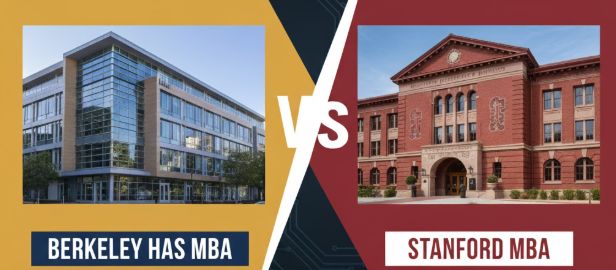
When comparing the Berkeley Haas MBA vs Stanford MBA, you’re essentially deciding between two of the world’s most prestigious business programs. Both are based in California and attract the brightest minds from across the globe yet each has a distinct personality and purpose.
The Stanford Graduate School of Business (GSB) emphasizes global leadership, entrepreneurship, and innovation. It’s perfect for students aiming to build startups or lead multinational firms. On the other hand, the UC Berkeley Haas School of Business is built around its “Defining Leadership Principles,” focusing on collaboration, inclusivity, and responsible innovation.
Whether you’re drawn to Stanford’s global network or Haas’s Silicon Valley connections, this in-depth comparison covers everything — from rankings and fees to class profiles, scholarships, and career outcomes, helping you make an informed choice.
Berkeley Haas MBA Overview
The Berkeley Haas MBA is a two-year, full-time program designed to challenge conventional thinking. With a mission to “develop leaders who redefine how we do business,” Haas focuses on leadership, strategy, and sustainability. Students benefit from hands-on learning, global immersion programs, and a collaborative environment that encourages questioning norms. The curriculum integrates technology and innovation with business strategy, preparing graduates for a changing global economy.
| Factor | Details |
| Program Duration | 2 years |
| Language of Instruction | English |
| Intake | August |
| FT Global MBA Ranking (2025) | #12 worldwide |
| Tuition Fees (per year) | $79,000 |
| Average Salary After Graduation | $160,000 |
| Employment Rate (3 months post-grad) | 93% |
| Top Recruiters | Deloitte, Apple, Meta, BCG, PwC |
| International Students | ~38% |
| Campus Location | Berkeley, California |
Academic Experience:
The Haas MBA includes three core terms covering finance, leadership, and analytics, followed by electives in fields like entrepreneurship, innovation, and global management. Students can also pursue dual degrees such as MBA/MPH and MBA/JD.
Key Strengths:
- Strong focus on sustainability and ethics
- Exceptional tech and consulting placements
Immersive experiential learning through the Applied Innovation program
Networking access to over 40,000 alumni worldwide
Stanford MBA Overview
The Stanford GSB MBA is synonymous with innovation and leadership excellence. The two-year, full-time program offers unmatched academic flexibility, allowing students to design their learning path through over 100 electives and interdisciplinary collaborations with Stanford’s other schools. Stanford encourages students to explore their leadership potential and build ventures that make a global impact. The curriculum integrates business foundations with personalized leadership development and practical exposure through the Global Experience Requirement.
| Factor | Details |
| Program Duration | 2 years |
| Language of Instruction | English |
| Intake | September |
| FT Global MBA Ranking (2025) | #4 worldwide |
| Tuition Fees (per year) | $82,455 |
| Average Salary After Graduation | $175,000 |
| Employment Rate (3 months post-grad) | 94% |
| Top Recruiters | McKinsey, BCG, Google, Amazon, Goldman Sachs |
| International Students | ~39% |
| Campus Location | Stanford, California |
Academic Experience:
Stanford’s MBA follows a flexible, student-centered structure with first-year core courses such as Leadership Labs, Data & Decisions, and Managerial Finance. The second year lets students specialize in areas like innovation, social impact, or finance.
Key Strengths:
- Direct access to Silicon Valley’s startup ecosystem
- Leadership-focused learning with mentorship programs
- Diverse electives and global study trips
- Exceptional post-MBA salaries and job offers from elite firms
Berkeley Haas MBA vs Stanford MBA: Quick Comparison
| Parameter | Stanford MBA | Berkeley Haas MBA |
| Ranking (FT 2025) | #4 | #12 |
| Program Duration | 2 years | 2 years |
| Average GMAT | 738 | 730 |
| Average Salary | $175,000 | $160,000 |
| Employment Rate | 94% | 93% |
| Tuition Fees (per year) | $82,455 | $79,000 |
| International Students | 39% | 38% |
| Key Strength | Innovation, Entrepreneurship, Leadership | Collaboration, Tech, Sustainability |
Analysis: Stanford’s prestige and global influence are unmatched, attracting top-tier recruiters from consulting, venture capital, and finance. Haas, however, combines strong academics with an inclusive culture and deep ties to the technology sector — perfect for students seeking long-term careers in innovation.
Rankings and Reputation
Stanford GSB consistently ranks among the Top 5 business schools globally. It’s widely regarded for its entrepreneurship track record and leadership development programs. In the Financial Times 2025 Global MBA Rankings, it placed #4, and in QS 2025, #2 worldwide.
Berkeley Haas, meanwhile, ranks #12 in FT 2025 and #10 in QS 2025, maintaining its position as one of the most respected business schools globally. Haas’s defining leadership principles Question the Status Quo, Confidence Without Attitude, Students Always, and Beyond Yourself — form the foundation of its reputation for ethical leadership.
While Stanford’s global name often gives it a higher brand value, Haas is exceptionally strong in technology management, sustainability, and innovation, making it a top choice for those wanting to merge business with impact.
Fees and Scholarships
Both the Stanford MBA and Berkeley Haas MBA come with a significant financial commitment, though the overall costs differ slightly. The annual tuition for Stanford stands at $82,455, compared to $79,000 at Berkeley Haas. When living expenses are included—approximately $35,000 at Stanford and $33,000 at Haas—the total cost for the two-year program amounts to around $234,000 and $220,000 respectively. Despite the small gap in tuition, both schools offer a range of need-based and merit-based scholarships that help ease the financial burden for deserving students.
Stanford offers prestigious awards such as the Knight-Hennessy Scholars, Reliance Dhirubhai Fellowship, and Siebel Scholars Program, with average grants ranging from $35,000–$40,000. Similarly, Berkeley Haas provides the Haas Fellowships, Dean’s Fellowship, and Diversity Scholarships, typically worth between $30,000–$35,000. Post-graduation returns are impressive for both MBAs — Stanford graduates earn an average salary of $175,000 plus a $30,000 signing bonus, while Haas graduates report about $160,000 in salary and a $25,000 bonus. While Stanford offers a slightly faster ROI due to its higher compensation levels, Haas delivers exceptional value for money, particularly for candidates pursuing careers in consulting, technology, or sustainable business leadership.
Which Program Should You Choose?
Both the Stanford MBA and Berkeley Haas MBA offer exceptional academic experiences, but the right choice ultimately depends on your career goals, leadership style, and personal priorities.
The Stanford MBA is ideal for students who aspire to launch startups, enter venture capital, or lead major global organizations. It’s built for those who want to connect with top CEOs and influential business leaders, and who value a high-impact, leadership-driven curriculum that encourages innovation and bold decision-making. Stanford’s network and resources make it especially appealing for professionals targeting consulting, finance, or entrepreneurial ventures with international opportunities.
In contrast, the Berkeley Haas MBA suits individuals who prefer a smaller, more collaborative cohort and thrive in an environment rooted in teamwork and community. It’s perfect for students passionate about sustainability, technology, and social impact, or those who want to build careers in consulting, product management, or innovation strategy. Haas emphasizes values such as curiosity, inclusion, and balance, helping students grow as grounded yet forward-thinking leaders.
Both programs guarantee strong ROI, exceptional brand recognition, and global career success. If your focus is on prestige, global reach, and entrepreneurial leadership, Stanford GSB is the stronger choice. However, if you value culture, collaboration, and innovation with purpose, Berkeley Haas is the ideal fit.
Conclusion
Choosing between the Berkeley Haas MBA vs Stanford MBA depends on your career goals and values. The Stanford MBA is ideal for aspiring entrepreneurs and leaders seeking innovation, global exposure, and a strong network. In contrast, the Berkeley Haas MBA suits those who value collaboration, sustainability, and technology-driven growth. Both programs offer excellent ROI, global recognition, and strong post-MBA opportunities. Stanford provides unmatched prestige and access to venture capital, while Haas offers a close-knit, values-driven community with deep ties to Silicon Valley. In short, Stanford builds bold global leaders, and Haas shapes innovative, purpose-driven changemakers.

 Abhyank Srinet