


 Abhyank Srinet
Table of Contents
- Introduction
- What Are the Latest Rankings of MFin Schools in France?
- Which Are the Top MFin Colleges in France for 2027?
- 1. HEC Paris – Master in International Finance
- 2. ESCP Business School – MSc Finance
- 3. ESSEC Business School – Master in Finance
- 4. SKEMA Business School – MSc Financial Markets & Investments
- 5. EDHEC Business School – MSc Finance Programmes
- 6. emlyon business school – Finance Master's Programmes
- 7. IÉSEG School of Management – Master in Finance
- 8. Grenoble Ecole de Management – Finance Specialisations
- 9. NEOMA Business School – Finance Specialisations
- How Much Do the Best MFin Schools in France Cost in 2027?
- What Are the Living Expenses for MFin Students in France?
- What Are the Admission Requirements for Masters in Finance in France?
- Can You Study MFin in France Without GMAT?
- What Scholarships Are Available for MFin Students in France?
- What Jobs Can You Get After an MFin in France?
- What Is the Average Salary After an MFin in France?
- Can Indian Students Work in France During and After an MFin?
The best MFin schools in France to consider for 2027 include HEC Paris, ESCP Business School, ESSEC Business School, SKEMA Business School, EDHEC Business School, emlyon business school, IÉSEG School of Management, Grenoble Ecole de Management and NEOMA Business School. These institutions offer master's degrees in finance or closely related specialisations.According to the Financial Times Masters in Finance 2026 ranking, ESCP ranks first worldwide, followed by SKEMA in second, ESSEC in fourth, EDHEC in fifth and HEC Paris in seventh.
Introduction
France is one of the leading destinations for students planning a Masters in Finance abroad. Business schools such as HEC Paris, ESCP, ESSEC and EDHEC offer specialised programmes in investment banking, corporate finance, financial markets and asset management. Many students choose France because of its established business schools and access to European financial markets.
For Indian students targeting the 2027 intake, choosing the right programme involves comparing tuition, eligibility, course duration, scholarships and employment opportunities. This guide covers the best MFin schools in France with current ranking information, verified programme details and practical advice to help you build a suitable university shortlist.
What Are the Latest Rankings of MFin Schools in France?
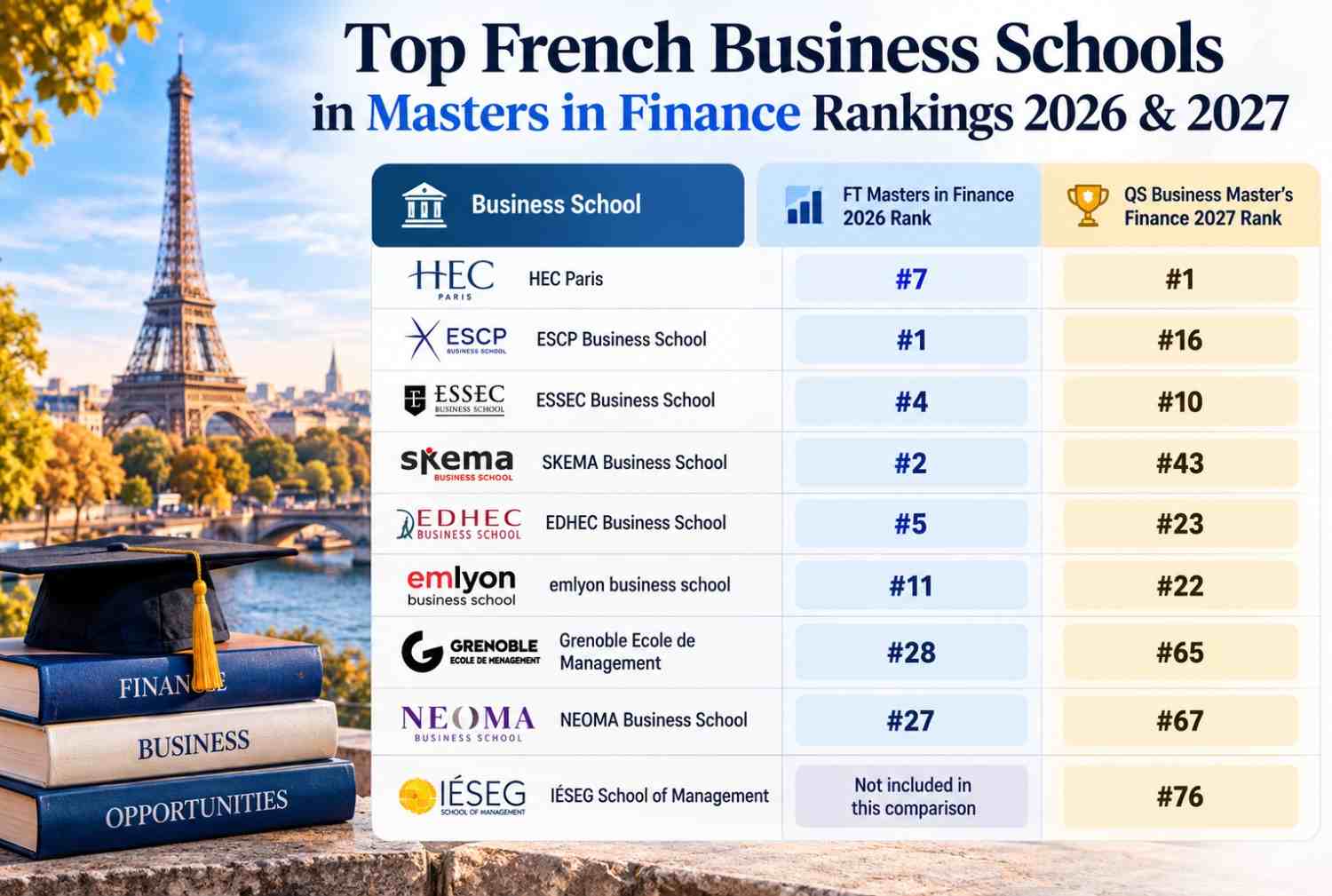
France has several highly ranked pre-experience Masters in Finance programmes. However, the Financial Times and QS use different ranking methods, so their results should be considered separately.
The following table compares the latest published results rather than mixing rankings from different years.
| Business School | FT Masters in Finance 2026 | QS Business Master's Finance 2027 |
|---|---|---|
| HEC Paris | #7 | #1 |
| ESCP Business School | #1 | #16 |
| ESSEC Business School | #4 | #10 |
| SKEMA Business School | #2 | #43 |
| EDHEC Business School | #5 | #23 |
| emlyon business school | #11 | #22 |
| Grenoble Ecole de Management | #28 | #65 |
| NEOMA Business School | #27 | #67 |
| IÉSEG School of Management | Not included in this comparison | #76 |
Which Are the Top MFin Colleges in France for 2027?
The following shortlist includes established French business schools offering pre-experience finance master's programmes or related finance specialisations.
It is an editorial comparison, not a separate independent ranking. The order should not be interpreted as a universal measure of programme quality.
| Business School | Finance Programme | Location | Useful For |
|---|---|---|---|
| HEC Paris | Master in International Finance | Jouy-en-Josas, near Paris | Capital markets and corporate finance |
| ESCP Business School | MSc Finance | Paris and London | Investment banking and financial markets |
| ESSEC Business School | Master in Finance | France, with programme-specific international options | Corporate finance, financial markets and fintech |
| SKEMA Business School | MSc Financial Markets & Investments | Programme-dependent campus | Financial markets and investment analysis |
| EDHEC Business School | MSc Finance specialisations | Nice and other programme-specific locations | Corporate finance, financial engineering and markets |
| emlyon business school | MSc Finance-related specialisations | France, depending on programme | Finance and investment careers |
| IÉSEG School of Management | Master in Finance | Paris | Financial analysis, banking and fintech |
| Grenoble Ecole de Management | Finance-related MSc programmes | Grenoble and programme-dependent campuses | Financial analysis and specialist finance study |
| NEOMA Business School | Finance-related MSc programmes | Programme-dependent campus | Finance, analysis and business applications |
1. HEC Paris – Master in International Finance
HEC Paris offers a Master in International Finance designed for students interested in capital markets, corporate finance and related financial careers. The programme combines advanced finance education with professional development and access to the school's wider employer network.
HEC ranks first worldwide in the QS Business Master's Rankings 2027 for Finance and seventh in the Financial Times Masters in Finance 2026 ranking. These positions come from different methodologies and should not be treated as interchangeable.
For 2027–28, HEC publishes tuition and fees of approximately ₹52.75 lakh (€47,950). Most Indian students should also account for an additional international student charge of ₹2.20 lakh (€2,000), bringing the tuition-related total to approximately ₹54.95 lakh (€49,950).
HEC also publishes a living-cost estimate of approximately ₹1.65 lakh (€1,500) per month. The programme can suit applicants who have strong academic preparation and a clear interest in specialised finance roles.
Read our HEC Paris MFin Fees and Scholarships Guide for a detailed cost breakdown.
2. ESCP Business School – MSc Finance
ESCP Business School offers an MSc Finance programme with a Paris and London study experience. It is especially relevant to students interested in investment banking, financial markets and international finance careers.
ESCP ranks first worldwide in the Financial Times Masters in Finance 2026 ranking. It has held the top position for four consecutive years, according to the latest published results.
For September 2027 entry, ESCP publishes a standard programme cost of approximately ₹36.08 lakh (€32,800). However, students with fewer than 240 ECTS-equivalent credits may need an additional online semester costing approximately ₹5.17 lakh (€4,700).
This pathway difference matters for Indian applicants whose previous degree may be assessed against European credit requirements. ESCP's programme also includes a compulsory professional internship and a master's thesis.
For eligibility, campuses and career outcomes, see our ESCP Europe MFin Review.
3. ESSEC Business School – Master in Finance
ESSEC Business School offers a Master in Finance with specialisations related to corporate finance, financial markets and fintech. The programme can be completed in different durations depending on an applicant's prior academic qualification.
ESSEC ranks fourth in the Financial Times Masters in Finance 2026 ranking and tenth in the QS Business Master's Rankings 2027 for Finance.
According to ESSEC's published admission guidance, applicants with a three-year bachelor's degree normally follow the two-year M1+M2 route. Applicants with a four-year bachelor's degree or a master's degree may apply directly to the one-year M2 route.
ESSEC has published its 2027 admissions calendar but currently marks the relevant 2027 tuition amounts as to be announced. Indian students should therefore avoid treating 2026 tuition as confirmed 2027 pricing.
4. SKEMA Business School – MSc Financial Markets & Investments
SKEMA Business School offers an MSc Financial Markets & Investments focused on investment analysis and financial market activities. It is relevant to students considering careers in banking, trading, asset management and financial research.
SKEMA ranks second worldwide in the Financial Times Masters in Finance 2026 ranking. The programme is also included in the QS Business Master's Rankings 2027, where SKEMA ranks forty-third in Finance.
Students should evaluate the specific programme campus, duration and curriculum rather than assuming all SKEMA finance degrees follow the same structure.
Fees can vary by intake and programme pathway. Applicants should consult SKEMA's current admissions and tuition information before planning their total budget.
5. EDHEC Business School – MSc Finance Programmes
EDHEC Business School offers several specialist MSc programmes within finance, including options related to financial engineering, corporate finance and sustainable finance. These courses provide different academic pathways depending on the student's interests.
EDHEC ranks fifth worldwide in the Financial Times Masters in Finance 2026 ranking and twenty-third in the QS Business Master's Rankings 2027 for Finance.
EDHEC's official finance programme guidance indicates tuition around €28,950–€30,000 for certain MSc Finance programmes, but these are indicative figures and not a confirmed single 2027 tuition amount for every specialisation.
Indian students should choose the exact MSc programme first, then check its current tuition, duration and admission requirements. Comparing different EDHEC degrees as though they were one identical MFin can lead to incorrect cost estimates.
6. emlyon business school – Finance Master's Programmes
emlyon business school offers postgraduate education relevant to finance and investment careers. Students interested in specialised finance study should review the school's current MSc offerings and identify the degree that matches their professional goals.
emlyon ranks eleventh in the Financial Times Masters in Finance 2026 ranking and twenty-second in the QS Business Master's Rankings 2027 for Finance.
The curriculum and employment opportunities depend on the exact programme selected. Applicants should therefore avoid relying on one generic emlyon tuition or salary figure for all finance-related degrees.
The school can be worth researching for students comparing French finance education across different price points and specialisations. Verify current entry requirements and official fees for the intended 2027 programme.
7. IÉSEG School of Management – Master in Finance
IÉSEG School of Management offers an English-taught Master in Finance in Paris. The programme focuses on financial analysis, banking, capital markets and financial technology.
For the published 2027 intake information, IÉSEG lists total tuition of approximately ₹33.88 lakh (€30,800) for the Fast Track and ₹37.18 lakh (€33,800) for the Regular Track.
The programme also offers financial assistance through tuition waivers for eligible applicants. Its current admissions guidance states that GMAT and GRE scores are optional rather than mandatory.
IÉSEG can be a relevant choice for applicants seeking a finance programme with multiple study pathways. Indian students should check whether their undergraduate qualification fits the Fast Track or Regular Track.
8. Grenoble Ecole de Management – Finance Specialisations
Grenoble Ecole de Management offers finance-related postgraduate study with analytical and professional applications. Students should select the exact MSc programme based on the courses and specialisation available for their intended intake.
The school appears in recognised business master's rankings, including the Financial Times Masters in Finance 2026 ranking.
For Indian applicants, important factors include the quantitative requirements, internship opportunities, campus and full programme duration.
The school's current programme-specific tuition should be checked directly. Older figures from previous admission cycles should not be presented as 2027 fees.
9. NEOMA Business School – Finance Specialisations
NEOMA Business School offers postgraduate finance-related education for students interested in financial analysis and business applications. The suitable programme depends on the applicant's academic preparation and preferred finance career.
NEOMA ranks twenty-seventh in the Financial Times Masters in Finance 2026 ranking and sixty-seventh in the QS Business Master's Rankings 2027 for Finance.
Students should examine the available finance specialisations, admissions requirements and study format before applying.
As with other French business schools, tuition and career outcomes must be checked for the exact degree and reporting year. A general university ranking does not replace programme-specific research.
How Much Do the Best MFin Schools in France Cost in 2027?
The cost of studying a Masters in Finance in France varies by university, degree structure and applicant category. Some programmes publish one total fee, while others have separate academic years or pathway-related charges.
The following table uses official university fee information where a comparable figure has been confirmed.
| Business School | Approximate Tuition in INR | Original Amount | Fee Status |
|---|---|---|---|
| HEC Paris | ₹54.95 lakh | €49,950 | Published 2027–28 total including international charge for most Indian applicants |
| ESCP Business School | ₹36.08 lakh | €32,800 | September 2027 standard programme fee; extra semester may apply |
| IÉSEG Fast Track | ₹33.88 lakh | €30,800 | Published intake fee, excluding separately listed mandatory extras |
| IÉSEG Regular Track | ₹37.18 lakh | €33,800 | Published intake fee, excluding separately listed mandatory extras |
| ESSEC Business School | To be announced | 2027 tuition TBA | Depends on one-year or two-year route |
| EDHEC Business School | Approximately ₹31.85–₹33.00 lakh | €28,950–€30,000 | Indicative range cited by school, not a confirmed uniform 2027 fee |
| SKEMA Business School | Verify selected programme | See school fee schedule | Programme-specific |
| emlyon business school | Verify selected programme | See school fee schedule | Programme-specific |
| Grenoble Ecole de Management | Verify selected programme | See school fee schedule | Programme-specific |
| NEOMA Business School | Verify selected programme | See school fee schedule | Programme-specific |
Currency note: INR amounts are illustrative and use €1 = ₹110. The figures exclude living expenses, insurance, visas and other personal costs unless specifically stated.
Comparison note: Published fees from different programmes are not always directly comparable. Confirm whether your chosen route includes additional semesters, administrative charges or international student fees.
For a detailed breakdown of tuition and other expenses, read our HEC Paris MFin Fees Guide.
What Are the Living Expenses for MFin Students in France?
Living expenses depend on the city, accommodation and programme duration. Students in Paris may have a different financial commitment from those studying in Nice, Grenoble or other French locations.
Accommodation
Accommodation is one of the main living expenses for international students. University residences, shared apartments and private rentals have different pricing and availability.
Students should also consider housing deposits, utilities and travel to campus. Accommodation near a school may save commuting time but is not necessarily the lowest-cost option.
HEC Paris publishes a monthly planning estimate of approximately ₹1.65 lakh (€1,500) for living costs overall, while ESSEC identifies a broader monthly range of approximately ₹1.43–₹2.20 lakh (€1,300–€2,000).
These are university-specific estimates, not official averages for every student in France.
Food and Transport
Monthly spending depends on meal preferences, accommodation facilities and local transport needs. Students who prepare meals regularly may have a different food budget from those who eat out frequently.
Transport costs also depend on the location of the programme and housing. Students should check current local transport passes and commuting routes.
Use official university guidance for the relevant city wherever available. Avoid assuming that every French business school has the same cost of living.
Insurance and Personal Expenses
Students should include applicable insurance, academic materials, mobile services and other essential expenses in their financial plans.
International students may also need to account for visa-related costs, relocation and travel between India and France.
Some programmes include particular administrative or student services within tuition, while others list them separately.
Review the programme's official fee schedule before adding expenses to avoid double-counting university charges.
What Are the Admission Requirements for Masters in Finance in France?

Admission requirements vary between the best MFin schools in France. Most programmes consider undergraduate academic performance, quantitative preparation, admission tests, English proficiency and application materials.
Undergraduate Degree
Finance master's programmes often consider students with degrees in business, economics, finance, engineering, mathematics and related disciplines.
However, specific academic requirements vary by school and programme route. Applicants should not assume that every three-year Indian bachelor's degree qualifies for the same duration.
ESSEC, for example, distinguishes its one-year and two-year routes according to prior academic qualifications.
Students should verify degree equivalency and available entry routes before applying.
GMAT and GRE Requirements
There is no single GMAT or GRE policy across French MFin programmes. Some schools require an accepted management test, while others treat these scores as optional.
HEC Paris and ESSEC publish management-test requirements for their standard admissions routes. IÉSEG's current Master in Finance guidance describes GMAT and GRE as optional.
A strong test score may support an application where scores are considered, but it does not guarantee admission.
Applicants should verify the exact test rules for their chosen 2027 intake.
English-Language Proficiency
Many French business schools offer finance master's programmes taught in English. Applicants may therefore need IELTS, TOEFL or another accepted language qualification.
Exemptions may apply to students who completed eligible previous education in English. These conditions vary by institution.
For example, IÉSEG publishes programme-specific English test requirements, while ESSEC has its own exemption conditions.
Check the accepted tests and minimum scores rather than relying on a general France-wide IELTS requirement.
Work Experience and Internships
Several pre-experience finance master's programmes welcome recent graduates. Full-time professional experience is not a universal admission requirement.
Relevant internships can still strengthen an application by demonstrating finance knowledge, professional skills and career motivation.
Students interested in investment banking or financial markets can benefit from academic projects in valuation, modelling or investment analysis.
Applicants should also distinguish pre-experience degrees from programmes designed for experienced finance professionals.
Can You Study MFin in France Without GMAT?
Yes, some French finance master's programmes allow applications without mandatory GMAT or GRE scores. However, this depends on the school's current policy.
IÉSEG's published Master in Finance admissions information, for example, states that GMAT and GRE scores are optional.
Applicants should not assume that HEC Paris, ESSEC or every other business school follows the same test policy.
Universities may still evaluate academic performance, quantitative ability, English proficiency and application motivation carefully.
What Scholarships Are Available for MFin Students in France?

Financial assistance is available at some French business schools through merit-based scholarships, need-based support and external funding programmes.
University Merit Scholarships
Some institutions offer scholarships based on academic achievement and the quality of an applicant's profile.
HEC Paris offers merit-based scholarship opportunities for eligible master's students, while IÉSEG publishes tuition waivers under several funding categories.
Scholarship amounts depend on the specific award and selection outcome.
Applicants should not assume that receiving admission automatically guarantees financial support.
Need-Based Funding
Need-based scholarships may consider household finances and other eligibility factors.
HEC Paris offers an Equal Opportunity Scholarship under its published rules, while ESCP provides certain forms of tuition assistance for eligible candidates.
Some French schemes are limited to specific applicant categories or previous educational circumstances.
Indian students should verify eligibility before including an award in their financial plan.
External Scholarships
Indian students can also investigate external funding programmes, including applicable Campus France and government-supported opportunities.
The Charpak Scholarship may be relevant where the particular award's academic and nationality requirements are met.
HEC Paris also identifies the Eiffel Excellence Scholarship among its external funding opportunities.
Funding rules and deadlines change, so applicants should consult the official scholarship provider and university guidance.
What Jobs Can You Get After an MFin in France?
Graduates of finance master's programmes may pursue careers in investment banking, corporate finance, financial markets, asset management and risk management.
The available roles depend on technical skills, previous experience, language ability and the employment market.
| Career Area | Potential Job Roles | Useful Skills |
|---|---|---|
| Investment Banking | Investment Banking Analyst, M&A Analyst | Valuation, financial modelling, transactions |
| Corporate Finance | Corporate Finance Analyst, Treasury Analyst | Accounting, budgeting, financial analysis |
| Asset Management | Investment Analyst, Portfolio Analyst | Portfolio theory, investment research |
| Financial Markets | Markets Analyst, Trading Analyst | Derivatives, market analysis, quantitative skills |
| Risk Management | Credit Risk Analyst, Market Risk Analyst | Statistics, risk modelling |
| Financial Consulting | Financial Advisory Analyst, Finance Consultant | Modelling, research, communication |
Investment Banking
Investment banking is a popular career interest among students applying to leading finance programmes.
Typical responsibilities include financial analysis, company valuation, transactions and capital-raising support.
Relevant skills include accounting, financial modelling and professional communication.
Recruitment is competitive, and studying at a well-known school does not guarantee an offer.
Asset Management and Financial Markets
Asset management careers involve investment research, portfolio analysis and financial decision-making.
Financial markets roles can require strong knowledge of derivatives, securities and risk.
Some positions also demand quantitative skills, programming or specialised mathematical preparation.
Applicants should compare the curriculum with the technical requirements of their preferred jobs.
Corporate Finance and Consulting
Corporate finance professionals work on budgeting, valuation, investments and financial strategy.
Consulting and advisory roles may involve financial analysis, transactions or corporate restructuring.
These fields can provide different career paths from investment banking and trading.
Students should evaluate employer demand and their personal skill profile rather than assuming every finance role offers similar compensation.
What Is the Average Salary After an MFin in France?
There is no single verified average starting salary covering all MFin graduates in France. Schools publish different measures, including starting compensation, employment-survey averages and alumni earnings several years after graduation.
For example, HEC Paris reports an average starting salary of approximately ₹1.13 crore (€103,000) in its 2025 graduation survey.
ESCP publishes an average salary of approximately ₹1.18 crore (€107,200) in its recent graduate outcomes, but the methodology must be considered before comparing it directly with another school's starting salary.
The Financial Times also publishes purchasing-power-adjusted alumni salary measures approximately three years after graduation. Those figures should not be converted into guaranteed entry-level salaries.
For a wider programme comparison, see our Masters in Finance Salary Guide.
Can Indian Students Work in France During and After an MFin?
Eligible non-European students holding an appropriate French student residence permit may generally work up to 964 hours annually under current French regulations.
This is a legal work limit, not a guarantee that students will find part-time employment.
Working During Your Studies
Part-time employment may help with some personal expenses, depending on job availability and individual circumstances.
Students must comply with their residence-permit conditions and applicable employment rules.
Some employers may require French-language skills, particularly for customer-facing work.
Part-time income should not be treated as guaranteed funding for tuition.
Working After Graduation
Graduates may be eligible for French post-study residence arrangements, depending on their qualification, nationality and immigration status.
The available permit, duration and conditions should be checked through current official French-government information.
Work authorisation can also depend on salary, the employment contract and the relationship between the job and the qualification.
Students should not assume that every finance master's automatically provides unrestricted employment rights across Europe.
Official government reference: French Government Guidance on Foreign Student Employment.