
 Abhyank Srinet


Table of Contents
- Introduction
- What Does Algebra Test on the Current GMAT?
- Which GMAT Algebra Topics Should You Practise?
- Which GMAT Algebra Formulas Should You Know?
- How Should You Use These GMAT Algebra Practice Questions?
- What Are the Easy GMAT Algebra Practice Questions?
- What Are the Medium-Difficulty GMAT Algebra Questions?
- What Are the Advanced GMAT Algebra Practice Questions?
- What Is the GMAT Algebra Practice Answer Key?
- How Can You Solve GMAT Algebra Questions Faster?
- Where Can You Find Official GMAT Quantitative Practice?
- What Should Indian Applicants Know About GMAT Algebra Practice?
- Related Blogs
GMAT algebra practice questions should cover algebraic manipulation, linear equations, systems of equations, inequalities, quadratic relationships, functions, exponents and algebra-based word problems. The current GMAT Quantitative Reasoning section contains 21 Problem Solving questions in 45 minutes, so effective practice must build accuracy, reasoning and pacing rather than formula recall alone.
Introduction
These GMAT algebra practice questions are designed for applicants who want realistic multiple-choice practice instead of a long theory-only lesson. The set moves from basic equations to multi-step problems and gives a clear explanation after every answer. All questions on this page are original GMAT-style exercises created for practice; they are not official GMAC questions.
The current GMAT tests algebra and arithmetic through Quantitative Reasoning, while Data Sufficiency is placed in Data Insights. Quantitative Reasoning has 21 questions in 45 minutes and does not permit a calculator. In this blog, we cover the tested algebra skills, formulas, 15 worked questions, common mistakes and official practice resources.
What Does Algebra Test on the Current GMAT?
Algebra on the current GMAT tests whether you can translate information, manipulate expressions and use relationships between variables to solve a problem. GMAC states that Quantitative Reasoning measures foundational arithmetic and algebra knowledge through 21 Problem Solving questions. It tests application and logic rather than advanced mathematics.
The official GMAT quantitative skill groups identify the following relevant areas. These categories should guide your preparation instead of unsupported claims about a fixed number or percentage of algebra questions.
| Algebra skill | What you may need to do | Practice focus |
|---|---|---|
| Algebraic manipulation | Expand, factor or simplify expressions | Signs, fractions and like terms |
| Linear equations | Solve for one or more variables | Isolation, substitution and elimination |
| Linear inequalities | Find the permitted range of a variable | Reversing the sign after multiplying or dividing by a negative number |
| Quadratic and other relationships | Factor expressions or use relationships between roots | Factoring, discriminants and root properties |
| Systems of equations | Use two or more relationships together | Eliminating unnecessary variables |
| Functions and formulas | Substitute values or interpret a newly defined rule | Reading notation before calculating |
| Translation into algebra | Convert a verbal condition into an equation | Rates, ratios, percentages and totals |
For the official description of the section, see GMAC's current GMAT exam content.
Which GMAT Algebra Topics Should You Practise?
.jpg)
Prioritise linear equations, algebraic expressions, inequalities, systems of equations, quadratics, exponents, roots, functions and algebra-based word problems. These skills overlap, so a question that appears to test rates or percentages may still require you to create and solve an equation.
Core Algebra Topics for GMAT Quant
Focus on linear equations, systems of equations, inequalities, quadratic equations, algebraic expressions, exponents, roots, functions and word problems. Practising these topics helps you recognise variable relationships, select the correct method and solve GMAT algebra practice questions more accurately under time pressure.
Linear Equations and Algebraic Expressions
Start by combining like terms and isolating the required variable. Then practise expressions in which you do not need to find every variable. If the question gives 3a − 2b, for example, look for a direct way to obtain the requested multiple of that expression.
Systems of Equations
Use substitution when one variable is already isolated. Use elimination when adding or subtracting equations can remove a variable quickly. Before solving both variables, check whether the question asks only for a combined expression.
Inequalities and Absolute Values
Treat inequalities like equations except when multiplying or dividing by a negative number; that operation reverses the inequality sign. For absolute-value equations, consider both the positive and negative cases.
Quadratic Equations
Try factoring before using the quadratic formula. Also learn the sum and product of roots because many GMAT algebra questions with answers can be solved without calculating each root separately.
Exponents, Roots and Functions
Rewrite exponential terms using the same base whenever possible. For functions, substitute carefully and follow the defined operation exactly, especially when the notation is unfamiliar.
Algebra-Based Word Problems
Define the variable before writing an equation. Translate one sentence at a time, maintain consistent units and answer the quantity actually requested. This process reduces avoidable errors in rates, ratios, percentages and work problems.
Which GMAT Algebra Formulas Should You Know?

You should know the core algebraic identities and relationships well enough to recognise when they shorten a solution. The GMAT rewards efficient reasoning, so understanding a formula is more useful than memorising it without context.
| Concept | Formula or rule | Use |
|---|---|---|
| Difference of squares | a2 − b2 = (a − b)(a + b) | Factor an expression quickly |
| Square of a sum | (a + b)2 = a2 + 2ab + b2 | Expand or connect a sum with squares |
| Square of a difference | (a − b)2 = a2 − 2ab + b2 | Expand or simplify a squared difference |
| Quadratic formula | x = (−b ± √(b2 − 4ac)) ÷ 2a | Solve ax2 + bx + c = 0 when factoring is difficult |
| Sum and product of roots | Sum = −b/a; product = c/a | Answer root questions without solving the full equation |
| Exponent multiplication | am × an = am+n | Combine powers with the same base |
| Exponent division | am ÷ an = am−n | Simplify quotients with the same non-zero base |
| Absolute value | |u| = c means u = c or u = −c, where c ≥ 0 | Find both possible cases |
How Should You Use These GMAT Algebra Practice Questions?
Complete the questions without a calculator, record your answer and reasoning, and open the explanation only after committing to an option. The official Quantitative Reasoning section does not allow a calculator, so calculator-free practice is essential.
- Complete Questions 1–5 without timing yourself.
- Attempt Questions 6–10 while tracking time and accuracy.
- Complete Questions 11–15 as one uninterrupted set.
- Record whether each error came from a concept gap, translation error, sign mistake or slow method.
- Retry missed questions after two or three days without reading the earlier solution.
What Are the Easy GMAT Algebra Practice Questions?
These five questions test equation solving, expression matching, simultaneous equations, percentages and exponents. Focus on clean setup and accurate calculation before trying to increase speed.
Question 1: Single-Variable Linear Equation
If 5x − 7 = 3x + 9, what is the value of x?
- 5
- 6
- 7
- 8
- 9
Answer and explanation
Answer: D (8). Subtract 3x from both sides: 2x − 7 = 9. Add 7: 2x = 16. Divide by 2: x = 8.
Question 2: Matching an Algebraic Expression
If 3a − 2b = 11, what is the value of 6a − 4b?
- 11
- 18
- 22
- 33
- 44
Answer and explanation
Answer: C (22). The requested expression is twice the given expression: 6a − 4b = 2(3a − 2b) = 2(11) = 22. You do not need the individual values of a and b.
Question 3: System of Linear Equations
If x + y = 13 and x − y = 5, what is the value of x?
- 4
- 8
- 9
- 13
- 18
Answer and explanation
Answer: C (9). Add the equations to eliminate y: 2x = 18. Therefore, x = 9.
Question 4: Percentage Equation
After a 20% discount, a course costs ₹1,200. What was its original price?
- ₹1,350
- ₹1,440
- ₹1,500
- ₹1,600
- ₹1,800
Answer and explanation
Answer: C (₹1,500). Let the original price be p. After a 20% discount, 80% remains, so 0.80p = 1,200. Therefore, p = 1,200 ÷ 0.80 = 1,500.
Question 5: Exponential Equation
If 2x+1 = 16, what is the value of x?
- 2
- 3
- 4
- 5
- 8
Answer and explanation
Answer: B (3). Rewrite 16 as 24. The bases are equal, so x + 1 = 4 and x = 3.
What Are the Medium-Difficulty GMAT Algebra Questions?
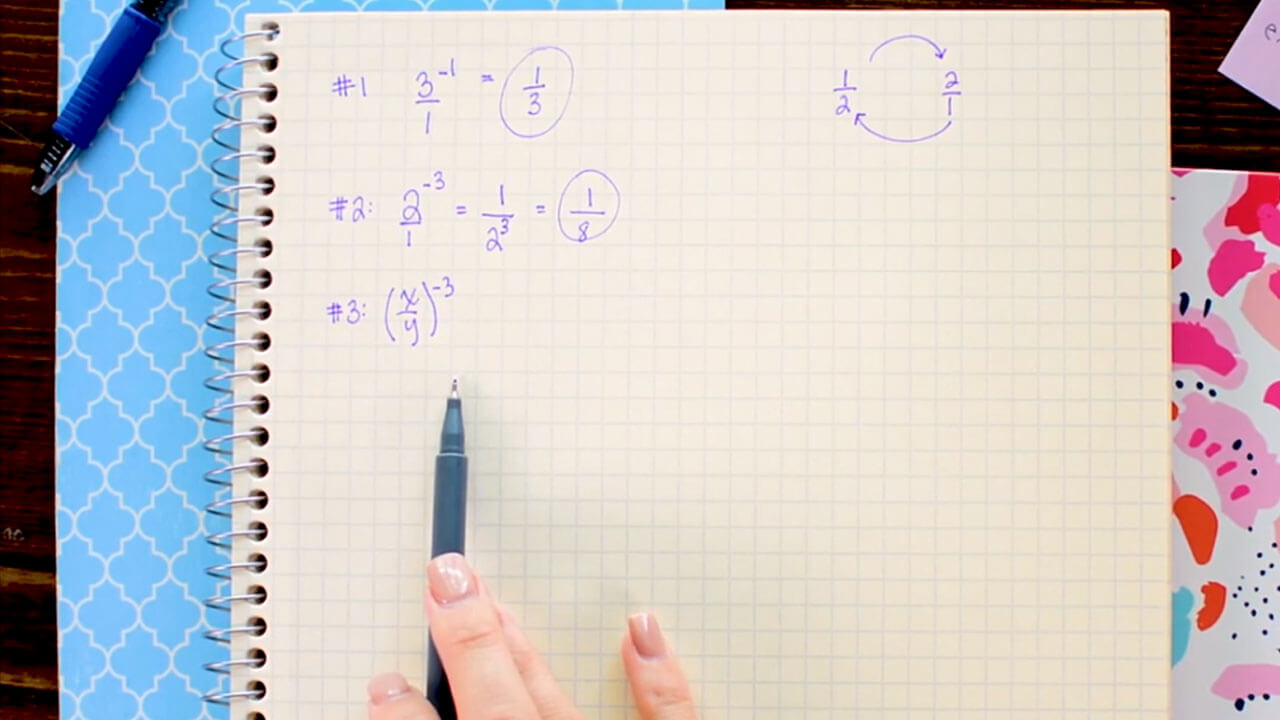
These GMAT algebra practice questions combine familiar concepts with a condition, sign rule or simplification step. Work through them before checking the GMAT algebra questions with answers.
Question 6: Quadratic Roots
What is the larger solution of x2 − 9x + 20 = 0?
- 2
- 4
- 5
- 9
- 20
Answer and explanation
Answer: C (5). Factor the expression: (x − 4)(x − 5) = 0. The solutions are 4 and 5, so the larger solution is 5.
Question 7: Linear Inequality
Which option describes all values of x that satisfy −3x + 7 > 19?
- x > −4
- x < −4
- x > 4
- x < 4
- x = −4
Answer and explanation
Answer: B (x < −4). Subtract 7: −3x > 12. Divide by −3 and reverse the inequality sign: x < −4.
Question 8: Absolute-Value Equation
If |2x − 5| = 7, what is the sum of all possible values of x?
- −7
- −1
- 5
- 6
- 7
Answer and explanation
Answer: C (5). Solve both cases. If 2x − 5 = 7, then x = 6. If 2x − 5 = −7, then x = −1. Their sum is 6 + (−1) = 5.
Question 9: Function and Root Relationship
For f(t) = t2 − 5t + 6, f(k) = 0. What is the product of all possible values of k?
- 2
- 3
- 5
- 6
- 8
Answer and explanation
Answer: D (6). Set k2 − 5k + 6 = 0 and factor: (k − 2)(k − 3) = 0. The possible values are 2 and 3, and their product is 6.
Question 10: Simplifying an Algebraic Fraction
If x ≠ 2 and (x2 − 4) ÷ (x − 2) = 7, what is the value of x?
- 2
- 3
- 4
- 5
- 7
Answer and explanation
Answer: D (5). Factor the numerator: x2 − 4 = (x − 2)(x + 2). Because x ≠ 2, cancel x − 2. Then x + 2 = 7, so x = 5.
What Are the Advanced GMAT Algebra Practice Questions?

These GMAT algebra practice questions reward pattern recognition and equation setup. Look for identities, root relationships and common bases before starting a longer calculation.
Question 11: Sum and Product Identity
If x + y = 10 and xy = 21, what is the value of x2 + y2?
- 42
- 52
- 58
- 79
- 100
Answer and explanation
Answer: C (58). Use (x + y)2 = x2 + 2xy + y2. Therefore, x2 + y2 = 102 − 2(21) = 100 − 42 = 58.
Question 12: Quadratic Coefficient
The two positive roots of t2 − kt + 18 = 0 differ by 3. What is the value of k?
- 3
- 6
- 9
- 12
- 18
Answer and explanation
Answer: C (9). Let the smaller root be u and the larger root be u + 3. Their product is 18, so u(u + 3) = 18. Thus, u2 + 3u − 18 = 0, or (u + 6)(u − 3) = 0. The positive roots are 3 and 6. Their sum equals k, so k = 9.
Question 13: Combined Exponents
If 4x × 2x+1 = 128, what is the value of x?
- 1
- 2
- 3
- 4
- 6
Answer and explanation
Answer: B (2). Rewrite 4x as 22x and 128 as 27. Then 22x × 2x+1 = 23x+1 = 27. Thus, 3x + 1 = 7 and x = 2.
Question 14: Production-Rate Equation
Machine A produces x units per hour, while Machine B produces x + 4 units per hour. Together they produce 64 units in 4 hours. How many units does Machine B produce per hour?
- 6
- 8
- 10
- 12
- 16
Answer and explanation
Answer: C (10). Their combined hourly rate is 64 ÷ 4 = 16. Therefore, x + (x + 4) = 16, so 2x = 12 and x = 6. Machine B produces x + 4 = 10 units per hour.
Question 15: Reciprocal Identity
If x + 1/x = 3 and x ≠ 0, what is the value of x2 + 1/x2?
- 3
- 5
- 7
- 9
- 11
Answer and explanation
Answer: C (7). Square the given expression: (x + 1/x)2 = x2 + 2 + 1/x2 = 9. Subtract 2 to get x2 + 1/x2 = 7.
What Is the GMAT Algebra Practice Answer Key?
The correct options are 1-D, 2-C, 3-C, 4-C, 5-B, 6-C, 7-B, 8-C, 9-D, 10-D, 11-C, 12-C, 13-B, 14-C and 15-C. Use the table to review performance by concept rather than looking only at the total score.
| Question | Correct answer | Concept |
|---|---|---|
| 1 | D (8) | Linear equation |
| 2 | C (22) | Expression matching |
| 3 | C (9) | System of equations |
| 4 | C (₹1,500) | Percentage equation |
| 5 | B (3) | Exponents |
| 6 | C (5) | Quadratic roots |
| 7 | B (x < −4) | Inequality |
| 8 | C (5) | Absolute value |
| 9 | D (6) | Function and roots |
| 10 | D (5) | Algebraic fraction |
| 11 | C (58) | Algebraic identity |
| 12 | C (9) | Root relationship |
| 13 | B (2) | Combined exponents |
| 14 | C (10) | Rate equation |
| 15 | C (7) | Reciprocal identity |
How Can You Solve GMAT Algebra Questions Faster?
Use the simplest valid path: simplify first, identify the requested expression, and avoid solving variables the question does not ask for. Speed should come from choosing a shorter method, not skipping logical steps.
- Read the final question first: Know whether you need one variable, a sum, a product or a range.
- Write constraints: Note whether values must be positive, non-zero, integers or distinct.
- Match expressions: Multiply or combine a given equation when it directly produces the requested expression.
- Factor before using a long formula: Many quadratic expressions split into simple binomials.
- Use common bases: Rewrite exponential terms using the same base before equating powers.
- Check the answer in the original condition: This catches sign errors and invalid roots.
What Mistakes Should You Avoid in GMAT Algebra?
The most common avoidable errors are losing a negative sign, ignoring a constraint, cancelling a zero factor and answering for the wrong quantity. An error log should record the cause of the mistake, not only the correct answer.
| Mistake | Why it causes errors | Correction |
|---|---|---|
| Not reversing an inequality | Division or multiplication by a negative number changes the order | Reverse < and > immediately |
| Using only one absolute-value case | A valid second solution may be missed | Solve the positive and negative cases |
| Cancelling without a restriction | The cancelled expression may equal zero | State excluded values before cancelling |
| Solving every variable | Unnecessary work increases time and error risk | Target only the requested value or expression |
| Ignoring units | Rates and totals may use different time periods | Convert all quantities to consistent units |
Where Can You Find Official GMAT Quantitative Practice?
Use GMAC's free sample questions and Official Starter Kit to compare third-party GMAT algebra practice questions with the real exam's wording and interface. GMAC's free Starter Kit includes Official Practice Exams 1 and 2 plus more than 70 real GMAT questions across the three sections.
Start with the official GMAT sample questions, then use the GMAT Official Starter Kit for full-format practice. Review every explanation and compare the official solution with your method.
What Should Indian Applicants Know About GMAT Algebra Practice?
Indian applicants take the same GMAT and follow the same algebra syllabus as candidates in every other country. There is no India-specific set of Quantitative Reasoning topics, so preparation should be based on the current official exam rather than local coaching labels or outdated question formats.
If you have not studied mathematics recently, begin with untimed concept drills and then move to mixed, timed sets. Because the official section allows about 2 minutes and 9 seconds per question on average, a 15-question set should eventually take about 32 minutes. This is a pacing benchmark derived from the official 45-minute, 21-question structure, not a rule for every individual question.
Related Blogs
Use these MiM-Essay guides to review concepts before attempting another timed set.
Conclusion
Strong GMAT algebra performance comes from recognising relationships, choosing a short solution method and reviewing the reason behind every error. Work through these questions without a calculator, revisit missed concepts and use official GMAC material to confirm that your preparation matches the current exam.


