
 Abhyank Srinet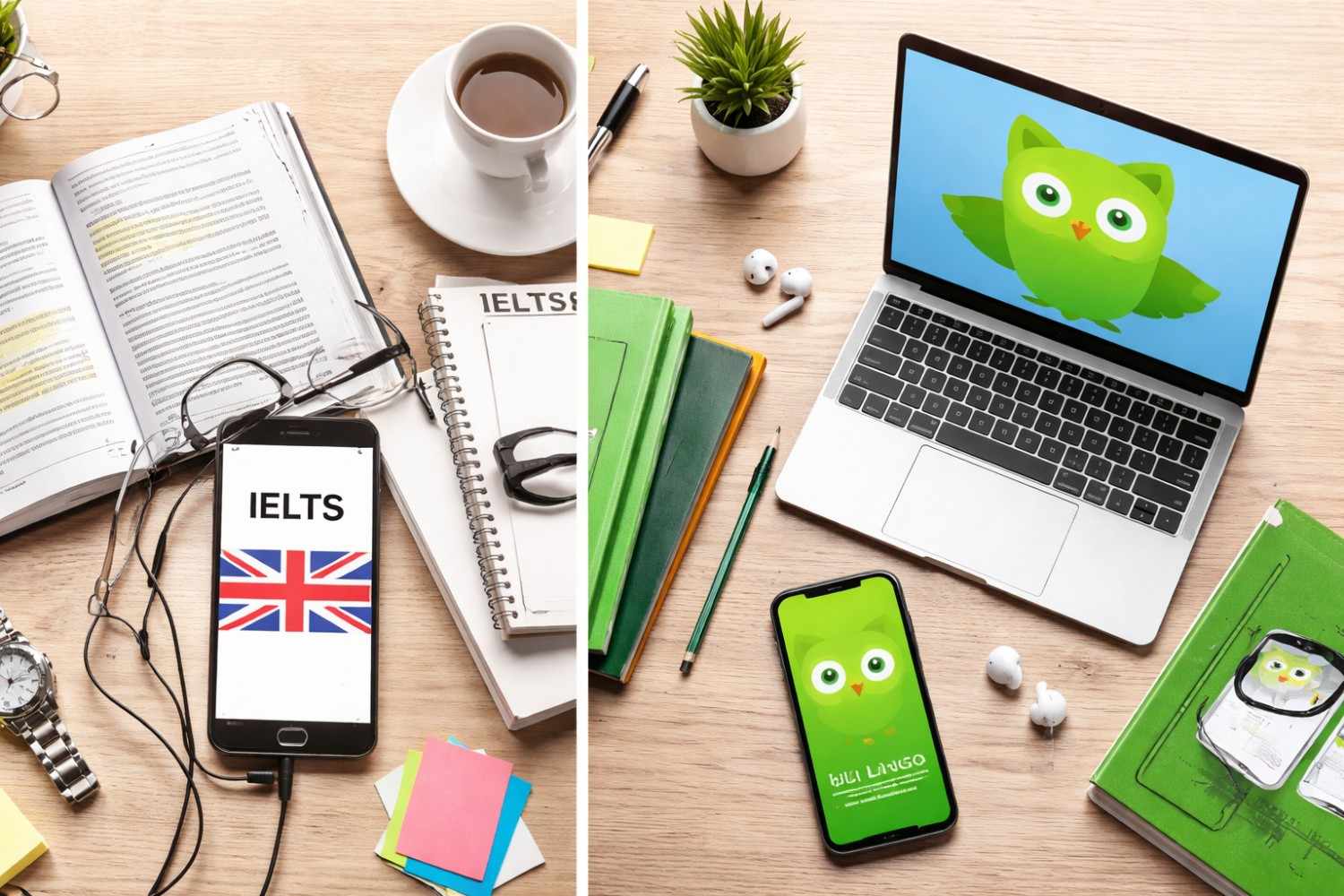


Table of Contents
- Introduction
- IELTS vs Duolingo Comparison: What Are the Main Differences?
- How Much Do IELTS and Duolingo Cost in India?
- What Is the Duolingo English Test Format?
- IELTS vs Duolingo Results: Which Test Is Faster?
- IELTS vs Duolingo Score Comparison: What DET Score Equals IELTS?
- Is Duolingo Easier Than IELTS?
- IELTS vs Duolingo University Acceptance: Which Is More Widely Accepted?
- Which Test Is Better for University Acceptance?
- IELTS vs Duolingo Decision Framework: How Should You Choose?
- IELTS vs Duolingo Preparation Time: How Long Should You Study?
- IELTS vs Duolingo for Applicants from India: Which Is More Practical?
- IELTS vs Duolingo: Which Test Wins Each Category?
- Which Is Better for You: IELTS or Duolingo?
IELTS is generally the safer choice if you want the widest recognition by universities and immigration authorities, while the Duolingo English Test (DET) is better if you prioritise lower-cost, at-home testing and faster completion. In India, IELTS Academic costs ₹19,000, takes about 2 hours 45 minutes, and computer-test results are usually available within 1–2 days. DET costs approximately ₹6,700 ($70), takes about one hour, is taken from home, and normally provides certified results within two days. More than 13,500 organisations trust IELTS, while DET is accepted by more than 6,500 programs and institutions worldwide.
Introduction
Choosing between IELTS vs Duolingo can affect much more than how you prove your English proficiency. Your choice can influence application timing, testing cost, university options and, in some countries, how easily you meet later immigration requirements. That is why selecting an English test only because one looks easier or cheaper can create unnecessary problems later.
The Duolingo English Test has expanded rapidly because it is shorter, cheaper and can be completed from home. IELTS, meanwhile, continues to offer much broader institutional and immigration recognition. In this guide, we compare IELTS and Duolingo across fees, test format, scores, difficulty, results, university acceptance, visa implications, preparation and practical suitability so you can choose the test that works best for your study-abroad plans.
IELTS vs Duolingo Comparison: What Are the Main Differences?

At a basic level, both IELTS Academic and DET measure whether you have enough English proficiency to study successfully in an English-speaking academic environment. The major difference is how they test those skills and where their scores can be used.
IELTS follows a longer, clearly divided testing format with Listening, Reading, Writing, and Speaking sections. DET is a shorter digital adaptive test taken from home, with question difficulty responding to the test taker's performance.
IELTS vs Duolingo Detailed Comparison
| Factor | IELTS | Duolingo English Test |
|---|---|---|
| Full Name | International English Language Testing System | Duolingo English Test |
| Common Abbreviation | IELTS | DET |
| India Fee | ₹19,000 | Approx. ₹6,700 ($70) |
| Test Length | 2 hours 45 minutes | About 1 hour |
| Delivery | Primarily secure test-centre delivery | Fully online from home |
| Speaking | Human IELTS examiner | Digital speaking tasks |
| Score | 0–9 bands | 10–160 |
| Result Speed | Usually 1–2 days on computer | Within 2 days |
| Recognition | 13,500+ organisations | 6,500+ programs/institutions |
| Adaptive Testing | No | Yes |
| Score Validity | Usually 2 years | 2 years |
| Immigration Use | Broad recognition; exact IELTS version depends on route | Limited; depends heavily on country/route |
| Convenience | Requires more scheduling | High – no appointment or travel |
| Best Advantage | Recognition | Cost + convenience |
| Main Limitation | Cost and longer duration | Acceptance is less universal |
The correct choice depends on your destination, university list and immigration needs rather than simply which test appears easier.
How Much Do IELTS and Duolingo Cost in India?
For applicants from India, cost is one of the clearest differences between IELTS and DET. IELTS Fee in India: The official IELTS Academic and IELTS General Training fee in India is ₹19,000 in 2026 for both IELTS on Computer and IELTS on Paper where available.
Duolingo English Test Fee: The Duolingo English Test currently costs approximately ₹6,700 ($70) for one test using the August 19, 2026 USD/INR rate. Duolingo states that the DET costs $70 and can be completed from home.
Which Test Is Cheaper?
DET is clearly cheaper for the initial test attempt.
| Test | Approximate Cost |
|---|---|
| IELTS Academic India | ₹19,000 |
| Duolingo English Test | Approx. ₹6,700 ($70) |
| Approximate Initial Cost Difference | ₹12,300 |
This can matter if your application budget is tight. However, do not choose DET only because it costs less. First make sure every important program on your shortlist accepts it.
A ₹6,700 test becomes poor value if you later discover that one of your priority universities or immigration routes requires another English test.
Note: IELTS free resources
What Is the Duolingo English Test Format?
DET is designed as a digital-first adaptive assessment. The test takes roughly one hour and contains short tasks testing:
- Reading
- Writing
- Listening
- Speaking
Its graded adaptive portion takes about 45 minutes, followed by approximately 10 minutes of writing and speaking samples.
Unlike IELTS, DET does not separate the entire test into four long blocks. The test presents shorter tasks, and its adaptive technology changes aspects of difficulty according to performance.
The current DET speaking assessment includes different speaking task types, including Picture Description, Extended Speaking, Speaking Sample and Interactive Speaking. Interactive Speaking simulates a conversation through adaptive follow-up questions.
IELTS vs Duolingo Results: Which Test Is Faster?

The difference is much smaller than many outdated comparison articles suggest.
IELTS Result Time:
For IELTS on Computer, results are usually available in 1–2 days. IELTS states that around 80% of computer-test scores are available within two days and roughly half within one day.
IELTS on Paper results traditionally take 13 days globally; the official IELTS results page currently notes 7 days in India where paper-based testing remains available during the transition.
Duolingo Result Time:
DET certified results are normally available within two days.
Which Is Faster?
For students taking IELTS on Computer, there is now very little practical difference:
- IELTS on Computer: usually 1–2 days
- Duolingo: usually within 2 days
Therefore, the old argument that “IELTS always takes 13 days while Duolingo takes two days” is no longer accurate.
If deadlines are approaching, both tests can now offer fast results, although DET still has the convenience advantage of at-home testing.
IELTS vs Duolingo Score Comparison: What DET Score Equals IELTS?
IELTS uses a 0–9 band scale, while DET reports scores on a 10–160 scale. Duolingo maintains an official concordance with IELTS Academic based on candidates who took both assessments. Concordance should be treated as an approximate comparison, not a guarantee that every university will use the same equivalency.
IELTS to Duolingo Score Comparison
| IELTS Academic Band | Approximate DET Overall Score |
|---|---|
| 5.0 | 75–80 |
| 5.5 | 85–90 |
| 6.0 | 95–100 |
| 6.5 | 105–115 |
| 7.0 | 120–125 |
| 7.5 | 130–135 |
| 8.0 | 140–145 |
| 8.5 | 150–155 |
| 8.5–9.0 | Up to 160 |
Important: Use this only as a broad concordance. Your target university may publish its own minimum DET score, IELTS score and individual skill requirements.
For example, a program might accept an overall score while still requiring minimum Writing, Speaking, Listening or Reading subscores.
Is Duolingo Easier Than IELTS?
Neither test is universally easier.
DET may feel easier or more convenient for candidates who:
- Are comfortable taking tests on computers
- Prefer shorter exams
- Perform well with changing question formats
- Prefer speaking into a computer instead of speaking to an examiner
- Feel more comfortable testing at home
IELTS may feel easier for candidates who:
- Prefer predictable sections
- Want to practise one skill at a time
- Are comfortable speaking to another person
- Prefer a traditional exam structure
- Want extensive official practice resources
- Perform better in controlled test-centre environments
DET is adaptive, so the difficulty of tasks changes during the assessment. IELTS follows a more fixed test structure.
The better question is therefore not “Which test is easier?” but “Which format allows me to demonstrate my English ability more accurately?”
IELTS vs Duolingo University Acceptance: Which Is More Widely Accepted?

This is where IELTS currently has the strongest advantage.
How Widely Is IELTS Accepted?
IELTS reports that more than 13,500 organisations worldwide trust or accept its results. This includes universities, colleges, professional bodies, employers and immigration authorities.
IELTS also reports recognition by more than 3,400 institutions in the United States alone.
How Widely Is the Duolingo English Test Accepted?
DET is now accepted by more than 6,500 programs and institutions worldwide. Duolingo reports acceptance across the US, Canada, UK, Europe and other destinations.
Duolingo also states that all eight Ivy League universities accept DET in some capacity, alongside graduate business schools such as Harvard Business School, Kellogg, Wharton and Chicago Booth.
However, this is the key qualification:
DET acceptance can vary by university, degree level and individual program.
A university appearing on a DET acceptance list does not automatically mean that every master's, MBA or specialised master's program at that university accepts the test. Duolingo itself recommends checking the specific admissions requirements of each program.
Which Test Is Better for University Acceptance?
If you have not finalised your university shortlist, IELTS offers more flexibility because of its broader recognition.
DET makes more sense when:
- You already know your target universities.
- Every important program accepts DET.
- You do not need a different English test for your immigration plan.
If even one high-priority program requires IELTS, TOEFL or another test, taking IELTS first may save you from paying for two separate exams.
IELTS vs Duolingo for the USA
For US university admissions, both IELTS and DET can be useful. IELTS reports recognition by more than 3,400 US institutions. DET is also accepted by thousands of programs globally and by many prominent American institutions.
For the US, the most important step is to check your specific master's program, not simply the university name.
For example, requirements can differ between:
- MBA programs
- Master in Management programs
- MS programs
- Engineering schools
- Graduate arts and science departments
- Undergraduate admissions
Therefore, do not rely on statements such as “Duolingo is accepted in the USA” without checking the program itself.
IELTS vs Duolingo for the UK
Several UK universities and programs accept DET for admission.
For the UK Student visa, however, the rules depend on how your English proficiency is assessed.
If you are studying at degree level or above with a Higher Education Provider, the university may assess your English ability itself and may accept a different test, provided the required English level is met. (gov.uk)
Where a Secure English Language Test (SELT) is specifically required, the test must come from a UKVI-approved provider. UK government guidance maintains the official list of acceptable SELTs. (gov.uk)
Therefore:
Do not assume that DET admission acceptance automatically means DET is a UKVI-approved SELT.
Check both:
- Your university's English-language admission policy.
- The English evidence required for your specific Student visa situation.
IELTS vs Duolingo Decision Framework: How Should You Choose?
You can make the decision much easier by answering five questions.
1. Have You Finalised Your University List?
If no, IELTS provides greater flexibility because of its broader recognition.
If yes, check whether every shortlisted program accepts DET.
If all your target programs accept DET, you can consider it more seriously.
2. Which Country Are You Targeting?
If your application is mainly focused on US universities that accept DET, the Duolingo English Test can be an efficient choice.
If you want greater portability across the UK, Australia, Canada and multiple countries, IELTS generally gives you more flexibility.
3. Do You Need the Test for Immigration Later?
This is a major consideration.
If the same English test may later be useful for immigration, professional registration or other official purposes, IELTS generally has a broader official footprint.
DET should primarily be treated as an academic-admission test unless you have separately verified its use for the immigration route you need.
4. What Is Your Budget?
If cost matters strongly:
DET: approx. ₹6,700 ($70)
IELTS India: ₹19,000
DET is therefore around ₹12,300 cheaper for the initial attempt at the current exchange rate.
5. Which Test Format Fits You Better?
Choose IELTS if you prefer:
- Structured sections
- Human Speaking interview
- Traditional test preparation
- Secure test-centre environment
- Wider recognition
Consider DET if you prefer:
- Shorter testing time
- At-home testing
- Adaptive questions
- Lower cost
- Digital speaking tasks
- Flexible scheduling
IELTS vs Duolingo Preparation Time: How Long Should You Study?
There is no reliable universal rule saying that IELTS takes 12 weeks while DET takes six weeks.
Preparation depends on:
- Your current English level
- Required university score
- Weakest skill
- Previous exposure to English
- Familiarity with the exam
- Practice-test performance
- How much time you can study each week
How Long Does IELTS Preparation Take?
IELTS cites research suggesting that, among students undertaking English-language or IELTS preparation courses, it can take around three months on average to improve by up to half a band. Individual results can vary significantly.
A student already scoring 6.5 and targeting 7.0 may therefore need a very different preparation plan from someone starting well below the required level.
How Long Does Duolingo Preparation Take?
Duolingo's official guidance emphasises that DET measures your existing academic English proficiency. Short-term memorisation or cramming is unlikely to dramatically change your score.
Instead, candidates are advised to:
- Learn the current test format
- Practise English regularly
- Take the free official practice test
- Become comfortable with the testing setup
- Prepare their equipment and environment
Therefore, do not choose DET because someone tells you it can always be “prepared for in two weeks.” Your required preparation depends mainly on how far your current English ability is from your target score.
IELTS vs Duolingo for Applicants from India: Which Is More Practical?
For applicants from India, the decision usually comes down to university list, immigration plans, cost, and convenience.
Choose IELTS If You Want Maximum Flexibility
IELTS is usually the stronger choice if:
- You are applying across several countries.
- Your university shortlist is still changing.
- You may target Australia.
- You want greater immigration portability.
- Some programs do not accept DET.
- You prefer a human Speaking test.
- Paying ₹19,000 is manageable within your application budget.
Choose Duolingo If Your Universities Accept It
DET can be a very practical option if:
- Every shortlisted program accepts DET.
- You primarily need the test for university admission.
- You want to minimise application expenses.
- You are comfortable with digital adaptive testing.
- You have a suitable private testing environment.
- You prefer taking the exam from home.
- You want a shorter test.
At approximately ₹6,700 ($70), DET can significantly reduce testing costs compared with the ₹19,000 IELTS fee in India.
But lower cost should never replace acceptance verification.
IELTS vs Duolingo: Which Test Wins Each Category?
IELTS and Duolingo are both good English tests, but they are better for different needs. Duolingo is usually better for students who want a cheaper, shorter and more convenient test. IELTS is better for students who want wider acceptance and more flexibility for university and visa purposes.
| Category | Better Choice | Why |
|---|---|---|
| Lower Cost | Duolingo | Approx. ₹6,700 ($70) vs ₹19,000 |
| Shorter Test | Duolingo | About 1 hour vs 2h 45m |
| At-Home Convenience | Duolingo | Built as a remote test |
| Wider Recognition | IELTS | 13,500+ organisations |
| Broader Immigration Utility | IELTS | Accepted across more government pathways |
| Fast Results | Tie / Slight IELTS Computer Edge | IELTS 1–2 days; DET within 2 days |
| Predictable Format | IELTS | Four clearly structured skills |
| Adaptive Testing | Duolingo | Digital adaptive design |
| Human Speaking Interview | IELTS | Speaking with examiner |
| Multi-Country Flexibility | IELTS | Wider institutional/immigration portability |
| Tight Budget | Duolingo | Considerably cheaper |
| Australia Immigration Planning | IELTS | Approved secure-centre IELTS tests are recognised |
| Already-Verified DET University List | Duolingo | Faster, cheaper and convenient |
Which Is Better for You: IELTS or Duolingo?
.jpg)
The better test depends on your own study-abroad plan. No one answer works for everyone. If you want a test that is accepted more widely and gives you more flexibility across countries, IELTS is usually the safer choice. It is a good option if you are still deciding between universities or if visa requirements are important for you.
Duolingo can be a better choice if your universities already accept it and you want something cheaper, shorter and easier to take from home. It can also be useful if you are short on time and want a more convenient testing option.
Choose IELTS if:
- You are applying to universities in different countries.
- Your university list is not final yet.
- You want wider acceptance.
- Visa or immigration requirements matter to you.
- You prefer a clear test format with separate sections.
- You are comfortable speaking with an examiner.
Choose Duolingo if:
- All your target universities accept it.
- You mainly need the admission test.
- You want to spend less.
- You prefer a shorter test.
- You want to take the test from home.
- You are comfortable with online and computer-based questions.
Related Blogs
- ELTS Free Resources
- What is IELTS Exam
- Best Ways to Prepare for IELTS at Home
- IELTS Speaking Section
Conclusion
Choosing between IELTS vs Duolingo is not about which test is easier it is about which test fits your goals, timeline, and target universities. Both exams serve the same purpose: helping you prove your English proficiency and secure admission. But the right choice depends on how well it aligns with your overall study abroad plan. If you are looking for wider global acceptance, stronger visa reliability, and long-term flexibility, IELTS is the safer option. On the other hand, if your priority is faster results, lower cost, and convenience, Duolingo can be a smart and practical choice — especially if your universities accept it.
The most important thing is to avoid making a random decision. A wrong choice can delay your applications by months, increase your costs, and limit your university options. Always check your university requirements first, understand your deadlines, and plan your budget carefully. In the end, ielts vs duolingo is just the starting point. What truly matters is the university you choose, the skills you build, and the effort you put into your career after admission. Make the right decision now, and you set a strong foundation for your entire study abroad journey.