
 Abhyank Srinet


Introduction
A lower-than-expected GMAT score can make MBA applications stressful, especially when you are targeting international business schools. However, MBA programs with low GMAT scores are not limited to lesser-known universities. Some established schools publish broad score distributions, while others assess applicants without a fixed minimum.
The important step is choosing schools that match your entire profile rather than relying on a single test score. This guide explains how to compare MBA colleges accepting low GMAT scores, which official school policies are useful, and how Indian applicants can create a realistic shortlist for the 2027 admission cycle.
What Is Considered a Low GMAT Score for MBA Admissions?
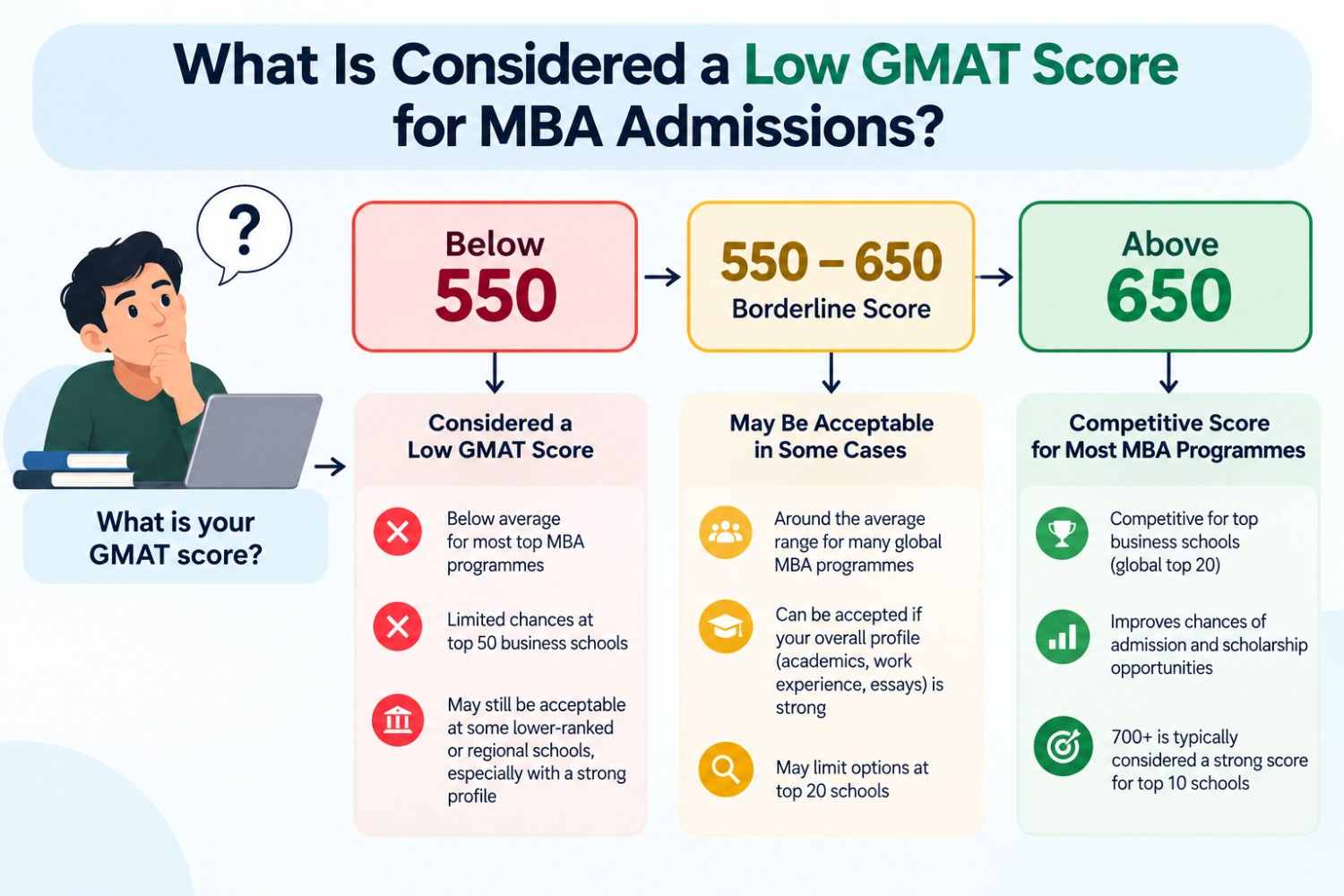
A low GMAT score is one that falls below the typical performance of applicants or enrolled students at your target school. There is no universal score that every business school considers low. A result that is below one school's median may fall within another school's published admitted-student range.
Current GMAT Scores and the Previous GMAT Scale
The current GMAT uses a 205–805 total-score scale and measures Quantitative Reasoning, Verbal Reasoning and Data Insights. The previous GMAT used a 200–800 scale and included a different exam structure.
You should not compare a previous-edition score of 650 directly with a current GMAT score of 655. GMAC recommends using percentile-based concordance when interpreting scores across editions. This distinction matters because many older MBA articles still publish historical GMAT averages without identifying the test version.
How to Interpret Your Score Against a School Profile
| Published Measure | Meaning | How to Use It |
|---|---|---|
| Minimum score | A stated admission threshold, if the school has one | Check whether you meet eligibility requirements |
| Median score | The middle score in the published distribution | Compare your result with the typical enrolled student |
| Average score | The arithmetic mean of reported scores | Use as a reference, not an admissions cutoff |
| Middle 80% range | The score interval containing the middle 80% of the reported group | Understand the spread, including applicants below the median |
| Full score range | Lowest to highest reported scores | See the breadth of admitted performance, not your individual admission probability |
A score inside a school's published range does not guarantee admission. Similarly, a score below its median does not automatically mean rejection.
Which MBA Programs Consider Applicants With Low GMAT Scores?
Applicants researching MBA programs with low GMAT scores should prioritise official class profiles and admissions requirements. The schools below illustrate different types of flexibility: a published lower-end score, a broad middle-80% range, no fixed minimum, or an approved alternative test route.
| Business School and Programme | Official GMAT Evidence | What It Means |
|---|---|---|
| Texas McCombs Full-Time MBA, USA | Current GMAT median 655; middle 80% 615–695 | Some enrolled students scored below 650, but admission remains competitive |
| Dartmouth Tuck MBA, USA | Current GMAT average 671; full range 595–775 | The published class includes a lower score; this is not a general acceptance threshold |
| ESMT Berlin Full-Time MBA, Germany | No fixed minimum for its accepted admissions tests | Applicants are reviewed across academic and professional factors |
| Rutgers Full-Time MBA, USA | GMAT, GRE or EA; selective test waivers available | Candidates may seek an approved waiver based on academic preparation |
| Rutgers Part-Time MBA, USA | GMAT/GRE optional under the published policy | A flexible alternative for working professionals, not equivalent to the full-time MBA |
Important: These examples do not establish a universal GMAT cutoff. Score statistics refer to the class profiles available during this review; admissions policies may change by intake and programme.
Texas McCombs School of Business
Texas McCombs provides one of the clearest examples of a published score distribution. Its Full-Time MBA Class of 2027 has a current GMAT median of 655 and a middle-80% range from 615 to 695. This shows that some enrolled students entered with scores below the median, including scores below 650.
For applicants exploring MBA programs with GMAT scores below 650, McCombs is worth researching because the distribution supplies more useful evidence than an unsupported cutoff. However, a score near the lower end of the range is not enough on its own. Applicants should demonstrate quantitative ability, clear career goals and meaningful professional achievements.
Best fit: Candidates with relevant work experience, strong academic preparation and an interest in management careers in the United States.
Dartmouth Tuck School of Business
Dartmouth Tuck is an important example of why applicants should not treat an MBA class average as a minimum requirement. Its published Class of 2027 data reports a current GMAT average of 671 and a score range of 595–775.
This does not make Tuck an easy-admission MBA or establish 595 as an acceptable target. It means at least one reported score was below the class average. Applicants with lower scores need compelling evidence of academic readiness, leadership, teamwork and professional impact.
Best fit: Applicants with distinctive professional achievements who can clearly explain their career plans and contribution to the MBA community.
ESMT Berlin Full-Time MBA
ESMT Berlin states that its Full-Time MBA has no specific minimum GMAT, GRE, Executive Assessment or Business Admissions Test score. It evaluates the entire application, although strong test performance remains important.
This makes ESMT worth considering when researching top business schools with low GMAT requirements. Applicants from non-quantitative backgrounds should pay particular attention to demonstrating analytical ability through transcripts, work experience and admissions-test performance.
Best fit: Professionals seeking a European MBA with interests in leadership, technology, innovation and international business.
Official source: ESMT Berlin Full-Time MBA admissions FAQs.
Rutgers Business School Full-Time MBA
Rutgers considers GMAT, GRE or Executive Assessment scores for its Full-Time MBA and allows selected applicants to request test waivers. The school evaluates alternative evidence such as strong academic results, relevant professional qualifications, advanced quantitative education and substantial work experience.
A waiver is reviewed individually and is not guaranteed. Rutgers also notes that test scores can influence scholarship decisions. This makes the waiver route particularly relevant for applicants who have a lower GMAT score but stronger evidence of academic preparation elsewhere in their profile.
Best fit: Candidates interested in an American MBA who can demonstrate academic readiness through previous study and meaningful professional experience.
Official source: Rutgers Full-Time MBA application checklist.
Rutgers Business School Part-Time MBA
Rutgers also offers a Part-Time MBA with an optional GMAT/GRE policy. This is a separate programme from its Full-Time MBA and should not be treated as an identical alternative.
Part-time study may suit candidates who want to advance their management education while continuing their careers. International applicants should check programme delivery, attendance requirements and visa eligibility before selecting a part-time MBA abroad.
Best fit: Working professionals who need a flexible study format and can meet the programme's attendance and eligibility requirements.
Can You Get Into a Good MBA Programme With a GMAT Score Below 650?
Yes, admission is possible with a current GMAT score below 650, but your chances depend on your chosen programme and wider application. Texas McCombs publishes a current GMAT middle-80% range starting at 615, while Dartmouth Tuck reports a full range beginning at 595.
These figures should be treated as evidence of admission outcomes, not proof that every applicant with a similar score has a realistic chance. School selectivity, academic background, experience and career goals matter.
Why Class Profiles Matter More Than Generic Cutoffs
Many MBA colleges accepting low GMAT scores do not publish a single cutoff that determines admission. Instead, they provide averages, medians or distributions. Comparing these measures can help you identify schools where your test score is closer to the enrolled-student profile.
A useful shortlist should also consider employment outcomes, location, programme duration, scholarship availability and your career plan.
What Do MBA Admissions Committees Consider Beyond GMAT Scores?
.jpeg)
Business schools use test results to assess academic preparation, but most also examine the experiences and qualities applicants would bring to the classroom. A lower score is easier to contextualise when other parts of the application provide strong, credible evidence.
Academic Performance and Quantitative Readiness
Strong grades in subjects such as mathematics, statistics, accounting and economics can demonstrate preparation for quantitative MBA coursework. Applicants from non-quantitative disciplines may benefit from relevant additional study.
Professional Experience and Career Progression
Admissions teams assess the quality of your work, not only the number of years completed. Promotions, increased responsibilities, business achievements and evidence of decision-making can strengthen your profile.
Leadership and Teamwork
Leadership does not always require a management title. Leading projects, helping teams solve difficult problems, mentoring colleagues or improving business processes can provide meaningful examples.
Career Goals and Recommendations
Your essays should explain why you need an MBA, which career transition you want to make and why the chosen programme fits your goals. Recommendations are most useful when they describe specific achievements and personal qualities.
What Can You Do If Your GMAT Score Is Low?

You have several possible routes if your test result is below your target school's typical score. The right option depends on your academic background, deadlines, budget and the school's published admissions requirements.
Retake the GMAT
A retake may be worthwhile when your practice scores are consistently higher, you know which weaknesses to address and there is enough time before the application deadline. Avoid repeated attempts without a clear improvement plan.
Consider the GRE or Another Accepted Test
Some MBA programmes accept the GRE or Executive Assessment. Other schools provide their own approved assessment. Always verify which tests the specific MBA programme accepts before registering.
Explore Conditional Test Waivers
Some schools allow applicants to request a waiver based on academic preparation, advanced qualifications or substantial experience. A waiver removes an admissions requirement only when approved; it does not guarantee admission or a scholarship.
For details about programmes that offer no-test or waiver routes, read MiM-Essay's MBA Without GMAT guide.
How Can You Strengthen an MBA Application With a Low GMAT?
The most effective approach is to address the concern raised by your score while presenting clear evidence of your academic and professional potential.
Build Evidence of Analytical Ability
Highlight university modules, professional certifications or work projects that required quantitative reasoning. Explain your contribution and the results rather than simply listing courses or software tools.
Use Essays to Show Career Clarity
Describe your short-term goals, long-term direction and the skills you need from an MBA. Connect your achievements with the opportunities offered by each school.
Choose Recommenders Who Know Your Work
Prioritise people who can describe your responsibilities, progress, judgement and teamwork with specific examples. A detailed recommendation is more useful than a generic endorsement from someone senior.
Address the GMAT Score When Necessary
If your score differs substantially from a school's typical class profile, consider a brief explanation in an optional essay where the school invites one. Focus on additional evidence of preparation rather than making excuses.
How Should Indian Applicants Choose MBA Programs With Low GMAT Scores?

Indian applicants should compare schools based on current GMAT performance, degree background, work experience, programme cost and intended career market. A realistic shortlist is more useful than applying widely to schools selected only because they advertise flexible scores.
Compare Your Academic and Professional Profile
Check how schools review Indian university transcripts, CGPA systems and quantitative subjects. Applicants with engineering, commerce or non-technical degrees may need different types of evidence to demonstrate readiness.
Plan the Full MBA Budget
Compare tuition, accommodation, insurance, travel, living expenses and potential loan costs. Calculate the full amount in INR, with the school's original currency shown in brackets, using a dated exchange rate before making financial decisions.
Do not assume that a lower GMAT requirement means lower tuition or greater scholarship availability. Check official fee schedules and funding conditions for each intake.
Research Employment and Visa Requirements
Evaluate whether employers in your preferred country recruit international MBA graduates and whether the programme supports your intended career transition. Review official visa and post-study work conditions separately from university marketing claims.
Build a Balanced School Shortlist
Create a balanced list of ambitious, competitive and comparatively realistic options using official profiles and the strength of your overall application. No MBA admission should be treated as guaranteed, even if your score falls within the school's published range.
If the USA is your preferred destination, explore MBA Programs in the USA for Low GMAT Scores for a more geographically focused shortlist.
Should You Retake the GMAT or Apply With Your Current Score?
You should consider a retake when a higher score could meaningfully improve your competitiveness and you have enough preparation time. Applying with your existing score may be more sensible if it is within your target school's published range and the rest of your profile is strong.
| Your Situation | Suggested Approach |
|---|---|
| Practice scores are consistently higher than your result | Consider a focused GMAT retake |
| Your score falls within the published class range | Assess the whole profile before deciding |
| The school has no fixed minimum | Check how academic readiness is evaluated |
| You qualify for a potential waiver | Confirm eligibility and obtain approval where required |
| Your score is far below the school's reported distribution | Reconsider school selection or improve test performance |
| Application deadlines are approaching | Compare the benefit of a retake against the time needed for a strong application |
For test preparation and scoring strategy, see MiM-Essay's GMAT Previous Year Question Papers guide.
Are MBA Programs With Low GMAT Scores Worth It?
Worth it if... the programme supports your career goals, has credible academic and employment outcomes, fits your budget and gives you a realistic opportunity to demonstrate strengths beyond your test score. A lower GMAT result does not automatically reduce the value of a well-chosen MBA.
Think twice if... you are selecting a school only because its score expectations seem lower. Before committing, examine the programme's reputation, total cost, scholarship conditions, employer connections and post-study options. Flexible admission requirements alone do not make an MBA a good investment.
Conclusion
Finding the right MBA programs with low GMAT scores starts with understanding official admission policies and matching them to your academic background, professional achievements and career goals. Focus on programme fit, evidence of readiness and a balanced school shortlist rather than relying on advertised cutoffs alone. If you need help choosing realistic options, MiM-Essay can help you review your profile and plan your applications.