
 Abhyank Srinet



The LSE MSc Finance and Economics 2027 is a 10-month, full-time master's programme at the London School of Economics. The tuition fee is approximately ₹53.04 lakh (£41,900). Applicants need a strong quantitative academic background, and most Indian students must submit a GMAT or GRE score. Work experience is not required, and admissions are competitive, with applications accepted on a rolling basis. Scholarships are available, and graduates can explore careers in investment banking, quantitative finance, asset management and economic consulting.
Introduction
The LSE MSc Finance and Economics is a 10-month, full-time master's programme at the London School of Economics and Political Science. It combines advanced finance, economics and quantitative analysis. The 2027 tuition fee is approximately ₹53.04 lakh (£41,900), with GMAT or GRE required for most applicants holding non-UK degrees.
For Indian students planning to study in London, understanding the requirements, total costs and career prospects is important. This guide explains the LSE MSc Finance and Economics admission process, GMAT/GRE expectations, scholarships, deadlines and graduate outcomes using official university information.
What Is the LSE MSc Finance and Economics?
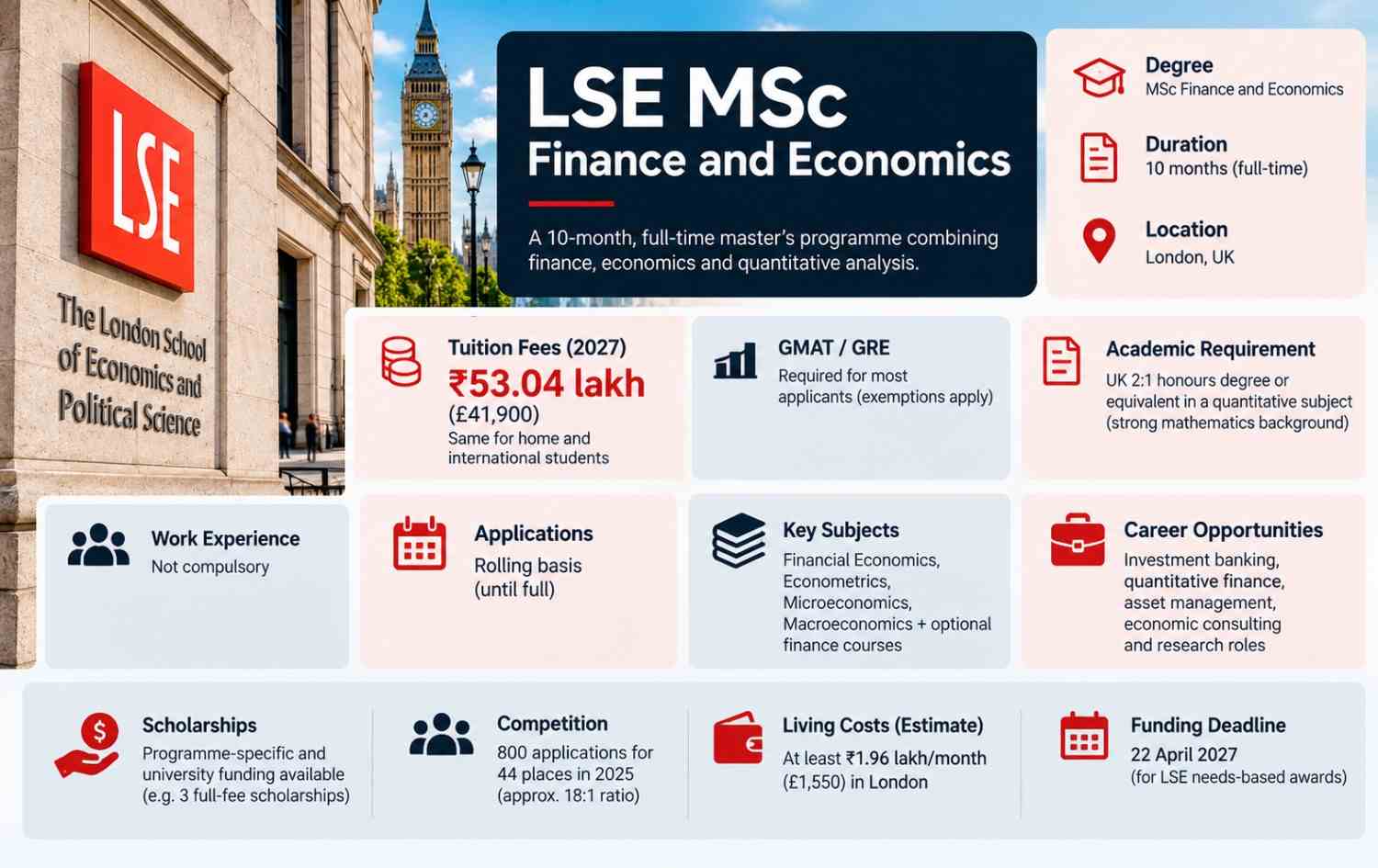
The LSE MSc Finance and Economics is a specialised postgraduate degree taught jointly by LSE's Departments of Finance and Economics. It helps students understand financial markets using economic theory, mathematical models and data analysis.
Programme Overview
| Category | Details |
|---|---|
| University | London School of Economics and Political Science |
| Programme | MSc Finance and Economics |
| Programme code | LN43 |
| Intake | 2027/28 |
| Duration | 10 months |
| Study mode | Full-time |
| Location | London, UK |
| Tuition fees | Approx. ₹53.04 lakh (£41,900) |
| GMAT/GRE | Required unless an official exemption applies |
| Work experience | Not compulsory |
| Application deadline | Rolling admissions until full |
| Funding deadline | 22 April 2027 for LSE needs-based awards |
Source: LSE official 2027/28 programme page. INR estimates use an illustrative exchange rate of ₹126.59 per £1.
Who Should Consider This Programme?
The programme suits students with strong mathematics and analytical skills. Common academic backgrounds include economics, mathematics, engineering, statistics, finance and physics.
It can be particularly relevant to students interested in quantitative finance, investment analysis, economic research and financial markets.
What Are the LSE MSc Finance and Economics Requirements?
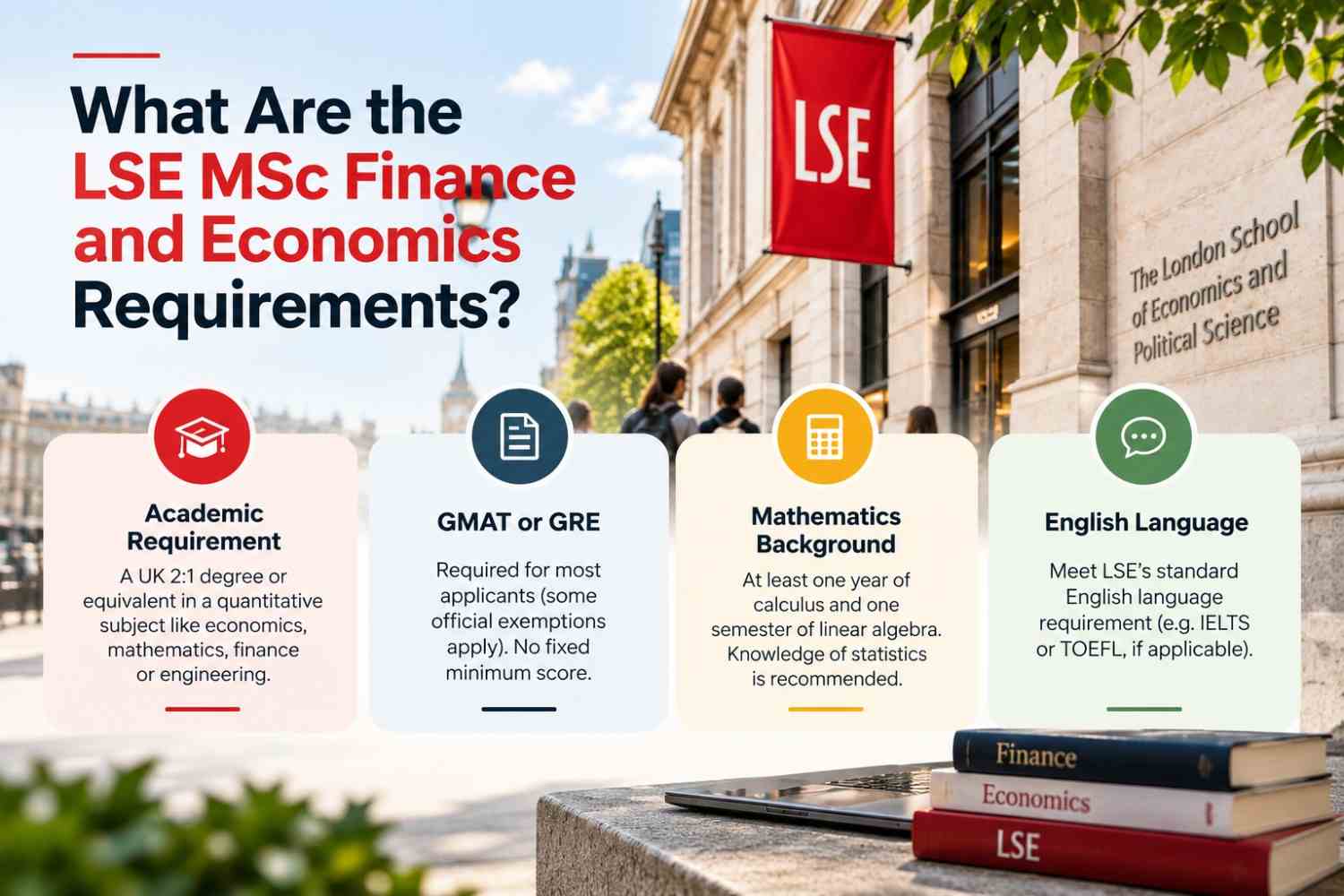
Applicants need at least a UK upper second-class honours degree (2:1), or its international equivalent, in a quantitative subject. LSE also expects good mathematical preparation.
Academic Qualifications
Students from economics, mathematics, engineering, finance, physics and similar fields can apply. LSE looks closely at quantitative preparation rather than assessing applicants only by their degree title.
Mathematics Requirements
Applicants should normally have studied at least one year of calculus and one semester of linear algebra. Additional knowledge of statistics, probability and mathematical modelling is useful.
English Language Requirements
The programme follows LSE's Standard English language requirement. Applicants who need to demonstrate English proficiency must meet the university's accepted test and component score requirements.
English language evidence is not necessarily required when the initial application is submitted, but any conditions must be satisfied before enrolment.
Work Experience Requirements
Work experience is not mandatory. Recent graduates can apply directly, while students with relevant internships or professional experience should include them in their application.
Can Indian Students Apply for LSE MSc Finance and Economics?
Yes. Indian students can apply with a recognised bachelor's degree in a quantitative field, provided they meet the academic, mathematical and testing requirements.
Indian Degree and CGPA Requirements
LSE publishes general Indian qualifications equivalent to UK degree classifications. These are guidelines rather than guaranteed admission thresholds.
| Qualification Level | General LSE Indian CGPA Guidance |
|---|---|
| UK 2:1 equivalent | 7.6/10, or the equivalent on other recognised scales |
| UK first-class equivalent | 8.5/10, or the equivalent on other recognised scales |
LSE notes that many previously admitted students achieved first-class results or equivalent. Applicants should also demonstrate the mathematical preparation needed for the programme.
Suitable Indian Academic Backgrounds
Students with BTech, BSc, BA Economics and other suitable degrees may be eligible. What matters most is whether the transcript shows relevant quantitative coursework and strong performance.
A student with a different degree title may still be competitive if their mathematical preparation meets LSE's expectations.
Is GMAT or GRE required for LSE MSc Finance and Economics?
Yes. The LSE MSc Finance and Economics generally requires GMAT or GRE from applicants who do not qualify for the university's published exemptions. Most students applying with Indian undergraduate degrees will need a test score.
LSE GMAT Requirements
LSE does not publish a fixed minimum GMAT score. Students should review the official LSE GMAT and GRE requirements to understand the accepted tests, exemptions and score submission rules.
Older guidance referring to GMAT scores in the high 600s relates to the previous scoring scale. Applicants taking the current GMAT should not treat those numbers as a current minimum cutoff.
LSE GRE Requirements
The GRE is accepted as an alternative to the GMAT. Strong quantitative performance is particularly important because the programme includes advanced mathematical and econometric coursework.
GMAT and GRE Exemptions
LSE lists exemptions that include eligible UK undergraduate degree holders, certain University of London programme graduates or students, and applicants in countries where relevant tests are unavailable in person or online.
Applicants should use the official programme-specific exemption rules rather than assume that work experience or a strong CGPA automatically removes the testing requirement.
Which Test Should You Choose?
Choose the test that allows you to demonstrate your strongest academic ability. Compare official practice results and consider the test requirements of other universities you plan to apply to.
For a wider comparison, read our GMAT vs GRE guide.
How Competitive Is LSE MSc Finance and Economics Admission?
Admission is highly competitive. LSE reports 800 applications and an intake of 44 students for its 2025 programme data, equivalent to about 18 applications per enrolled student.
Application Competition
| Official Measure | 2025 Data |
|---|---|
| Applications | 800 |
| Intake | 44 |
| Applications-to-intake ratio | Approximately 18:1 |
Important: This is an applications-to-intake ratio, not an acceptance rate. LSE does not provide the total offers made in these figures, so they cannot be used to calculate the percentage of applicants admitted.
What Makes an Application Competitive?
Strong academic grades, mathematical ability, suitable GMAT or GRE performance, academic recommendations and clear motivation all matter. Applicants should explain why the specific finance and economics curriculum fits their interests.
What Will You Study in LSE MSc Finance and Economics?
Students study financial economics, econometrics, microeconomics and macroeconomics, along with specialised finance subjects. The 2027/28 curriculum includes updates that should not be confused with older course structures.
Core Courses for 2027
| Course | Main Focus |
|---|---|
| Financial Economics (FM436) | Economic foundations of finance and financial markets |
| Financial Econometrics (FM437) | Statistical methods and financial data analysis |
| Microeconomics (EC4A1) | Advanced economic decision-making and models |
| Advanced Macroeconomics: Financial Markets and the Macroeconomy (EC4B7) | Connections between financial markets and macroeconomic conditions |
Optional Finance Subjects
Students can choose from options that may include Financial Engineering, Risk Management in Financial Markets, Fixed Income Securities and Credit Markets, Portfolio Management and Big Data and Finance.
Course availability may change, and students should check the official programme rules when selecting options.
Pre-Sessional Preparation
The compulsory pre-sessional programme begins in late August 2027. It includes academic preparation and professional development activities before regular teaching begins.
How Much Are the LSE MSc Finance and Economics Fees in 2027?
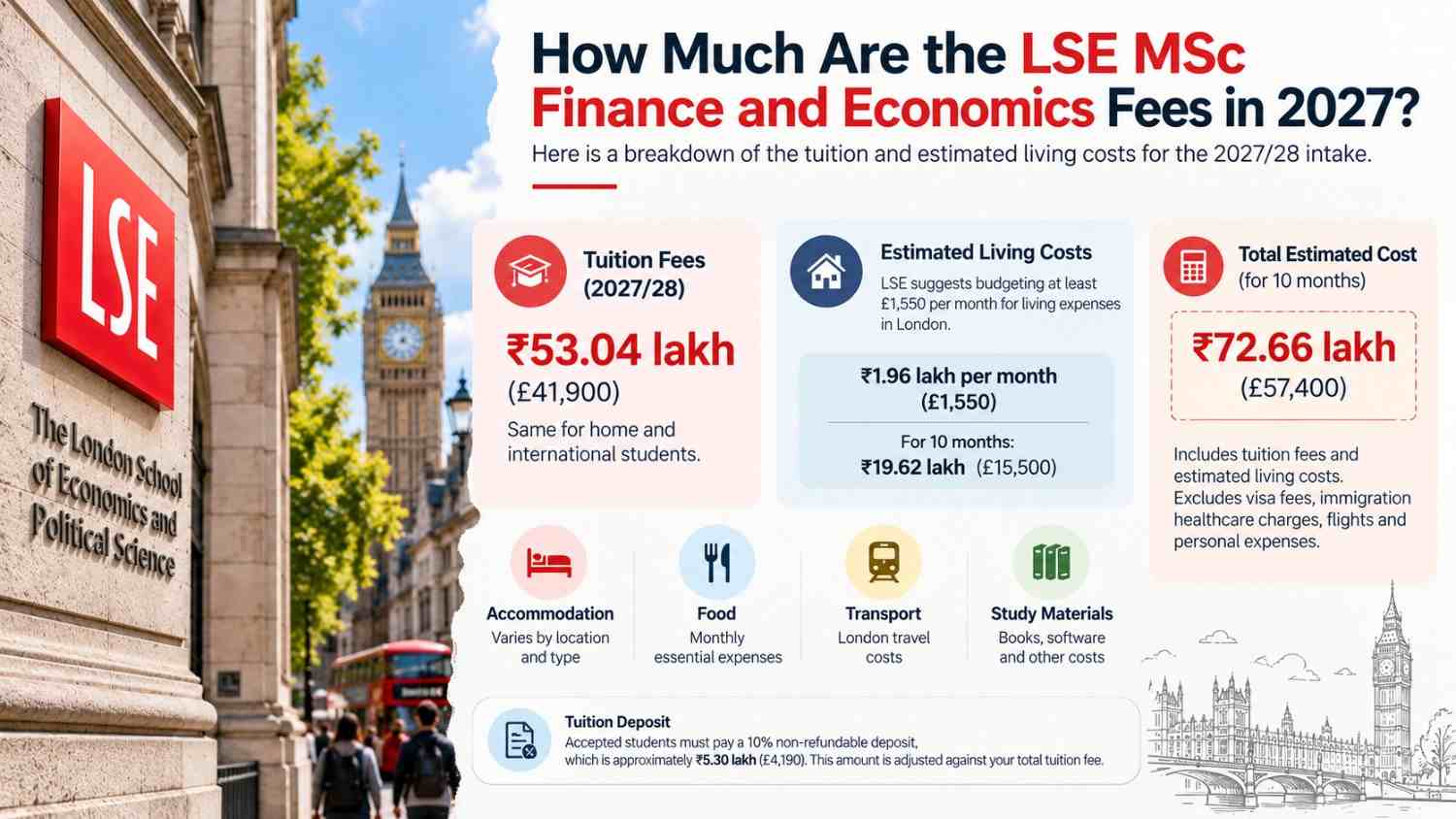
The LSE MSc Finance and Economics fees for 2027/28 are approximately ₹53.04 lakh (£41,900). The fee is the same for home and overseas students on this programme.
Tuition and Living Costs
LSE recommends budgeting at least £1,550 per month for living expenses in London. For a 10-month course, this gives a useful starting point for financial planning.
| Expense | INR Estimate | GBP Amount |
|---|---|---|
| Tuition fees | ₹53.04 lakh | £41,900 |
| Monthly living costs | ₹1.96 lakh | £1,550 |
| Living costs for 10 months | ₹19.62 lakh | £15,500 |
| Tuition and living total | ₹72.66 lakh | £57,400 |
INR amounts are illustrative conversions at £1 = ₹126.59. The total excludes Student visa costs, immigration healthcare charges, flights, accommodation deposits and personal contingencies.
Admission Deposit
Students accepting an offer must pay a non-refundable tuition deposit of 10%, approximately ₹5.30 lakh (£4,190).
The deposit is part of the tuition fee, not an additional course charge. Payment deadlines depend on when the offer is received.
Budgeting for London
Living costs depend on accommodation, transport and personal spending. Students should prepare a separate budget for initial relocation costs and unexpected expenses.
What Scholarships Are Available for LSE MSc Finance and Economics?
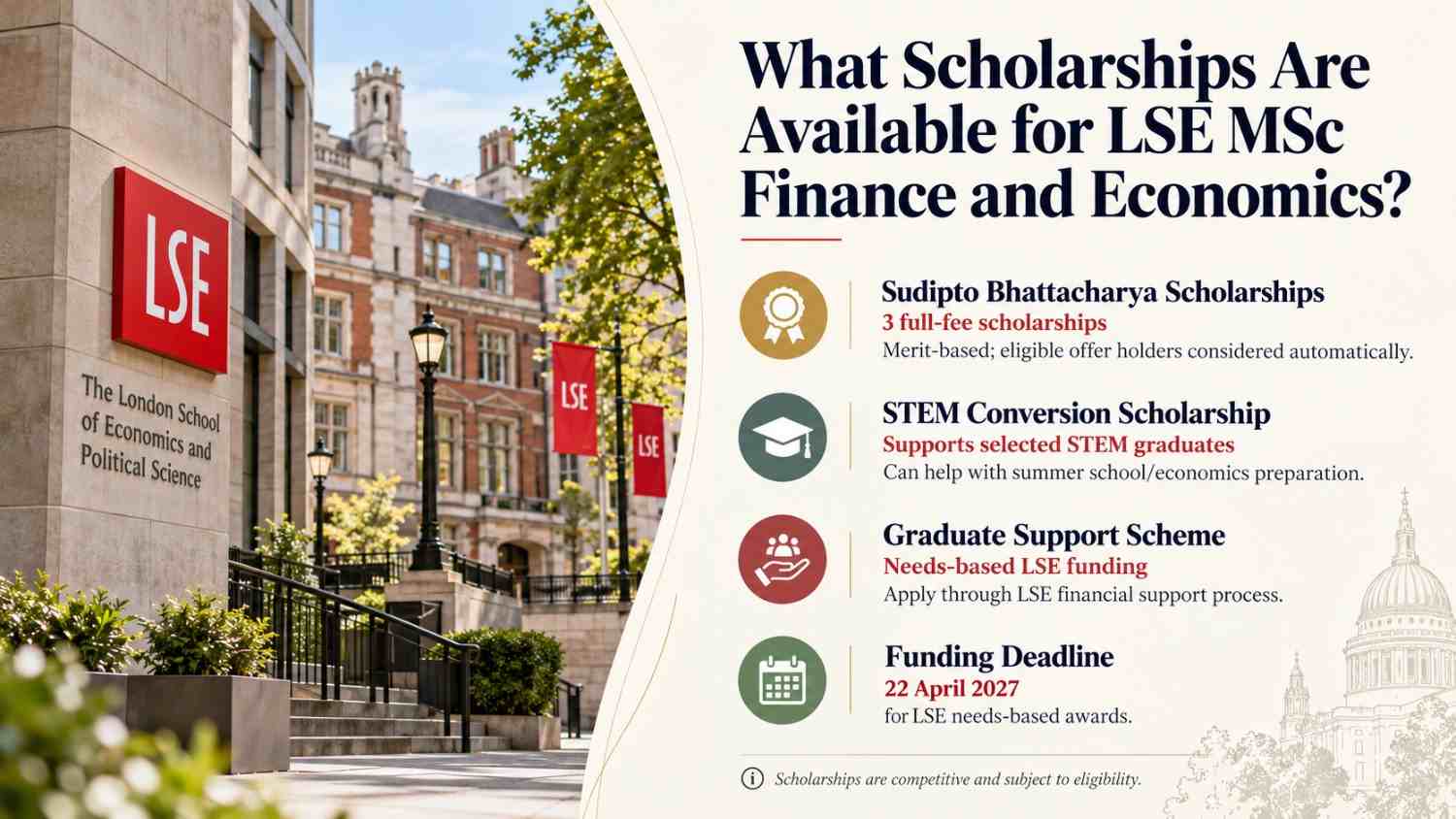
Students can explore programme-specific scholarships and university funding. Awards are competitive, and eligibility differs by scheme.
Sudipto Bhattacharya Scholarships
The Department of Finance offers three full-fee scholarships for this programme. Awards are based on academic merit, and eligible offer holders are considered automatically.
Applying early may improve the opportunity to be considered while funding decisions are being made.
STEM Conversion Scholarship
The MSc Finance and Economics Conversion Scholarship supports selected students from science, technology, engineering and mathematics backgrounds who need further preparation in economics or econometrics.
The award can cover eligible LSE Summer School course costs and associated living support, subject to the scholarship's conditions.
Graduate Support Scheme
LSE also provides needs-based financial support for eligible students. Applicants must secure an offer and complete the required financial support application.
The published 2027 needs-based funding deadline is 22 April 2027.
Education Loans for Indian Applicants
Indian students may consider secured or unsecured education loans for tuition and living expenses. Compare interest rates, repayment conditions, collateral rules and currency-related charges before choosing a lender.
When Is the LSE MSc Finance and Economics Deadline for 2027?
Applications operate on a rolling basis. There is no fixed final admission deadline, and the programme closes when all available places are filled.
Important Application Dates
| Event | Date or Status |
|---|---|
| 2027/28 applications | Open at the time of review |
| Final admission deadline | Rolling until full |
| Needs-based funding deadline | 22 April 2027 |
| Pre-sessional programme | Late August 2027 |
When Should You Apply?
Apply when your academic documents, tests and references are ready. Early preparation gives you more time for scholarship consideration, financing and relocation.
How Can You Apply for LSE MSc Finance and Economics?
Students must apply through LSE's graduate application system and submit the supporting documents required for the programme.
Application Documents
- Academic transcripts and degree qualifications
- Academic statement of purpose
- Two academic references for recent graduates
- Updated CV
- GMAT or GRE score where required
- English language evidence where applicable
Academic Statement of Purpose
Explain why the programme matches your academic interests and career direction. Use examples from coursework, projects or internships that show your quantitative ability.
Academic Recommendations
Choose referees who can describe your analytical skills, academic performance and readiness for advanced study. Give them enough time to prepare specific references.
Application Review
LSE reviews academic performance, motivation, recommendations and required testing information. Decisions depend on the strength of the complete application and available places.
How Should Indian Students Prepare for LSE Admissions?
Indian students should focus on three main areas: academic preparation, entrance tests and financial planning. Starting early can make the application process more manageable.
Strengthen Your Quantitative Background
Review your knowledge of calculus, linear algebra, statistics and economics. Use academic projects to demonstrate skills relevant to the programme.
Prepare for GMAT or GRE
Choose a test based on your strengths and the universities on your shortlist. Give particular attention to quantitative performance.
Prepare a Clear Application
Explain your interest in financial economics with specific examples. Avoid general statements that could apply to any university.
Plan Funding and Relocation
Calculate your total expenses, explore scholarships and arrange funds for deposits and initial living costs. Allow time for the Student visa application and accommodation planning.
What Are the LSE MSc Finance and Economics Career Outcomes?
Graduates enter investment banking, quantitative finance, economic consulting, research and other financial services roles. Some continue towards doctoral research in finance or economics.
Popular Career Paths
| Industry | Possible Roles |
|---|---|
| Investment banking | Investment Banking Analyst, Financial Analyst |
| Asset management | Investment Analyst, Portfolio Analyst |
| Quantitative finance | Quantitative Analyst, Trading Analyst |
| Economic consulting | Economic Analyst, Research Analyst |
| Financial research | Research Associate, Market Analyst |
| Public institutions | Economic Research and Policy Roles |
Employers of Recent Graduates
LSE's official programme page identifies employers from the previous three years, including J.P. Morgan, Morgan Stanley, Bank of America, McKinsey & Company, BCG, the European Central Bank, IMF, Oliver Wyman and Vanguard.
These are examples of historical graduate destinations, not guaranteed recruiters or job offers.
LSE Finance Salary Prospects
LSE does not publish a verified average starting salary for this exact programme in the 2027 information reviewed here.
Graduate pay varies by role, employer, work location and experience. Students should avoid treating general London finance salaries or university-wide averages as the expected salary for every graduate.
Career Support
The Department of Finance runs professional development activities such as CV workshops, interview preparation, sector sessions and alumni networking opportunities.
How Is LSE MSc Finance and Economics Different from MSc Finance?
The two programmes have different academic focuses. MSc Finance and Economics places greater emphasis on economic theory, econometrics and quantitative models, while MSc Finance offers broader training for financial services careers.
| Factor | MSc Finance and Economics | MSc Finance |
|---|---|---|
| Main focus | Finance, economics and econometrics | Broader financial markets and corporate finance |
| Academic preparation | Strong mathematical foundation | Quantitative preparation with broader academic backgrounds considered |
| Career interests | Quantitative finance, economic analysis and research | Investment banking, corporate finance and other financial services roles |
| Duration | 10 months | 10 months |
For a wider comparison of international finance degrees, explore our Masters in Finance guide.
Is LSE MSc Finance and Economics Worth It for Indian Students?
It can be a good choice for students with strong quantitative skills and clear interests in finance and economics. However, the programme requires a significant financial commitment and careful career planning.
Reasons to Consider the Programme
Students benefit from specialist teaching, advanced quantitative coursework, access to professional development activities and exposure to London's financial sector.
What Should You Consider Before Applying?
Think about academic fit, programme cost, financing, career preferences and the countries where you may seek employment. Strong university recognition alone does not guarantee a job.
Students comparing different degrees can also use the MiM-Essay School Explorer to review other options.
Conclusion
The LSE MSc Finance and Economics is a strong option for students who want to combine finance with advanced economic analysis. Before applying, focus on academic preparation, your entrance test, career goals and financial planning. Choose the programme because it matches your interests and long-term plans.