⭐ Quick Answer
The LSE MSc Finance and Private Equity is a 10-month master's degree in London. It combines general finance with a focus on private equity. Tuition for 2027/28 is ₹67.86 lakh (£53,600). Applicants without a UK undergraduate degree must submit GMAT or GRE scores. LSE reported 528 applications and 19 entrants in 2025. Its combined 2025 finance employment report shows that 92% of graduates accepted a job offer within three months. However, LSE does not publish a separate average salary for this programme.
Introduction
Private equity is an attractive career choice for students interested in investments, business deals and company growth. However, getting into this field requires strong finance skills and a good understanding of how businesses work. The LSE MSc Finance and Private Equity offers a way to study both areas through a single master's degree at the London School of Economics and Political Science.
For the 2027 intake, the course lasts 10 months and costs ₹67.86 lakh (£53,600) in tuition. LSE received 528 applications for just 19 enrolled places in 2025. Its combined finance employment report also recorded 97% employment within six months. In this blog, we explain the course, admission requirements, fees, scholarships, salary prospects and career options. We also discuss whether it is worth the investment for Indian students.
Why Choose LSE MSc Finance and Private Equity in 2027?
![Why Choose LSE MSc Finance and Private Equity in 2027]()
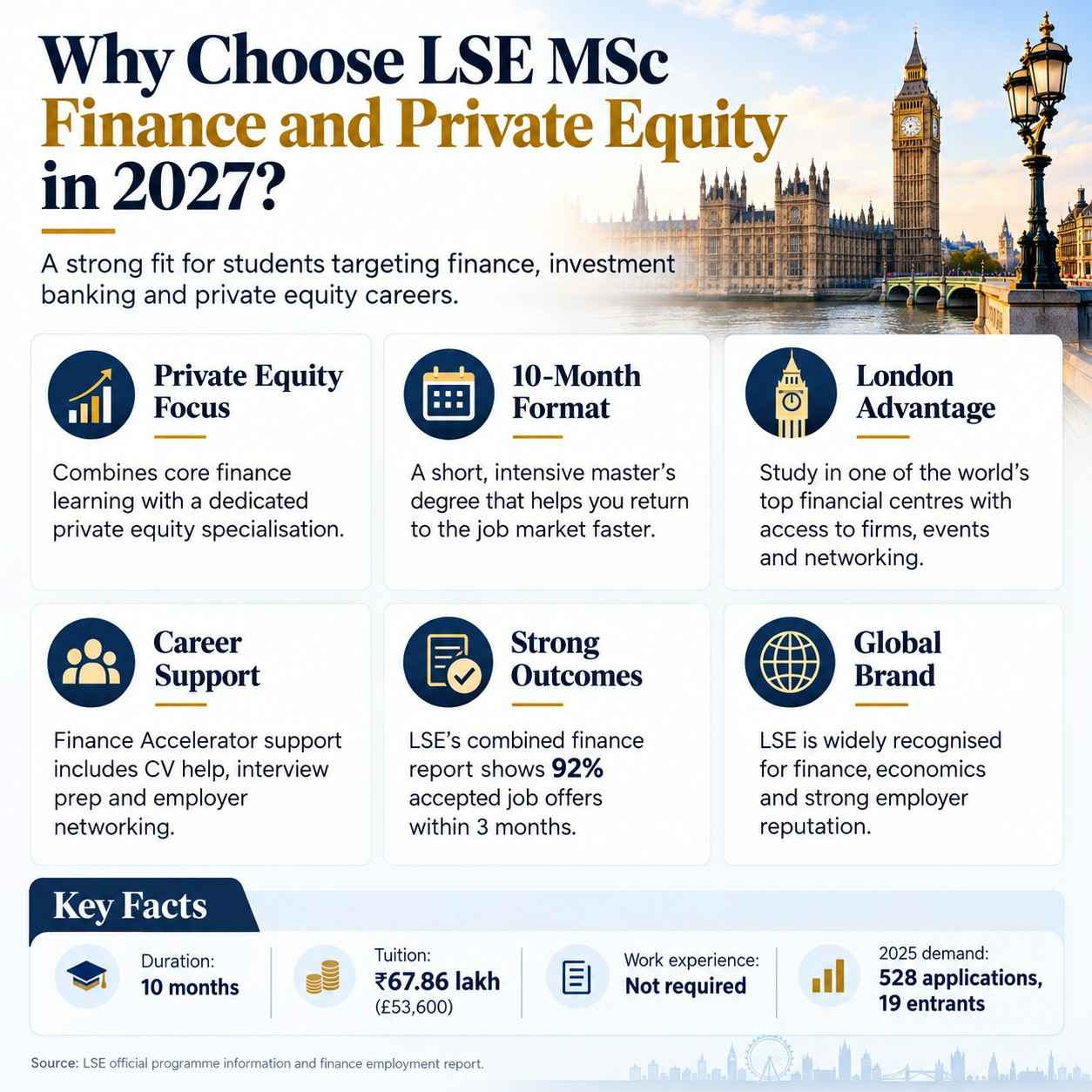
The LSE MSc Finance and Private Equity stands out because it combines a broad finance degree with a required private equity course. Students learn how financial markets work and how firms make investment decisions. They also study how private equity funds invest in businesses and create value.
This matters because private equity is not only about buying companies. It involves studying business performance, managing risks and planning how an investment can grow. The course helps students understand these decisions while building skills that also apply to investment banking and corporate finance.
Some of the main reasons students consider this programme include:
- Private equity specialisation: Learn how funds invest in companies, support growth and manage business change.
- Finance foundation: Build knowledge of company valuation, financial markets and investment decisions.
- Industry exposure: Learn through case studies and sessions with finance professionals.
- London location: Study in a city with major banks, investment firms and financial institutions.
- Career preparation: Access CV support, interview practice and alumni networking through the Finance Accelerator.
The course may suit fresh graduates who already have a clear interest in finance. It can also work for students with internship experience who want to develop their skills further. However, choosing a private equity degree does not guarantee a job in private equity. Students still need strong technical skills and relevant experience.
How Much Does LSE MSc Finance and Private Equity Cost in 2027?
The LSE MSc Finance and Private Equity fees for 2027/28 are ₹67.86 lakh (£53,600). This is the same tuition fee for UK and international students. However, living in London adds a large amount to the total cost.
LSE suggests budgeting at least ₹1.96 lakh (£1,550) per month for living expenses. This covers basic needs such as accommodation, food, transport and personal spending. Your actual expenses may be higher depending on where you live.
The table below gives an estimated budget for 10 months of study in London.
| Expense | Estimated Cost in INR (Original GBP) |
| Tuition Fees | ₹67.86 lakh (£53,600) |
| Monthly Living Expenses | ₹1.96 lakh (£1,550) |
| Living Expenses for 10 Months | ₹19.62 lakh (£15,500) |
| Total Tuition and Living Costs | ₹87.48 lakh (£69,100) |
| Visa, Healthcare and Flights | Additional expenses |
INR figures use an illustrative exchange rate of ₹126.60 per GBP. The total is a planning estimate, not a fixed cost. It excludes travel, visa charges and any living expenses beyond 10 months.
Students should also plan for the tuition deposit. LSE requires a deposit equal to 15% of the tuition fee, which is around ₹10.18 lakh (£8,040). This amount is part of the total tuition fee and is not charged separately.
Before accepting an offer, students should compare education loan terms and expected living costs. A small change in the exchange rate can also affect how much an Indian student pays in rupees.
Can Scholarships Reduce the Cost of Studying at LSE?
LSE offers financial support through university and department scholarships. Some awards depend on financial need, while others consider academic performance. Funding is competitive, so students should not assume they will receive a scholarship.
The main options worth exploring include:
- Graduate Support Scheme: Offers financial help to eligible students based on their financial situation.
- Women in Finance Scholarship: Provides up to ₹31.65 lakh (£25,000) towards tuition for selected female applicants.
- Antoine Faure-Grimaud Scholarship: Offers up to ₹31.65 lakh (£25,000) based on academic merit and financial need.
The funding deadline for LSE's needs-based awards is 22 April 2027. Students should apply early and check the requirements for each award. More details are available on the official LSE programme and funding page.
What Are the Admission Requirements for LSE MSc Finance and Private Equity?
![What Are the Admission Requirements for LSE MSc Finance and Private Equity]()
Getting into the LSE MSc Finance and Private Equity programme is competitive. LSE looks for students with strong grades, good mathematics skills and a clear interest in finance. Applicants can come from different academic backgrounds, including commerce, economics, engineering and other subjects.
The minimum requirement is a UK upper second-class degree or its international equivalent. Students must also have studied mathematics at a level equal to A-level Mathematics. This is important because the course uses calculus, statistics and financial analysis.
What Academic Background Do Indian Students Need?
Indian students normally need a recognised bachelor's degree of at least three years. LSE's general entry guide lists a CGPA of 7.6/10 as one possible equivalent of a UK 2:1 degree. Other grading scales have different requirements.
Meeting this minimum does not guarantee admission. LSE states that many students admitted in past years held first-class degrees or equivalent results. Applicants should check the official entry requirements for Indian students before applying.
Is GMAT or GRE Required for Admission?
Applicants without a UK undergraduate degree must submit a GMAT or GRE score. LSE accepts both tests but strongly prefers GMAT. The university does not publish a minimum score that guarantees admission.
Students should focus on building strong quantitative skills rather than targeting an unofficial cutoff. A good test score can support an application, but LSE also considers grades, references and the student's reasons for applying.
Can You Apply Without Work Experience?
Yes. Work experience is not required for LSE Finance and Private Equity. Fresh graduates can apply if they meet the academic and test requirements.
However, internships, finance projects and other relevant work can help. For example, a student who has worked on company valuation or financial research may have useful experience to discuss in the application.
How Difficult Is It to Get Into LSE MSc Finance and Private Equity?
The LSE MSc Finance and Private Equity receives far more applications than the number of students who join each year. In 2025, LSE reported 528 applications and 19 entrants. This gives an applications-to-intake ratio of about 28:1.
This does not mean the acceptance rate is 3.6%. The figures show applications and enrolled students, not the number of admission offers. LSE does not publish an official acceptance rate for this programme.
Students can improve their applications by showing clear evidence of their skills and interests. Instead of making broad claims about finance, they should explain what they have studied, worked on or learned.
Three areas deserve special attention:
- Academic preparation: Show strong performance in mathematics, statistics, finance or other demanding subjects.
- Practical experience: Discuss internships, investment research or projects involving financial data.
- Career direction: Explain why private equity interests you and how the degree supports your plans.
For example, an applicant who studied a company's financial statements could explain what they learned about business value. Such examples help show a real interest in finance and a clear reason for choosing the programme.
How Does the LSE MSc Finance and Private Equity Curriculum Work?
The LSE MSc Finance and Private Equity curriculum starts with core finance subjects before moving into private equity and other specialist areas. Students learn how businesses raise funds, how financial markets operate and how investors assess different opportunities.
The programme also includes a four-week pre-sessional course starting in late August 2027. This helps students prepare for the main degree and begin their career development.
What Will You Study During the Programme?
The course follows three teaching stages. Each stage builds on the skills learned in the previous one, moving from finance theory to more practical business problems.
- Autumn Term: Study Corporate Finance and Asset Markets. These courses cover company funding, financial markets and investment decisions.
- Winter Term: Study the required Private Equity course and select optional subjects based on your interests.
- Sprint Term: Apply finance concepts through Topics in Asset Management and Corporate Investment and Financial Policy.
Students can also explore optional courses such as mergers and buyouts, financial engineering, risk management, fixed income and sustainable finance. These choices help them develop skills for different areas of the finance industry.
How Is LSE MSc Finance Different From Finance and Private Equity?
Many students compare the LSE Masters in Finance with the specialist private equity degree. Both programmes follow almost the same structure and teach the same core finance subjects.
The main difference is the Private Equity course. It is compulsory in MSc Finance and Private Equity but optional in the general MSc Finance programme. This makes the specialist degree more suitable for students who already know they want to study private equity.
LSE also advises students not to choose these two degrees as their first and second programme choices in the same application. Applicants should select their preferred course and explain why it matches their interests.
What Salary Can You Expect After LSE MSc Finance and Private Equity?
![What Salary Can You Expect After LSE MSc Finance and Private Equity]()
The LSE MSc Finance and Private Equity salary depends on the job role, employer, location and previous experience. Graduates may work in investment banking, private equity, asset management, consulting and other finance roles.
LSE does not publish a separate average salary for MSc Finance and Private Equity. However, UK graduate salary research provides a useful reference for students who want to estimate possible earnings after graduation.
What Are the Average Starting Salaries in UK Finance?
Salary levels differ across finance roles. Investment banking often offers higher starting pay than many general finance positions. However, these jobs are also competitive and may involve long working hours.
The table below uses 2026 UK graduate salary data reported by Prospects. These are market benchmarks from major graduate employers, not salaries reported by LSE graduates.
| UK Graduate Career Area | Average Starting Salary in INR (Original GBP) |
| Banking and Finance | ₹57.60 lakh (£45,500) |
| Investment Banking | ₹75.96 lakh (£60,000) |
Source: Prospects UK Graduate Finance Jobs Guide.| LSE mfin salary
These figures should be used as general salary references. Actual offers may be lower or higher. Students should also consider income tax, housing costs and any education loan repayments when estimating their savings.
What Are the Career Opportunities After LSE MSc Finance and Private Equity?
The LSE MSc Finance and Private Equity can lead to careers across the finance sector. Its combination of general finance and private equity study gives graduates skills that apply to several roles.
LSE's combined 2025 employment report for MSc Finance and MSc Finance and Private Equity recorded strong outcomes. Around 92% of graduates accepted a job offer within three months, while 97% were employed within six months.
These figures cover both programmes together. They do not show employment rates for private equity students alone.
Which Career Paths Can Graduates Explore?
Students often focus on private equity before joining the course. However, the skills they develop can also be useful in banking, consulting and other investment-related roles.
- Investment Banking: Work on company deals, financial analysis, mergers and acquisitions.
- Private Equity: Study potential investments, assess businesses and support investment teams.
- Asset Management: Research investments and help manage portfolios.
- Financial Consulting: Support businesses with financial planning, performance and strategy.
LSE lists recent graduate employers such as Goldman Sachs, JP Morgan, Morgan Stanley, Citi, HSBC, UBS and McKinsey & Company. These are past graduate destinations and do not guarantee placement with any employer.
How Does LSE Help Students Prepare for Finance Jobs?
LSE offers career support through its Finance Accelerator. Students can attend CV workshops, practise interviews and learn about different areas of the finance industry. They can also meet alumni and professionals through networking events.
Career preparation is especially important because many finance firms start recruitment early. Students who want banking or private equity jobs should research employers and prepare their technical skills before the course begins.
Is LSE MSc Finance and Private Equity Worth It for Indian Students in 2027?
![Is LSE MSc Finance and Private Equity Worth It for Indian Students in 2027]()
The LSE MSc Finance and Private Equity can be worth considering for Indian students who want an international finance career. The university's London location, finance curriculum and career support are important advantages. However, the high cost makes financial planning essential.
With tuition and basic living costs estimated at ₹87.48 lakh (£69,100), students should think carefully about how they will pay for the degree. Education loans can help, but repayments will depend on interest rates and income after graduation.
Before making a decision, Indian students should consider the following:
- Career goals: Decide whether you want to work in private equity, banking or another area of finance.
- Total cost: Include tuition, living expenses, travel, visa fees and loan interest.
- Job market: Research graduate recruitment in the UK and the skills employers expect.
- Financial risk: Plan for a situation where finding a job takes longer than expected.
Students should also consider UK immigration rules. As of October 2026, eligible master's graduates applying for a Graduate visa on or after 1 January 2027 can receive 18 months of post-study permission. This does not guarantee a job or future visa sponsorship.
Check the UK Government Graduate visa guidance before making a final decision.
Who Should Consider This Degree?
The programme may be a good fit for students who enjoy mathematics, financial analysis and business research. It is also worth considering if you have already completed finance projects or internships and want deeper training.
However, students who are unsure about private equity may prefer a general MSc Finance degree with more freedom to choose subjects. Those with several years of work experience should also compare programmes designed for experienced finance professionals.
The best choice depends on how closely the course matches your skills, career goals and budget.
Related Blogs
Students planning a master's degree in finance can explore these related MiM-Essay guides. They cover other programmes, fees and career options in the UK.
Conclusion
The LSE MSc Finance and Private Equity offers a mix of finance knowledge, private equity training and access to London's financial sector. Its 10-month course can suit students who want careers in investment banking, private equity or related fields. However, the high tuition fee and competitive job market mean students should plan carefully. Indian applicants should compare the full cost, admission requirements, scholarships and career options before deciding whether this degree is the right investment for 2027.

 Abhyank Srinet