


 Abhyank Srinet
 The Singapore Management University MBA is a Singapore-based programme offered by the Lee Kong Chian School of Business. The full-time SMU MBA runs for 15 months with the flexibility to complete it within 10 months, while the part-time option runs for 20 months with the flexibility to finish within 15 months. For the August 2027 intake, tuition is approximately ₹62.07 lakh (S$82,840), inclusive of GST. The programme ranks #41 worldwide and #3 in Asia in the QS Global MBA Rankings 2027. Applicants need a bachelor's degree, at least two years of post-degree work experience and an accepted admissions test unless they qualify for one of SMU's specified exemptions.
What Are the Key SMU MBA Facts for 2027?
| SMU MBA Detail | Latest Official Information |
|---|---|
| Business School | Lee Kong Chian School of Business, Singapore Management University |
| Location | Singapore |
| Full-Time Duration | 15 months, with flexibility to complete within 10 months |
| Part-Time Duration | 20 months, with flexibility to complete within 15 months |
| Intakes | January and August |
| 2027 Tuition | Approx. ₹62.07 lakh (S$82,840), inclusive of GST |
| Application Fee | Approx. ₹7,492 (S$100), inclusive of GST |
| Minimum Work Experience | 2 years of post-degree full-time work experience |
| Admissions Tests | GMAT, GRE or SMU Admissions Test for eligible candidates |
| Official Minimum GMAT/GRE | No minimum score published |
| Official Acceptance Rate | Not officially disclosed |
| QS Global MBA 2027 | #41 worldwide / #3 in Asia |
| Financial Times Global MBA 2026 | #57 worldwide / #13 in Asia |
| Employment | 80% employed within 6 months |
Introduction
The SMU MBA at Singapore Management University's Lee Kong Chian School of Business is designed for professionals who want an accelerated management degree with a strong connection to Singapore and Asian business markets. Its curriculum combines core management subjects with digital transformation, analytics, leadership, elective flexibility and opportunities for practical industry exposure.
For applicants targeting the 2027 intake, several details have changed, including tuition, global rankings and fee arrangements. In this blog, we explain the SMU MBA class profile, admissions requirements, GMAT and GRE policy, curriculum, application deadlines, fees, scholarships, career outcomes and what Indian applicants should consider before applying.
What Makes the Singapore Management University MBA Different?
The SMU MBA stands out for its accelerated structure, location in central Singapore, flexible elective choices and strong emphasis on digital business, analytics and leadership.
Accelerated Full-Time Format
The standard full-time programme runs for 15 months, but students can complete all credit requirements within 10 months if they choose an accelerated route. This can appeal to professionals who want to reduce the time spent away from full-time employment.
Singapore Business Location
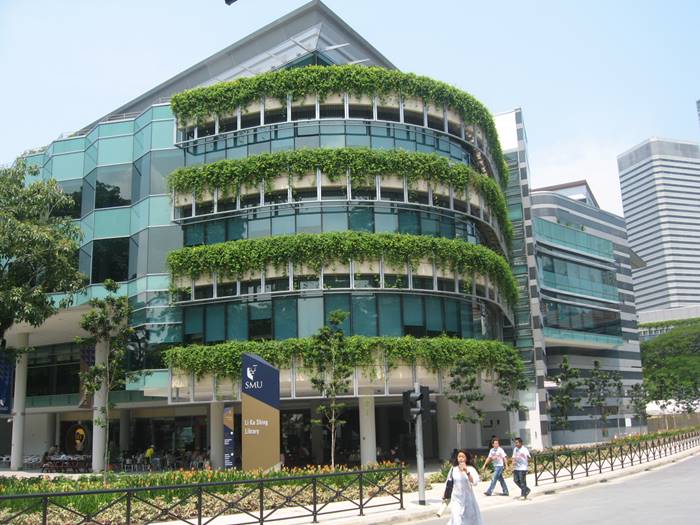
Singapore Management University is located in central Singapore, placing students close to one of Asia's major financial and corporate centres. This gives the programme a natural connection to employers, industry speakers and business networks across Singapore and Southeast Asia.
Digital and Analytical Focus
The curriculum includes Business Analytics and Leading Digital Transformation as core modules. SMU also integrates digital skills and analytical thinking across elective options in finance, marketing, operations and strategy.
International and Asian Exposure
Students can gain exposure to regional business environments through international exchange, immersion opportunities and classroom interaction with participants from different professional and national backgrounds.
What Is the SMU MBA Class Profile?

SMU's current MBA programme page displays an internationally diverse profile with an average age of 30, 63% international students, 26 nationalities and 5.9 years of average work experience.
However, SMU explicitly states that these figures are based on Full-Time and Part-Time MBA Classes from 2018–2021. A newer complete cohort profile is not currently published on the main programme page, so these numbers should not be described as a 2027 class profile.
| Profile Metric | Official Figure Displayed by SMU |
|---|---|
| Average Age | 30 |
| Average Work Experience | 5.9 years |
| International Students | 63% |
| Nationalities | 26 |
| Gender Ratio | 3:2 |
| Source Cohorts | Classes of 2018–2021 |
Applicants should therefore use these figures for general cohort context rather than treating them as current-year admissions statistics.
What Is the SMU MBA Acceptance Rate?
Singapore Management University does not officially publish a current MBA acceptance rate. Applicants should therefore avoid treating third-party figures such as 25%, 30%, 45% or 49% as verified SMU statistics.
Competitiveness is better assessed through the actual admission requirements: academic performance, professional achievements, leadership potential, work experience, admissions-test performance, essays, referee reports and interview performance.
What Are the SMU MBA Admission Requirements?
Applicants need a recognised bachelor's degree, at least two years of post-degree work experience and an accepted admissions test unless they qualify for one of SMU's specific exemptions.
| Requirement | Current SMU MBA Requirement |
|---|---|
| Academic Qualification | Recognised bachelor's degree |
| Work Experience | Minimum 2 years post-degree full-time experience |
| Admissions Test | GMAT, GRE or SMU Admissions Test for eligible candidates |
| Minimum GMAT/GRE | No official minimum score |
| TOEFL / IELTS | Required if previous undergraduate or postgraduate education was not taught in English |
| Resume | Required |
| Academic Transcripts | Required |
| Personal Statements | 2 required |
| Referee Reports | 2 |
| Interview | Online interview for shortlisted applicants |
Academic and Professional Profile
SMU looks for strong academic aptitude, professional accomplishments, leadership potential, international outlook and the ability to contribute meaningfully to the learning environment.
Work Experience
Two years of post-degree full-time work experience is the minimum requirement. SMU's published historical class-profile data shows that students have typically entered with considerably more experience, so applicants should focus on the quality and progression of their professional record rather than only meeting the minimum.
Does the SMU MBA Require GMAT or GRE?
Yes. Most applicants must submit the GMAT, GRE or an SMU Admissions Test score where they are eligible to take the SMU test. SMU does not publish a minimum GMAT or GRE score on its current MBA programme page.
The school states that stronger-than-average performance across verbal, quantitative and writing components can make an applicant more competitive.
Who Can Receive a Test Exemption?
SMU lists specific exemptions for recent graduates of SMU and Singapore's local autonomous universities who meet stated GPA requirements. These exemptions do not represent a general test waiver for all international applicants.
For a deeper test discussion, see our SMU MBA GMAT guide.
What Should Indian Applicants Know About the SMU MBA?
Indian applicants should view the SMU MBA as a Singapore-based programme with strong exposure to Asian business rather than simply as a shorter alternative to a U.S. or European MBA.
- Work experience: At least two years of post-degree full-time experience is required.
- Admissions test: Indian applicants should generally expect to submit GMAT, GRE or be approved to take the SMU Admissions Test because SMU's automatic GPA-based exemptions are tied mainly to specified Singapore institutions.
- English testing: TOEFL or IELTS is required only when previous undergraduate or postgraduate education was not conducted in English.
- Fees: International applicants for the August 2027 intake should budget around ₹62.07 lakh (S$82,840) in tuition before adding living costs.
- Scholarships: Indian applicants can explore eligible merit and leadership-based awards, but should check nationality conditions carefully because some awards are limited to ASEAN or other specified economies.
- Career geography: Applicants should decide whether they want to build a career in Singapore, Southeast Asia or another Asian market before judging the programme purely by salary rankings.
What Does the SMU MBA Curriculum Include?
The SMU MBA combines eight core modules with elective study across finance, leadership, operations, management, strategy, marketing and communications.
Eight Core Modules
The core curriculum covers the main management disciplines while incorporating analytical and digital skills.
- Corporate Finance
- Financial Accounting
- Leading Digital Transformation
- Business Analytics
- Marketing
- Operations Management
- Organisational Behaviour and Leadership
- Strategic Management
Elective Flexibility
Students select electives based on their professional interests. Current options span areas such as entrepreneurial finance, financial analytics, sustainable investing, supply-chain strategy, digital operations, entrepreneurship, design thinking, innovation, consumer behaviour and digital marketing.
Sustainability and ESG
SMU states that ESG content is integrated across its MBA core curriculum. Students also attend a compulsory sustainability workshop as part of the programme.
Experiential Learning
Full-time students can gain additional practical experience through internship opportunities, international exchange or other experiential formats depending on their programme pathway and intake.
Applicants can review the official Singapore Management University MBA programme for the latest curriculum.
When Are the SMU MBA Application Deadlines?

Singapore Management University offers both January and August MBA intakes, with several application periods during the year.
The dedicated SMU application page currently lists the following deadlines:
| Intake | Round | Application Deadline |
|---|---|---|
| January | Round 1 | 15 March |
| January | Round 2 | 15 July |
| January | Final | 31 October |
| August | Round 1 | 30 November |
| August | Round 2 | 28 February |
| August | Final | 31 May |
Applicants should confirm the final date in the live application portal before submission because SMU's programme-summary page can display slightly different final-day dates.
How Much Does the SMU MBA Cost in 2027?
For the August 2027 intake, SMU lists tuition at approximately ₹62.07 lakh (S$82,840), inclusive of GST. The fee is indicative and can be revised by the university.
| 2027 Fee Component | Approximate Cost |
|---|---|
| Tuition | ₹62.07 lakh (S$82,840), inclusive of GST |
| Application Fee | ₹7,492 (S$100), inclusive of GST |
| International Miscellaneous Fee from Aug 2027 | Approx. ₹35,964 (S$480), with applicable GST treatment per SMU's detailed fee note |
| Advance Tuition Fee from Aug 2027 | Approx. ₹7.49 lakh (S$10,000) |
What Scholarships Are Available for the SMU MBA?

SMU MBA partial scholarships can cover up to approximately ₹15.73 lakh (S$21,000) of tuition under the current published funding information, with no bond attached.
Scholarship categories currently listed by SMU include:
- Academic Excellence
- Global Awareness
- Leadership
- Community Impact
- Impact on Asia
- Women in Business
- SMU-ASEAN
Some scholarships are considered automatically when candidates meet the relevant criteria, while others require students to apply after admission.
Applicants should check eligibility carefully because nationality, academic performance, leadership background and admissions-test performance can affect individual awards.
How Is the SMU MBA Ranked in 2027?
The Singapore Management University MBA reached its highest Asian position in the QS Global MBA Rankings 2027, ranking #3 in Asia and #41 worldwide.
| Ranking | SMU MBA Position |
|---|---|
| QS Global MBA Rankings 2027 | #41 worldwide |
| QS Global MBA Rankings 2027 – Asia | #3 in Asia |
| Financial Times Global MBA Ranking 2026 | #57 worldwide |
| Financial Times Global MBA Ranking 2026 – Asia | #13 in Asia |
| FT 2026 Value-for-Money Indicator | #23 worldwide |
See the QS Global MBA Rankings and the SMU Financial Times ranking announcement for the latest ranking context.
What Are the Career Outcomes After the SMU MBA?
SMU reports that 80% of its MBA graduates are employed within six months of graduation. The programme also provides career support and access to a wider network of companies for internships, recruitment and industry engagement.
Financial Times Salary Data
The Financial Times Global MBA Ranking 2026 reports a weighted SMU MBA alumni salary of approximately ₹1.49 crore (US$155,830). This figure represents alumni earnings around three years after graduation and should not be interpreted as an average starting salary immediately after the MBA.
Career Support
SMU MBA students receive access to dedicated career counsellors, professional-development support and employer-networking opportunities throughout the programme.
For a more detailed career discussion, see our SMU MBA salary guide.
Is the SMU MBA Worth It for Indian Applicants?
Worth it if The SMU MBA can make sense if you want an accelerated MBA in Singapore, are interested in careers connected to Asian business markets and value a curriculum combining management fundamentals with analytics, digital transformation and leadership. Its central Singapore location, improving international rankings and shorter full-time format can also be attractive to professionals who want to reduce time away from work.
Think twice if You are primarily targeting U.S. or European recruiting markets, need a programme with a highly transparent recent employment report, or expect an MBA brand alone to guarantee a job in Singapore. Indian applicants should compare tuition, scholarships, visa and employment rules, target industry, salary expectations and education-loan repayment before deciding whether the SMU MBA fits their plans.
For a deeper decision analysis, read Is the SMU MBA Worth It?.
Conclusion
The Singapore Management University MBA is best suited to experienced professionals who want an accelerated management degree with strong exposure to Singapore and Asian business. Before applying, compare the programme's curriculum, career geography, scholarship opportunities and overall financial commitment with your post-MBA goals rather than relying on ranking or brand name alone.