
 Abhyank Srinet


Table of Contents
Choosing where to do your MBA is a big decision, and both Wharton and Booth are great options for anyone aiming to build a global career. These schools are known for their strong academics, world-class faculty, and excellent job placements in top companies like McKinsey, Google, and Goldman Sachs.
In this comparison of Wharton MBA vs Booth MBA, we’ll help you understand what makes each program special — from how they teach and what they focus on to who they’re best suited for. Whether you prefer a structured and leadership-focused MBA like Wharton or a flexible, analytical program like Booth, this guide will make it easier for you to choose the right one.
Quick Comparison – Wharton MBA vs Booth MBA
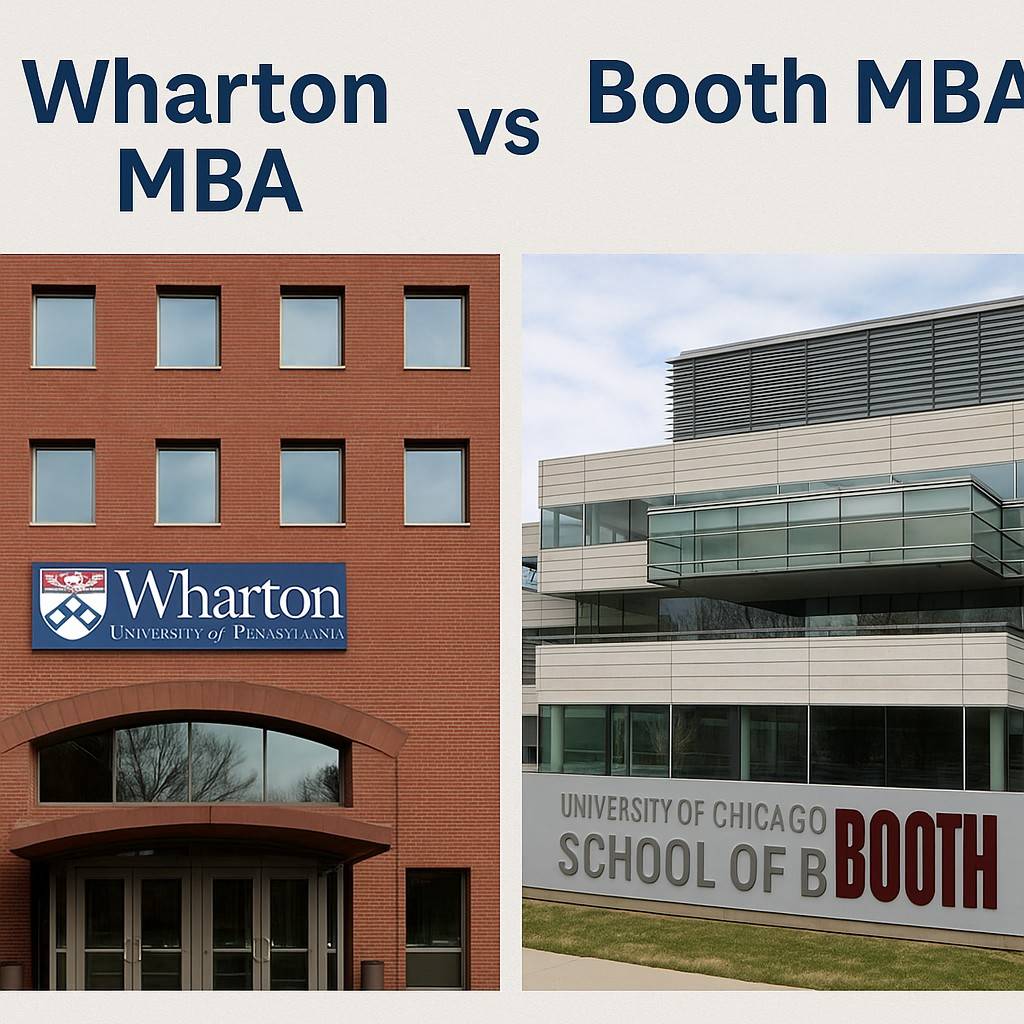
The Wharton School and Chicago Booth School of Business both offer top-tier MBA experiences, but with different strengths. Wharton focuses on structured leadership development, while Booth emphasizes flexibility and analytical rigor. Both programs attract talented professionals globally and provide strong career outcomes.
| Metric | Wharton MBA | Booth MBA |
|---|---|---|
| Tuition Fee (Annual) | $87,370 | $80,961 |
| Program Length | 24 months (Full-time) | 21 months |
| Location | Philadelphia, Pennsylvania | Chicago, Illinois |
| Average Work Experience | 5 years | 5 years |
| Estimated Total Cost (per year) | $118,568 (tuition + living expenses) | $119,286 |
| Average Salary (Post-MBA) | $175,000 (median base) | $175,000 (median base) |
| Job Offers Within 3 Months | 98% | 86.8% |
| Program Focus | Leadership, global business, finance | Flexibility, analytical thinking, and experiential learning |
Program Structure & Duration – Wharton MBA vs Booth MBA
.jpg)
The Wharton MBA vs Booth MBA comparison highlights how two of the world’s most prestigious business schools approach management education differently. Both programs offer world-class academics, strong career outcomes, and access to elite networks, yet their program design, duration, and learning philosophy set them apart.
Wharton MBA Program Structure
The Wharton MBA is a 24-month, full-time program built to balance academic depth with leadership development. It follows a semester-based system and combines a strong foundational core with extensive opportunities for customization.
Key Features of the Wharton MBA:
- Comprehensive Core Curriculum: The first year encompasses essential subjects such as accounting, microeconomics, marketing, finance, and operations. This ensures that every student develops a solid understanding of core business concepts.
- Customization Options: In the second year, students choose from 19 majors and over 200 electives, allowing them to specialize in areas such as Finance, Entrepreneurship & Innovation, Marketing, or Strategic Management.
- Leadership Development: The program integrates leadership growth through the McNulty Leadership Program, which focuses on teamwork, communication, and decision-making under pressure.
- Global Learning Opportunities: Students can opt for dual-degree programs through partnerships with Penn Law, Lauder Institute (MBA + MA in International Studies), or Penn Engineering to gain multidisciplinary exposure.
- Practical Experience: A mandatory summer internship bridges the first and second year, allowing students to apply theoretical knowledge to real-world business challenges.
- Program Duration: The Wharton MBA runs for 24 months, offering a balance between academic rigor and experiential learning.
Booth MBA Program Structure
The Chicago Booth Full-Time MBA is a 21-month program known for offering the most flexible curriculum among elite business schools. Rather than following a fixed core structure, Booth gives students complete control over their learning path.
Key Features of the Booth MBA:
- Flexible Curriculum Design: Apart from one required course, Leadership Effectiveness and Development (LEAD), students can completely design their academic paths. This freedom allows them to dive into electives and advanced topics from the very beginning.
- Quarter-Based Academic Calendar: Booth’s shorter quarters enable students to take more courses annually, creating a dynamic and fast-paced learning environment that encourages experimentation and depth.
- Analytical Focus: The Booth MBA is rooted in data-driven thinking. Every subject from finance to marketing emphasizes analytical problem-solving and evidence-based decision-making.
- Concentration Areas: Students can choose from 13 concentration areas, including Economics, Finance, Entrepreneurship, Strategic Management, and Analytic Finance, aligning the program closely with individual career goals.
- Experiential Learning: Booth integrates real-world exposure through lab courses, entrepreneurial challenges like the New Venture Challenge, and global immersion programs, helping students gain practical insights into diverse business settings.
- Program Duration: The full-time Booth MBA lasts 21 months, allowing students to complete their degree slightly faster without compromising academic depth.
Global Rankings – Wharton MBA vs Booth MBA

When it comes to choosing between the Wharton MBA vs Booth MBA, rankings play a big role in helping students understand each school’s global reputation. Both Wharton and Booth consistently appear at the top of major international rankings because of their academic excellence, leadership focus, and outstanding career outcomes.
| Ranking Source | Wharton MBA | Booth MBA |
|---|---|---|
| U.S. News & World Report 2024 (U.S.) | #1 | #3 |
| Financial Times Global MBA Rankings 2024 | #1 | #7 |
| QS Global MBA Rankings 2025 | #2 (Global) | #4 (Global) |
| Bloomberg Businessweek 2024–25 (U.S.) | #2 | #3 |
| The Economist (Final Rankings 2022) | #1 | #2 |
Wharton MBA vs Booth MBA Class Profile
When you compare the Wharton MBA vs Booth MBA, both attract ambitious, high-achieving professionals with strong academic and professional backgrounds. However, the class profiles show some interesting differences in diversity, size, and academic focus. Here’s a simple breakdown based only on official data from both schools.
| Metric | Wharton MBA | Booth MBA |
|---|---|---|
| Class Size | 874 students | 632 students |
| Applications Received | 6,194 | Not disclosed |
| Average Work Experience | 5 years | 5 years |
| Gender Composition | 44% Women, 56% Men | 42% Women, 58% Men |
| International Students | 26% | 38% |
| Countries Represented | 68 | 54 |
| Universities Represented | 240+ | 260+ |
| Average GMAT | 733 | 730 |
| Average GPA | 3.7 | 3.6 |
| Top Pre-MBA Industries | Consulting, Finance, Tech | Consulting, Finance, Tech |
| Location | Philadelphia, Pennsylvania | Chicago, Illinois |
Scholarships and Financial Aid – Wharton MBA vs Booth MBA

Both Wharton and Booth provide extensive financial aid opportunities to help students manage the cost of their MBA programs. Each school offers a mix of fellowships, scholarships, and loan options, with merit-based awards automatically considered during admission. Here’s a simplified and factual comparison based on official school sources.
Wharton MBA Scholarships and Financial Aid
The Wharton MBA Financial Aid Office offers multiple funding options for admitted students, ensuring that finances do not stand in the way of earning a world-class business education.
1. Wharton Fellowship Program:
- All admitted students are automatically considered for the Wharton Fellowship, which is awarded purely on merit.
- The fellowship does not require a separate application—the admissions committee reviews each student’s academic achievements, leadership experience, and professional accomplishments during evaluation.
- Fellowships are typically awarded for two academic years and are split equally over four semesters.
- The award amount varies based on the applicant’s profile and funding availability.
2. Disbursement & Usage:
- Fellowship funds are directly applied to tuition and fees.
- If students receive any external sponsorships or scholarships that cover full tuition, the Wharton Fellowship may be adjusted accordingly.
3. Additional Aid Options:
- Wharton encourages students to explore external scholarships, corporate sponsorships, and government programs.
- The school also guides federal and private student loans for U.S. citizens and international loan programs that do not require a U.S. co-signer.
Booth MBA Scholarships and Financial Aid
The Chicago Booth School of Business also offers generous financial aid to full-time MBA students through merit-based scholarships, fellowships, and loans.
1. Merit-Based Scholarships:
- Every applicant is automatically considered for Booth’s merit-based scholarships; no separate application is needed.
- Awards are based on academic excellence, professional achievements, leadership potential, and overall contribution to the Booth community.
- Scholarships can range from partial tuition to full tuition coverage, depending on merit and availability.
2. Named Fellowships:
Booth offers several specialized fellowships for outstanding students, including:
- The Ramakrishnan Family Fellowship (for students demonstrating academic excellence and leadership potential).
- The Distinguished Fellowship (for top applicants across industries).
- Forté Foundation Fellowships (for women who exhibit leadership in business).
- The Civic Scholars Program (for students committed to public or nonprofit sectors).
3. International Student Support:
- All scholarships and fellowships at Booth are open to international students.
- The school also partners with loan providers to offer financing options without requiring a U.S. co-signer.
4. Loan Programs:
- Booth provides access to federal student loans for U.S. citizens and private educational loans for both domestic and international students.
Which Program Should You Choose?
Deciding between the Wharton MBA and the Booth MBA can be tough because both are world-class programs with excellent professors, strong networks, and great job outcomes. The real difference lies in how you like to learn and where you see your career going after graduation.
Why Choose the Wharton MBA
The Wharton MBA is great if you want a well-structured program that focuses on leadership and real-world business strategy. It’s perfect for students who want to work in finance, consulting, or global management and prefer a mix of guidance and flexibility.
Why Wharton might be right for you:
- It offers a structured curriculum that builds a solid foundation in business before letting you specialize in one of 19 majors.
- The McNulty Leadership Program helps you grow as a leader through practical learning and real-world challenges.
- You’ll gain global exposure through study trips, dual degrees, and international partnerships.
- Wharton has one of the strongest alumni networks in the world, with more than 100,000 members across 150 countries.
- Career opportunities are incredible — many graduates go into top firms like McKinsey, BCG, Bain, and Goldman Sachs.
Choose Wharton if you like a structured program, value leadership development, and want to build an international career with a powerful network behind you.
Why Choose the Booth MBA
The Booth MBA is the right fit if you prefer flexibility, independence, and a more analytical way of learning. It’s ideal for students who want to take charge of their studies and customize their MBA journey.
Why Booth might be right for you:
- The curriculum is fully flexible — apart from one required course (LEAD), you design your own path.
- It’s known for being data-driven and analytical, making it perfect for careers in finance, strategy, technology, or entrepreneurship.
- The smaller class size creates a more close-knit and collaborative environment.
- Students enjoy more freedom to explore different subjects and career interests.
- Graduates often land roles in investment banking, private equity, and consulting, with excellent post-MBA salaries.
Choose Booth if you like having control over your learning, enjoy working with data, and prefer a program that rewards independent, analytical thinkers.
Related Blogs
- Wharton MBA Essays
- Wharton MBA Interview questions
- Chicago MBA Essays
- Chicago MBA interview questions
Conclusion
Both the Wharton MBA and Booth MBA offer incredible opportunities to grow your career and leadership skills. Wharton is ideal if you prefer structure, teamwork, and a strong global network, while Booth suits those who enjoy flexibility, data-driven learning, and independent thinking. No matter which you choose, both programs will help you build valuable connections, gain real-world experience, and open doors to top global careers. The best choice depends on how you like to learn and the kind of business leader you want to become.


