
 Abhyank Srinet


Columbia MBA has 5 confirmed 2027 application deadlines across 2 entry options. January 2027 Entry has 2 rounds: 17 June 2026 and 13 August 2026. August 2027 Entry has 3 rounds: 9 September 2026, 5 January 2027, and 29 March 2027. Indian applicants should target August Entry Round 1 or Round 2 for internships, scholarships, GMAT/GRE score reporting, recommendations, and visa planning. Columbia releases January-entry decisions on a rolling basis, while August-entry final decisions arrive on 14 December 2026, 24 March 2027, and 12 May 2027. Application fee is approximately ₹23,830 ($250). Test codes: GMAT QF8-N6-52; GRE 6442 for reporting.
Introduction
The Columbia MBA deadlines for 2027 are important for Indian applicants because Columbia Business School has 2 different entry options: January Entry and August Entry. January Entry is a 16-month accelerated MBA without the traditional summer internship, while August Entry follows the standard MBA path with internship access. This means your deadline choice affects not only admission timing, but also internship planning, scholarship review, education loan timing, visa preparation, and post-MBA career strategy.
For most Indian applicants targeting consulting, finance, technology, product management, or leadership roles in the US, the August Entry is usually the safer option because it includes the traditional summer internship. However, the January Entry can be useful for entrepreneurs, sponsored candidates, family business applicants, or professionals who do not need a summer internship. Before choosing your round, review the official Columbia MBA options and deadlines page and align your timeline with your GMAT/GRE score, essays, recommendation, funding, and visa plan.
Columbia MBA Deadlines 2027 — Complete Table
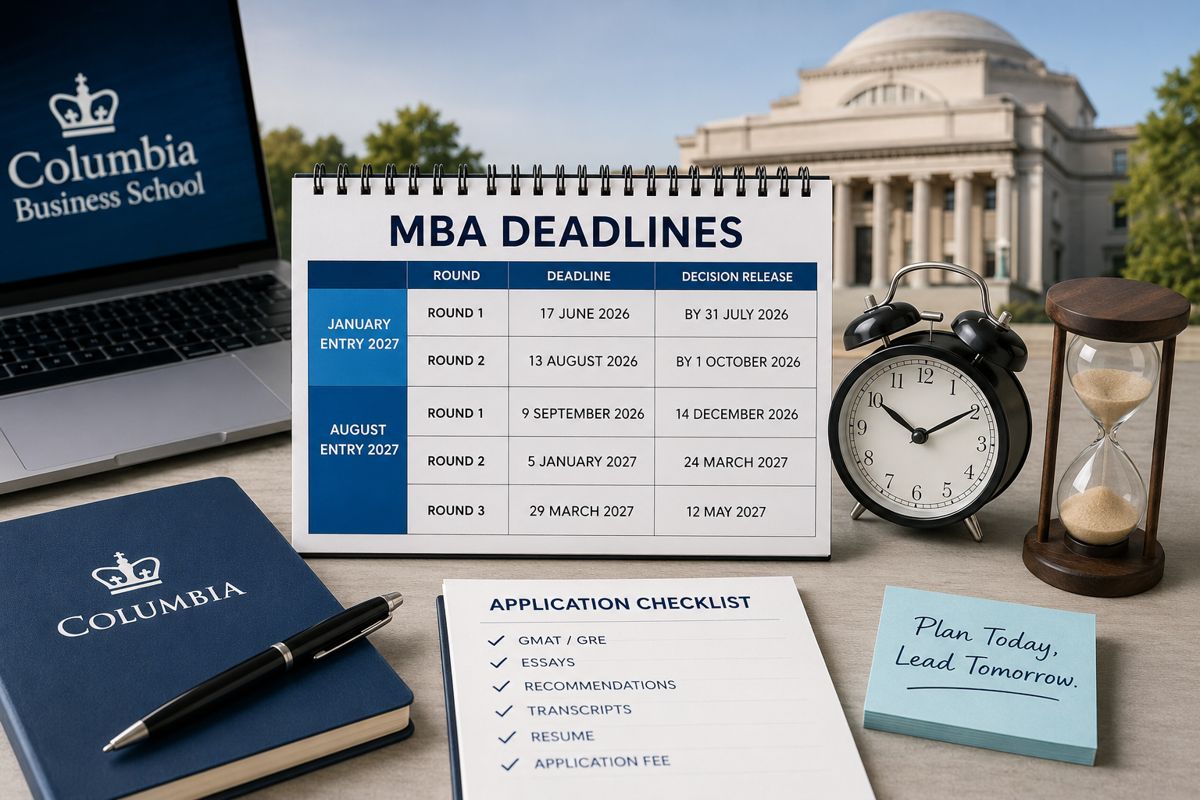
Below are all confirmed Columbia MBA application deadlines for the January 2027 and August 2027 entry options, including interview decision dates and final decision release dates.
| Entry Option | Round | Application Deadline | Interview Decisions Released | Final Decisions Released | Best For Indian Applicants |
|---|---|---|---|---|---|
| January 2027 Entry | Round 1 | 17 June 2026 at 12:00 PM ET | Rolling | Ongoing, no later than 31 July 2026 | Sponsored candidates, entrepreneurs, and applicants not needing a summer internship |
| January 2027 Entry | Round 2 | 13 August 2026 at 12:00 PM ET | Rolling | Ongoing, no later than 1 October 2026 | Late January-entry applicants with strong funding and clear career plans |
| August 2027 Entry | Round 1 | 9 September 2026 at 12:00 PM ET | By 2 November 2026 | 14 December 2026 | Best round for Indian applicants targeting scholarships and internships |
| August 2027 Entry | Round 2 | 5 January 2027 at 12:00 PM ET | By 17 February 2027 | 24 March 2027 | Strong fallback if GMAT/GRE, essays, or recommendations need more time |
| August 2027 Entry | Round 3 | 29 March 2027 at 12:00 PM ET | By 30 April 2027 | 12 May 2027 | Only if profile is complete and funding/visa planning is already strong |
These dates are listed on the official Columbia Business School MBA options and deadlines page. Last verified: July 2026.
Columbia MBA January Entry vs August Entry — Which Deadline Should You Choose?
Indian applicants should choose August Entry if they want the traditional MBA internship route, and January Entry if they do not need a summer internship. Columbia’s January-entry MBA is completed in 16 months over 4 consecutive semesters and does not include the traditional summer internship break. This makes it better suited for entrepreneurs, family business applicants, sponsored candidates, or professionals who already have a clear return-to-work plan.
The August Entry is usually better for Indian applicants who want to recruit for consulting, investment banking, technology, product management, private equity, venture capital, or leadership development roles in the US. The summer internship gives international students a structured way to test a function, build US work experience, and convert internship performance into a full-time offer. For this reason, Indian applicants who are unsure between the 2 entry options should usually prioritize August Entry unless they have a strong reason to skip the internship.
Columbia MBA Round-by-Round Guide
January Entry Round 1 — 17 June 2026
January Entry Round 1 is the best Columbia MBA deadline for applicants who want the accelerated 16-month MBA and already have a clear career plan. Indian applicants should use this round if they are sponsored, returning to a family business, building a venture, or not dependent on a US summer internship. Since January-entry applications are reviewed on a rolling basis within each round, applying earlier can improve your timing for a faster decision. This round also leaves more time for funding, visa preparation, and relocation before the January start.
January Entry Round 2 — 13 August 2026
January Entry Round 2 is the final round for candidates targeting the January 2027 Columbia MBA. Indian applicants should be careful with this round because final decisions may arrive as late as 1 October 2026, which leaves a shorter window for visa documentation, funding, accommodation, and travel. This round is practical only if your GMAT/GRE score, essays, recommendation, and funding plan are already strong. If you need a summer internship or want more time, August Entry is usually safer.
August Entry Round 1 — 9 September 2026
August Entry Round 1 is the strongest Columbia MBA deadline for Indian applicants targeting scholarships, internships, and a smoother visa timeline. It gives the most time between admission decision and programme start, which helps with education loans, visa documentation, accommodation, and relocation to New York. If your GMAT/GRE score and essays are ready by August 2026, this should be your target round. Indian applicants aiming for competitive post-MBA careers should treat this as the priority round.
August Entry Round 2 — 5 January 2027
August Entry Round 2 is the best fallback for Indian applicants who need more time to improve test scores, strengthen essays, or secure a better recommendation. It still gives a workable timeline because final decisions are released on 24 March 2027. However, Indian applicants should not wait until January unless the extra time clearly improves the application. Round 2 can be a smart choice if it helps you submit a stronger GMAT Focus Edition, GRE, essay story, or leadership profile.
August Entry Round 3 — 29 March 2027
August Entry Round 3 is the final Columbia MBA deadline for the August 2027 intake. Indian applicants should use this round only if the application is complete and funding is already planned. The final decision date of 12 May 2027 leaves less time for visa preparation, housing in New York, loan disbursement, and travel. Round 3 is possible, but it is not ideal for scholarship-dependent Indian applicants or students who need a relaxed visa timeline.
Best Round to Apply for Indian Applicants — Columbia MBA

For Indian applicants, August Entry Round 1 is the best Columbia MBA round, and August Entry Round 2 is the safest fallback. January Entry can work only if you do not need the traditional summer internship and already have a clear career plan.
The first reason is internship access. Many Indian applicants apply to US MBA programmes to switch careers, build US work experience, and access structured recruiting. In that case, August Entry is usually stronger because it includes the summer internship path. January Entry is faster, but it is not designed around the traditional internship route.
The second reason is scholarship and funding timing. Early application gives you more time to understand fellowship options, external funding, education loans, and financial documentation. Columbia’s Financial Aid Office notes that the MBA is a major investment and provides budget planning support through its official cost and aid resources. Indian applicants should therefore avoid leaving funding planning until after admission.
The third reason is visa timing. After admission, Indian students need time for I-20 processing, SEVIS fee payment, DS-160 completion, visa appointment scheduling, financial documents, housing, travel, and pre-arrival steps. A Round 1 or Round 2 August Entry admit has more time to manage these steps than a late Round 3 applicant.
The practical recommendation is simple: apply to August Entry Round 1 if your profile is ready by September 2026. Apply to August Entry Round 2 if you need extra time for GMAT/GRE, essays, or recommendation quality. Choose January Entry only if the no-internship format fits your goals.
Columbia MBA Application Timeline for Indian Students
This timeline is designed for Indian applicants targeting Columbia MBA August Entry Round 1 or Round 2. If you are applying for January Entry, move the same preparation steps earlier by 2–3 months.
| When | What Indian Applicants Should Do |
|---|---|
| 8–9 months before deadline | Start GMAT Focus Edition, Executive Assessment, or GRE preparation. Build a realistic score target based on Columbia’s competitiveness. |
| 6–7 months before deadline | Research Columbia MBA, January vs August Entry, career outcomes, New York recruiting, and post-MBA role fit. |
| 5–6 months before deadline | Shortlist recommenders and confirm whether your current supervisor or a senior professional contact can support your application. |
| 4–5 months before deadline | Take your first test attempt and request transcripts from your Indian university. |
| 3–4 months before deadline | Start essays, short answers, resume, and Columbia-specific career story. |
| 2–3 months before deadline | Finalize school fit, leadership examples, community impact examples, and recommendation inputs. |
| 6 weeks before deadline | Complete a full application review and confirm test score reporting. Columbia’s GMAT/EA code is QF8-N6-52 and GRE code is 6442. |
| 2 weeks before deadline | Submit the application, pay the application fee of approximately ₹23,830 ($250), and confirm all materials are complete. |
| After interview invite | Prepare for Columbia-specific interview questions, career goals, leadership examples, and New York fit. |
| After admission | Begin I-20, visa, funding, accommodation, and travel planning immediately. |
Columbia MBA Cost and Funding Snapshot for Indian Applicants
The latest published Columbia MBA August Entry first-year budget is approximately ₹1.36 crore ($143,030), including tuition of approximately ₹89.51 lakh ($93,908). For January Entry, the latest published first-year budget is approximately ₹1.30 crore ($136,104). Indian applicants should use these figures for education loan planning, scholarship planning, and visa financial documents.
| Cost Item | August Entry Amount | January Entry Amount | What It Means for Indian Applicants |
|---|---|---|---|
| Tuition | Approximately ₹89.51 lakh ($93,908) | Approximately ₹89.51 lakh ($93,908) | This is the largest cost component and should be planned early with loans, savings, scholarships, or sponsorship. |
| Mandatory fees | Approximately ₹6.47 lakh ($6,783) | Approximately ₹5.71 lakh ($5,989) | Fees differ slightly by entry format and are part of the official cost of attendance. |
| Health insurance | Approximately ₹5.55 lakh ($5,823) | Approximately ₹3.44 lakh ($3,605) | Health insurance is a major planning item for Indian applicants moving to the US. |
| Books and supplies | Approximately ₹1.23 lakh ($1,290) | Approximately ₹1.23 lakh ($1,290) | This covers academic material and should be included in your MBA budget. |
| Food and housing | Approximately ₹28.82 lakh ($30,231) | Approximately ₹25.61 lakh ($26,872) | New York living costs are high, so Indian applicants should keep extra buffer beyond the official estimate. |
| Personal expenses | Approximately ₹3.47 lakh ($3,636) | Approximately ₹3.08 lakh ($3,232) | Useful for mobile, clothing, local travel, setup costs, and miscellaneous expenses. |
| Transportation | Approximately ₹1.30 lakh ($1,359) | Approximately ₹1.15 lakh ($1,208) | Add extra India-US flight costs separately because actual travel costs vary. |
| First-year total budget | Approximately ₹1.36 crore ($143,030) | Approximately ₹1.30 crore ($136,104) | This is the official budget used for financial planning and funding estimates. |
| Application fee | Approximately ₹23,830 ($250) | Approximately ₹23,830 ($250) | This non-refundable fee must be paid when submitting the application. |
Columbia lists the full MBA budget on its Full-Time MBA cost page. INR conversions are approximate and use $1 = ₹95.319, checked on 2 July 2026. Actual bank, card, and education loan conversion rates may vary.
Columbia MBA Scholarship Deadlines — What Indian Applicants Need to Know

Indian applicants should apply early for Columbia MBA scholarships and fellowships because funding review is closely linked to the admissions timeline. Columbia Business School provides financial aid resources and recognizes students who demonstrate exceptional academic achievement and professional potential. However, Indian applicants should not wait until later rounds if funding is important.
Round 1 for August Entry is the safest round if you want maximum time for fellowship review, external scholarships, education loan comparison, and financial documentation. Round 2 is still workable if your profile improves significantly with extra time. Round 3 should be treated carefully because final decisions arrive in May 2027, leaving less room for funding, visa, and housing planning.
For January Entry, Indian applicants should apply as early as possible within the round because applications are reviewed on a rolling basis. Since January Entry starts sooner and has a compressed timeline, funding planning should begin before submission, not after admission.
Columbia MBA Deadline History — How Dates Have Shifted
Columbia MBA deadlines have become more structured compared with the older rolling-admissions model, especially for August Entry. For Indian applicants, this makes planning easier because interview and final decision dates are now clearer for each round.
| Entry / Round | 2027 Deadline | Pattern | Applicant Impact |
|---|---|---|---|
| January Entry Round 1 | 17 June 2026 | Early summer deadline | Best for fast decision and smoother relocation before January start. |
| January Entry Round 2 | 13 August 2026 | Final January-entry deadline | Tighter visa and funding timeline for Indian applicants. |
| August Entry Round 1 | 9 September 2026 | Early fall deadline | Strongest round for Indian applicants targeting scholarships and internships. |
| August Entry Round 2 | 5 January 2027 | Post-year-end deadline | Good fallback if the extra time improves test score or essays. |
| August Entry Round 3 | 29 March 2027 | Final August-entry deadline | Useful only if profile and funding are already complete. |
The key observation is that Indian applicants should not treat Columbia MBA as a last-minute application. Because Columbia has separate January and August pathways, your first decision should be entry format, and your second decision should be round strategy.
What Happens If You Miss the Columbia MBA Deadline?

Missing a Columbia MBA deadline means you must apply in the next available round, or wait for the next entry cycle if the final round has passed. Columbia requires all materials, including the application fee and recommendation, to be submitted before the deadline for the application to be considered complete.
If you miss January Entry Round 1, you can still apply in January Entry Round 2. If you miss January Entry Round 2, you should evaluate August Entry instead. If you miss August Entry Round 1, Round 2 remains a strong fallback. If you miss August Entry Round 3, use the next cycle to strengthen your test score, essays, recommendation, career story, and funding plan.
Columbia MBA Documents Required by the Deadline
By the Columbia MBA deadline, applicants must submit a complete online application, valid test score, recommendation, essays, resume, transcripts, and the application fee of approximately ₹23,830 ($250). Columbia states that all application materials, including the recommendation and application fee, must be submitted before the deadline.
| Document / Requirement | What Indian Applicants Should Prepare |
|---|---|
| Online application form | Complete the Columbia MBA online application before the round deadline. |
| Application fee | Pay approximately ₹23,830 ($250) before submission. |
| Transcripts | Upload scanned PDF transcripts from each undergraduate and graduate institution attended. |
| GMAT / Executive Assessment / GRE | Submit a self-reported valid score. Columbia’s GMAT/EA code is QF8-N6-52 and GRE code is 6442. |
| Resume | Upload a current professional resume, ideally one page, showing impact, leadership, and career growth. |
| Essays and short answers | Prepare Columbia’s short answer questions and essays based on your selected entry term. |
| Recommendation | Submit one professional recommendation, ideally from a current supervisor if possible. |
| Interview | Prepare after receiving an invite. Interviews are by invitation only. |
Indian applicants should not leave recommendations until the final week. Corporate recommenders in India can get busy during year-end, appraisal cycles, quarter close, or travel periods. Share your achievements and career context early so the recommendation is specific, not generic.
Columbia MBA GMAT and GRE Deadline for Indian Applicants
.jpeg)
Indian applicants should complete the GMAT Focus Edition, Executive Assessment, or GRE at least 4–6 weeks before their Columbia MBA target deadline. Columbia allows applicants to self-report a valid GMAT, Executive Assessment, or GRE score at submission, and admitted students must later submit the official score.
Columbia Business School’s GMAT and Executive Assessment code is QF8-N6-52, and its GRE code is 6442. The school accepts both the GMAT Exam 10th Edition and the GMAT Focus Edition. If your score is expiring soon, Columbia says applicants should send the score report and submit the application at least one week before the score expires.
For Indian applicants, the safer approach is to complete testing early and leave time for one retake. Do not rush Round 1 with a weak score if Round 2 gives you enough time to submit a stronger application.
Columbia MBA Interview Timeline After the Deadline
Columbia MBA interview timelines depend on the entry option and round. January-entry applications are reviewed on a rolling basis within each round, while August-entry interview decision dates are fixed by round.
| Entry / Round | Interview Decision Timing | Indian Applicant Preparation Tip |
|---|---|---|
| January Entry Round 1 | Rolling | Prepare immediately after submission because decision movement can happen before the final notification date. |
| January Entry Round 2 | Rolling | Keep visa and funding documents ready because the start date is closer. |
| August Entry Round 1 | By 2 November 2026 | Start interview prep by October 2026, especially for career goals and Columbia fit. |
| August Entry Round 2 | By 17 February 2027 | Use January and early February to prepare leadership, teamwork, and why-CBS answers. |
| August Entry Round 3 | By 30 April 2027 | Prepare quickly because final decisions arrive on 12 May 2027. |
For Indian applicants, the Columbia MBA interview should show clear career direction, maturity, leadership, community fit, and understanding of New York’s business ecosystem. You can also review our Columbia MBA interview questions guide for structured preparation.
Related Blogs
- Columbia MBA Review
- Columbia MBA Essays
- Columbia MBA Interview Questions
- Columbia MBA Salary
- Study Abroad Consultants
Conclusion
Columbia MBA deadlines are more than application dates; they decide your entry format, internship access, scholarship timing, education loan planning, visa preparation, and relocation timeline. For Indian applicants, August Entry Round 1 is usually the best choice because it gives the strongest timeline for internships, funding, and post-admit planning. August Entry Round 2 is a strong fallback if extra preparation improves your GMAT/GRE score, essays, or recommendation. January Entry can be a smart option only when you do not need the traditional summer internship and already have a clear career path.
If you are serious about Columbia MBA, start at least 8–9 months before your target deadline. Complete your test early, plan your recommendation carefully, keep transcripts ready, and build a strong Columbia-specific career story. A strong Columbia MBA application is not created in the final week; it is built through clear positioning, strong examples, and timely submission.