


 Abhyank Srinet
Quick Answer: What Is FSFM MFin?
FSFM MFin is the Master of Finance (MSc) offered by Frankfurt School of Finance & Management in Germany. It is a two-year, full-time, English-taught programme worth 120 ECTS credits. Its three-day study model allows students to combine classroom learning with opportunities for internships and part-time professional experience.For the August 2027 intake, tuition is approximately ₹46.85 lakh (€44,000), excluding enrolment and application fees. The final application deadline is 30 June 2027.
Introduction
The FSFM MFin at Frankfurt School of Finance & Management is designed for graduates and young professionals interested in careers in investment banking, corporate finance, capital markets and risk management. Located in Frankfurt, the programme combines finance theory with practical learning, quantitative analysis and exposure to the financial services industry.
Indian applicants considering Frankfurt School's Master of Finance for 2027 should compare tuition, admission requirements, scholarships, curriculum and employment outcomes before applying. This guide explains the latest verified programme information, including the three-day study model, GMAT requirements, career statistics and financial considerations.
What Are the Quick Facts About FSFM MFin?
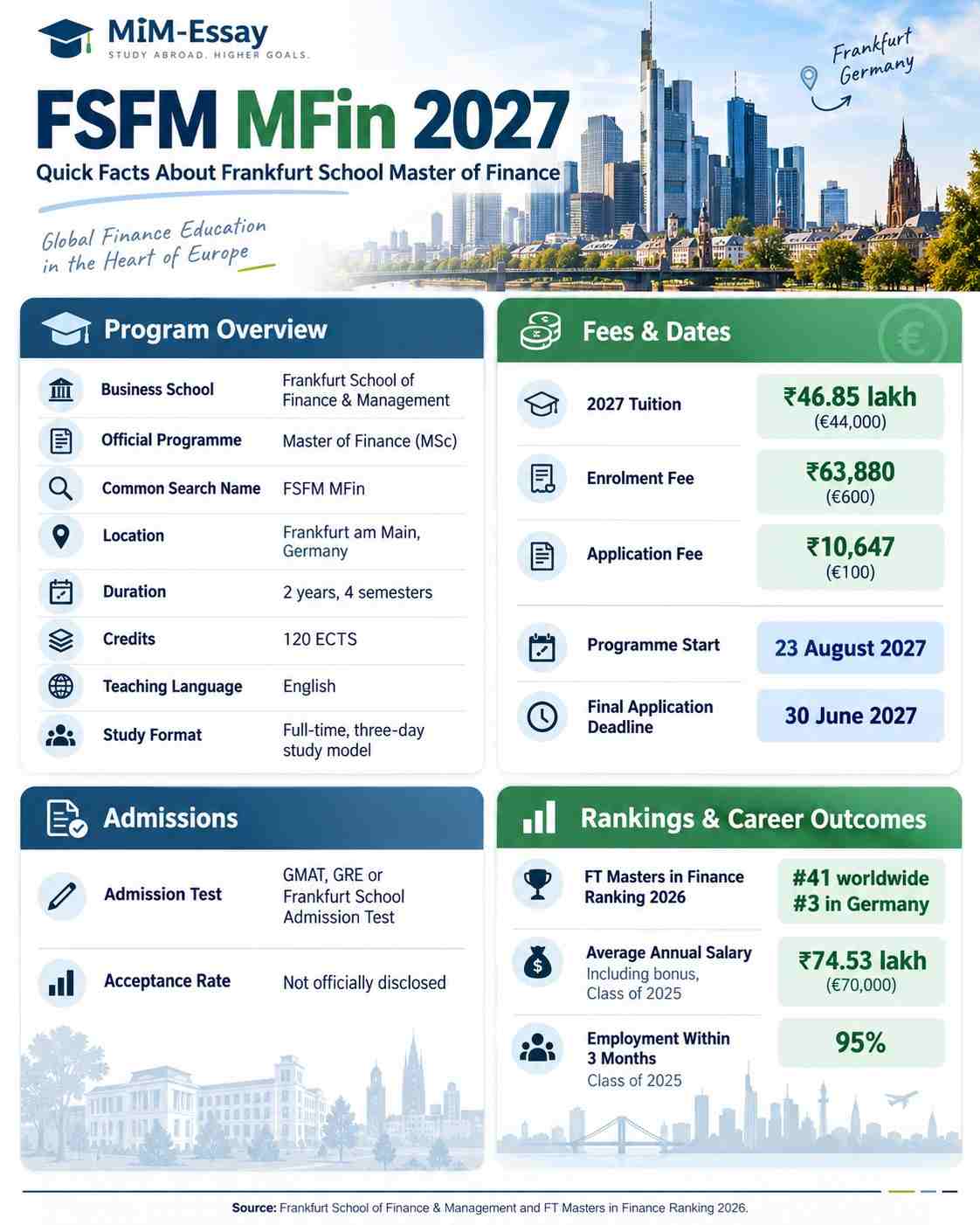
| Factor | Latest Verified Information |
|---|---|
| Business School | Frankfurt School of Finance & Management |
| Official Programme | Master of Finance (MSc) |
| Common Search Name | FSFM MFin |
| Location | Frankfurt am Main, Germany |
| Duration | 2 years, 4 semesters |
| Credits | 120 ECTS |
| Teaching Language | English |
| Study Format | Full-time, three-day study model |
| 2027 Tuition | ₹46.85 lakh (€44,000) |
| Enrolment Fee | ₹63,880 (€600) |
| Application Fee | ₹10,647 (€100) |
| Programme Start | 23 August 2027 |
| Final Application Deadline | 30 June 2027 |
| Admission Test | GMAT, GRE or Frankfurt School Admission Test |
| FT Masters in Finance Ranking 2026 | #41 worldwide, #3 in Germany |
| Average Annual Salary | ₹74.53 lakh (€70,000), including bonus, Class of 2025 |
| Employment Within 3 Months | 95%, Class of 2025 |
| Acceptance Rate | Not officially disclosed |
Why Choose Frankfurt School Master of Finance?
Frankfurt School's Master of Finance combines advanced financial education with a study format designed to support professional experience. Students learn core finance concepts while developing analytical and practical skills relevant to financial institutions and corporate roles.
Location in Frankfurt
Frankfurt is an important financial centre in Germany and home to major banking and financial institutions. Studying in the city can provide exposure to finance-related employers, professional events and industry networks.
However, the university's location does not guarantee employment. Applicants should evaluate their previous experience, language abilities and eligibility to work in Germany.
Three-Day Study Model
The FSFM MFin follows a three-day study model, with classes scheduled over two weekdays and one Saturday. The remaining days provide flexibility for internships, part-time employment, independent study and professional development.
This is a full-time academic programme, not a part-time degree. Students must still complete the required coursework and examinations.
Professional Finance Resources
Frankfurt School provides access to financial data and analytical tools such as Bloomberg and FactSet. Its programme also incorporates Python and practical market analysis.
The school maintains educational connections with organisations including CFA Institute, CAIA Association and GARP, which may be useful for students exploring professional finance qualifications.
What Are the FSFM MFin Admission Requirements for 2027?
FSFM MFin applicants need a recognised undergraduate degree, adequate English proficiency, an accepted admission assessment and a successful interview. Frankfurt School welcomes applicants from finance, economics, business and other relevant quantitative backgrounds.
| Requirement | Official Admission Criteria |
|---|---|
| Undergraduate Degree | Bachelor's degree equivalent to at least 180 ECTS credits |
| Preferred Academic Background | Business, Economics, Finance or a related quantitative discipline |
| GMAT/GRE | Accepted as admission assessments |
| Alternative Test | Frankfurt School Admission Test (BT Methods) |
| English Proficiency | IELTS 7.0 or an accepted equivalent |
| Interview | Successful admissions interview required |
| Work Experience | No universal three-year professional experience requirement published |
| Application Fee | ₹10,647 (€100) |
Academic Qualifications
Applicants generally need a bachelor's degree equivalent to at least 180 ECTS credits. Finance, economics and business backgrounds are relevant, but Frankfurt School also welcomes graduates from engineering and other disciplines.
Applicants from non-finance backgrounds may enter the Finance Immersion Track, which develops foundational knowledge before more advanced modules.
English Language Requirements
The programme is taught in English. Frankfurt School lists IELTS 7.0 or an accepted equivalent and publishes a TOEFL requirement on its admissions page.
Because English-testing formats and accepted alternatives can change, applicants should verify their specific test and score requirements directly with the admissions team.
Work Experience
The Master of Finance is suitable for recent graduates and young professionals. Unlike some post-experience finance programmes, it does not impose a blanket requirement of three years of professional employment.
Finance internships, quantitative projects and professional exposure may still help applicants demonstrate motivation and readiness for the programme.
Is GMAT or GRE Required for FSFM MFin?
Yes, an accepted admission assessment is compulsory for standard applicants. However, students can choose between the GMAT, GRE and Frankfurt School Admission Test rather than being required to take only the GMAT.
GMAT and GRE
Frankfurt School accepts valid GMAT or GRE scores as part of the admissions process. It does not publish a universal current Master of Finance average GMAT score of 650 or a guaranteed admission threshold.
Applicants should therefore avoid treating unofficial score estimates as compulsory minimum requirements.
Frankfurt School Admission Test
The Frankfurt School Admission Test (BT Methods) is an alternative assessment. Frankfurt School states that this test can only be taken once.
Applicants should choose their testing route after reviewing the official admissions instructions and their preparation needs.
Can Applicants Receive a Test Waiver?
Frankfurt School states that the GMAT, GRE or internal assessment cannot generally be waived for the standard Master of Finance programme.
A separate pathway for Frankfurt School bachelor's graduates includes specific waiver provisions. These should not be assumed to apply to external applicants.
For the latest requirements, visit the official Frankfurt School Master of Finance page.
What Is the FSFM MFin Class Profile?

Frankfurt School's published 2026 Master of Finance class profile reports an average age of 24 and students representing 43 nationalities. The programme attracts both recent graduates and young professionals from different academic and cultural backgrounds.
| Class Profile Factor | Published Information |
|---|---|
| Average Age | 24 years |
| Nationalities | 43 |
| Programme | Master of Finance |
| Reporting Intake | 2026 |
The university also publishes geographic information for the 2025 intake, including students from Germany, other European countries and Asia.
These statistics refer to different published intake years and should not be combined to construct an artificial profile for the 2027 cohort.
What Is the FSFM MFin Curriculum?
The FSFM MFin curriculum consists of four semesters and 120 ECTS credits. Students begin in an appropriate entry track, study common quantitative and finance subjects, choose a concentration and complete advanced electives and a master's thesis.
First Semester: Finance Foundations
The first semester provides two entry routes depending on the student's academic background.
| Finance Immersion Track | Business Track |
|---|---|
| Statistics & Econometrics | Statistics & Econometrics |
| Foundations of Finance | Finance & Investment |
| Macro- & Monetary Economics | Monetary Economics & Digital Currency |
| Financial Products & Modelling | Financial Products & Modelling |
| Financial Statement Analysis | M&A Accounting |
The Finance Immersion Track supports students requiring a stronger finance foundation. The Business Track builds on existing knowledge in economics, business or finance.
Second Semester: Advanced Finance
The second semester develops technical skills through common courses in analytics, valuation and risk management.
- Data Analytics & Machine Learning in Finance
- Corporate Finance & Valuation
- Risk Management
Students also begin concentrating on an area that matches their academic interests and career goals.
Third Semester: Concentration Electives
The third semester focuses on advanced coursework within the selected concentration. The programme allows students to develop deeper knowledge in corporate finance, capital markets or central banking and regulation.
Fourth Semester: Electives and Master's Thesis
In the final semester, students complete a master's thesis and choose between additional electives, an entrepreneurship option or an eligible study-abroad opportunity.
Frankfurt School publishes a range of specialised elective courses. Availability and selection restrictions should be confirmed for the relevant academic year.
Which Specialisations Are Available in FSFM MFin?
The current Frankfurt School Master of Finance curriculum identifies three principal concentrations: Corporate Finance, Capital Markets & Risk Management, and Central Banking & Financial Regulation.
| Concentration | Key Subjects | Career Relevance |
|---|---|---|
| Corporate Finance | Advanced Corporate Valuation, Financial Markets & Institutions | Investment banking, valuation and corporate finance |
| Capital Markets & Risk Management | Portfolio Management, Derivatives Analysis | Investments, trading and financial risk |
| Central Banking & Financial Regulation | Monetary Policy & Financial Markets, Central Bank Watching | Monetary policy, regulation and financial institutions |
Applicants should select a concentration based on the roles they want to pursue and the technical skills they need to develop.
What Are the FSFM MFin Fees for 2027?
The Frankfurt School Master of Finance tuition fee for the 2027 intake is approximately ₹46.85 lakh (€44,000). An additional enrolment fee of approximately ₹63,880 (€600) and application fee of approximately ₹10,647 (€100) apply.
| Fee Component | Approximate INR | Original EUR |
|---|---|---|
| Programme Tuition | ₹46.85 lakh | €44,000 |
| Enrolment Fee | ₹63,880 | €600 |
| Application Fee | ₹10,647 | €100 |
| Total Published Academic Charges | ₹47.59 lakh | €44,700 |
INR values use an indicative rate of ₹106.467 per €1 on 14 October 2026 and are rounded. Living expenses, travel, insurance and visa-related costs are additional.
What Are the Early-Bird Discounts?
Frankfurt School offers two published early-bird tuition discounts for the August 2027 Master of Finance intake.
| Application Timing | Discount | Tuition After Discount |
|---|---|---|
| By 30 November 2026 | ₹4.26 lakh (€4,000) | ₹42.59 lakh (€40,000) |
| By 31 March 2027 | ₹2.13 lakh (€2,000) | ₹44.72 lakh (€42,000) |
| Standard Tuition | No early-bird discount | ₹46.85 lakh (€44,000) |
The discounts are based on the published application deadlines. Applicants should confirm the eligibility and application conditions before relying on a reduced tuition amount.
What Other Costs Should Students Budget For?
Students should include accommodation, food, health insurance, local transport, travel, visa costs and personal expenses in their budgets.
The three-day study model may provide opportunities for paid work, but applicants should not assume that employment is guaranteed or sufficient to cover their living expenses.
For wider budgeting guidance, read our cost of studying management in Germany guide.
What Scholarships Are Available for FSFM MFin?
Frankfurt School provides merit-based and need-based financial support, alongside selected external and partner-funded scholarships. Funding availability depends on the applicant's profile, the scholarship criteria and the relevant application cycle.
Frankfurt School Scholarships
Applicants can indicate their interest in scholarships through the school's online application process. Awards may consider academic achievement, personal background, financial circumstances and professional ambition.
FIRM Scholarship
Frankfurt School works with the Frankfurt Institute of Risk Management and Regulation (FIRM), which offers financial support connected to risk management studies. The school states that eligible awards may cover up to two semesters of tuition.
CHOM CAPITAL Scholarship
The CHOM CAPITAL partnership supports eligible applicants interested in sustainability and finance. Applicants should demonstrate relevant interests and experience according to the published scholarship conditions.
Lincoln International Scholarship
Frankfurt School also lists a scholarship in collaboration with Lincoln International for applicants interested in mergers and acquisitions, global strategy and analytical finance careers.
Scholarships are competitive and may not be awarded to every eligible applicant. Check the official Frankfurt School funding information before applying.
When Is the FSFM MFin Application Deadline for 2027?

The final published application deadline for Frankfurt School's August 2027 Master of Finance intake is 30 June 2027. The programme is scheduled to begin on 23 August 2027.
| Important Event | Date |
|---|---|
| Early-Bird Discount 1 Deadline | 30 November 2026 |
| Early-Bird Discount 2 Deadline | 31 March 2027 |
| Final Application Deadline | 30 June 2027 |
| Programme Start | 23 August 2027 |
Applicants seeking scholarships or requiring additional time for visa arrangements should prepare before the final application deadline.
How Do You Apply for FSFM MFin?
The Frankfurt School Master of Finance application is completed online and includes document review, an admissions interview and a final admissions decision.
- Check Eligibility: Review your bachelor's degree, quantitative background and English-language qualifications.
- Prepare an Admission Test: Choose GMAT, GRE or the Frankfurt School Admission Test.
- Collect Documents: Prepare the academic and personal information required by the application portal.
- Complete the Online Application: Enter your academic background, achievements and motivation for studying finance.
- Apply for Scholarships: Complete the relevant funding section if you want to be considered.
- Attend the Interview: Explain your academic preparation, finance interests and career goals.
- Receive the Decision: Frankfurt School communicates admission and scholarship decisions after the evaluation process.
- Complete Enrolment: Follow the instructions provided with your offer and arrange the required payments.
What Should You Include in FSFM MFin Essays and Interviews?
Applicants should demonstrate genuine interest in finance, readiness for quantitative coursework and a clear understanding of how Frankfurt School supports their goals.
Academic Motivation
Explain how your undergraduate coursework, internships or finance projects developed your interest in financial markets and analysis. Use specific experiences instead of generic claims about being passionate about finance.
Career Goals
Describe the financial sector or role you want to enter and explain how the curriculum and concentration options support that direction.
Interview Preparation
Prepare to discuss your academic record, problem-solving experience, finance knowledge and reasons for choosing Frankfurt School.
The exact current essay prompts and interview questions should be checked in the application portal. Older prompts should not be treated as confirmed requirements for 2027.
What Is the FSFM MFin Acceptance Rate?
Frankfurt School does not officially publish a current acceptance rate for its Master of Finance programme. Therefore, a numerical estimate such as 10% should not be presented as a verified admission statistic.
Applicants should assess their competitiveness using published academic criteria, quantitative preparation, test performance and interview requirements instead.
What Is the Average Salary After FSFM MFin?
Frankfurt School reports an average annual salary of approximately ₹74.53 lakh (€70,000), including bonus, for its Master of Finance Class of 2025. The school also states that 95% of graduates found employment within three months of graduation.
| Employment Measure | Class of 2025 Result |
|---|---|
| Average Annual Salary Including Bonus | ₹74.53 lakh (€70,000) |
| Employment Within 3 Months | 95% |
| Employment in Banking | 50% |
| Employment in Other Financial Services | 19% |
| Employment in Consulting | 8% |
| Graduates Working in Germany | 82% |
Source: Frankfurt School's official Master of Finance Class of 2025 employment statistics. The annual salary includes bonuses and should not be compared directly with base-salary figures from other universities.
Which Job Functions Do Graduates Enter?
The Class of 2025 employment report shows that Frankfurt School Master of Finance graduates entered a range of finance-related functions.
| Job Function | Share of Class of 2025 |
|---|---|
| Investment Banking | 24% |
| Mergers & Acquisitions | 15% |
| Consulting | 13% |
| Asset & Wealth Management | 10% |
| Corporate Banking | 10% |
| Finance & Controlling | 7% |
| Sales & Trading | 6% |
| Risk Management | 5% |
| Other Functions | 10% |
These results describe one graduating class and should not be interpreted as guaranteed outcomes for future students.
Where Do FSFM MFin Graduates Work?
The official Class of 2025 employment information shows that 82% of graduates worked in Germany, while 13% worked in other European countries.
These figures indicate that Germany was the main employment destination for the reporting cohort. However, finding employment depends on professional skills, language proficiency, employer requirements and work authorisation.
What Is the FSFM MFin Ranking in 2026?
Frankfurt School's Master of Finance is ranked #41 worldwide and #3 in Germany in the Financial Times Masters in Finance 2026 ranking. The school also reports a worldwide salary ranking of #24 within the same edition.
| Ranking Category | Financial Times 2026 Position |
|---|---|
| Worldwide Masters in Finance | #41 |
| Germany | #3 |
| Worldwide Salary Indicator | #24 |
Financial Times rankings consider graduate salaries, career progression, programme characteristics and other measures. Their salary-related indicators are not the same as immediate post-graduation starting salaries.
Students comparing universities can explore our best Master in Finance colleges guide.
How Does FSFM MFin Compare With Other Management Degrees?
The Frankfurt School Master of Finance is a specialised finance degree. It differs from the school's Master in Management and MBA programmes in its academic focus and intended applicant profile.
| Factor | FSFM MFin | FSFM MiM | FSFM MBA |
|---|---|---|---|
| Primary Focus | Finance and financial markets | General business management | Leadership and management development |
| Typical Audience | Recent graduates and young professionals | Early-career applicants | Experienced professionals |
| Study Emphasis | Quantitative finance and specialisation | Broad management foundations | Management and career development |
| Career Direction | Banking, investments, risk and corporate finance | Management and business functions | Leadership and career progression |
Applicants exploring broader management education can compare the Frankfurt School MiM and Frankfurt School MBA.
For a general explanation of degree differences, read our MBA vs MFin comparison.
What Should Indian Applicants Know About FSFM MFin?

Indian applicants should evaluate academic eligibility, programme cost, German employment conditions and quantitative preparation before applying to Frankfurt School. The English-taught curriculum can be attractive, but completing the degree does not guarantee employment in Germany.
- Check Academic Eligibility: Confirm that your Indian bachelor's degree is accepted as equivalent to the required academic qualification.
- Prepare for Admission Testing: Plan for GMAT, GRE or the Frankfurt School Admission Test well before applying.
- Demonstrate Finance Readiness: Highlight accounting, economics, mathematics, data analysis, finance projects and relevant internships.
- Plan the Full Budget: Include tuition, enrolment, application fees, living expenses, insurance and travel in INR.
- Apply Before Discount Deadlines: Early-bird tuition reductions may lower the overall investment when conditions are met.
- Learn German: Although the programme is taught in English, German language skills can support daily life and expand employment opportunities.
- Review Visa and Employment Rules: Confirm the official requirements applicable to Indian students and graduates before making financial commitments.
- Use Employment Data Carefully: Compare reported salary measures, work locations and class years rather than assuming the same outcome for every graduate.
For general study planning, explore our management studies in Germany guide.
Is FSFM MFin Worth It for Indian Students?
Worth it if... you want a specialised finance education, have the quantitative preparation required for the programme and value the opportunity to combine academic learning with practical experience. Frankfurt School may suit applicants targeting banking, corporate finance, investment management or risk-related careers in Germany and beyond.
Think twice if... you expect guaranteed employment, are unwilling to develop German language skills or would face an unmanageable financial commitment. Compare the total investment, career objectives and likely employment opportunities before choosing the programme.
Applicants evaluating finance degrees across countries can also consult our global MFin salary comparison.
Related Blogs
- Frankfurt School MiM: Admissions, Fees and Careers
- Frankfurt School MBA: Programme, Fees and Employment
- Best Master in Finance Colleges Abroad
- Master in Finance Salary: Global School Comparison
Conclusion
The FSFM MFin offers a combination of finance education, flexible study scheduling and practical professional development in Germany. Its curriculum and career support can be relevant for applicants interested in banking, investments and financial management. Indian students should compare admission requirements, tuition, scholarships, employment opportunities and their personal career goals before deciding whether Frankfurt School's Master of Finance is the right choice.