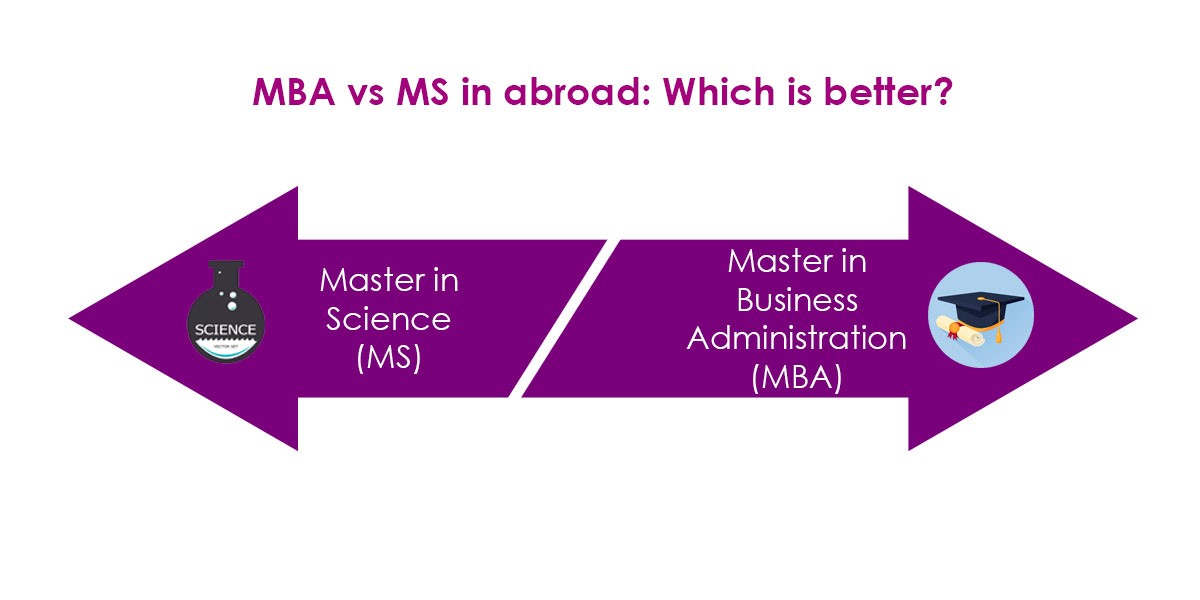
✅ Different Focus: MBA programs build broad business and leadership skills, while MS degrees provide specialized knowledge in specific fields.
💼 Work Experience: MBA usually requires prior work experience, but many MS programs accept fresh graduates.
⏳ Cost & Duration: MBA degrees are often more expensive and longer, while MS programs are shorter and cost less.
⭐ Career Outcomes: MBA graduates move into management and leadership roles, while MS graduates take on specialized technical positions.
🌐 Networking: MBA programs provide wider networking opportunities compared to MS programs.
Deciding between an MBA and an MS degree is not always easy. Both programs are popular, but they serve different purposes and can impact your career in different ways. An MBA is more focused on management, leadership, and business growth, while an MS gives you in-depth knowledge in a specific subject or technical area.
The choice often depends on your career goals, work experience, and the industry you want to enter. Knowing the differences in cost, skills, and job outcomes can make the decision clearer. This blog on mba vs ms covers all these factors to help you choose the program that fits your future. In this blog, you will find simple and useful insights.
Which degree should you pursue?
Both MBA and MS degrees can open up many doors and offer great salaries and job opportunities. The best choice in MBA vs MS depends on what you love to do and where you see yourself in the future.
What is an MBA?
An MBA, or Master of Business Administration, is a degree that teaches you all about how businesses work and how to manage them well. It covers a lot of different areas like finance, marketing, and how to be a great leader.
Typical Coursework: You'll study how to make smart business decisions by studying MBA abroad, understand the financial side of business, market products, and lead teams effectively.
Skillset Developed: Leadership, strategic thinking, financial management, and communication skills are key areas you'll improve on.
Salary and Job Prospects: Graduates often see a big jump in their salaries. Jobs can range from being a company manager to starting your own business.
What is an MS?
An MS, or Master of Science, is focused on giving you deep knowledge about a specific area of study. It’s more about becoming an expert in a field like engineering, biology, or computer science.
Typical Coursework: You'll dive deep into subjects, with lots of research and technical work. Depending on your field, you might be working in labs or with advanced computer software.
Skillset Developed: You'll get really good at researching, solving complex problems, and working with the latest technology in your field.
Salary and Job Prospects: Specializing can lead to high-paying jobs in fields like tech, science, and engineering. Jobs are often in research, development, or at companies that are at the forefront of technology.
The decision between pursuing an MBA vs MS after engineering—or in any context—should be based on a combination of career goals, industry requirements, academic and personal interests, and financial considerations.
Aligning Career Goals and Industry Demands: MBA vs MS
When deciding between pursuing an MBA vs MS one's career aspirations play a critical role. The choice between these two paths largely hinges on the industry you aim to enter and the roles you aspire to hold.
MBA: An MBA is designed to equip students with broad management skills and an understanding of business operations. This degree is particularly valuable for those looking to ascend to leadership positions, pivot into a new industry, or foster entrepreneurial ventures. Industries where an MBA offers a distinct advantage include:
Consulting: Management consulting firms often prefer candidates with strong leadership and strategic thinking skills, qualities that an MBA program emphasizes.
Finance: For roles in investment banking, private equity, and venture capital, an MBA in finance is highly regarded as it provides both the quantitative skills and the network necessary for success.
Technology Management: With tech companies valuing leaders who can manage growth and innovation, an MBA can open doors to roles in product management, strategy, and operations.
MS: Conversely, a Master of Science focuses on specialized knowledge in a particular field, offering depth over the breadth of an MBA. An MS is ideal for individuals aiming for technical mastery or research-oriented roles. Key sectors where an MS may provide better opportunities include:
Engineering and Technology: For roles in software development, engineering design, and data science, an MS in a relevant field can be more advantageous, providing the technical depth needed.
Life Sciences and Healthcare: In fields like biotechnology, pharmaceuticals, and healthcare analytics, an MS offers the specialized knowledge that is often required.
Academic and Research Institutions: For those looking to enter academia or research, an MS can be a stepping stone to a PhD.
How Do Financial Considerations Impact Your Decision?
The investment in education and the potential return in terms of post-graduation salary are crucial factors to consider between MBA vs MS:
MBA Programstend to be more expensive on average compared to MS programs, partly due to their association with high-paying leadership roles. The return on investment (ROI) for an MBA can be substantial, especially if one graduates from a top-tier business school, as these institutions often boast strong corporate partnerships and alumni networks that can open doors to lucrative opportunities.
MS Programs generally cost less, but the financial return depends significantly on the field of study and the job market for that specialty. Fields in high demand, such as computer science, data analytics, and engineering specializations, can offer high salaries and good ROI.
What Pays More in the Long Run?
When comparing the long-term financial benefits of an MBA vs MS, it's crucial to consider not just the starting salaries but also the potential for salary growth and career progression over time. Both MBA vs MS degrees can lead to lucrative careers, but their paths and opportunities can differ significantly. Let's look at a simplified analysis to understand the potential MBA salary growth and MS Salary increment, too.
Career Stage
MBA Average Salary
MS Average Salary
Entry-Level
$60,000 - $100,000
$55,000 - $90,000
Mid-Career
$100,000 - $140,000
$80,000 - $120,000
Senior-Level
$140,000 - $200,000+
$120,000 - $160,000+
Executive
$200,000 - $300,000+
$160,000 - $220,000+
The Decision-Making Process
When deciding whether to pursue an MBA vs MS, it's essential to reflect on your career goals, interests, and the kind of work environment you thrive in. Here are some steps and questions to guide your decision-making process:
Evaluate Your Career Goals
Do you see yourself leading a team or an entire company in the future? Are you more excited about becoming an expert in a specific technical field?
Consider Your Interests
Which subjects or areas do you enjoy studying or reading about in your free time? Does the idea of managing people and projects excite you, or do you prefer the idea of deep-diving into research and technical problems?
Assess Your Background
What was your undergraduate degree in, and how does it complement an MBA or an MS?
Do you have any work experience that aligns more closely with MBA vs MS, focusing on business management or technical expertise?
Research Potential Careers
What kind of jobs can you get with an MBA vs. an MS in your area of interest? Which degree aligns better with the salary and job growth potential you're aiming for?
Look Into the Curriculum
Which MBA vs MS program offers courses that you find most appealing and beneficial for your career path? Are there specific skills you wish to gain that are more aligned with one degree over the other?
Consider the Long-Term Impact
How does each degree contribute to your long-term career objectives? Which degree will give you the flexibility or specialization you desire in the evolving job market?
Choosing between an MBA vs MS is not just about immediate benefits but about where you see yourself in the future. It’s about aligning your education with your career aspirations, interests, and the life you envision for yourself. Take the time to research, reflect, and reach out to professionals in your field of interest. Remember, the right choice is the one that brings you closer to your personal and professional goals. Your education is a stepping stone to the future you aspire to, so choose a path that excites you, challenges you, and prepares you for the success you dream of.
Both degrees can boost careers, but in different ways. An MBA is better if you want to move into management, leadership, or consulting roles. An MS is better if you want to gain deep technical expertise and work in specialized fields like data science, engineering, or biotechnology. The right choice depends on your career goals, background, and industry demand.
Is MBA more expensive than MS?
Yes, in most cases an MBA is more expensive than an MS. The average MBA tuition abroad ranges between $60,000–$120,000, while MS programs usually cost $30,000–$70,000. However, MBA graduates often see higher salary growth and long-term ROI, while MS students may recover costs faster due to lower fees and STEM job opportunities.
Can I do an MBA without work experience or should I choose MS instead?
Most international MBA programs require 2–5 years of work experience, making them less suitable for fresh graduates. If you are applying right after college, an MS (or a MiM – Master in Management) is a better choice. It allows you to build technical or business skills and later apply for an MBA when you have work experience.
Who earns more in the long run: MBA or MS graduates?
On average, MBA graduates earn more in the long run. Entry-level salaries for MBA graduates are around $60,000–$100,000, rising to $200,000+ at executive level. MS graduates usually start with $55,000–$90,000, and senior roles can reach $120,000–$160,000+. The difference is that MBA careers focus on leadership, while MS careers are more technical and specialized.
Which is better: MBA or MS?
Neither MBA nor MS is universally “better” — it depends on your career goals. An MBA is better if you want leadership roles in business, consulting, finance, or product management. An MS is better if you want technical depth in fields like computer science, engineering, or data analytics. If your aim is management and higher salaries over time, MBA is the stronger option. If your focus is research, technology, or specialized skills, MS is the right choice
Know Your Author
Abhyank Srinet
|
Study Abroad Expert
Abhyank Srinet, the founder of MiM-Essay, is a globally recognized expert in study abroad and admission consulting. His passion is helping students navigate the complex world of admissions and achieve their academic dreams. Abhyank earned a Master's degree in Management from ESCP Europe, where he developed his skills in data-driven marketing strategies, driving growth in some of the most competitive industries.
Abhyank has helped over 10,000+ students get into top business schools with a 98% success rate over the last seven years. He and his team offer thorough research, careful shortlisting, and efficient application management from a single platform.
His dedication to education also led him to create MentR-Me, an AI-powered platform that offers personalized guidance and resources, including profile evaluation, application assistance, and mentoring from alumni of top global institutions.
Continuously adopting the latest strategies, Abhyank is committed to ensuring that his clients receive the most effective guidance. His profound insights, extensive experience, and unwavering dedication have helped his clients securing of over 100 crores in scholarships, making him an invaluable asset for individuals aiming to advance their education and careers and leading both his ventures to seven-figure revenues.

 Abhyank Srinet