
 Abhyank Srinet


Table of Contents
- Introduction
- What Are the Quick Facts About MEM in Europe?
- What Is a Masters in Engineering Management in Europe?
- Which Are the Best Universities for Masters in Engineering Management in Europe?
- What Are the Leading MEM Programmes in Europe for Indian Students?
- University of Leicester – Master of Engineering Management
- Sheffield Hallam University – MSc Engineering Management
- Middlesex University – MSc Engineering Management
- Loughborough University – MSc Engineering Management
- University of Warwick – MSc Engineering Business Management
- University of Bath – MSc Engineering Business Management
- Technical University of Munich – MSc Management and Technology
- University College London – MSc Engineering with Innovation and Entrepreneurship
- How Much Does a Masters in Engineering Management in Europe Cost in 2027?
- Is Germany More Affordable Than the UK for Engineering Management?
- What Are the Eligibility Requirements for MEM in Europe?
- How Can Indian Students Apply for MEM in Europe for 2027?
- When Are the MEM Application Deadlines in Europe for 2027?
- What Scholarships Are Available for MEM Students in Europe?
- What Jobs Can You Get After MEM in Europe?
- What Are the Post-Study Work Opportunities After MEM in Europe?
- How Is a Masters in Engineering Management Different From an MiM or MBA?
- What Should Indian Applicants Consider Before Choosing MEM in Europe?
- Is Masters in Engineering Management in Europe Worth It for Indian Students?
A Masters in Engineering Management in Europe can be a good option for Indian engineering graduates who want to combine technical knowledge with business management, operations, innovation and leadership skills. Universities offering relevant programmes include Leicester, Sheffield Hallam, Loughborough, Warwick, Bath and the Technical University of Munich (TUM). However, some offer an exact Engineering Management degree, while others provide related engineering-business qualifications.
Introduction
Masters in Engineering Management in Europe programmes are designed for students who want to understand how engineering projects, business operations and organisational decisions work together. These degrees can help technical graduates build knowledge in project management, finance, innovation, manufacturing and leadership without moving entirely away from engineering.
For Indian students planning the 2027 intake, choosing a programme involves more than university reputation. Course titles, entry requirements, total costs and employment opportunities vary across countries. This guide compares European Engineering Management programmes, current tuition fees, admission requirements, career options and practical steps for applying.
What Are the Quick Facts About MEM in Europe?
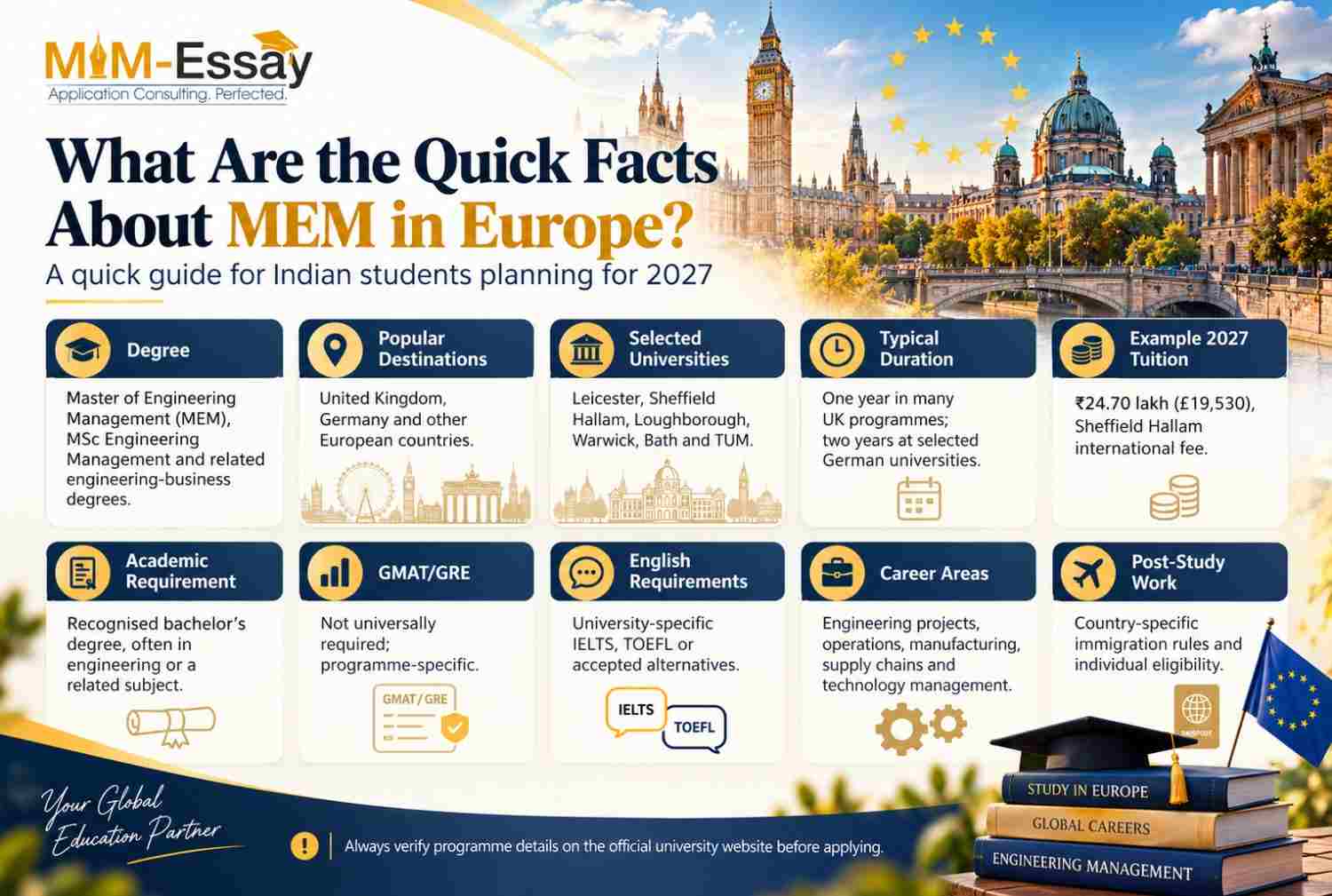
| Factor | 2027 Information |
|---|---|
| Degree | Master of Engineering Management (MEM), MSc Engineering Management and related engineering-business degrees |
| Popular Destinations | United Kingdom, Germany and other European countries |
| Selected Universities | Leicester, Sheffield Hallam, Loughborough, Warwick, Bath and TUM |
| Typical Duration | One year in many UK programmes; two years at selected German universities |
| Example 2027 Tuition | ₹24.70 lakh (£19,530), Sheffield Hallam international fee |
| Academic Requirement | Recognised bachelor's degree, often in engineering or a related subject |
| GMAT/GRE | Not universally required; programme-specific |
| English Requirements | University-specific IELTS, TOEFL or accepted alternatives |
| Career Areas | Engineering projects, operations, manufacturing, supply chains and technology management |
| Post-Study Work | Country-specific immigration rules and individual eligibility |
Currency basis: Approximate exchange rates of ₹126.45 per pound and ₹106.12 per euro, referenced on 21–22 October 2026. INR amounts are rounded and will change with exchange rates.
What Is a Masters in Engineering Management in Europe?
A Masters in Engineering Management combines engineering knowledge with business and management skills. It prepares students to understand both the technical and organisational challenges involved in developing products, delivering projects and managing engineering operations.
European universities use different degree titles. Some award a Master of Engineering Management, while others offer MSc Engineering Management, Engineering Business Management or Management and Technology.
What Subjects Are Included?
- Engineering Project Management: Planning, coordinating and evaluating complex technical projects.
- Operations Management: Improving production, quality, resources and business processes.
- Technology and Innovation: Assessing new technologies and bringing engineering ideas into practical use.
- Business Strategy: Understanding competition, organisational priorities and commercial decisions.
- Financial Management: Evaluating costs, budgets and investment decisions for engineering projects.
- Supply Chain Management: Understanding procurement, logistics and the movement of goods and materials.
- Sustainability: Exploring resource efficiency, responsible engineering and environmental considerations.
- Leadership: Developing communication, teamwork and decision-making skills.
Which Are the Best Universities for Masters in Engineering Management in Europe?
The best university depends on whether you want an exact Engineering Management degree, an engineering-business programme or a wider technology-management qualification. The following is a selection of relevant universities, not an official top-ten ranking.
| University | Country | Official Programme | Duration | Programme Type |
|---|---|---|---|---|
| University of Leicester | UK | Master of Engineering Management | Check selected study route | Exact MEM degree |
| Sheffield Hallam University | UK | MSc Engineering Management | 1 year full-time | Engineering Management |
| Middlesex University | UK | MSc Engineering Management | 1 year full-time | Engineering Management |
| Loughborough University | UK | MSc Engineering Management | 1 year full-time | Engineering Management |
| University of Warwick | UK | MSc Engineering Business Management | 12 months full-time | Related engineering-business degree |
| University of Bath | UK | MSc Engineering Business Management | 1 year full-time | Related engineering-business degree |
| Technical University of Munich | Germany | MSc Management and Technology | 2 years | Related technology-management degree |
| University College London | UK | MSc Engineering with Innovation and Entrepreneurship | 1 year full-time | Related engineering-innovation degree |
Important: These universities have been selected for programme relevance, not placed in ranking order. Applicants should compare the exact degree and academic modules before choosing.
What Are the Leading MEM Programmes in Europe for Indian Students?
For Indian applicants, a useful shortlist should include universities with clearly stated entry requirements, suitable engineering-related curricula and transparent tuition fees.
University of Leicester – Master of Engineering Management
The University of Leicester offers an exact Master of Engineering Management qualification. The programme helps engineering graduates develop commercial, leadership and project-management skills.
It also offers a route with an industry component, although placement arrangements and any additional charges must be checked separately.
For September 2027 entry, Leicester lists international tuition of ₹32.88 lakh (£26,000). Its January 2027 entry has a different published fee of ₹31.74 lakh (£25,100).
Applicants generally need a relevant undergraduate qualification equivalent to a good second-class honours degree. The university lists IELTS 6.5 or an accepted equivalent where English-language evidence is required.
Sheffield Hallam University – MSc Engineering Management
Sheffield Hallam offers a one-year, full-time MSc Engineering Management with a focus on engineering systems, strategic management and leadership.
Students can develop knowledge relevant to engineering projects and technical organisations while studying management-related subjects.
The university lists September 2027 international tuition of approximately ₹24.70 lakh (£19,530). It also advertises a separate work-experience route that must be selected according to its admission and visa conditions.
Middlesex University – MSc Engineering Management
Middlesex University's MSc Engineering Management is designed for students with an engineering background who want to develop technical and managerial skills.
The programme covers areas such as engineering operations, management and professional practice.
For September 2027, the university lists full-time international tuition of approximately ₹24.78 lakh (£19,600). Its published entry requirement is normally a recognised degree equivalent to a UK lower second-class honours qualification.
Loughborough University – MSc Engineering Management
Loughborough offers an MSc Engineering Management focused on combining engineering knowledge with business expertise and the management of technical projects.
Its full-time programme lasts one year, with subjects designed to develop organisational and leadership capabilities in engineering environments.
For the 2027/28 academic year, Loughborough lists international tuition of approximately ₹40.15 lakh (£31,750). Scholarships may be available to eligible applicants.
University of Warwick – MSc Engineering Business Management
Warwick Manufacturing Group offers MSc Engineering Business Management, combining engineering understanding with management, digital transformation and sustainable business practices.
The September 2027 programme lasts 12 months. Warwick lists an application deadline of 31 August 2027, although international applicants should allow additional time for funding and visa preparation.
The university has not yet confirmed its 2027 tuition on the programme page, so applicants should avoid relying on older fee estimates.
University of Bath – MSc Engineering Business Management
The University of Bath offers a one-year MSc Engineering Business Management beginning in September 2027.
The course develops understanding of management, operations, strategy and technology in an engineering context.
It may suit applicants interested in coordinating technical projects or developing broader management responsibilities within engineering organisations.
Technical University of Munich – MSc Management and Technology
TUM offers a two-year MSc Management and Technology combining business administration with engineering or natural-science specialisation.
The programme is related to Engineering Management, but it is not officially named Master of Engineering Management.
TUM charges qualifying international students from third countries approximately ₹4.24 lakh (€4,000) per semester. A standard four-semester course would therefore involve approximately ₹16.98 lakh (€16,000) in tuition before semester contributions and living expenses, assuming no fee changes or exemptions.
The application period is normally 1 April to 31 May for the winter semester and 1 November to 30 November for the summer semester.
Source: TUM MSc Management and Technology.
University College London – MSc Engineering with Innovation and Entrepreneurship
UCL offers a one-year MSc Engineering with Innovation and Entrepreneurship. The programme combines technical knowledge with commercialisation, innovation and entrepreneurial management.
Although related to Engineering Management, its focus is more specifically on developing and bringing engineering-based innovations to market.
For 2027/28, international tuition is approximately ₹56.14 lakh (£44,400). The university lists an application deadline of 25 June 2027 for applicants requiring a visa.
How Much Does a Masters in Engineering Management in Europe Cost in 2027?
The cost of a Masters in Engineering Management in Europe depends on the country, institution, course duration and whether the university charges international students a different tuition rate.
The following table uses verified university figures. Fees refer to the stated programme and intake, rather than a generic European average.
| University | Programme | Approximate International Tuition | Fee Basis |
|---|---|---|---|
| Sheffield Hallam | MSc Engineering Management | ₹24.70 lakh (£19,530) | 2027 full course |
| Middlesex | MSc Engineering Management | ₹24.78 lakh (£19,600) | 2027 full-time course |
| Leicester | Master of Engineering Management | ₹32.88 lakh (£26,000) | September 2027 programme |
| Loughborough | MSc Engineering Management | ₹40.15 lakh (£31,750) | 2027/28 full-time academic year |
| TUM | MSc Management and Technology | ₹4.24 lakh (€4,000) per semester | International third-country tuition |
| UCL | MSc Engineering with Innovation and Entrepreneurship | ₹56.14 lakh (£44,400) | 2027/28 full-time academic year |
| Warwick | MSc Engineering Business Management | To be confirmed | 2027 fee not yet published |
Fee note: UK figures refer to the indicated course or academic year. TUM's amount is a semester charge, not the full degree cost. Accommodation, food, insurance, travel and other expenses are additional.
Official reference: University of Leicester Master of Engineering Management – 2027 Fees.
For a detailed financial comparison, read our Cost of MEM in Europe guide.
Is Germany More Affordable Than the UK for Engineering Management?
Germany can offer lower tuition for selected engineering-management-related master's programmes, but this depends on the university and the student's fee status.
For example, TUM's MSc Management and Technology lists €4,000 per semester for qualifying third-country international students, while several UK Engineering Management programmes charge a fixed international tuition fee for a one-year course.
However, a two-year German programme generally involves a longer period of living expenses than a one-year UK degree. The lower annual tuition does not automatically mean a better financial return.
What Should Students Compare?
- Total Tuition: Calculate the complete programme cost, not just one semester.
- Study Duration: A longer course may require additional accommodation and living expenses.
- Language Requirements: Check teaching language and language expectations for internships and jobs.
- Academic Eligibility: German programmes may have specific credit and subject prerequisites.
- Employment Plans: Research local engineering industries and relevant employers.
What Are the Eligibility Requirements for MEM in Europe?

Most Engineering Management programmes require an undergraduate qualification in engineering or a relevant technical subject. Exact academic and English-language requirements differ between universities.
Academic Qualifications
Universities commonly accept applicants with recognised qualifications in engineering or related technical fields.
Leicester asks for a good second-class honours qualification or equivalent in a relevant subject. Sheffield Hallam, Middlesex and Loughborough publish their own academic thresholds.
GMAT and GRE Requirements
GMAT or GRE is not a universal requirement for Masters in Engineering Management in Europe. Several UK programmes primarily assess academic qualifications and English-language proficiency.
Applicants should not assume that a particular GMAT score is necessary for every European MEM course.
English-Language Requirements
Applicants may need an accepted English-language test, such as IELTS, TOEFL or another university-approved qualification.
Leicester lists IELTS 6.5 or an accepted equivalent. Other institutions may have different overall or component-score requirements.
Work Experience Requirements
Professional work experience is not compulsory for every European Engineering Management programme. Some courses admit graduates with limited experience, while others may value relevant employment or professional projects.
Students should confirm whether internships, industry training or prior employment are relevant to the programme's selection criteria.
How Can Indian Students Apply for MEM in Europe for 2027?
Indian applicants should begin by choosing a country and university based on academic eligibility, programme fit and total cost. Application requirements and visa processes differ between European destinations.
- Shortlist Relevant Programmes: Compare exact Engineering Management degrees with related engineering-business qualifications.
- Check Academic Requirements: Confirm that your Indian engineering degree meets the university's entry criteria.
- Review English Requirements: Arrange IELTS, TOEFL or acceptable alternatives where required.
- Prepare Academic Documents: Collect transcripts, degree certificates and any required translations.
- Write a Motivation Statement: Explain your engineering background, management interests and career goals.
- Prepare Your CV: Include technical projects, internships and professional experience.
- Apply Before the Deadline: Follow the correct intake and international-applicant timetable.
- Arrange Funding: Compare scholarships, savings and education loans.
- Complete Visa Requirements: Follow the rules for the relevant destination and academic programme.
For a wider overview of postgraduate applications from India, read our Study Abroad Guide.
When Are the MEM Application Deadlines in Europe for 2027?

Engineering Management application deadlines vary by university and country. Some universities publish a single deadline, while others accept applications for different start dates.
| University | Programme | Published Application Timing |
|---|---|---|
| Warwick | MSc Engineering Business Management | 31 August 2027 |
| UCL | MSc Engineering with Innovation and Entrepreneurship | 25 June 2027 for applicants requiring a visa |
| TUM | MSc Management and Technology | 1 April–31 May for winter-semester applications |
| Other Universities | Engineering Management programmes | Follow the individual 2027 admissions calendar |
Indian applicants should not wait until the final published date if they need time for financial arrangements, scholarships, accommodation and immigration documentation.
What Scholarships Are Available for MEM Students in Europe?
Some European universities offer merit-based scholarships or other financial assistance for international postgraduate students. Availability depends on the institution, programme and applicant's eligibility.
University Scholarships
Warwick Manufacturing Group offers WMG Excellence Scholarships for eligible applicants. Awards are competitive and depend on the applicable scholarship criteria.
Academic Merit Funding
Some universities provide fee reductions based on academic performance or other achievements. Students should verify whether a scholarship is available for the exact Engineering Management degree.
External Funding
Indian applicants may explore suitable external scholarships or education loans. Check eligibility, application dates and repayment conditions before relying on any funding source.
Applicants can also compare broader education expenses in our Masters in Engineering Management Cost guide.
What Jobs Can You Get After MEM in Europe?
Engineering Management graduates can pursue roles that combine technical understanding with business, planning and organisational skills. Actual opportunities depend on experience, specialisation, location and employer requirements.
| Career Area | Potential Roles | Relevant Skills |
|---|---|---|
| Engineering Projects | Project coordinator, engineering project analyst | Planning, budgeting and technical coordination |
| Manufacturing | Production analyst, manufacturing improvement specialist | Process analysis and operational improvement |
| Operations | Operations analyst, operations coordinator | Performance measurement and process management |
| Supply Chain | Supply chain analyst, procurement specialist | Logistics, forecasting and supplier coordination |
| Technology Management | Technology project analyst, innovation coordinator | Technology evaluation and stakeholder communication |
| Quality Management | Quality engineer, quality improvement analyst | Quality systems and continuous improvement |
| Consulting | Engineering consultant, operations consultant | Problem-solving and business analysis |
What Is the Average Salary After MEM in Europe?
There is no single reliable starting salary that represents all Engineering Management master's graduates across Europe.
Salary outcomes vary by country, employer, industry, previous professional experience and the role secured after graduation. Universities may report broader engineering employment outcomes without separating graduates of a specific MEM course.
Students should prioritise official, programme-specific employment reports where available rather than using generic engineering manager salaries as starting salaries for fresh graduates.
What Are the Post-Study Work Opportunities After MEM in Europe?
Post-study work options depend on the destination country, qualification and individual immigration eligibility. Europe does not offer one common post-study work visa for all MEM graduates.
United Kingdom
Eligible students may apply for the UK's Graduate visa after completing a qualifying degree and meeting the immigration requirements. The permitted duration depends on the rules applicable at the time of application.
For applicants receiving an eligible non-doctoral Graduate visa from January 2027, the published duration is 18 months.
Germany
Eligible international graduates of German higher education institutions may apply for permission to remain for up to 18 months to seek qualified employment after graduation, subject to current immigration rules.
Other European Countries
Work authorisation and post-study residence arrangements differ across European countries. Students should check government immigration guidance before relying on a particular stay-back period.
Applicants comparing Engineering Management with general business master's degrees can review our MiM in Europe guide.
How Is a Masters in Engineering Management Different From an MiM or MBA?
An MEM focuses on managing engineering and technology-related activities, while an MiM usually provides broader business foundations and an MBA is often designed for applicants with more professional experience.
| Factor | MEM | MiM | MBA |
|---|---|---|---|
| Main Focus | Engineering, technology and management | General business and management | Business leadership and career progression |
| Typical Background | Engineering or related technical degree | Different academic disciplines | Graduates with professional experience |
| Curriculum | Engineering projects, operations, innovation and technical management | Marketing, finance, strategy and organisational management | Strategy, leadership and broad business functions |
| Career Direction | Technical projects, engineering operations and technology management | Early-career business functions | Management progression and career changes |
Applicants should choose based on the knowledge they want to develop, not simply which qualification has the more familiar title.
What Should Indian Applicants Consider Before Choosing MEM in Europe?

Indian engineering graduates should compare their eligibility, the actual programme curriculum, total budget and realistic employment options before selecting a university.
- Verify the Degree Title: Check whether the university awards an Engineering Management degree or a related qualification.
- Confirm Academic Equivalency: Review how the institution assesses Indian engineering degrees and grades.
- Assess Technical Fit: Some courses require specific engineering subjects or previous quantitative study.
- Compare Total Tuition: Distinguish programme fees from annual or semester charges.
- Review Language Requirements: Understand both university teaching requirements and local employment expectations.
- Check Industry Exposure: Review whether projects, placements or employer activities are compulsory, optional or competitive.
- Evaluate Funding: Compare scholarships, savings and education-loan repayment obligations.
- Understand Visa Rules: Avoid assuming the same post-study work arrangements apply in every European country.
- Research Career Paths: Identify realistic entry-level roles before selecting a course.
Is Masters in Engineering Management in Europe Worth It for Indian Students?
Worth it if... you have an engineering or technical background and want to develop the business and leadership skills needed to coordinate technical projects, improve operations or support innovation. The right course may provide relevant training for engineering-related management careers when its curriculum and cost match your goals.
Think twice if... you are choosing the degree only because of expected management salaries or post-study work rights, or if the total study cost is difficult to justify. A MEM does not guarantee a managerial position immediately after graduation, and employment outcomes depend on previous experience, local recruitment conditions and individual skills.
Related Blogs
- Cost of MEM in Europe: Tuition and Living Expenses
- Masters in Engineering Management Cost Abroad
- MiM in Europe: Universities, Fees and Careers
- Study Abroad Guide for Indian Students
Conclusion
A Masters in Engineering Management in Europe can help engineering graduates build management, business and leadership skills while remaining connected to technical industries. The right programme depends on its academic focus, eligibility requirements, complete cost and realistic career opportunities. Indian applicants should compare official university information and choose a course that supports their professional goals rather than relying only on university reputation.


