
 Abhyank Srinet


Table of Contents
- Introduction
- MIT Sloan MBA vs Harvard MBA: Quick Comparison
- Program Structure & Duration
- Global Rankings of MIT and Harvard MBA
- MIT Sloan vs Harvard MBA Class Profile & Diversity
- Admissions Criteria & Acceptance Rate
- MIT Sloan vs Harvard MBA Fees & Scholarships
- MIT Sloan and Harvard MBA Career Outcomes
- MIT Sloan MBA vs Harvard MBA for Indian students
- Strengths & Ideal Fit: Which One Might Suit You Better?
MIT Sloan MBA vs Harvard MBA is a comparison between two full-time, two-year, STEM-designated MBA programmes in Cambridge, Massachusetts. MIT Sloan is better aligned with technology, analytics, product management, innovation and hands-on learning, while Harvard suits applicants prioritising general management, leadership and case-based learning. For 2026–27, annual tuition is ₹88.52 lakh ($91,892) at MIT Sloan and ₹81.65 lakh ($84,760) at Harvard, with estimated annual costs of ₹1.29 crore ($134,189) and ₹1.26 crore ($130,318), respectively.
Introduction
Choosing between MIT Sloan and Harvard Business School can be difficult because both offer world-class MBA programs and strong career opportunities. The MIT Sloan MBA Vs Harvard MBA choice mainly depends on your career goals. MIT Sloan is better suited to students interested in technology, innovation, analytics, entrepreneurship, and hands-on learning, while Harvard MBA is especially strong for leadership, general management, consulting, entrepreneurship, and case-based learning.
Both schools offer access to leading employers, global alumni networks, and strong post-MBA career opportunities. In this guide, we compare MIT Sloan and Harvard MBA across admissions, curriculum, fees, scholarships, salaries, career outcomes, networking, and overall value to help you decide which MBA fits your goals better.
MIT Sloan MBA vs Harvard MBA: Quick Comparison
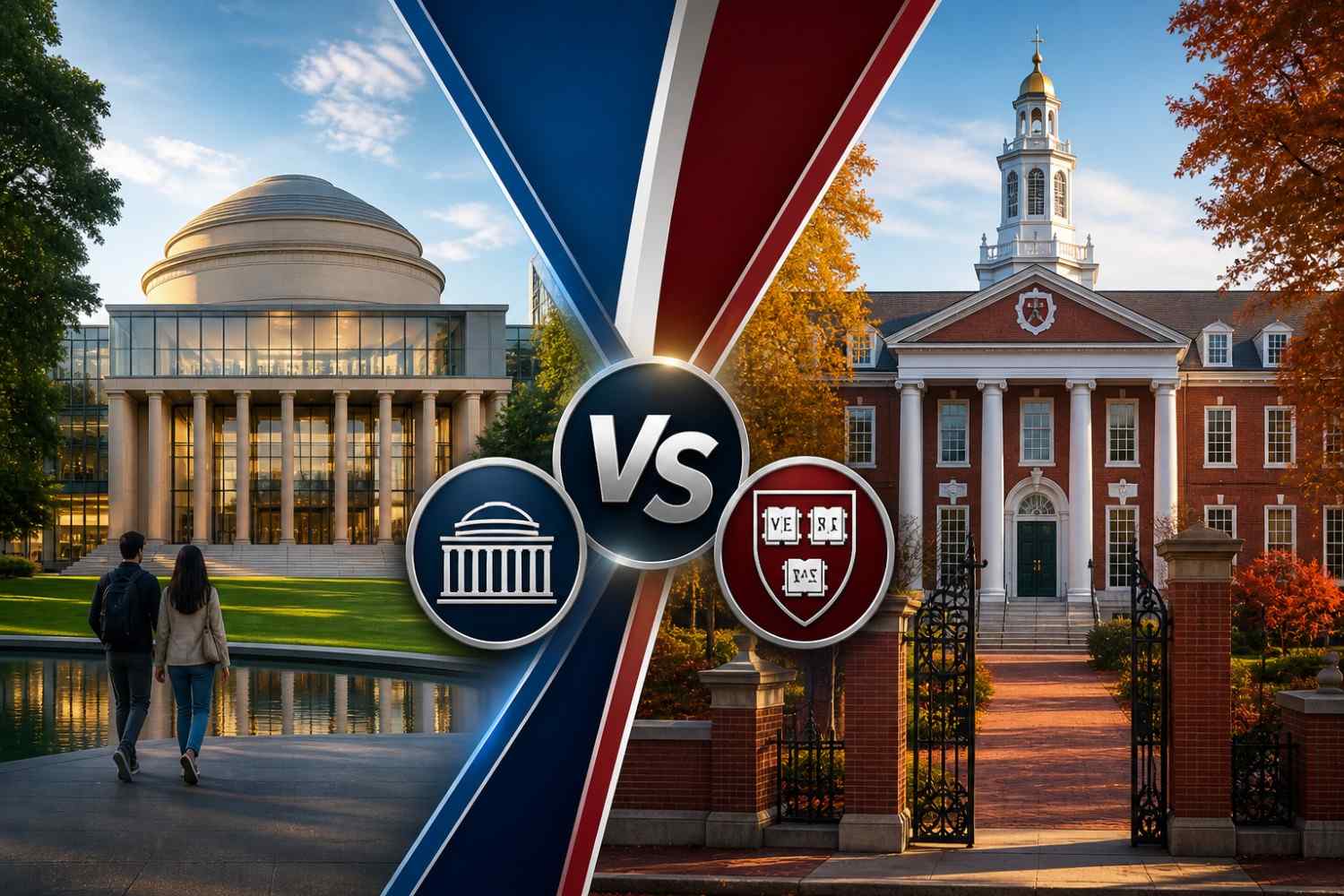
MIT Sloan and Harvard Business School are both two-year, full-time, STEM-designated MBA programs in Cambridge, Massachusetts. The biggest differences are visible in class size, teaching approach, current test-score profiles, costs and post-MBA industry outcomes.
The table below uses the latest officially available class-profile, cost and employment data from both schools.
| Feature | MIT Sloan MBA | Harvard MBA |
|---|---|---|
| Class Size | ~450 students | ~943 students |
| Median GMAT | 675 | 685 |
| Work Experience | 5 years | 4.9 years |
| International Students | 42% | 37% |
| Employment Rate | 91% | 90% |
| Average Salary | ₹1.68 crore ($175,000) | ₹1.77 crore ($184,500) |
| MBA Tuition 2026–27 | ₹88.06 lakh ($91,892) | ₹81.23 lakh ($84,760) |
MIT Sloan's Class of 2027 includes 450 MBA and LGO students, while Harvard's Class of 2027 includes 943 MBA students. HBS reports a 685 median on the current GMAT Exam and 730 on the GMAT 10th Edition.
For career outcomes, MIT Sloan reports a ₹1.68 crore ($175,000) median base salary for its Class of 2025, while Harvard reports ₹1.77 crore ($184,500). The 91% and 90% figures refer specifically to job-seeking graduates receiving an offer, not the percentage of the entire graduating class employed.
Program Structure & Duration
The program structure and duration differ in how each school delivers its MBA experience. MIT Sloan focuses on innovation and flexibility through technology-driven learning, while Harvard emphasizes leadership and management through real-world case studies.
MIT Sloan MBA: Flexible and Tech-Driven
MIT Sloan MBA is a two-year full-time program. The program begins with a Core semester that covers leadership, economics, data, operations, and organizational processes. After the core, students choose electives and can cross-register in other MIT departments (engineering, computer science, data, etc.).
Harvard MBA: Case-Based and Leadership-Focused
Harvard MBA is also a two-year, full-time program with a general management curriculum focused on real-world practice. The first year emphasizes foundational courses (finance, strategy, leadership, accounting). The second year allows deeper specialization via electives, many through the case method framework.
Global Rankings of MIT and Harvard MBA

MIT Sloan and Harvard Business School remain highly ranked, but their positions vary depending on the ranking methodology. The latest available QS ranking is now the QS Global MBA Rankings 2027, while the latest Financial Times ranking is the FT Global MBA Ranking 2026.
| Ranking Source | MIT Sloan MBA | Harvard MBA |
|---|---|---|
| QS Global MBA Rankings 2027 | #1 | #2 |
| Financial Times Global MBA Ranking 2026 | #1 | #10 |
QS's newly released 2027 Global MBA ranking places MIT Sloan first globally and Harvard Business School second.
The Financial Times 2026 Global MBA ranking places MIT Sloan first globally, while Harvard Business School ranks tenth. Because rankings use different criteria, applicants should use them as one comparison factor rather than as a direct measure of admissions chances or career outcomes.
MIT Sloan MBA Rankings
MIT Sloan stands out for its strength in innovation, technology, and analytics, making it a top choice for students aiming to combine management with technical expertise. With its strong focus on entrepreneurship and data-driven decision-making, Sloan continues to attract leaders in tech, consulting, and finance.
Harvard MBA Rankings
Harvard Business School remains one of the most prestigious MBA programs in the world. Known for its leadership-driven education and powerful global network, Harvard ranks consistently high for general management and career outcomes. Its case-based learning model and strong alumni influence make it a benchmark in business education.
MIT Sloan vs Harvard MBA Class Profile & Diversity
The latest Class of 2027 data shows that MIT Sloan has a smaller MBA cohort, while Harvard has more than twice as many students. Both schools also report separate figures for the current GMAT Exam and the older GMAT 10th Edition, so these scores should not be combined into one unlabeled GMAT figure.
MIT Sloan MBA Class Profile
MIT Sloan's MBA Class of 2027 profile includes MBA and Leaders for Global Operations students. The latest official profile reports 450 students, approximately five years of average work experience and 42% international students.
| Class Profile | Details |
|---|---|
| Class Size | 450 students |
| Median GMAT | 675 |
| Women | 47% |
| International Students | 42% |
| Work Experience | 5 years |
Keep the two GMAT versions separate throughout the page. A score of 675 on the current GMAT Exam should not be presented as directly equivalent to a 720 score from the GMAT 10th Edition.
Harvard MBA Class Profile
Harvard Business School's Class of 2027 includes 943 students from 62 countries. Women make up 44% of the class, international students account for 37%, and the average student entered with 4.9 years of work experience.
| Class Profile | Details |
|---|---|
| Class Size | 943 students |
| Median GMAT | 685 |
| Women | 44% |
| International Students | 37% |
| Work Experience | 4.9 years |
HBS reports a middle-80% GMAT Exam range of 645–735 and a GMAT 10th Edition range of 690–770. It does not publish a minimum GMAT or GRE score for MBA admission.
Admissions Criteria & Acceptance Rate
The admissions criteria and acceptance rate reflect how competitive both programs are. MIT Sloan and Harvard MBA evaluate candidates based on academic strength, leadership potential, and professional achievements.
MIT Sloan MBA Admissions
The MIT Sloan MBA remains one of the most selective business programs worldwide, with an estimated acceptance rate of around 14%. Sloan looks for candidates who demonstrate innovation, analytical strength, and a record of leadership impact.
The school evaluates applicants holistically through essays, recommendations, and interviews. Compared to Harvard, MIT Sloan tends to attract candidates with stronger technical or analytical profiles.
Harvard MBA Admissions
Harvard Business School admits approximately 9% of applicants, making it one of the toughest MBA programs to enter. The admissions team seeks individuals with outstanding leadership potential, strong academic credentials, and clarity in professional vision.
Harvard values diversity of experience and personal drive, focusing heavily on impact and leadership readiness.
Curriculum & Learning Approach
When comparing MIT Sloan vs Harvard MBA, both programs offer world-class teaching but with different approaches. MIT Sloan emphasizes Action Learning, where students solve real business challenges through hands-on projects. In contrast, Harvard MBA follows its signature Case Study Method, engaging students in debate-driven classes to build leadership and decision-making skills.
Both aim to develop future leaders, but Sloan leans toward innovation and analytics, while Harvard focuses on strategy and leadership excellence.
MIT Sloan vs Harvard MBA Fees & Scholarships

When deciding between the MIT Sloan MBA and the Harvard MBA, understanding costs and available financial aid options is key. Both programs offer exceptional academic experiences but differ slightly in tuition, living expenses, and scholarship support. Knowing these details can help you plan your finances and evaluate your return on investment.
MIT Sloan MBA Fees & Scholarships
The MIT Sloan MBA combines academic rigor with an emphasis on innovation and technology. While tuition costs are significant, the school offers several financial aid options to make the program accessible for deserving candidates.
| Feature | MIT Sloan MBA |
|---|---|
| Tuition Fees (2025–26) | ₹88.52 lakh ($91,892) per year |
| Application Fee | ₹24,083 ($250) |
| Living Costs (estimated) | ₹40.74 lakh ($42,297) (housing, food, insurance, personal) |
| Total Estimated Cost | ₹1.29 crore ($134,189) per year |
Scholarships: MIT Sloan automatically considers admitted students for merit-based and need-based fellowships. Key awards include the Legatum Fellowship, McKinsey Award, and MIT Sloan Leadership Fellowship. Students may also apply for external scholarships and student loans through MIT’s Financial Services Office.
Harvard MBA Fees & Scholarships
The Harvard MBA is globally recognized for its leadership education and wide financial aid opportunities. Although tuition is slightly lower than MIT’s, Harvard provides one of the most generous need-based fellowship systems among top business schools.
| Feature | Harvard MBA |
|---|---|
| Tuition Fees (2025–26) | ₹81.65 lakh ($84,760) per year |
| Application Fee | ₹24,083 ($250) |
| Living Costs (estimated) | ₹43.89 lakh ($45,558)(housing, materials, healthcare, personal) |
| Total Estimated Cost | ₹1.26 crore ($130,318) |
Scholarships: Harvard Business School offers need-based scholarships to domestic and international students, including eligible Indian applicants. Approximately 50% of MBA students receive need-based aid, with an average award of ₹96.33 lakh ($100,000) over two years, or about ₹48.17 lakh ($50,000) per year. Around 10% of students with the highest demonstrated financial need receive full-tuition scholarships. Most awards fall between ₹28.90 lakh and ₹67.43 lakh ($30,000–$70,000) per year. Students may also combine HBS funding with external scholarships, savings and education loans.
While MIT Sloan focuses on innovation and provides targeted fellowships, Harvard MBA offers broader access through need-based aid and one of the largest fellowship funds globally. Both programs justify their costs with high ROI, global alumni reach, and strong career advancement potential.
MIT Sloan and Harvard MBA Career Outcomes
Career outcomes reflect how graduates perform after completing their MBA covering job placements, salaries, and top hiring sectors. This section compares how MIT Sloan MBA vs Harvard MBA graduates fare in the job market and the global career opportunities each school offers.
MIT Sloan MBA Career Outcomes
MIT Sloan graduates report impressive career success across technology, consulting, and finance. According to the official MIT Sloan 2025–26 MBA Employment Report, the Class of 2025 recorded an average base salary of ₹1.67 crore ($173,132) and a median base salary of ₹1.69 crore ($175,000). The offer rate reached 91% within three months and increased to 94.1% by the report’s publication date. Consulting remained the largest hiring industry, followed by technology and finance.
| Top Hiring Sectors | % of Graduates |
|---|---|
| Consulting | 32% |
| Technology | 26% |
| Finance | 20% |
Harvard MBA Career Outcomes
Harvard Business School’s official Class of 2025 Employment Report states that 90% of students seeking employment had received an offer three months after graduation, rising to approximately 94% by November 2025. Harvard also reported that about 150 graduates were launching their own ventures and roughly 80 were joining startups.
| Top Hiring Sectors | % of Graduates |
|---|---|
| Consulting | 26% |
| Finance | 34% |
| Technology | 19% |
Overall, MIT Sloan excels in innovation and tech-driven roles, while Harvard MBA leads in consulting and finance placements. Both programs deliver outstanding ROI, global mobility, and career progression opportunities for graduates.
MIT Sloan MBA vs Harvard MBA for Indian students
MIT Sloan MBA vs Harvard MBA for Indian students is not just about rankings—it’s about which program fits your career goals, budget, and post-MBA opportunities. Both MIT Sloan School of Management and Harvard Business School attract highly competitive Indian applicants every year, but the right choice depends on your target industry, GMAT score, and long-term ROI. While Harvard is known for consulting and leadership roles, MIT Sloan stands out for technology and product-focused careers.
GMAT expectations for Indian applicants
Indian applicants typically need higher GMAT scores to stay competitive in the applicant pool. At MIT Sloan, while the class average is around 730, most successful Indian applicants score between 740 and 760+. At Harvard MBA, competitive applicants often aim for 750+, especially for consulting or finance roles. However, both schools evaluate profiles holistically—strong leadership, clear goals, and impactful work experience can offset slightly lower scores.
OPT and STEM OPT after graduation
For Indian students planning to work in the U.S., visa flexibility is a key factor. MIT Sloan offers a clear STEM-designated pathway, allowing up to 3 years of OPT, which is a major advantage for tech and product roles. Harvard MBA also offers access to STEM OPT through certain pathways, but it is less structured compared to Sloan. This makes MIT Sloan a stronger option for those prioritizing longer U.S. work opportunities.
Indian alumni networks
Both schools have strong Indian alumni presence, but the industry distribution differs. Harvard Business School has a larger alumni base in consulting, finance, and global leadership roles, while MIT Sloan School of Management has a strong network in technology, startups, and product management. Alumni accessibility is high at both schools through events, LinkedIn, and regional chapters.
Strengths & Ideal Fit: Which One Might Suit You Better?

The strengths and ideal fit section helps you decide which MBA aligns better with your goals. MIT Sloan is best for innovation and tech-focused careers, while Harvard MBA suits those aiming for leadership and global management roles.
MIT Sloan MBA: Innovation & Analytics Focus
- Best for: Tech, analytics, and entrepreneurship careers.
- Culture: Collaborative and experimental learning.
Harvard MBA: Leadership & Global Reach
- Best for: Consulting, finance, and corporate leadership.
- Culture: Competitive and globally networked.
Related Blogs
Conclusion
MIT Sloan and Harvard both offer strong MBA outcomes, but they differ in learning style, class size and career focus. MIT Sloan is more closely associated with analytics, technology and Action Learning, while Harvard emphasizes case-based general management and leadership. Applicants should choose based on career goals, curriculum fit and total cost.