
Please screenshot this page and send it to info@mim-essay.com

close

Master Coordinate Geometry GMAT for a High Quant Score

Coordinate Geometry GMAT: Master the Basics for a High Quant Score

coordinate geometry gmat

Key Takeaways
-Coordinate Geometry GMATGraduates who perform well in the GMAT Quant section, particularly in topics like geometry, often secure starting salaries of $100,000+ annually after admission to top business schools.
-Based on recent data, GMAT test-takers from India, aged 25-28, make up a significant portion of the applicant pool. The majority hold undergraduate degrees in engineering and business, seeking advanced degrees abroad for better career prospects.
-Key topics in GMAT geometry include lines, slopes, distance between points, midpoint formulas, and the equation of a circle. Understanding these basics can improve your overall problem-solving speed.
-Around 90% of GMAT test-takers who score in the 700-800 range secure jobs within three months post-graduation from top MBA programs, reflecting the strong career prospects linked to high GMAT scores.

Coordinate Geometry plays a crucial role in the GMAT Quantitative section, helping test-takers apply geometry concepts on the Cartesian plane. Whether you’re solving for distances, midpoints, or the slope of a line, mastering these concepts can significantly improve your overall GMAT score. This guide is designed to help you navigate the essential topics of coordinate geometry, with clear explanations and practical tips tailored specifically for GMAT success. From understanding the fundamental formulas to tackling advanced-level questions, this blog will equip you with the knowledge to handle the trickiest geometry problems on test day.

Coordinate Geometry Basics for GMAT

Coordinate Geometry Basics for GMAT

Coordinate geometry, often referred to as analytic geometry, is an integral component of the GMAT Quantitative section. It combines the principles of algebra and geometry to solve problems involving points, lines, and shapes on a coordinate plane. Understanding the core concepts and formulas in this area can significantly improve your performance in geometry-related GMAT questions.

Here’s a deep dive into the fundamentals of coordinate geometry you need to master for the GMAT.

1. Cartesian Plane

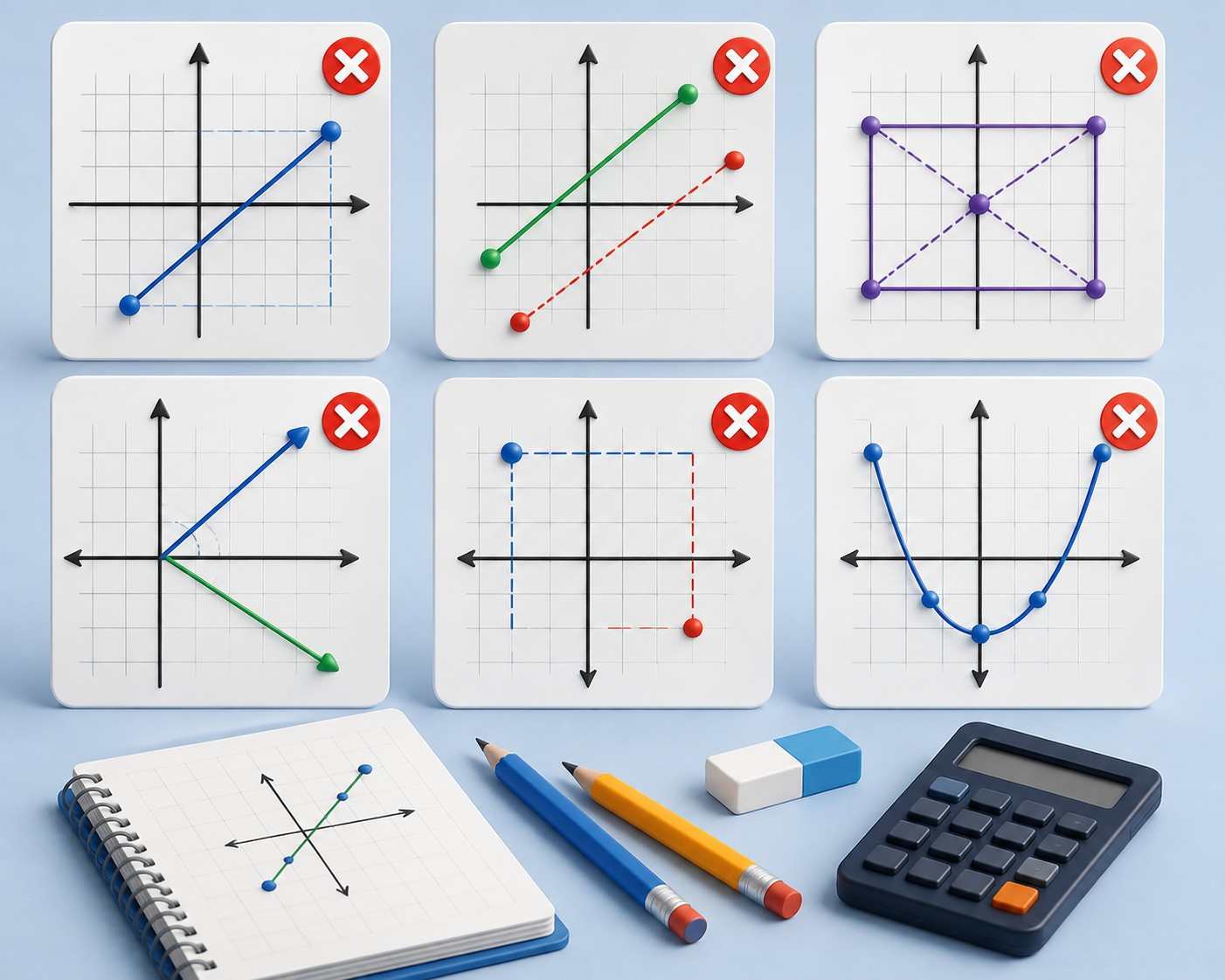
At the heart of coordinate geometry is the Cartesian plane, a two-dimensional grid formed by the intersection of two perpendicular axes: the x-axis (horizontal) and the y-axis (vertical). Any point on this plane can be described by a pair of coordinates (x,y)(x, y)(x,y), where xxx represents the horizontal position, and yyy represents the vertical position. For instance, the point (3,−2)(3, -2)(3,−2) is located 3 units to the right of the origin (0,0) and 2 units below the x-axis.

2. Slope of a Line

The slope of a line measures its steepness and indicates how much the y-coordinate changes for a given change in the x-coordinate. The slope is calculated using two points (x1,y1)(x_1, y_1)(x1​,y1​) and (x2,y2)(x_2, y_2)(x2​,y2​) on the line. The slope formula is:

slope (m)=y2−y1x2−x1\text{slope (m)} = \frac{y_2 - y_1}{x_2 - x_1}slope (m)=x2​−x1​y2​−y1​​A positive slope means the line is rising, while a negative slope means it is falling. Horizontal lines have a slope of zero, and vertical lines have an undefined slope. Understanding slopes helps in solving GMAT questions that involve parallel or perpendicular lines. Parallel lines have equal slopes, whereas perpendicular lines have slopes that are negative reciprocals of each other.

Slope Formula: m = (y2 - y1) / (x2 - x1)

Understanding slopes helps in solving GMAT questions involving parallel or perpendicular lines.

3. Distance Formula

The distance formula allows you to calculate the length of a straight line connecting two points (x1,y1)(x_1, y_1)(x1​,y1​) and (x2,y2)(x_2, y_2)(x2​,y2​) on the coordinate plane. It is derived from the Pythagorean theorem and is given by the following formula:

Distance Formula: Distance = √((x2 - x1)2 + (y2 - y1)2)

This formula is particularly useful when solving problems that ask you to find the distance between two points, such as when determining the lengths of sides in geometric shapes like triangles or rectangles.

4. Midpoint Formula

The midpoint formula is used to find the point exactly halfway between two points (x1, y1) and (x2, y2):

Midpoint Formula: Midpoint = ((x1 + x2) / 2, (y1 + y2) / 2)

5. Equation of a Line

One of the most common tasks in coordinate geometry is finding the equation of a line. The most straightforward form of a linear equation is the slope-intercept form:

Slope-Intercept Form: y = mx + b

Another useful form is the point-slope form:

Point-Slope Form: y - y1 = m(x - x1)

6. Circle Equation

In coordinate geometry, the equation of a circle with center (h, k) and radius r is:

Circle Equation: (x - h)2 + (y - k)2 = r2

This formula can be used to solve questions that ask you to find the radius, diameter, or the coordinates of the center of a circle. Circles typically appear in more advanced coordinate geometry questions.

Coordinate Geometry Formulas Table

Concept Formula Description
Slope of a Line m = (y2 - y1) / (x2 - x1) The steepness of a line between two points.
Distance Between Two Points Distance = √((x2 - x1)2 + (y2 - y1)2) Length of the straight line between two points.
Midpoint Formula Midpoint = ((x1 + x2) / 2, (y1 + y2) / 2) Point exactly between two given points.
Equation of a Line (Slope-Intercept Form) y = mx + b Equation of a line with slope m and y-intercept b.
Equation of a Line (Point-Slope Form) y - y1 = m(x - x1) Equation for a line when slope and one point are known.
Circle Equation (x - h)2 + (y - k)2 = r2 Equation of a circle with center (h, k) and radius r.

Syllabus of Coordinate Geometry in GMAT

Syllabus of Coordinate Geometry in GMAT

While coordinate geometry may initially seem daunting, it’s one of the more approachable topics within the GMAT Quant section. The key to success is understanding the core concepts and applying them systematically to solve questions. Below is a detailed explanation of the important topics you’ll encounter in GMAT coordinate geometry and how you can master them for your test.

1. Lines and Slopes

One of the foundational topics in coordinate geometry is understanding how to calculate and interpret the slope of a line. The slope formula m = (y2 - y1) / (x2 - x1) measures the steepness or incline of a line, and it’s crucial for solving various problems involving linear equations. You’ll also need to recognize whether two lines are parallel or perpendicular based on their slopes:

  • Parallel lines have identical slopes.
  • Perpendicular lines have slopes that are negative reciprocals (e.g., m1 × m2 = -1).

To strengthen your skills in this area, use the official GMAT Quantitative Review or online platforms like Khan Academy, which offer interactive slope-related exercises.

2. Distance and Midpoint Formulas

Distance and midpoint calculations frequently appear in GMAT geometry questions, especially those involving triangles, rectangles, and other geometric shapes plotted on a coordinate plane. Below are the key formulas you need to remember:

  • Distance Formula: Distance = √((x2 - x1)2 + (y2 - y1)2)
  • Midpoint Formula: Midpoint = ((x1 + x2) / 2, (y1 + y2) / 2)

To improve your abilities with these concepts, consider practicing through GMAT practice tests from trusted resources like Manhattan Prep or the official GMAT website.

3. Equations of Lines

The equation of a line is another fundamental concept in GMAT coordinate geometry. The most common form you’ll use is the slope-intercept form: y=mx+by = mx + by=mx+b, where:

  • m is the slope of the line.
  • B is the y-intercept or the point where the line crosses the y-axis.

You may also need to work with the point-slope form y−y1=m(x−x1)y - y_1 = m(x - x_1)y−y1​=m(x−x1​), especially in questions where you’re given a point and the slope but not the y-intercept. Understanding how to manipulate these equations is crucial for solving line-related questions, including those that ask you to calculate intersections of lines or determine if they are parallel or perpendicular.

To practice solving line equations, check out resources like Magoosh for structured lessons and real GMAT-style problems.

4. Circles on the Coordinate Plane

Some GMAT questions involve circles, and it’s essential to understand the standard equation of a circle:

(x - h)2 + (y - k)2 = r2, where:

  • (h, k) represents the center of the circle.
  • r is the radius.

You may encounter questions that ask you to analyze the properties of a circle, such as calculating the distance between the center and a point on the circumference, or determining whether a given point lies inside, on, or outside the circle. To excel at these questions, you can refer to official GMAT guides or practice circle-related problems on study resources like GMAT Club forums, where experts discuss complex geometry questions in detail.

5. Parabolas and Quadratics

Though less common, the GMAT may test your understanding of parabolas, especially in relation to quadratic functions. The standard equation of a parabola is:

y = ax2 + bx + c.

You may be required to graph the parabola or analyze its key features, such as the vertex, axis of symmetry, and the direction of opening. To improve your understanding of these concepts, use advanced quant courses from providers like Veritas Prep.

Study Resources to Master Coordinate Geometry for GMAT

To gain confidence in coordinate geometry, leveraging the right study materials is key. Here are some top resources that can help you:

  • GMAT Official: This official guide provides authentic GMAT problems, including questions on coordinate geometry, complete with detailed explanations.
  • Khan Academy: Known for its clear explanations, Khan Academy offers free lessons on coordinate geometry, including exercises on lines, slopes, and distances.
  • Manhattan Prep: Manhattan’s GMAT prep books, especially their geometry-focused sections, offer in-depth practice for coordinate geometry problems.
  • Magoosh GMAT Prep: Magoosh’s online platform offers video lessons and practice problems specifically geared toward improving your geometry skills for the GMAT.

By thoroughly familiarizing yourself with these topics and consistently practicing problems, you’ll build a solid foundation to confidently tackle GMAT coordinate geometry questions.
 

Important Formulas for Coordinate Geometry in GMAT

Important Formulas for Coordinate Geometry in GMAT

When solving coordinate geometry problems on the GMAT, having a solid grasp of key formulas is essential. These formulas will allow you to quickly navigate through questions involving lines, distances, and areas. Here’s a roundup of the most important ones:

  • Slope Formula:
    slope = (y2 - y1) / (x2 - x1)
    This formula helps determine the steepness of a line passing through two points (x1, y1) and (x2, y2).
  • Distance Formula:
    Distance = sqrt((x2 - x1)2 + (y2 - y1)2)
    Use this to find the length between two points on a plane.
  • Midpoint Formula:
    Midpoint = ((x1 + x2) / 2, (y1 + y2) / 2)
    It’s particularly helpful when you need to locate the exact center between two points.
  • Equation of a Line (Slope-Intercept Form):
    y = mx + b
    Where m is the slope of the line and b is the y-intercept, or the point where the line crosses the y-axis.
  • Equation of a Circle:
    (x - h)2 + (y - k)2 = r2
    Here, (h, k) represents the center of the circle, and r is the radius. This equation is useful in questions where the GMAT tests your ability to analyze circular shapes on the coordinate plane.

Having these formulas at your fingertips will make it much easier to solve coordinate geometry questions quickly and accurately during the GMAT exam.

Types of Coordinate Geometry GMAT Questions

Coordinate geometry questions on the GMAT typically fall into a few main categories. Understanding these types will allow you to better prepare and recognize patterns during the test. Let’s explore the most common question types:

  • Line and Slope Problems: You may be asked to calculate the slope of a line, determine whether lines are parallel or perpendicular, or find the equation of a line based on given points.
  • Distance and Midpoint Problems: These questions involve calculating the distance between two points or identifying the midpoint of a line segment. You may also encounter questions about the relative positioning of points on the coordinate plane.
  • Geometric Shapes on the Coordinate Plane: Some questions will present shapes, such as triangles, rectangles, or circles, plotted on the coordinate plane. You'll need to apply geometry concepts to calculate areas, perimeters, or other relevant properties.
  • Intersection Points: In some cases, you’ll be asked to find the intersection of two lines by solving their equations simultaneously. These types of problems test both your algebraic and geometric understanding.

By practicing each of these types of questions, you'll become adept at recognizing the approach required to solve them efficiently.

Coordinate Geometry GMAT Question Difficulty Levels

GMAT questions vary in difficulty, and coordinate geometry is no exception. Here’s how these questions are generally distributed:

  • Easy Questions: Typically involve basic formulas, such as calculating the slope of a line or finding the distance between two points. These questions usually require straightforward application of the distance, slope, or midpoint formulas.
  • Medium Questions: These might involve more complex multi-step problems. For instance, you may be asked to find the equation of a line given certain conditions, or solve problems involving geometric shapes like triangles and rectangles on the coordinate plane.
  • Hard Questions: At the high end of the GMAT difficulty spectrum, coordinate geometry problems may require you to solve systems of equations, deal with non-standard shapes, or interpret multiple conditions at once. Some questions may combine algebraic and geometric concepts, requiring a deeper understanding of both subjects.

By practicing questions across these difficulty levels, you’ll develop the skills necessary to tackle even the hardest coordinate geometry problems on the GMAT.

How to Solve Coordinate Geometry Problems Faster on the GMAT

How to Solve Coordinate Geometry Problems Faster on the GMAT

Given the time pressure in the GMAT Quant section, speed is crucial. Here are some tips to help you solve coordinate geometry problems more efficiently:

  • Memorize Key Formulas: Ensure you have the distance, midpoint, and slope formulas committed to memory. This will save valuable time during the test.
  • Recognize Question Types: Quickly identifying whether a question is asking for a slope, a distance, or an equation will allow you to zero in on the correct approach without wasting time.
  • Practice Mental Math: While the GMAT doesn’t allow calculators, being able to perform basic calculations quickly in your head will improve your speed.
  • Draw Diagrams: For more complex questions, sketching a quick diagram of the problem can help you visualize the solution more clearly and avoid mistakes.

By applying these strategies, you’ll be able to manage your time better and ensure you don’t get stuck on challenging questions.

Practice Resources for Coordinate Geometry GMAT Preparation

To master coordinate geometry for the GMAT, consistent practice is key. Here are some valuable resources to help you sharpen your skills:

  • GMAT Official Guide: The official GMAT guide contains numerous practice problems, including those focused on coordinate geometry.
  • Mentor Me GMAT Prep: This platform offers personalized GMAT coaching, including focused practice sessions on coordinate geometry. It’s a great resource for targeting your weaknesses and improving your score.
  • Online GMAT Practice Tools: Websites like GMATClub and Khan Academy provide free practice questions and tutorials specifically on GMAT geometry, allowing you to test your skills in real-time.

Regular practice using these resources will help you get comfortable with coordinate geometry and ensure you’re fully prepared on test day.

Coordinate Geometry in GMAT vs Other Geometry Topics

In the GMAT Quant section, geometry questions cover a range of topics, including both coordinate geometry and traditional geometry. Each of these topics tests different problem-solving skills and concepts. Here's a comparison of how coordinate geometry differs from other geometry topics and how mastering it can give you a competitive edge on the GMAT:

Coordinate Geometry:

  • Algebra Meets Geometry: Coordinate geometry involves placing geometric figures—like points, lines, and shapes—on a coordinate plane and solving problems using both algebraic and geometric principles. Key concepts include:
    • Equations of Lines: Understanding how to derive and manipulate equations of lines based on slopes and points.
    • Distances & Midpoints: Calculating the distance between two points or determining the midpoint of a line segment.
    • Intersection of Lines: Identifying where two lines meet or determining if lines are parallel or perpendicular.
  • Dual Focus: This topic requires proficiency in both algebra (working with equations, slopes, and graphing) and geometry (understanding shapes, angles, areas, and perimeters).
  • Problem-Solving: GMAT questions related to coordinate geometry often involve identifying positions of points, calculating distances, or determining relationships between geometric figures on the plane.

Other Geometry Topics:

  • Pure Geometry Focus: Topics such as angles, polygons, circles, and 3D shapes dominate traditional geometry questions.
  • Areas & Perimeters: Questions may ask you to calculate the area or perimeter of 2D shapes like triangles, rectangles, or circles.
  • Angles: You'll need to understand angle relationships, such as complementary, supplementary, or the interior angles of polygons.
  • Volume & Surface Area: Traditional geometry includes calculating the volume and surface area of 3D shapes.
  • Memorization of Theorems: Success in traditional geometry often relies on remembering key theorems and formulas, such as the Pythagorean theorem and properties of triangles.

Coordinate Geometry GMAT Success Stories

Many students have significantly boosted their GMAT Quant scores by honing their skills in coordinate geometry. Let’s take a look at a success story that highlights how focused practice and the right resources can lead to dramatic improvements:

Student A: From Struggling with Geometry to a 700+ GMAT Score

When Student A began their GMAT preparation, they found themselves struggling with geometry, particularly coordinate geometry. The combination of algebra and geometric concepts felt overwhelming at first. Despite these challenges, Student A decided to make coordinate geometry a focal point of their study plan, breaking down the topic into manageable steps.

Here’s how Student A turned their struggle into success:

  • Breaking Down Concepts: Rather than trying to learn everything at once, they focused on mastering one concept at a time, starting with the basics of the coordinate plane and gradually moving on to more complex topics like line equations and intersections.
  • Practice and Consistency: Student A regularly practiced coordinate geometry questions, gradually improving their speed and accuracy.
  • Utilizing Resources: Student A turned to several resources, including Mentor Me GMAT Prep, which provided targeted practice questions and time-saving techniques.
  • Time-Saving Techniques: Through practice, Student A memorized essential formulas and learned to recognize common question types early on, allowing them to solve questions faster and more accurately.

The result? After weeks of focused preparation, Student A's ability to answer coordinate geometry questions improved dramatically. This mastery contributed to a significant 100-point increase in their overall GMAT score, ultimately helping them surpass the 700+ mark.

Resources to Help You Master Coordinate Geometry for GMAT

To improve your proficiency in coordinate geometry, consider using these top-rated resources:

1. Mentr-Me GMAT Prep

MentR Me GMAT Prep, offers comprehensive GMAT preparation with a strong focus on the Quant section, including coordinate geometry. With targeted practice questions, time-saving tips, and detailed explanations, it’s a great tool for building your skills. Whether you are struggling with basic concepts or looking to tackle more advanced GMAT questions, MentR Me provides the strategies and insights you need to succeed.

2. Manhattan Prep GMAT Advanced Quant

Known for its in-depth coverage of advanced GMAT quant topics, this resource is excellent for students looking to challenge themselves. The book and course offer detailed explanations of coordinate geometry problems, helping you to grasp even the most complex questions.

3. Official GMAT Prep Software

The official GMAT prep tools from GMAC provide authentic questions that you’ll encounter on the test. These include a variety of coordinate geometry problems to familiarize you with the exam's format and difficulty.

4. Khan Academy

For those who need a refresher on the basics of coordinate geometry, Khan Academy offers free lessons that cover fundamental concepts, such as graphing lines, slopes, and equations of lines, making it a great supplementary resource.

5. GMAT Club Forum

This is a valuable resource where you can interact with other test-takers, ask questions, and access additional practice problems. It also offers solutions to coordinate geometry questions from past GMAT tests.

In the GMAT Quant section, geometry questions cover various topics, including both coordinate geometry and traditional geometry (e.g., angles, polygons, 3D shapes). Here's how coordinate geometry compares with other geometry topics:

Coordinate Geometry:

  • Involves placing geometric figures on a coordinate plane and solving problems using algebraic methods.
  • Requires understanding of both algebra (equations of lines, slopes, distances) and geometry (shapes, areas, perimeters).
  • Questions often involve identifying the positions of points, calculating distances between points, or determining the equation of a line.

Other Geometry Topics:

  • Topics include areas and perimeters of polygons, angles, circles, and 3D shapes like spheres and cylinders.
  • Focuses more on geometric properties and less on algebraic manipulation.
  • Traditional geometry questions may involve calculating the volume of shapes, identifying properties of triangles, or working with angles and ratios.

While both types of questions are important, coordinate geometry tends to combine elements of algebra and geometry, making it unique in terms of problem-solving approaches. For students with strong algebra skills, coordinate geometry may feel more intuitive, whereas traditional geometry requires memorizing and applying specific geometric theorems and formulas.

Coordinate Geometry GMAT Success Stories

Many students have significantly improved their GMAT Quant scores by focusing on mastering coordinate geometry. Here’s one such success story:

Student A: From Struggling with Geometry to a 700+ GMAT Score

When Student A began preparing for the GMAT, they struggled with geometry and found coordinate geometry particularly challenging. By focusing on breaking down the concepts into manageable steps and practicing questions regularly, they improved their understanding. They made use of resources like Mentor Me GMAT Prep and consistently applied time-saving techniques, such as memorizing formulas and recognizing question types early on.

After weeks of focused practice, Student A was able to complete coordinate geometry questions more efficiently and accurately, which contributed to a 100-point increase in their overall GMAT score.

Takeaway: Success in coordinate geometry requires dedication, practice, and the right resources. With time, even the most challenging topics can be mastered, leading to significant score improvements.

Related Blogs


Conclusion

Mastering coordinate geometry is a vital part of achieving a high score on the GMAT Quantitative section. By understanding the fundamental concepts like points, lines, slopes, distances, and equations, you’ll be well-equipped to tackle even the most challenging questions. Remember, coordinate geometry isn’t just about memorizing formulas; it’s about applying logical reasoning and analytical skills to solve real-world problems presented in a geometric format.

As you prepare for the GMAT, practice regularly with different types of coordinate geometry questions, ranging from basic to advanced levels. Focus on time management and accuracy, as this will help you build confidence when dealing with geometry problems under exam conditions. Utilize available resources, such as GMAT prep books, online tools, and targeted practice from programs like Mentor Me GMAT Prep, to strengthen your skills.

How much weightage does coordinate geometry have on the GMAT Quant section?

Coordinate geometry questions typically make up a small portion of the GMAT Quant section, but mastering them can still significantly impact your overall score. They often appear in conjunction with other algebraic or geometric concepts, so understanding the basics is crucial.

What is the hardest type of coordinate geometry question on the GMAT?

The most challenging questions often involve multiple steps, such as finding the equation of a line and then solving for an intersection point or determining distances between complex shapes. These questions require both geometric reasoning and algebraic manipulation.

Are calculators allowed on the GMAT for geometry questions?

No, calculators are not allowed during the Quant section of the GMAT. This is why it's important to practice solving problems quickly and accurately using mental math and estimation strategies.

Know Your Author
Photo of Abhyank
Abhyank Srinet
|
Study Abroad Expert

Abhyank Srinet, the founder of MiM-Essay, is a globally recognized expert in study abroad and admission consulting. His passion is helping students navigate the complex world of admissions and achieve their academic dreams. Abhyank earned a Master's degree in Management from ESCP Europe, where he developed his skills in data-driven marketing strategies, driving growth in some of the most competitive industries.


Abhyank has helped over 10,000+ students get into top business schools with a 98% success rate over the last seven years. He and his team offer thorough research, careful shortlisting, and efficient application management from a single platform.

His dedication to education also led him to create MentR-Me, an AI-powered platform that offers personalized guidance and resources, including profile evaluation, application assistance, and mentoring from alumni of top global institutions.

Continuously adopting the latest strategies, Abhyank is committed to ensuring that his clients receive the most effective guidance. His profound insights, extensive experience, and unwavering dedication have helped his clients securing of over 100 crores in scholarships, making him an invaluable asset for individuals aiming to advance their education and careers and leading both his ventures to seven-figure revenues.

You may also like these Blogs