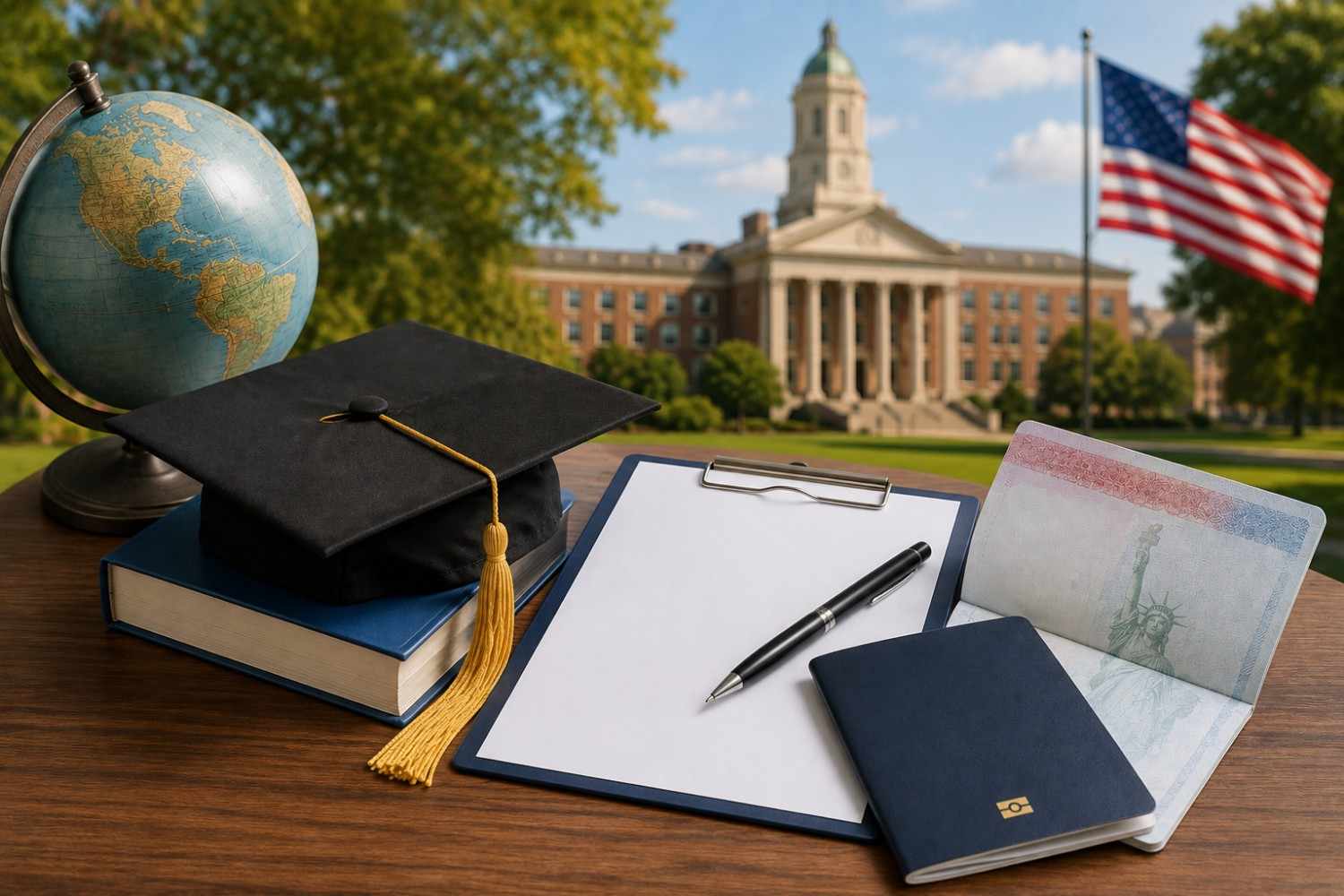
Getting admitted to a U.S. business school is only one part of starting an MBA in America. Most international students attending a full-time academic MBA also need to understand the F1 Visa for MBA in USA, including Form I-20, SEVIS, financial evidence, the DS-160 application and the visa interview.
The process becomes easier once each step is understood in the correct order. This guide explains the latest F-1 visa requirements for MBA students, current fees, 2026 rule changes, interview preparation, work opportunities, CPT, OPT and important guidance for Indian applicants.
What Is an F1 Visa for MBA in USA?
![F1 visa for MBA in USA with passport, student visa, graduation cap, U.S. university campus and study-abroad documents.]()
An F-1 visa is a nonimmigrant student visa used by international students who want to pursue a full course of academic study at an eligible U.S. institution. For most international applicants attending a full-time MBA at a SEVP-certified U.S. business school, the F-1 is the relevant student visa category.
F-1 vs J-1 vs M-1
The F-1 visa is the main student visa used by international students pursuing academic programs at U.S. colleges, universities and other approved institutions. It is commonly used for degrees such as an MBA, master's program, bachelor's degree or other full-time academic study at an SEVP-certified school.
The J-1 visa is generally used for approved exchange visitor programs, including certain students, researchers, trainees and scholars participating in structured cultural or educational exchange programs. Eligibility depends on the specific exchange category and sponsoring organisation.
The M-1 visa is designed for vocational or other recognised non-academic programs, such as technical, occupational or practical training courses. Unlike the F-1 category, it is not normally used for a traditional academic MBA or university degree.
Students researching business schools can also explore our MBA in USA guide before beginning the visa process.
Who Is Eligible for an F1 Visa for MBA in USA?
To qualify for an F-1 student visa, an MBA applicant must first receive admission to an eligible school and obtain Form I-20. The applicant must also show a genuine intention to pursue a full course of study, adequate financial resources and present intent to leave the United States after completing authorised activities. If you are still shortlisting universities, explore our guide to the top MBA colleges in USA before beginning the F1 visa process.
| Requirement | What It Means for an MBA Applicant |
| SEVP-Certified School | Your MBA institution must be authorised to enrol F-1 students |
| Form I-20 | Issued by the school after admission and required for the visa process |
| Full Course of Study | Your primary purpose in the United States must be academic study |
| Financial Ability | You must credibly demonstrate funding for your studies and living costs |
| Academic Preparation | You should be prepared to undertake the MBA for which you were admitted |
| Nonimmigrant Intent | You must establish that you qualify for temporary F-1 status |
What Changed for F1 Visa Applicants in 2026?
The F1 Visa for MBA in USA has seen important policy developments in 2026. Applicants should pay particular attention to online-presence screening, interview-location guidance and a major DHS rule changing how F-1 periods of admission are calculated.
Online Presence Review: The U.S. Department of State currently conducts online-presence review for F, M and J student and exchange-visitor visa applicants. Applicants in these categories are instructed to adjust the privacy settings of their social-media profiles to public or open to facilitate screening.
Where Should You Schedule the Interview?
Current Department of State guidance says nonimmigrant visa applicants should generally schedule their interview at a U.S. embassy or consulate in their country of nationality or residence. Applicants relying on residence may need to demonstrate that residence.
Fixed F-1 Admission Period
DHS published a final rule in July 2026 replacing the traditional duration-of-status framework with fixed admission periods for F students. The rule is scheduled to take effect in September 2026 unless the effective date is changed under the congressional-review process described by DHS.
Under the final rule, F-1 students are generally admitted for the program period listed on Form I-20, subject to a maximum four-year admission period, followed by a 30-day period to depart or take appropriate action to maintain lawful status.
Important: Because implementation rules can change, applicants should verify the latest position before travelling or making decisions about extensions, OPT or program changes.
How Do You Apply for an F1 Visa for MBA in USA?
![Indian MBA applicant reviewing F1 visa eligibility requirements, financial documents, admission paperwork and U.S. university study plans.]()
The F1 Visa for MBA in USA application follows a clear step-by-step process, starting with admission to an SEVP-certified business school and ending with your entry into the United States. Understanding each stage early can help you avoid documentation errors, delays and last-minute visa issues.
Step 1: Receive Admission from an SEVP-Certified Business School: Before applying for an F-1 visa, you must first receive admission to a U.S. institution certified by the Student and Exchange Visitor Program (SEVP). Only SEVP-certified schools can enrol international students in F-1 status and issue the documents needed for the visa process.
Step 2: Receive Form I-20: After your admission is confirmed and the school creates your SEVIS record, it will issue Form I-20. Review your name, program details, school information, program dates and financial information carefully before moving to the next step.
Step 3: Pay the SEVIS I-901 Fee: F-1 students currently pay a SEVIS I-901 fee of approximately ₹33,500 ($350). Keep the payment confirmation safely because it may be required during the visa application and interview process.
Step 4: Complete Form DS-160: Complete the online DS-160 nonimmigrant visa application carefully and accurately. The information you provide should remain consistent with your passport, Form I-20, academic history, employment history and supporting documents.
Step 5: Pay the Visa Application Fee: The current F-category nonimmigrant visa application processing fee is approximately ₹17,710 ($185). Keep the payment receipt or confirmation according to the instructions provided by the U.S. embassy or consulate handling your application.
Step 6: Schedule Your Visa Interview: Follow the instructions of the U.S. embassy or consulate where you plan to apply. Interview appointment availability can vary by location, season and visa category, so MBA applicants should begin the process early instead of waiting until close to the program start date.
Step 7: Prepare Your Documents: Organise all required and supporting documents before the interview. Important documents may include your passport, DS-160 confirmation, Form I-20, SEVIS fee receipt, academic records, financial evidence and other documents relevant to your MBA admission and funding.
Step 8: Attend the F-1 Visa Interview: During the interview, the consular officer may ask about your MBA choice, academic background, professional experience, funding arrangements and future plans. Your answers should be clear, truthful and consistent with the information submitted in your application.
Step 9: Wait for the Visa Decision: After the interview, your application may be approved, refused or placed under additional administrative processing. Processing times vary between cases and locations, so applicants should avoid relying on a fixed number of days for the final decision.
Step 10: Prepare for Entry to the United States: New F-1 student visas can generally be issued up to 365 days before the program start date. However, new students usually cannot enter the United States on the F-1 visa more than 30 days before the start date shown on Form I-20.
For a broader India-specific overview, read our USA Student Visa Process from India.
How Much Does an F1 Visa for MBA in USA Cost?
The two clearly published core government charges for a new F-1 applicant are the SEVIS I-901 fee and the nonimmigrant visa application fee. Together they currently total approximately ₹51,210 ($535).
| F1 Visa Cost | INR Approx. | Official Amount |
| SEVIS I-901 Fee | ₹33,500 | $350 |
| F-1 Visa Application Fee | ₹17,710 | $185 |
| Core Total | ₹51,210 | $535 |
Additional costs may arise depending on individual circumstances, document preparation, travel or nationality-specific rules. Always use the current government fee schedule rather than relying on an old blog or screenshot.
What Documents Are Required for an F1 Visa for MBA in USA?
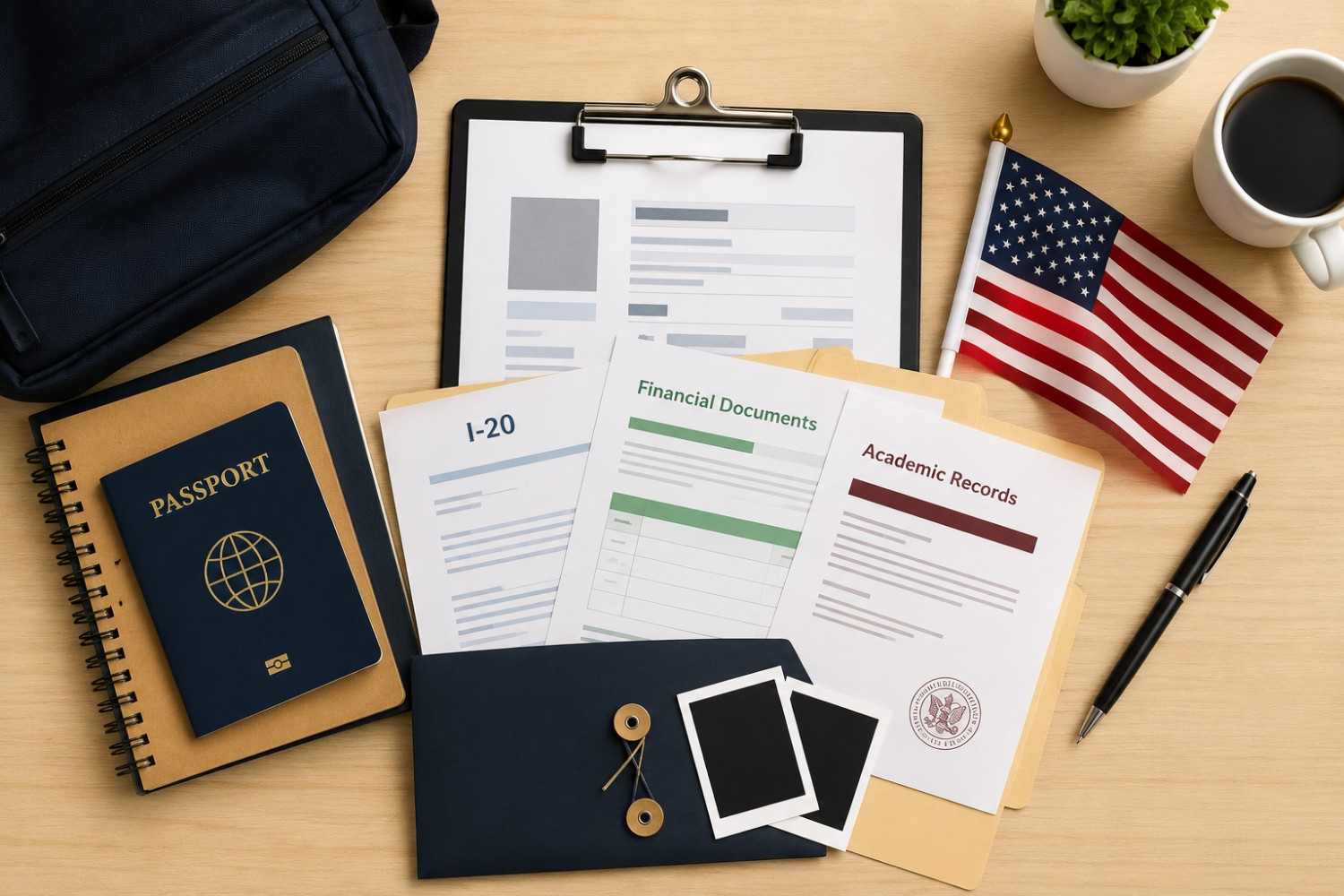
![F1 visa documents for MBA in USA including passport, Form I-20, financial records, academic documents and U.S. study application materials.]()
The Department of State lists several core documents for a student-visa interview. An MBA applicant should also be prepared with academic and financial evidence if requested.
Core Visa Documents
- Passport valid for travel to the United States
- DS-160 confirmation page
- Visa application fee payment receipt where required
- Form I-20 issued by the school
- Required photograph where applicable
- SEVIS I-901 payment confirmation
Supporting Academic Documents
- University transcripts
- Degree certificates
- MBA admission or enrolment documentation
- GMAT or GRE score where relevant
- English-language score where relevant
- Resume showing employment history
Supporting Financial Documents
- Bank statements
- Education-loan approval letters
- Scholarship or fellowship letters
- Sponsor documentation where applicable
- Evidence of other credible funding sources
How Much Bank Balance Is Required for an F1 Visa for MBA in USA?
There is no universal U.S. government rule requiring every F-1 MBA applicant to maintain a fixed bank balance, 1.5 times tuition or money for a fixed 28-day period. The financial assessment is based on whether your funding evidence credibly demonstrates that you can meet the costs of your education and stay. Possible funding sources can include personal or family funds, approved education loans, MBA scholarships in USA, assistantships, employer sponsorship or other legitimate financial support.
First-Year Funding
U.S. Department of State guidance says F-1 applicants should normally be able to show that enough readily available funds are available to cover the expenses of the first year of study. For an MBA student, this can include tuition, living expenses, health insurance, books and other costs shown on the Form I-20 or estimated by the university.
The funds should come from credible and verifiable sources such as personal savings, family support, approved education loans, scholarships or other legitimate financial arrangements. Applicants should be prepared to explain who is paying for the MBA, how the money was accumulated and whether the funds are genuinely available for educational expenses.
Later Years
Applicants should also be able to identify credible and reliable funding sources for the remaining duration of the MBA. You may not need to hold the entire cost of the full degree in cash at the time of the interview, but you should be able to explain how future tuition and living expenses will be financed.
Possible sources can include personal or family funds, approved education loans, scholarships, assistantships, employer sponsorship or other legitimate financial support. The key is to present a realistic funding plan that is consistent with the cost of the program and the financial information listed on your Form I-20.
Do Not Rely on Future OPT or CPT Income
Future earnings through Curricular Practical Training (CPT) or Optional Practical Training (OPT) should not be treated as the primary proof that you can finance the first year of your MBA. CPT and OPT are employment-authorisation options that depend on eligibility, academic requirements and the relevant approvals, so future income from these programs is not guaranteed.
MBA applicants should therefore demonstrate that they can meet their initial education and living costs without depending on future U.S. employment. Income earned later through an authorised internship or post-graduation OPT can support your overall finances, but it should not replace credible funding evidence during the F-1 visa application process.
What Should Indian Applicants Know About the F1 Visa for MBA in USA?
Indian MBA applicants should focus on three areas: consistent documentation, credible funding and a clear explanation of why the chosen MBA makes sense for their professional development. Visa officers assess the individual application rather than following a separate MBA approval formula for Indian students.
- Indian F-1 Visa Validity: The current U.S. reciprocity schedule for India lists F-1 visas as multiple-entry visas with a validity period of up to 60 months. This visa-stamp validity should not be confused with how long you are authorised to remain in the United States.
- Apply in India or Your Country of Residence: Current Department of State guidance generally expects nonimmigrant visa applicants to schedule interviews in their country of nationality or residence. Indian applicants should therefore normally follow the instructions for the appropriate U.S. mission processing their case.
- Keep Your MBA Story Consistent: Your DS-160, resume, Form I-20 information and interview answers should tell a consistent story about your education, professional experience, MBA choice and funding.
- Prepare for Online Presence Review: F-1 visa applicants are currently subject to online-presence review. The Department of State instructs F, M and J applicants to make social-media profiles public or open for the review process.
What Questions Are Asked in an F1 Visa Interview for MBA Students?
An MBA F-1 visa interview can focus on your school choice, professional background, funding and future plans. There is no official universal question list, so prepare around your real application rather than memorising scripted answers.
MBA and University Questions
- Why have you chosen this MBA?
- Why did you select this business school?
- Why do you need an MBA at this stage of your career?
- Which other schools did you apply to?
- How does the curriculum support your professional goals?
Financial Questions
- Who is funding your MBA?
- How will you pay your tuition and living expenses?
- Do you have an education loan?
- Did you receive a scholarship?
- What is the source of your sponsor's income?
Career and Intent Questions
- What are your plans after completing the MBA?
- How does this MBA fit your previous experience?
- Why study in the United States?
- What professional opportunities do you expect from the degree?
How Should You Answer?
Answer truthfully, clearly and concisely. Do not invent career plans, financial information or family circumstances because you think they sound more convincing. Your answers should remain consistent with the information submitted in your application.
Can You Work While Studying on an F1 Visa for MBA in USA?
![F1 visa for MBA in USA with passport, graduation cap, university campus, U.S. flag and study-abroad application documents.]()
Yes, but F-1 employment is regulated. Students should always speak with their Designated School Official before accepting work because unauthorised employment can put F-1 status at risk.
On-Campus Employment
Eligible F-1 students may generally work up to 20 hours per week in qualifying on-campus employment while school is in session. These roles can include jobs directly with the university or certain approved positions that provide services to students on campus. During official school breaks or vacations, eligible students may be allowed to work full-time on campus, subject to F-1 regulations and university policies. Students should still confirm their eligibility with their Designated School Official (DSO) before starting employment.
Off-Campus Employment
Off-campus employment is more restricted for F-1 students and is only allowed under specific categories and authorisation rules. Depending on the situation, students may need approval through options such as Curricular Practical Training (CPT), Optional Practical Training (OPT) or other authorised employment categories. Holding an F-1 visa does not automatically provide unrestricted permission to work for any employer in the United States. MBA students should always check with their DSO and obtain the required authorisation before accepting or beginning off-campus work.
Can MBA Students Do Internships Through CPT?
Yes, eligible MBA students can use Curricular Practical Training (CPT) when the practical training is an integral part of their academic curriculum and all F-1 eligibility requirements are met. CPT is commonly used for internships, practicums, cooperative education or other work experiences that directly relate to the student's MBA program and provide practical exposure alongside classroom learning.
For MBA students, CPT is particularly relevant for summer internships or curriculum-linked professional experiences completed before graduation. Students cannot simply begin an internship because it is related to business or management; the employment must qualify under the university's CPT rules and be authorised by the student's Designated School Official (DSO) before work begins. The DSO records the approved employer, location and employment dates on an updated Form I-20.
CPT can be authorised on either a part-time or full-time basis depending on the program and academic requirements. Students should also keep in mind that completing 12 months or more of full-time CPT can remove eligibility for OPT at the same education level, while part-time CPT does not have the same effect. Because university policies can differ, MBA students should confirm CPT eligibility with their DSO before accepting or starting an internship.
How Do CPT and OPT Work for MBA Students in the USA?
F-1 MBA students may be eligible for Curricular Practical Training (CPT) during their studies and Optional Practical Training (OPT) after graduation. Both options have specific eligibility and authorisation requirements.
- CPT Authorisation: Your Designated School Official (DSO) must authorise eligible CPT and issue an updated Form I-20 showing the authorisation before you begin employment.
- Impact of Full-Time CPT on OPT: Completing 12 months or more of full-time CPT makes a student ineligible for OPT at that education level. Part-time CPT does not have the same effect.
- OPT After an MBA: Optional Practical Training allows eligible F-1 students to gain temporary work experience directly related to their field of study. Students can generally receive up to 12 months of OPT at each education level.
- Post-Completion OPT: For most MBA graduates, post-completion OPT is the main F-1 work-authorisation route immediately after completing the degree. Students need a DSO recommendation and must apply to USCIS for employment authorisation.
- Working Before OPT Approval: Students should not begin post-completion OPT employment until the required employment authorisation has been approved and they are authorised to start working.
- STEM MBA and 36-Month OPT: Eligible students can combine up to 12 months of regular OPT with an additional 24-month STEM OPT extension. However, not every MBA automatically qualifies.
- STEM OPT Eligibility: The degree must meet DHS STEM eligibility requirements. Students must also work for an eligible E-Verify employer and satisfy the STEM OPT training-plan requirements.
- Check Your Degree Classification: Do not rely only on labels such as “STEM MBA.” Confirm your degree classification with your university and speak with your DSO to verify whether your program qualifies for the STEM OPT extension.
Applicants planning their career beyond OPT can read our USA Work Visa After MBA guide .
How Do You Maintain F1 Status During an MBA?
Receiving the F-1 visa is only the beginning. MBA students must continue following the conditions of their status throughout their study and authorised practical training.
- Maintain the required full course of study.
- Keep your Form I-20 and SEVIS information accurate.
- Speak with your DSO before employment or major status changes.
- Do not engage in unauthorised employment.
- Follow CPT and OPT authorisation requirements.
- Check travel documents before leaving and re-entering the United States.
- Follow the authorised admission period shown in your immigration records.
How Long Is an F1 Visa Valid for MBA Students?
Visa validity and immigration status are different concepts. The visa in your passport primarily allows you to travel to a U.S. port of entry and request admission. Your authorised stay is governed separately by immigration rules and your admission record.
- Indian Applicants: The Department of State's current reciprocity schedule lists the Indian F-1 visa as valid for multiple entries for up to 60 months.
- 2026 Admission-Period Change: DHS has published a final rule moving F students from the traditional duration-of-status framework to fixed periods of admission. Students whose authorised period will expire before their academic or practical-training activity is complete may need to follow the new extension-of-stay process where applicable.
When Should You Apply for an F1 Visa for MBA in USA?
Begin preparing as soon as your MBA admission and Form I-20 are available. New F and M student visas can currently be issued up to 365 days before the program start date.
However, receiving the visa early does not allow you to enter the country immediately. New students generally cannot enter the United States more than 30 days before the program start date.
Why Can an F1 Visa Application Be Refused?
A visa can be refused when the applicant does not establish eligibility under U.S. immigration law. For F-1 applicants, important areas include having a valid Form I-20, being prepared for the course of study, possessing sufficient financial resources and establishing the required temporary intent.
Common Problem Areas
- Unclear explanation of why the MBA is needed
- Weak or inconsistent funding evidence
- Differences between the DS-160 and interview answers
- Inability to explain the chosen university or program
- Documents that do not support the application
- Failure to establish eligibility for F-1 classification
A refusal should not be treated as evidence that a particular business school or applicant profile is automatically unacceptable. Each application is evaluated individually.
What Are the Most Common F1 Visa for MBA in USA questions?
Q: Do MBA students need an F1 visa in the USA?
Ans: Most international students attending a full-time academic MBA at a SEVP-certified U.S. business school use the F-1 student visa. Some applicants may fall under another category depending on their circumstances or program.
Q: How much does an F1 visa for MBA in USA cost?
Ans: The currently published core government charges are approximately ₹33,500 ($350) for the SEVIS I-901 fee and ₹17,710 ($185) for the F-category visa application fee, totalling approximately ₹51,210 ($535).
Q: How much bank balance is required for an F1 visa?
Ans: There is no universal government rule requiring a single fixed bank-balance amount. Applicants should credibly demonstrate readily available funding for the first year and reliable sources for later educational expenses.
Q: Can I apply for an F1 visa one year before my MBA?
Ans: New student visas may currently be issued up to 365 days before the program's start date. However, new students generally cannot enter the United States more than 30 days before the start date.
Q: Can I work while doing an MBA on an F1 visa?
Ans: Eligible F-1 students may generally work up to 20 hours per week in qualifying on-campus employment while school is in session. CPT, OPT and other employment categories have separate authorisation requirements.
Q: Can I do a summer internship during my MBA?
Ans: Yes, an eligible MBA student may be able to undertake an internship through CPT when it forms an integral part of the curriculum and the required DSO authorisation is obtained.
Q: How long can I work after an MBA on OPT?
Ans: Eligible F-1 graduates can generally receive up to 12 months of OPT at a given education level. Students with a qualifying STEM degree may be eligible for an additional 24-month STEM OPT extension.
Q: Is every MBA eligible for STEM OPT?
Ans: No. A program must meet the applicable STEM-degree requirements, and the student and employer must satisfy the other STEM OPT conditions. Confirm eligibility with the university and DSO rather than assuming every MBA qualifies.
Q: Can my spouse work in the USA on an F2 visa?
Ans: An F-2 dependent spouse does not receive general employment authorisation simply by holding F-2 status.
Q: How long is an F1 visa valid for Indian students?
Ans: The current U.S. reciprocity schedule lists F-1 visas for Indian citizens as multiple-entry visas valid for up to 60 months. Visa validity is different from the student's authorised period of stay.
Q: Does the U.S. check social media for F1 visas in 2026?
Ans: Yes. The Department of State says F, M and J visa applicants are subject to online-presence review and currently instructs these applicants to set social-media profiles to public or open for vetting.
Q: What happens to the F1 grace period in 2026?
Ans: DHS has published a final rule replacing the previous duration-of-status framework with fixed admission periods and a 30-day departure period. The rule was scheduled to become effective in September 2026, subject to the congressional-review provision stated by DHS. Students should verify current implementation before relying on an older 60-day rule.
Related Blogs
Official Sources
Conclusion
The F1 Visa for MBA in USA becomes much easier to manage when applicants understand the correct sequence and separate admission requirements from visa and work-authorisation rules. Start early, keep your academic and financial information consistent, understand how CPT and OPT apply to your MBA, and verify current government guidance before every major visa, employment or travel decision.

 Abhyank Srinet