
 Abhyank Srinet


Table of Contents
- MBA Salary in Singapore 2026: Pay, Jobs & ROI
- Introduction
- What Are the Quick Facts About MBA Salary in Singapore?
- How Do MBA Salaries Compare Across Top Singapore Business Schools?
- Which Industries Offer the Highest MBA Salaries in Singapore?
- What Are the Highest-Paying Jobs After an MBA in Singapore?
- How Do Starting Salary, Median Salary and Alumni Salary Differ?
- What Factors Affect MBA Salary in Singapore?
- How Do MBA Employment Outcomes Compare Across Singapore Schools?
- Is the MBA Salary in Singapore Enough to Justify the Cost?
- What Should Indian Applicants Know About MBA Salary in Singapore?
- How Should You Choose an MBA in Singapore Based on Salary?
- Is an MBA in Singapore Worth It for Salary Growth?
- Related Blogs
- Conclusion
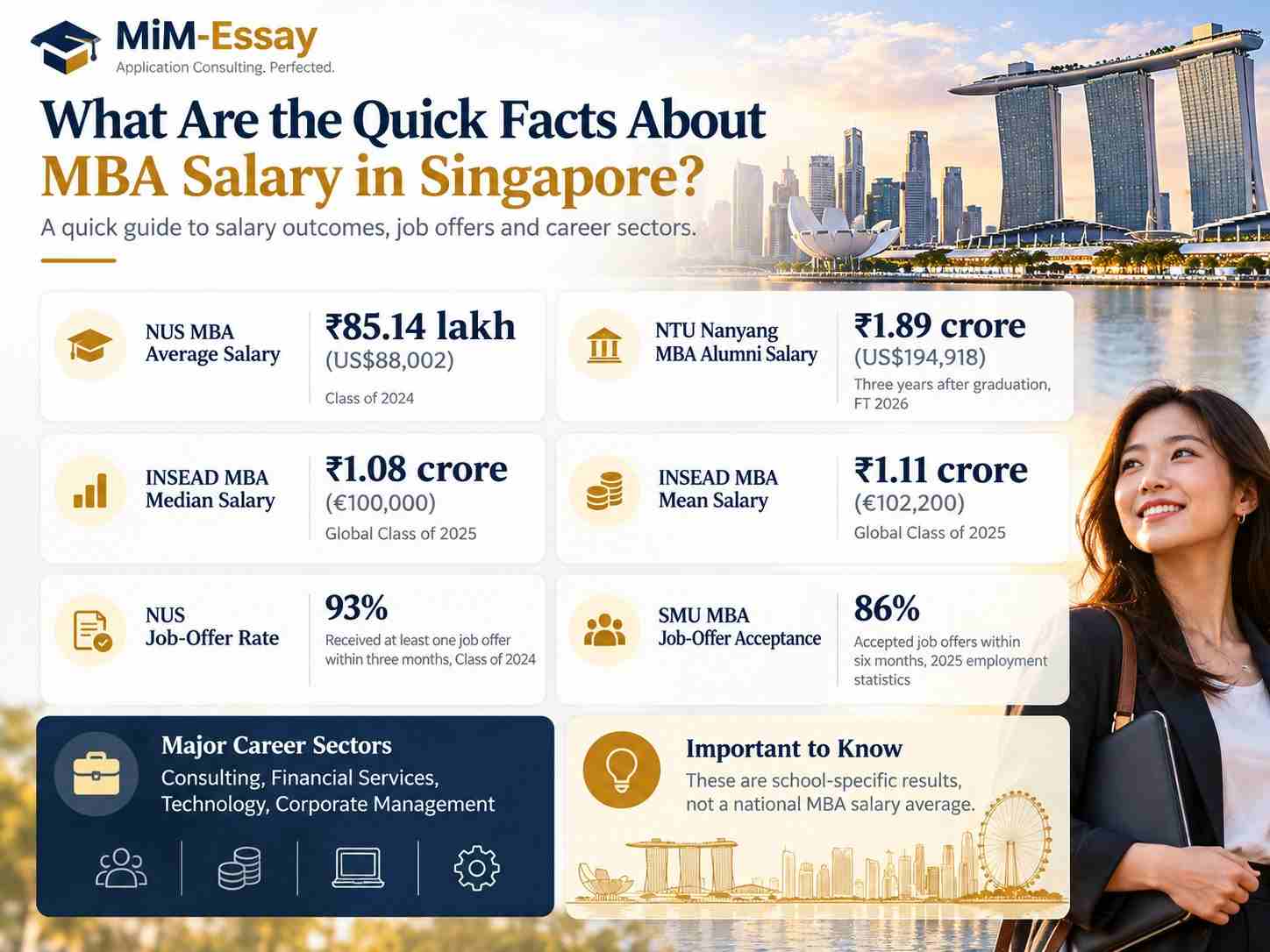
The MBA salary in Singapore depends on the business school, industry, work experience and employment location. The latest official NUS MBA career data reports an average post-MBA salary of approximately ₹85.14 lakh (US$88,002) for its Class of 2024. INSEAD reports an overall median annual salary of approximately ₹1.08 crore (€100,000) for its global MBA Class of 2025, while NTU reports approximately ₹1.89 crore (US$194,918) in average alumni salary three years after graduation in the Financial Times 2026 ranking.
Introduction
The MBA salary in Singapore is an important consideration for Indian professionals planning to study at business schools such as NUS, NTU, SMU and INSEAD. Singapore offers career opportunities across finance, consulting, technology and regional management, but salaries depend on the role, employer, previous experience and country of employment.
Comparing MBA salaries requires more than looking at the highest figure in a ranking table. Some schools report compensation immediately after graduation, while others publish alumni salaries several years later. This guide compares verified school outcomes, industry-wise compensation, job opportunities and financial considerations to help applicants understand their potential return on investment.
What Are the Quick Facts About MBA Salary in Singapore?
| Salary Factor | Latest Verified Information |
|---|---|
| NUS MBA Average Salary | ₹85.14 lakh (US$88,002), Class of 2024 |
| NTU Nanyang MBA Alumni Salary | ₹1.89 crore (US$194,918), three years after graduation, FT 2026 |
| INSEAD MBA Median Salary | ₹1.08 crore (€100,000), global Class of 2025 |
| INSEAD MBA Mean Salary | ₹1.11 crore (€102,200), global Class of 2025 |
| NUS Job-Offer Rate | 93% received at least one job offer within three months, Class of 2024 |
| SMU MBA Job-Offer Acceptance | 86% accepted job offers within six months, 2025 employment statistics |
| Major Career Sectors | Consulting, financial services, technology and corporate management |
| Salary Reporting | School-specific results; not a national MBA salary average |
How Do MBA Salaries Compare Across Top Singapore Business Schools?
NUS, NTU, SMU and INSEAD publish different types of employment information. NUS provides a post-MBA salary for a named class, NTU highlights longer-term alumni compensation, and INSEAD reports global salary outcomes by industry. SMU's available employment report provides job-offer and destination information without a directly comparable current MBA median salary.
| Business School | Latest Reported Salary | Measurement |
|---|---|---|
| NUS Business School | ₹85.14 lakh (US$88,002) | Average post-MBA salary, Class of 2024 |
| Nanyang Business School, NTU | ₹1.89 crore (US$194,918) | Average alumni salary three years after graduation, FT 2026 |
| INSEAD MBA | ₹1.08 crore (€100,000) | Global median annual salary, Class of 2025 |
| Singapore Management University | Not officially disclosed in a directly comparable current MBA salary measure | 2025 MBA employment statistics available |
Important: This table compares published outcomes from business schools offering MBAs in Singapore. It is not a ranking of Singapore-only starting salaries. Different graduating classes, salary definitions and employment locations limit direct comparisons.
NUS Business School MBA Salary
The National University of Singapore reports an average post-MBA salary of approximately ₹85.14 lakh (US$88,002) for its Class of 2024. The same official report states that 93% of graduates received at least one job offer within three months of graduation.
Career mobility is another important outcome. NUS reports that 51% of graduates changed location, 76% changed industry and 91% changed at least one career dimension.
These figures indicate the career transitions achieved by the reporting class. They do not guarantee that an individual graduate will secure employment in Singapore or receive the reported average salary.
Source: NUS MBA official career development and employment information.
Nanyang Business School MBA Salary
Nanyang Technological University's Nanyang MBA reports an average alumni salary of approximately ₹1.89 crore (US$194,918) in the Financial Times Global MBA Ranking 2026. This measures earnings three years after graduation, not immediate starting pay.
NTU also reports a 136% increase compared with pre-MBA salary under the Financial Times methodology. This is a specific alumni outcome and should not be applied to all MBA graduates in Singapore.
The three-year reporting period means graduates have had additional time to progress professionally after completing their degrees. Applicants should therefore avoid comparing this figure directly with a school's initial post-MBA salary.
Source: NTU official Nanyang MBA information.
INSEAD MBA Salary
INSEAD reports an overall annual median salary of approximately ₹1.08 crore (€100,000) and a mean salary of approximately ₹1.11 crore (€102,200) for its MBA Class of 2025.
INSEAD's salary statistics cover its global MBA graduates across employment markets. The figures therefore should not be described as salaries earned exclusively in Singapore, even though INSEAD operates an MBA campus there.
The report also provides industry-level salary and bonus information, making it useful for understanding differences between consulting, financial services, technology and corporate careers.
Source: INSEAD official MBA Employment Statistics 2025.
Singapore Management University MBA Employment
Singapore Management University's 2025 MBA employment statistics report that 86% of MBA students accepted job offers within six months of graduation.
Among reported job-offer destinations, 45.94% were in Singapore and 16.21% were in India. Technology accounted for 35.14% of reported industry offers, while financial services represented 13.51%.
A directly comparable current MBA median salary is not available in the verified employment data used for this comparison. It would therefore be misleading to assign SMU a salary figure taken from an unrelated postgraduate programme or a different reporting period.
Which Industries Offer the Highest MBA Salaries in Singapore?

Consulting, financial services, technology and corporate management are important post-MBA career sectors. However, publicly available school reports do not establish one reliable Singapore-wide starting salary for every industry.
INSEAD's Class of 2025 employment report provides a useful official comparison of global MBA compensation across industries.
| Industry | Median Annual Salary | Mean Annual Salary |
|---|---|---|
| Management Consulting | ₹1.15 crore (€106,100) | ₹1.16 crore (€107,200) |
| Financial Services | ₹1.04 crore (€96,000) | ₹1.08 crore (€99,400) |
| Corporate Sectors | ₹99.70 lakh (€91,900) | ₹1.04 crore (€95,900) |
Source: INSEAD MBA Employment Statistics, Class of 2025. These are global INSEAD outcomes across employment regions, not Singapore-only industry salaries.
Management Consulting
Management consulting offers opportunities for MBA graduates interested in business strategy, organisational transformation, operations and performance improvement.
INSEAD's 2025 report shows that consulting graduates recorded a global median annual salary of approximately ₹1.15 crore (€106,100). Actual Singapore compensation depends on the employer, job level and professional experience.
Financial Services
Financial services roles may include corporate finance, banking, investment analysis, risk management and financial strategy. Salaries vary significantly across positions and levels of responsibility.
INSEAD reports a global financial-services median salary of approximately ₹1.04 crore (€96,000) for its Class of 2025. Applicants should not assume this is the expected starting salary for every MBA finance role in Singapore.
Technology and Digital Business
Technology-related MBA roles can include product management, business operations, digital transformation and strategic partnerships.
Compensation depends on the company, responsibility level and technical experience. For technology-focused careers, students should assess individual employment reports and the type of roles graduates actually secure.
Corporate Management
Corporate management roles cover strategy, marketing, operations, business development and general management across different industries.
INSEAD's global corporate-sector median salary of approximately ₹99.70 lakh (€91,900) provides one school-specific benchmark, but it does not represent a national average for Singapore-based MBA graduates.
What Are the Highest-Paying Jobs After an MBA in Singapore?
Some MBA graduates pursue careers in consulting, investment management, corporate strategy, technology leadership and general management. However, a job title alone does not establish a reliable salary because compensation varies according to employer, seniority and previous work experience.
| Job Role | Typical Responsibilities | Relevant MBA Skills |
|---|---|---|
| Management Consultant | Business strategy and organisational improvement | Problem-solving, analytics and communication |
| Investment or Corporate Finance Manager | Financial planning, analysis and investment decisions | Finance, valuation and strategic analysis |
| Product Manager | Product strategy, development and cross-functional coordination | Technology strategy and customer analysis |
| Corporate Strategy Manager | Market analysis, growth planning and business decisions | Competitive strategy and financial analysis |
| Business Development Manager | Partnerships, market expansion and revenue growth | Marketing, negotiation and commercial strategy |
| Operations Manager | Process management, performance and resource allocation | Operations, analytics and leadership |
These are possible career directions, not guaranteed employment outcomes or salary rankings. Explore our MBA jobs in Singapore guide for a broader discussion of career paths and hiring considerations.
How Do Starting Salary, Median Salary and Alumni Salary Differ?

The MBA salary in Singapore can look very different depending on the metric used. Applicants should understand the difference between post-graduation compensation, the median salary of a cohort and alumni income measured several years later.
| Salary Measure | Meaning | How to Interpret It |
|---|---|---|
| Starting Salary | Compensation associated with employment after graduation | Useful for evaluating immediate post-MBA earning potential |
| Mean Salary | Arithmetic average of reported salaries | Can be influenced by unusually high or low salaries |
| Median Salary | Middle reported salary when observations are ordered | Useful for understanding the centre of the reported distribution |
| Alumni Salary | Earnings measured after a specified period following graduation | Reflects additional post-MBA career experience |
| Sign-On Bonus | Additional payment associated with accepting employment | Should not automatically be treated as recurring annual salary |
| Performance Bonus | Compensation linked to individual or company performance | May vary and is not guaranteed |
This distinction matters when comparing NUS, NTU and INSEAD. NTU's Financial Times alumni salary is measured three years after graduation, while NUS and INSEAD report different forms of post-MBA compensation.
What Factors Affect MBA Salary in Singapore?
MBA salaries depend on the interaction of work experience, target industry, job function, employer, programme reputation and employment geography. The degree can support career progression, but it does not create a fixed salary increase.
- Previous Work Experience: Applicants with relevant managerial or industry experience may qualify for different roles from those making a major career switch.
- Industry and Job Function: Consulting, finance, technology and corporate positions have different compensation structures.
- Employer and Seniority: Large multinational companies, regional businesses and startups may offer different salary and bonus packages.
- Business School: Recruiting networks, career services and alumni connections can influence access to employment opportunities.
- Career Switching: Moving into a different industry or function can affect the role and compensation secured after graduation.
- Employment Location: A Singapore MBA graduate may work in Singapore, India, another Asian market or elsewhere. Salary comparisons must account for location.
- Work Authorisation: International graduates must meet the relevant immigration and employer sponsorship requirements for their intended destination.
How Do MBA Employment Outcomes Compare Across Singapore Schools?
Employment rates and career mobility provide important context alongside salary. However, job offers, accepted offers and actual employment are different measures and should not be treated as equivalent.
| Business School | Reported Outcome | Reporting Period |
|---|---|---|
| NUS MBA | 93% received at least one job offer within three months | Class of 2024 |
| SMU MBA | 86% accepted job offers within six months | 2025 employment statistics |
| NTU Nanyang MBA | 136% salary increase reported through the FT alumni measure | FT Global MBA Ranking 2026 |
The results use different definitions and reporting periods. A job offer is not the same as confirmed employment, and long-term salary growth should not be presented as a graduation placement rate.
Is the MBA Salary in Singapore Enough to Justify the Cost?
The financial return from an MBA in Singapore depends on total tuition, living expenses, previous earnings, financing and post-graduation employment. A higher published salary does not automatically produce a better return on investment.
Tuition and Living Expenses
Applicants should calculate tuition, accommodation, insurance, daily living costs, travel and any additional compulsory charges. Programme duration also affects the overall commitment.
For updated university fees and budgeting considerations, see our MBA in Singapore cost guide.
Opportunity Cost
Opportunity cost represents the income a student may give up while pursuing a full-time MBA. Someone already earning a strong salary should include this amount when evaluating programme ROI.
Post-MBA Career Outcomes
Compare the programme's official salary results with your likely industry, employment location and previous experience. A salary reported across global markets may not reflect the opportunities available in Singapore for your particular profile.
Education Loan and Repayment
Indian applicants should account for loan interest, currency fluctuations and repayment obligations. The expected salary should be assessed against realistic employment scenarios rather than the highest figure in an employment report.
For a broader evaluation framework, read our MBA ROI and worth-it guide.
What Should Indian Applicants Know About MBA Salary in Singapore?

Indian applicants should compare salary outcomes with Singapore's living costs, employment requirements and the likelihood of securing a role in their chosen industry. Studying at a Singapore business school does not guarantee employment in the country.
- Compare the Right Salary Data: Use school-specific employment reports and distinguish immediate post-MBA pay from long-term alumni salaries.
- Check Employment Location: Confirm how many graduates secured roles in Singapore rather than assuming that all reported salaries represent Singapore-based employment.
- Review Work-Pass Requirements: Employers must follow Singapore's applicable work-pass rules. Salary requirements can vary by sector and applicant age.
- Plan for Currency Changes: Compare tuition and expected salary in INR while retaining the original currency to understand foreign-exchange exposure.
- Evaluate Previous Experience: Compare your current job function and career level with the types of post-MBA roles available to graduates.
- Consider Alternative Employment Markets: A Singapore MBA may support careers across Asia and other regions, but each location has different salary levels and immigration requirements.
- Assess Scholarships and Loan Burden: Financial aid can materially change programme affordability and expected ROI.
Singapore Employment Pass Requirements
Singapore's Ministry of Manpower sets minimum qualifying salaries for Employment Pass applicants, with requirements increasing according to age and differing between general and financial-services roles.
For new applications from January 1, 2027, the minimum threshold starts at S$6,000 per month for non-financial sectors and S$6,600 for financial services, with higher age-adjusted requirements. Applicants must also satisfy other applicable eligibility conditions.
These are work-pass thresholds, not expected MBA salaries. Securing an MBA degree does not automatically qualify a graduate for an Employment Pass.
How Should You Choose an MBA in Singapore Based on Salary?
Salary is an important selection factor, but applicants should also evaluate programme structure, career services, alumni networks, total fees and employer access. A programme is valuable when it supports a realistic career plan, not simply because its reported salary is high.
- Identify Your Target Role: Decide whether you want consulting, finance, technology, strategy or another management function.
- Check the Employment Report: Compare the same salary measures and reporting periods wherever possible.
- Review Career Mobility: Look at changes in industry, function and geography among graduates.
- Evaluate Recruiting Support: Review career coaching, alumni access, employer activities and recruitment opportunities.
- Calculate Total Investment: Include tuition, living expenses, financing and lost income.
- Understand Your Employment Market: Consider Singapore and alternative destinations before estimating post-MBA earnings.
For a complete comparison of programme formats, admission requirements and universities, explore our MBA in Singapore guide.
Is an MBA in Singapore Worth It for Salary Growth?
Worth it if... the programme provides credible access to roles aligned with your experience and career goals, you understand the relevant employment outcomes, and the likely financial benefits justify tuition and other costs. Singapore can be attractive for professionals seeking exposure to regional and international business opportunities.
Think twice if... you are relying on the highest alumni salary in a ranking, assuming that all graduates work in Singapore, or expecting a guaranteed salary increase. Compare school-specific data, job-market conditions and your financial obligations before deciding.
Related Blogs
- MBA in Singapore: Top Universities, Fees & Admissions
- NUS MBA Salary: Employment, Career Outcomes & ROI
- Nanyang MBA Salary: NTU Employment & Career Growth
- SMU MBA: Fees, Admissions & Career Opport
Conclusion
The MBA salary in Singapore can offer attractive career possibilities, but the financial outcome depends on the business school, previous experience, industry and employment location. NUS, NTU, INSEAD and SMU report different types of career information, so applicants should compare them carefully rather than relying on one headline salary. For Indian professionals, the right MBA is one that combines relevant career opportunities with manageable costs and a realistic plan for employment after graduation.