
 Abhyank Srinet



Table of Contents
- Introduction
- What Is the Difference Between MiM and MFin?
- How Do MiM and MFin Courses Differ in 2027?
- What Are the MiM vs MFin Eligibility Requirements for Indian Freshers?
- Which Are the Best MiM and MFin Universities for 2027?
- How Much Do MiM and MFin Programs Cost in 2027?
- What Jobs Can You Get After MiM vs MFin?
- MiM vs MFin Salary: Which Degree Offers Better ROI?
- Is MiM or MFin Better After BCom, BBA, Economics or BTech?
- Is MiM or MFin Better for Jobs in India and Abroad?
- MiM vs MFin 2027: Which Should Indian Freshers Choose?
MiM vs MFin: Which is better for Indian freshers? Choose MiM if you want to work in consulting, marketing, management or business operations. Choose MFin if you prefer banking, investments or financial analysis. Both degrees can accept students with no work experience. However, admission rules vary by university. Your choice should depend on your career goals, skills and study budget.
Introduction
Choosing between MiM vs MFin can be confusing for Indian students planning to study abroad in 2027. Both degrees offer good career options, but they teach different skills. A Master in Management (MiM) covers general business subjects. A Master in Finance (MFin) focuses on finance, banking and investments.
In the QS Business Master's Rankings 2027, HEC Paris ranks #1 in both Management and Finance. London Business School also reported that 92% of its 2025 Graduate Masters students received job offers within three months. This figure covers several programs, not just MiM or finance. In this blog, we compare MiM vs MFin fees, courses, jobs, salaries and admission rules to help Indian freshers choose the right degree.
What Is the Difference Between MiM and MFin?
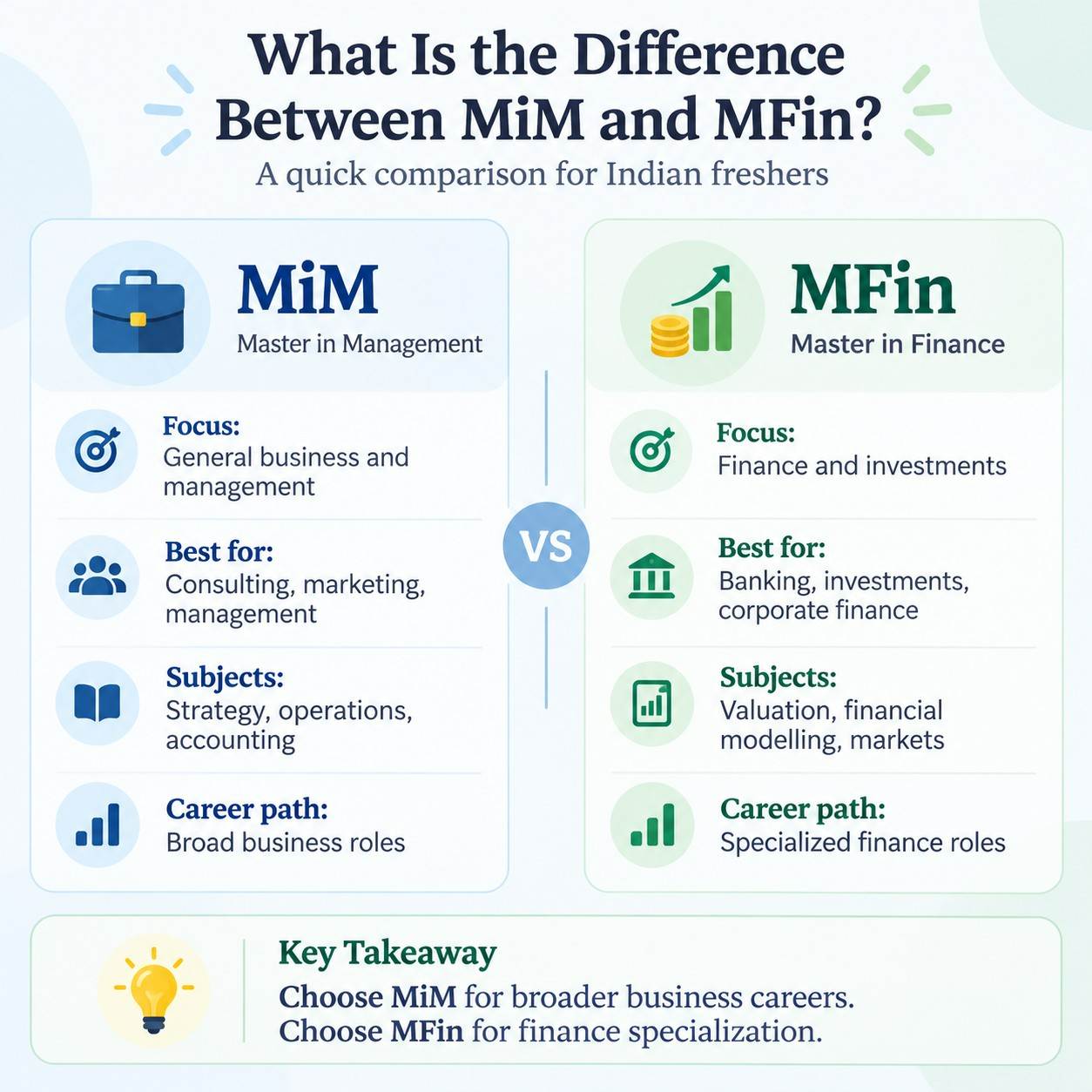
MiM teaches students how to manage different parts of a business. MFin focuses on how money, investments and financial markets work. Both degrees can lead to good jobs, but they prepare students for different roles. The table below shows the main differences.
| Factor | MiM | MFin |
|---|---|---|
| Full form | Master in Management | Master in Finance |
| Main focus | General business | Finance and investments |
| Ideal student | Graduates interested in business | Graduates interested in finance |
| Duration | Often 1–2 years | Often 10–24 months |
| Work experience | Usually little or none | Depends on the course |
| Subjects | Marketing, strategy, operations | Valuation, banking, investments |
| Jobs | Consulting, marketing, management | Banking, finance, investments |
| Maths skills | Depends on the course | Often more important |
| Career options | Broad business roles | More focused finance roles |
A MiM may suit you if you want to explore different business careers. An MFin may suit you if you already want to work in finance. Some jobs, such as consulting and business analysis, are open to graduates from both degrees.
How Do MiM and MFin Courses Differ in 2027?
MiM and MFin courses focus on different skills. A MiM teaches students how companies work and make decisions. An MFin teaches students how to study financial data and manage investments. The subjects can change from one university to another, so always check the course details.
What Subjects Do Students Study in a MiM?
A Master in Management covers many areas of business. Students learn about marketing, finance, strategy and daily business operations. Some schools also let students choose extra subjects based on their career goals.
Common MiM subjects include:
- Business Strategy: Learn how companies plan for growth.
- Marketing: Understand customers, branding and sales.
- Accounting: Learn how to read financial reports.
- Operations: Understand how businesses manage daily work.
- Business Analytics: Use data to make better decisions.
These subjects can help students prepare for different business jobs. A MiM is useful for students who do not want to focus on one field too early.
What Subjects Do Students Study in an MFin?
A Master in Finance focuses on money, investments and financial decisions. Students learn how to study company finances and understand market trends. Some schools also teach coding and data skills for finance jobs.
Common MFin subjects include:
- Corporate Finance: Learn how companies manage money.
- Financial Modelling: Build models to study future results.
- Investment Analysis: Learn how to assess investments.
- Risk Management: Identify and manage financial risks.
- Financial Markets: Study trading, banking and investments.
For example, HEC Paris offers two main focus areas in its Master in International Finance. These are Corporate Finance and Capital Markets. Students can choose based on their career interests.
What Are the MiM vs MFin Eligibility Requirements for Indian Freshers?
.jpeg)
Many MiM programs accept students from BCom, BBA, Economics and BTech backgrounds. MFin programs may ask for stronger maths skills or some knowledge of finance. However, students do not always need a finance degree to apply for MFin. The rules depend on the university and the course.
| Requirement | MiM | MFin |
|---|---|---|
| Bachelor's degree | Many subjects accepted | Many subjects accepted |
| Work experience | Often 0–2 years | Depends on the school |
| GMAT/GRE | Depends on the school | Depends on the school |
| English test | IELTS, TOEFL or accepted alternative | IELTS, TOEFL or accepted alternative |
| Maths skills | Useful | Often important |
| Internships | Helpful | Finance internships are helpful |
| Academic record | Strong grades preferred | Strong grades preferred |
Good grades and internships can support your application. You should also explain why you want to study the degree. Check the test rules and work experience limits before applying.
Can Indian Freshers Apply for MFin Without Work Experience?
Yes, many finance master's programs accept fresh graduates. Still, some MFin courses are meant for people who have already worked in finance. This is why students must check the exact course name.
Here are four examples from leading business schools:
- INSEAD Master in Finance: Designed for students with 0–2 years of experience.
- HEC Paris Master in International Finance: Accepts recent graduates from suitable academic backgrounds.
- LBS Masters in Financial Analysis: Accepts fresh graduates and those with up to two years of experience.
- LBS Masters in Finance: Normally requires at least two years of relevant work experience.
For freshers, the LBS Masters in Financial Analysis may be a better fit than its Masters in Finance. Both focus on finance, but they target students at different career stages.
Which Are the Best MiM and MFin Universities for 2027?
The right university can help you develop skills and find career opportunities. Compare course subjects, fees, location and job reports before applying. Rankings can help you create a shortlist, but they should not be your only reason for choosing a school.
The QS Business Master's Rankings 2027 list the following universities at the top of their Management and Finance categories.
| QS 2027 Rank | Top MiM Universities | Top Finance Master's Universities |
|---|---|---|
| 1 | HEC Paris | HEC Paris |
| 2 | London Business School | Oxford Saïd |
| 3 | ESSEC Business School | MIT Sloan |
Source: QS Business Master's Rankings 2027. These are separate rankings.
HEC Paris offers both a Master in Management and a Master in International Finance. London Business School also offers management and finance courses for recent graduates. Students should check each course's admission rules before applying.
INSEAD will welcome its first Master in Finance class in August 2027. The course includes 14 months of study and six months of work experience or internship. It also offers learning across France and Singapore.
How Much Do MiM and MFin Programs Cost in 2027?
The cost of MiM vs MFin depends on your university and study location. Tuition fees are only one part of the total cost. You also need money for rent, food, travel and other daily needs. A longer course may cost more because you spend more time abroad.
The table below shows published fees for three programs.
| University | Program | Tuition Fees |
|---|---|---|
| HEC Paris | Master in Management | ₹62,78,740 (€58,900) |
| HEC Paris | Master in International Finance | ₹51,11,470 (€47,950) |
| INSEAD | Master in Finance | ₹61,68,942 (€57,870) |
Sources: HEC Paris 2027/28 fee schedules and INSEAD's 2027 MFin fee information. Fees may change.
INR conversion: €1 ≈ ₹106.60, based on the EUR/INR mid-market rate on 30 October 2026 (rounded from €1 = ₹106.614). Exchange-rate source: XE. All INR figures are approximate. The amounts in euros are the original figures. Bank and card rates may differ.
HEC Paris also charges an extra ₹2,13,200 (€2,000) for students outside its exempt groups. Most Indian students should add this amount to their budget. The HEC MiM fee covers its standard two-year schedule.
What Extra Costs Should Indian Students Consider?
The total cost of studying abroad goes beyond tuition. Your city and lifestyle will affect how much you spend each month. You should plan for these costs before applying for an education loan.
Common expenses include:
- Rent: Student housing or a shared apartment.
- Food: Groceries, meals and daily needs.
- Transport: Buses, trains and local travel.
- Visa and insurance: Required fees and health cover.
- Flights: Travel to and from your study country.
- Application costs: Tests, applications and documents.
HEC Paris estimates living costs of about ₹1,59,900 (€1,500) per month in its 2026 guidance. INSEAD estimates around ₹23,45,200 (€22,000) for living costs during its MFin program. Students should also check scholarship options and loan interest rates.
What Jobs Can You Get After MiM vs MFin?

The jobs available after MiM vs MFin depend on your skills and career goals. MiM graduates can work in several business fields. MFin graduates often look for jobs in banking, investments and financial services. Both degrees offer career options, but no course guarantees a job.
What Are the Career Opportunities After a MiM?
MiM graduates can apply for jobs in consulting, marketing, operations and business analysis. These roles need people who understand how businesses work. Employers may also look at internships, communication skills and practical experience.
Common MiM jobs include:
- Business Analyst: Study business data and suggest changes.
- Management Consultant: Help companies solve problems.
- Marketing Associate: Support branding and marketing work.
- Operations Analyst: Improve how a business works.
- Management Trainee: Learn different areas of a company.
MiM graduates can work in consulting firms, technology companies and other industries. Check each school's job report to see where its graduates work.
What Are the Career Opportunities After an MFin?
MFin graduates often apply for roles in banks and investment firms. They may also work in finance teams at large companies. These jobs often need strong maths, accounting and financial analysis skills.
Common MFin jobs include:
- Financial Analyst: Study company finances and future costs.
- Investment Banking Analyst: Help with financial deals.
- Equity Research Analyst: Study companies and stocks.
- Risk Analyst: Find and assess financial risks.
- Corporate Finance Analyst: Help companies plan their finances.
HEC Paris lists asset management, equity research and private equity among its finance career paths. These roles can be hard to enter, so relevant skills and internships matter.
MiM vs MFin Salary: Which Degree Offers Better ROI?
Salary is a key factor when comparing MiM vs MFin. Some finance jobs may offer high starting pay. MiM graduates can also earn good salaries in consulting and management roles. Your salary will depend on your school, location, employer and experience.
The following figures come from official school reports. They use different measures, so they are not a direct salary comparison.
| University and Program | Reported Result |
|---|---|
| LBS Graduate Masters portfolio | 92% received job offers within three months, Class of 2025 |
| HEC Paris Master in International Finance | ₹1,09,79,800 (€103,000) average starting salary, 2025 survey |
Sources: London Business School and HEC Paris official career information.
The LBS result covers several Graduate Masters courses. It is not a MiM-only figure. The HEC salary is also from one program, so it may not reflect the pay at other schools.
How Can Indian Students Calculate MiM vs MFin ROI?
Return on investment (ROI) helps you compare your study costs with your future earnings. A high salary can be useful, but it does not always mean a faster return. You should also consider taxes, loan payments and living costs.
Use these points to assess ROI:
- Total cost: Add tuition, rent, travel and other expenses.
- Expected salary: Check official school job reports.
- Annual savings: Estimate how much money you can save each year.
- Payback period: Divide your total cost by annual savings.
- Career growth: Look at future job options and salary growth.
For example, suppose you spend ₹63,96,000 (€60,000) on a degree. If you save ₹21,32,000 (€20,000) each year, you may recover that amount in three years. This is only an example. Your actual result will depend on your job, savings and loan costs.
Is MiM or MFin Better After BCom, BBA, Economics or BTech?
Your bachelor's degree can help you choose between MiM and MFin. BCom and Economics students may already know some finance subjects. BBA students often have a base in business and management. BTech graduates may have strong maths and data skills. Still, your career interests matter more than your degree name alone.
| Bachelor's Degree | MiM Career Options | MFin Career Options |
|---|---|---|
| BCom | Consulting, business operations | Banking, corporate finance |
| BBA | Marketing, management | Finance, investments |
| Economics | Strategy, business analysis | Research, financial markets |
| BTech | Technology consulting | Financial analysis, quantitative finance |
For example, a BCom graduate who enjoys studying stocks may prefer an MFin. A BTech student who likes solving business problems may choose a MiM. Both students should check the subjects and entry rules before making a final choice.
Can Students Without a Finance Background Choose MFin?
Yes, some MFin programs accept students from engineering, maths and science backgrounds. However, these students may need good maths skills or basic finance knowledge. Some schools offer special study tracks to help them learn finance.
HEC Paris has an Accelerated Track for students from several non-finance fields. Students can also prepare by learning accounting, statistics and Excel. Relevant internships can help them understand how finance jobs work.
Is MiM or MFin Better for Jobs in India and Abroad?
Both MiM and MFin can help students explore jobs in India and other countries. However, each country has different hiring trends and visa rules. Finance jobs are often found in major banking centres. Management jobs can be found across many industries.
The UK offers jobs in banking, consulting and technology. France and other European countries also have roles in business and finance. Some jobs may need local language skills. Students returning to India can explore careers in banks, consulting firms and large companies.
What Should Students Check Before Choosing a Country?
Choosing a country takes more than checking university rankings. You should understand the local job market and rules for working after graduation. School career reports can show where past graduates found jobs.
Before you apply, check:
- Job locations: Where the school's graduates work.
- Visa rules: Whether you can seek work after graduation.
- Language needs: Whether local employers ask for another language.
- Hiring industries: Which fields offer roles that match your goals.
Always check current visa information on official government websites. Rules may change before the 2027 intake.
MiM vs MFin 2027: Which Should Indian Freshers Choose?

Your career goals should guide your choice between MiM and MFin. Think about the subjects you enjoy and the jobs you want. Also check your skills, budget and work experience. A degree is a major investment, so choose a course that fits your plans.
When Should You Choose a MiM?
A MiM may be a good fit if you want to learn about different areas of business. It can also help students from other fields build management skills. The degree offers a broad base for several entry-level careers.
Choose a MiM if you:
- Want to work in consulting, marketing or management.
- Enjoy business strategy and working with teams.
- Prefer learning about different business functions.
- Have little work experience and want broad career options.
When Should You Choose an MFin?
An MFin may suit you if finance is already your main career interest. It focuses on the skills needed for banking and investment jobs. Students who enjoy maths and financial data may prefer this course.
Choose an MFin if you:
- Want to work in banking or investment management.
- Enjoy accounting, maths and financial analysis.
- Want to learn valuation and financial modelling.
- Prefer a focused finance career.
If you are still unsure, compare the courses you have shortlisted. Review their subjects, entry rules, costs and job reports. This will help you make a choice based on facts rather than trends.
conclusion
The choice between MiM vs MFin in 2027 depends on your career goals, skills and budget. A MiM is a good option for Indian freshers who want to work in consulting, marketing or management. An MFin is better for students interested in banking, investments and corporate finance. Both degrees offer career opportunities, but salaries and job outcomes vary by university and country. Before making your decision, compare tuition fees, admission requirements, job prospects and ROI to choose the degree that best fits your future plans.