
 Abhyank Srinet


Table of Contents
- Introduction
- What Are the Latest MIT Sloan MFin Salary Statistics?
- How Much Signing Bonus Do MIT MFin Graduates Receive?
- What Is the MIT MFin Employment Rate?
- Which Jobs Do MIT MFin Graduates Get?
- Which Companies Recruit MIT Sloan MFin Graduates?
- Where Do MIT MFin Graduates Work?
- How Important Are MIT MFin Internships for Employment?
- How Much Does MIT MFin Cost Compared With Graduate Salaries?
- Is MIT MFin Worth It for Indian Students?
- What Should Indian Applicants Know About MIT MFin Salary and ROI?
- Where Can You Verify MIT MFin Salary Data?
- Related Blogs
- Conclusion
The MIT MFin salary for the Class of 2025 has a median base salary of approximately ₹1.19 crore (US$125,000) and an average base salary of ₹1.17 crore (US$122,858), according to MIT Sloan's latest verified employment report, released in February 2026. Graduates who reported signing bonuses received a median of approximately ₹23.75 lakh (US$25,000).Within six months of graduation, 97.1% of job-seeking graduates received employment offers, while 94.2% accepted offers. MIT MFin graduates pursued careers in quantitative research, investment banking, trading and asset management. These figures reflect Class of 2025 outcomes and do not guarantee future salaries.
Introduction
The MIT Sloan Master of Finance is a specialised programme for students interested in quantitative finance, investment banking and financial markets. Its strong mathematical focus and links with employers make graduate salaries an important consideration for applicants. However, understanding the MIT MFin salary requires looking beyond a single headline figure.
For Indian students considering the programme, salary, signing bonuses, job locations and tuition all influence the financial decision. This guide explains MIT Sloan's latest official employment data, the most common graduate roles, recruiting companies and what those outcomes may mean for your career and return on investment.
What Are the Latest MIT Sloan MFin Salary Statistics?
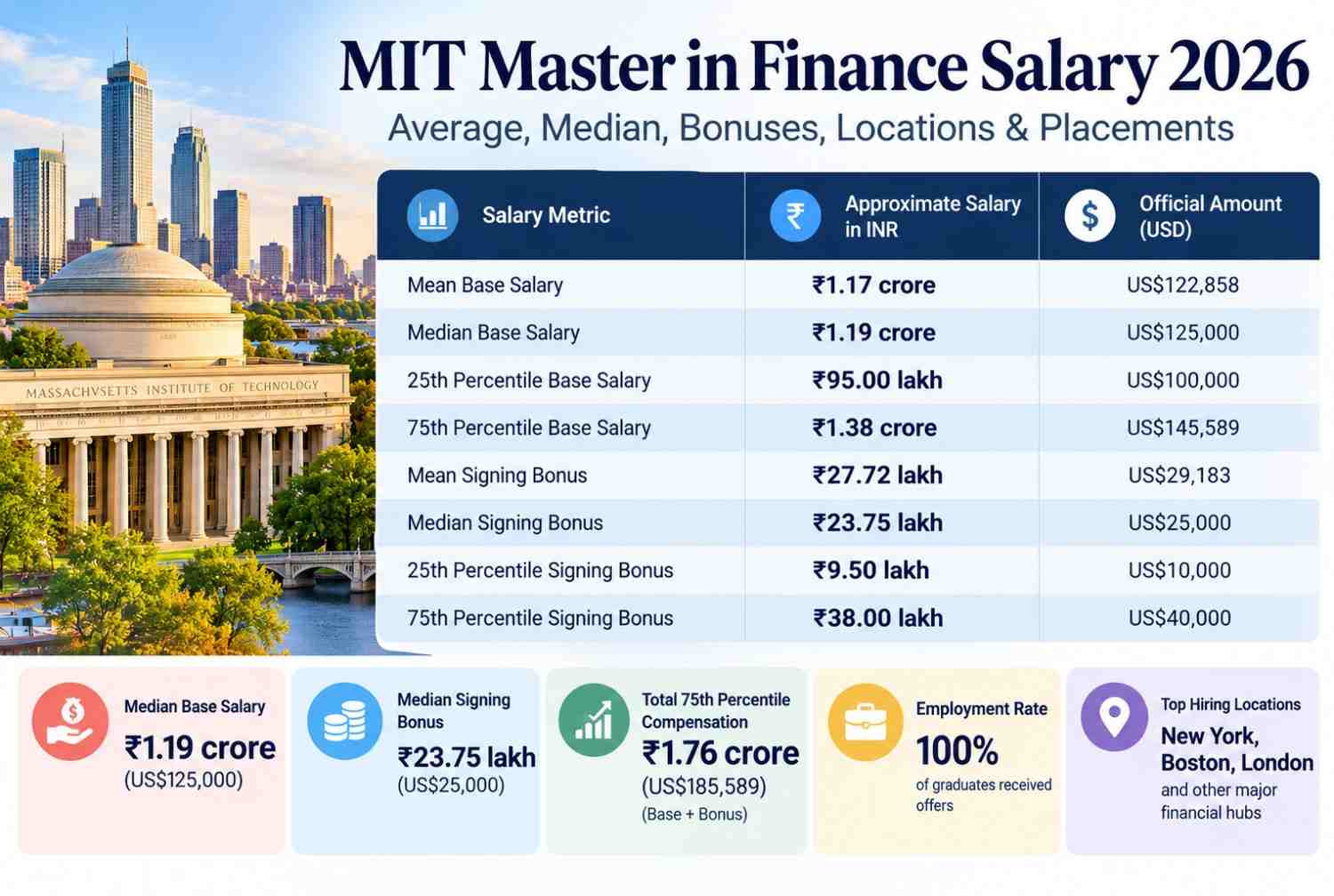
MIT Sloan's latest verified employment report provides salary information for its Class of 2025. This cohort includes graduates from the 18-month format in February 2025 and the 12-month format in May 2025.
The report shows both mean and median base salaries, salary percentiles and signing bonuses. These should be treated as separate compensation measures.
| Salary Metric | Approximate INR | Official Amount |
|---|---|---|
| Mean Base Salary | ₹1.17 crore | US$122,858 |
| Median Base Salary | ₹1.19 crore | US$125,000 |
| 25th Percentile Base Salary | ₹95.00 lakh | US$100,000 |
| 75th Percentile Base Salary | ₹1.38 crore | US$145,589 |
| Mean Signing Bonus | ₹27.72 lakh | US$29,183 |
| Median Signing Bonus | ₹23.75 lakh | US$25,000 |
| 25th Percentile Signing Bonus | ₹9.50 lakh | US$10,000 |
| 75th Percentile Signing Bonus | ₹38.00 lakh | US$40,000 |
Source: MIT Sloan Master of Finance Class of 2025 Employment Report.
Currency note: INR values use an illustrative exchange rate of US$1 = ₹95. The official salaries are reported in US dollars and actual exchange rates can change.
Reporting note: MIT received employment information from 100% of graduates, while 83.1% reported compensation information. Among those providing compensation information, 43.5% reported signing or starting bonus data.
Average Base Salary
The average MIT MFin salary for the Class of 2025 was approximately ₹1.17 crore (US$122,858). This is the arithmetic mean of the reported base salaries.
The mean can be affected by especially high or low salaries within the reporting group. It is useful for understanding the overall compensation level but does not describe what every graduate earns.
Students should also remember that base salary excludes signing bonuses and other variable compensation. Actual take-home income depends on taxes, employment location and individual circumstances.
Median Base Salary
The median MIT MFin salary was approximately ₹1.19 crore (US$125,000) for the Class of 2025. This represents the middle reported base salary rather than an average of all salaries.
The median is often helpful when comparing earning outcomes because it is less affected by extreme values. However, it still represents a particular graduating cohort.
Applicants should not interpret the median as a guaranteed employment offer. Personal skills, recruitment performance and the available job market all affect individual results.
Salary Percentiles
MIT Sloan reports a 25th percentile base salary of approximately ₹95 lakh (US$100,000) and a 75th percentile of approximately ₹1.38 crore (US$145,589).
This means the middle half of reported base salaries lies between these two values. The figures demonstrate variation in graduate compensation without establishing a guaranteed minimum or maximum.
Students should consider the entire reported distribution when evaluating the potential return on their investment. Using only the highest salary may create unrealistic financial expectations.
How Much Signing Bonus Do MIT MFin Graduates Receive?
MIT Sloan reports a mean signing bonus of approximately ₹27.72 lakh (US$29,183) and a median bonus of approximately ₹23.75 lakh (US$25,000) for the Class of 2025.
Signing bonuses can improve first-year earnings, but not all graduates receive them. MIT's bonus statistics refer to graduates who reported bonus information.
Average and Median Signing Bonuses
The average signing bonus reflects the mean of the reported awards. The median represents the middle bonus amount within the reporting group.
These figures should not be added automatically to every graduate's salary. Bonus eligibility depends on the job offer and employer.
Some employers may provide signing bonuses while others offer different compensation structures. Applicants should compare written employment offers rather than assuming a fixed additional payment.
Does the Signing Bonus Count as Base Salary?
No. A signing bonus is normally a separate compensation component and should not be confused with recurring annual base salary.
For example, a graduate with a base salary of ₹1.19 crore (US$125,000) and an actual signing bonus of ₹23.75 lakh (US$25,000) would receive approximately ₹1.43 crore (US$150,000) before applicable deductions and excluding other compensation.
This is an illustration, not MIT's reported average total compensation. The university does not state that the median salary earner also received the median signing bonus.
What Is the MIT MFin Employment Rate?
For the Class of 2025, 97.1% of MIT MFin graduates who were seeking employment received an offer within six months of graduation. The corresponding offer acceptance rate was 94.2%.
The difference matters because receiving an employment offer and accepting one are not the same outcome.
| Employment Timeline | Received an Offer | Accepted an Offer |
|---|---|---|
| At Graduation | 87.5% | 84.6% |
| Within 3 Months | 93.3% | 90.4% |
| Within 6 Months | 97.1% | 94.2% |
Reporting basis: These percentages refer to graduates seeking employment. MIT also includes certain postgraduate internship and contract opportunities in its accepted-offer statistics.
Employment Within Three Months
MIT Sloan reports that 93.3% of job-seeking MFin graduates had received an offer within three months of graduation. During the same period, 90.4% had accepted an offer.
This suggests that many candidates secured opportunities relatively soon after finishing the programme. However, the result reflects the Class of 2025 rather than a guaranteed outcome for future cohorts.
Applicants should also consider the time required for interviews, work authorisation and relocation. An accepted offer does not always mean employment begins immediately.
Employment Within Six Months
Within six months, 97.1% of job-seeking graduates had received an offer and 94.2% had accepted one.
These figures demonstrate the programme's reported employment outcomes in a particular recruitment market. They should not be presented as a universal placement guarantee.
Importantly, some accepted opportunities included postgraduate internships and contract employment. Students comparing universities should check how each institution defines its employment statistics.
Which Jobs Do MIT MFin Graduates Get?

MIT MFin graduates pursue roles across quantitative finance, investment banking, trading, portfolio management and financial research. The Class of 2025 report provides a breakdown of accepted offers by job function.
These percentages describe the types of jobs accepted, not the salary paid for each function.
| Job Function | Share of Accepted Offers | Example Careers |
|---|---|---|
| Quantitative Research / Data Science | 26.8% | Quantitative Researcher, Data Scientist |
| IBD / Transactions Advisory | 19.6% | Investment Banking Analyst, Transaction Analyst |
| Quantitative Trading – Research / Sales | 17.5% | Quantitative Trader, Trading Research Analyst |
| Fundamental Research | 7.2% | Investment Research Analyst |
| Portfolio Management | 7.2% | Portfolio Analyst |
| Private Equity / Venture Capital | 7.2% | Private Equity Investment Analyst |
| Corporate Finance | 3.1% | Financial Analyst |
| Risk Management | 1.0% | Risk Analyst |
Source: MIT Sloan Class of 2025 Employment Report. The table presents selected finance functions and is not a complete industry breakdown.
Quantitative Research and Data Science
Quantitative research and data science represented the largest reported finance function, accounting for 26.8% of accepted offers.
These roles may involve statistical modelling, mathematical finance, programming and investment research. They can be particularly relevant to students with backgrounds in engineering, mathematics, statistics or computer science.
Applicants interested in this area should examine MIT's quantitative curriculum and develop technical skills. The overall MIT MFin salary median does not indicate the exact compensation for quantitative research positions.
Investment Banking and Transactions Advisory
Investment banking and transactions advisory accounted for 19.6% of accepted offers in the Class of 2025.
These careers commonly involve company valuation, financial modelling, transaction analysis and advisory work. Employers may assess technical finance knowledge alongside communication and professional judgement.
Students targeting investment banking should explore recruiting requirements and internship opportunities. The programme's overall salary statistics should not be treated as an investment-banking-specific salary figure.
Quantitative Trading
Quantitative trading, research and sales accounted for 17.5% of accepted opportunities. These roles are often associated with financial markets, trading systems and quantitative analysis.
Relevant preparation may include probability, statistics, derivatives, programming and market knowledge. The particular skills required depend on the employer and trading strategy.
Students should evaluate whether their academic preparation suits highly technical recruitment processes. MIT does not provide one guaranteed quantitative trading salary for all graduates.
Portfolio Management and Private Equity
Portfolio management and private equity or venture capital each represented 7.2% of accepted finance-function offers.
Portfolio management can involve investment analysis, risk assessment and asset allocation. Private equity and venture capital work may include investment evaluation, financial modelling and company research.
These are competitive career areas with different recruitment processes. Students should review the programme's relevant courses and employer engagement opportunities before selecting a target career.
Which Companies Recruit MIT Sloan MFin Graduates?
MIT Sloan's Class of 2025 employment report identifies financial institutions, consulting companies, asset managers and quantitative trading firms among its graduate employers.
The university reports full-time and internship opportunities across 100 companies. The following are examples of employers listed in its official report.
| Employer | Reported Class of 2025 Full-Time Hires |
|---|---|
| Morgan Stanley | 8 |
| JP Morgan Chase & Co. | 5 |
| Goldman Sachs | 3 |
| BNP Paribas | 3 |
| Qube Research & Technologies | 3 |
| Trexquant Investment | 3 |
| Boston Consulting Group | 3 |
| Bank of America | 2 |
| Barclays | 2 |
| Deutsche Bank | 2 |
| Jefferies | 2 |
| McKinsey & Company | 2 |
Note: These are historical employer outcomes, not a guarantee that each company will recruit the same number of students in future years. MIT reports more employers than those shown in this selected list.
Investment Banks
Morgan Stanley, JP Morgan Chase, Goldman Sachs, Bank of America and other banks appear in MIT's official employment report.
These employers recruit for different functions, which may include investment banking, financial analysis, research and markets-related roles. Students should not assume every graduate hired by a bank entered the same department.
Recruitment requirements vary by team and location. Applicants should prepare for the particular finance function they intend to pursue.
Quantitative Finance Employers
MIT's report also includes quantitative investment and trading employers such as Qube Research & Technologies and Trexquant Investment.
These firms may seek candidates with strong mathematical, computational and analytical skills. Competition can be demanding, especially for research-intensive positions.
The MIT MFin curriculum can provide relevant preparation, but technical interviews often require additional practice. Students should assess the specific knowledge needed for their target role.
Where Do MIT MFin Graduates Work?

MIT Sloan's Class of 2025 accepted employment opportunities across North America, Europe, Asia and Latin America. The United States accounted for the largest regional share.
These percentages describe job destinations, not average salaries for each city.
| Employment Destination | Share of Accepted Offers |
|---|---|
| United States | 62.9% |
| New York City Metro | 38.1% |
| Boston Metro | 5.2% |
| Chicago Metro | 2.1% |
| Europe | 20.6% |
| London Metro | 9.3% |
| Paris Metro | 2.1% |
| Asia | 15.5% |
| Hong Kong Metro | 9.3% |
| Shanghai Metro | 4.1% |
| Latin America and Caribbean | 1.0% |
Source: MIT Sloan Class of 2025 Employment Report. City shares are included within their broader regions and should not be added to regional totals.
United States
The United States accounted for 62.9% of accepted offers, with New York City representing the largest reported metropolitan destination.
New York has a major concentration of financial institutions and investment employers, making it relevant for students seeking finance roles.
However, the cost of living and tax environment vary significantly between US cities. Students should not evaluate financial returns using salary alone.
Europe
Europe accounted for 20.6% of accepted offers in MIT Sloan's Class of 2025. London represented 9.3% of all accepted offers, while Paris accounted for 2.1%.
These outcomes show that graduate opportunities are not limited to the United States. However, employment requirements and compensation differ across countries.
Students planning to work in Europe should examine employer requirements, local language expectations and work authorisation.
Asia
Asia represented 15.5% of accepted offers, with Hong Kong and Shanghai among the reported employment destinations.
Financial markets, investment firms and other employers operate across major Asian financial centres. However, hiring conditions and salary structures can differ by location.
The MIT employment report does not provide a verified India-specific salary average. Indian applicants should not assume that the US-dollar cohort median represents likely compensation in India.
How Important Are MIT MFin Internships for Employment?
Internships can provide practical experience and access to employers. MIT Sloan offers both 12-month and 18-month MFin formats, with additional time for professional experience in the longer format.
The official 2025 employment report also includes internship results for students graduating in February 2026. These internship figures should not be confused with the Class of 2025 full-time employment statistics.
Internship Offer Rate
Among the February 2026 MFin cohort seeking summer 2025 internships, 98.9% received an internship offer and 97.9% accepted one.
These results relate to students in the 18-month programme who participated in the summer internship recruitment process. They do not mean that 98.9% of all MIT MFin students received permanent jobs.
MIT also reports that 47.2% of February 2025 graduates who accepted employment opportunities returned to their summer internship employer.
Internship Salary
For the summer 2025 internships, MIT reports a median monthly base salary of approximately ₹9.60 lakh (US$10,100) and a mean monthly base salary of approximately ₹9.80 lakh (US$10,320).
The middle 50% of reported monthly internship salaries ranged from approximately ₹6.70 lakh (US$7,050) to ₹11.88 lakh (US$12,500).
These are monthly internship compensation figures, not annual salaries. Compensation information was available for 67.4% of students with internship offers.
How Much Does MIT MFin Cost Compared With Graduate Salaries?
MIT MFin tuition varies according to programme duration. The university's current Registrar fee schedule lists 2026–27 tuition of approximately ₹92.04 lakh (US$96,884) for the 12-month option and approximately ₹1.26 crore (US$133,007) for the 18-month option.
These are tuition figures, not total attendance costs. Students must also budget for accommodation, food, health insurance, transport and personal expenses.
| Programme / Metric | Approximate INR | Official USD Amount |
|---|---|---|
| 12-Month MFin Tuition, 2026–27 Registrar Schedule | ₹92.04 lakh | US$96,884 |
| 18-Month MFin Tuition, 2026–27 | ₹1.26 crore | US$133,007 |
| Class of 2025 Median Base Salary | ₹1.19 crore | US$125,000 |
| Class of 2025 Mean Base Salary | ₹1.17 crore | US$122,858 |
Fee verification: MIT's online Registrar fee schedule lists US$96,884 for the 12-month option, while a separate 2026–27 MIT course-catalogue page shows US$93,834. Applicants should confirm the applicable amount directly with MIT before committing to payment.
Comparison warning: Salary is gross annual compensation before taxes, while tuition is an educational expense. Dividing tuition by gross salary does not provide a reliable payback period.
Is MIT MFin Worth It for Indian Students?
Worth it if... you have strong quantitative preparation, clear finance career goals and the financial resources to manage tuition and living expenses. MIT Sloan's published outcomes show opportunities in quantitative research, investment banking, trading and other specialist finance fields. The programme may be particularly relevant to Indian graduates interested in analytically demanding financial careers.
Think twice if... you are relying on the published median salary as a guaranteed outcome or planning to borrow without understanding your repayment obligations. Job location, employment authorisation, taxes and living costs can materially change the financial return. Applicants should assess both the educational opportunity and the personal financial risk.
What Should Indian Applicants Know About MIT MFin Salary and ROI?

Indian students should interpret MIT Sloan's salary figures within the US and international employment markets in which graduates work. The reported compensation cannot be treated as a guaranteed salary in India.
- Use the Correct Cohort: The latest verified full-time salary data comes from the Class of 2025.
- Understand Gross Salary: Reported base pay is before taxes and living expenses.
- Plan for Currency Risk: Education loans and international earnings may involve different currencies.
- Review Visa Rules: A STEM-designated degree does not guarantee employment or immigration approval.
- Compare Job Functions: Quantitative research, trading and investment banking require different skills.
- Prepare Technical Skills: Mathematics, statistics, programming and financial modelling may support certain career goals.
- Evaluate Internships: Professional experience can be valuable, especially for students changing industries.
- Build a Conservative Budget: Include tuition, accommodation, health insurance and loan interest.
Can Indian Students Earn the Reported MIT MFin Salary?
Indian graduates may compete for international finance opportunities where they meet employer requirements and applicable work-authorisation rules.
However, MIT does not publish a guaranteed salary for Indian nationals. The overall class figures combine reported compensation from graduates entering different roles and locations.
Students should therefore use the official median as a reference point rather than a personal salary forecast.
How Should Students Calculate ROI?
Start with the full cost of attendance, including tuition, housing, insurance, travel and financing expenses. Then estimate realistic income after taxes and living costs in your preferred employment location.
If you are borrowing, include loan interest and repayment obligations. Consider alternative employment outcomes rather than assuming you will immediately receive the reported median salary.
A useful ROI decision also accounts for career fit and the value of relevant skills. Short-term payback is only one part of the assessment.
Where Can You Verify MIT MFin Salary Data?
The following official MIT resources provide employment statistics, programme information and tuition details. Students should use the original reports when comparing financial outcomes.
- MIT Sloan Class of 2025 MFin Employment Report – Official salary, bonuses, employers, job functions and location data.
- MIT Sloan Career Development Office Employment Reports – Current and previous employment-report publications.
- MIT Registrar Tuition and Fees – Published programme tuition by academic year and duration.
Related Blogs
- MIT MFin Review: Fees, Admissions and Careers
- Masters in Finance Salary: Global Comparison
- Best MFin Colleges in Europe
- HEC Paris MFin Fees and Scholarships
Conclusion
MIT Sloan's Master of Finance offers access to specialised financial education and a range of international career opportunities. Its published salary and employment results are useful indicators, but they should be evaluated alongside programme costs, individual career goals and realistic job prospects. Indian applicants should focus on whether MIT's academic preparation and career pathways justify the investment for their circumstances.