


 Abhyank Srinet
Introduction
The Warwick MSc Finance is a one-year, full-time master's degree offered by Warwick Business School at the University of Warwick in the UK. It is designed for graduates who want to build careers in investment banking, asset management, financial analysis and consulting. The September 2027 intake starts on 27 September, with international tuition of approximately ₹61.06 lakh (£48,000).
For Indian students, the main questions are whether the degree is affordable, how competitive admission is and what career opportunities are available after graduation. Warwick combines advanced financial training, optional modules and dedicated careers support. This guide covers the latest verified fees, entry requirements, rankings, scholarships, employment outcomes and application process.
What Should You Know About Warwick MSc Finance in 2027?
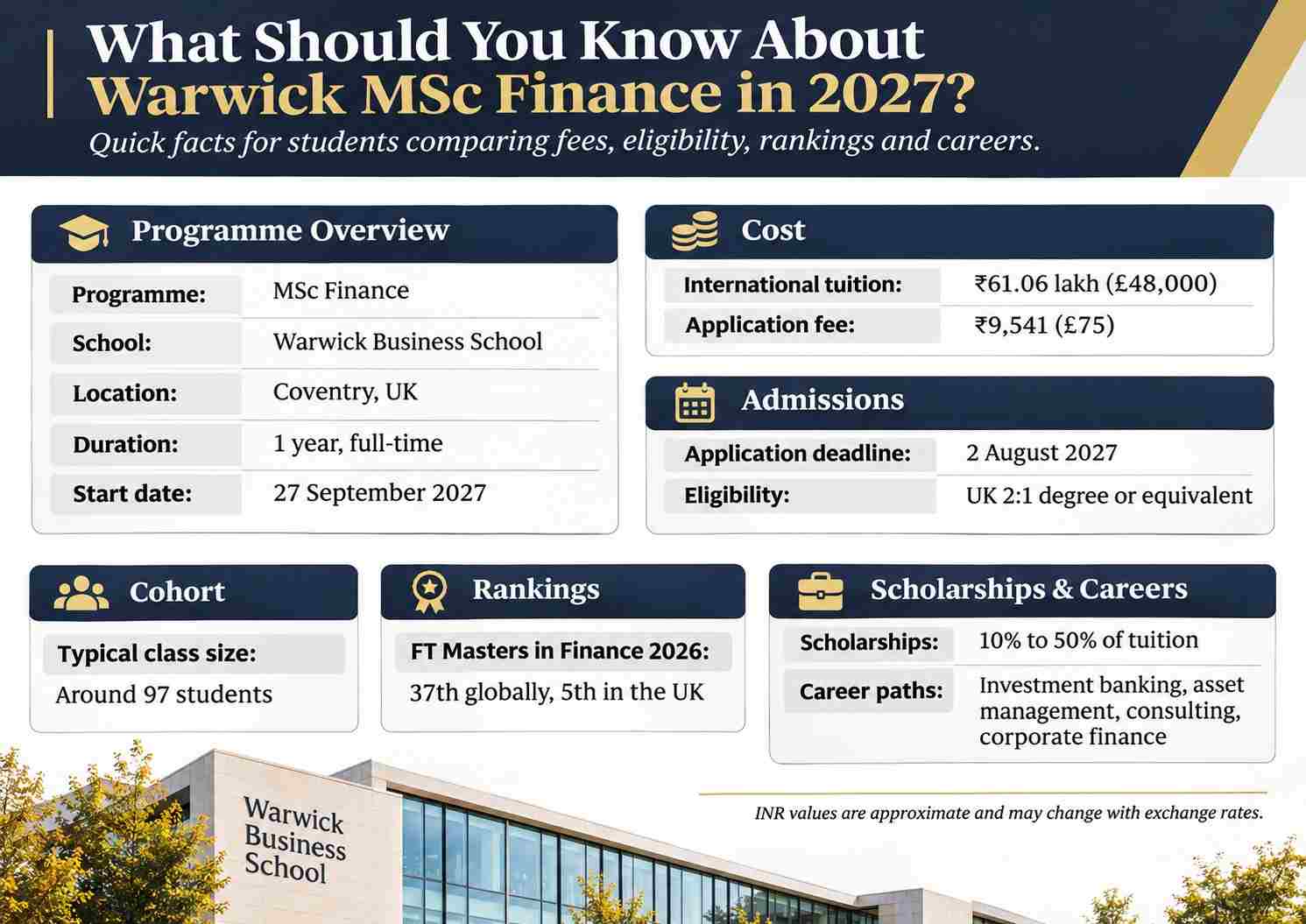
The Warwick MSc Finance is a full-time postgraduate programme starting in September 2027. It combines quantitative finance, practical applications and career preparation. Applicants need a strong academic background, and the university assesses admission through the submitted application rather than a published acceptance-rate threshold.
Warwick MSc Finance Quick Facts
| Category | 2027 Details |
|---|---|
| University | University of Warwick |
| Business school | Warwick Business School |
| Programme | MSc Finance |
| Location | Warwick Campus, Coventry, UK |
| Duration | 1 year, full-time |
| Start date | 27 September 2027 |
| International tuition | ₹61.06 lakh (£48,000) |
| Application fee | Approximately ₹9,541 (£75) |
| Application deadline | 2 August 2027 |
| Minimum academic requirement | UK 2:1 degree or overseas equivalent |
| Typical class size | Around 97 students |
| FT Masters in Finance 2026 | 37th globally, 5th in the UK |
INR conversions use approximately ₹127.21 per £1, based on the RBI reference rate dated 3 November 2026. Amounts are indicative and will change with exchange rates.
How Does Warwick MSc Finance Rank Globally?
The Warwick MSc Finance programme ranks 37th globally and 5th in the UK in the Financial Times Masters in Finance Pre-experience Ranking 2026. It also holds a strong position in the QS Business Master's Rankings. These rankings help students compare programmes, but they do not guarantee admission or employment.
Latest Published Finance Rankings
| Ranking | Warwick Position | Year |
|---|---|---|
| FT Masters in Finance | 37th worldwide | 2026 |
| FT Masters in Finance | 5th in the UK | 2026 |
| QS Business Master's Rankings: Finance | 19th worldwide | 2027 |
| QS Business Master's Rankings: Finance | 6th in the UK | 2027 |
Students should distinguish programme rankings from overall university rankings. A finance-specific ranking is more directly relevant when evaluating a specialised master's degree.
What Will You Study in the Warwick MSc Finance Programme?
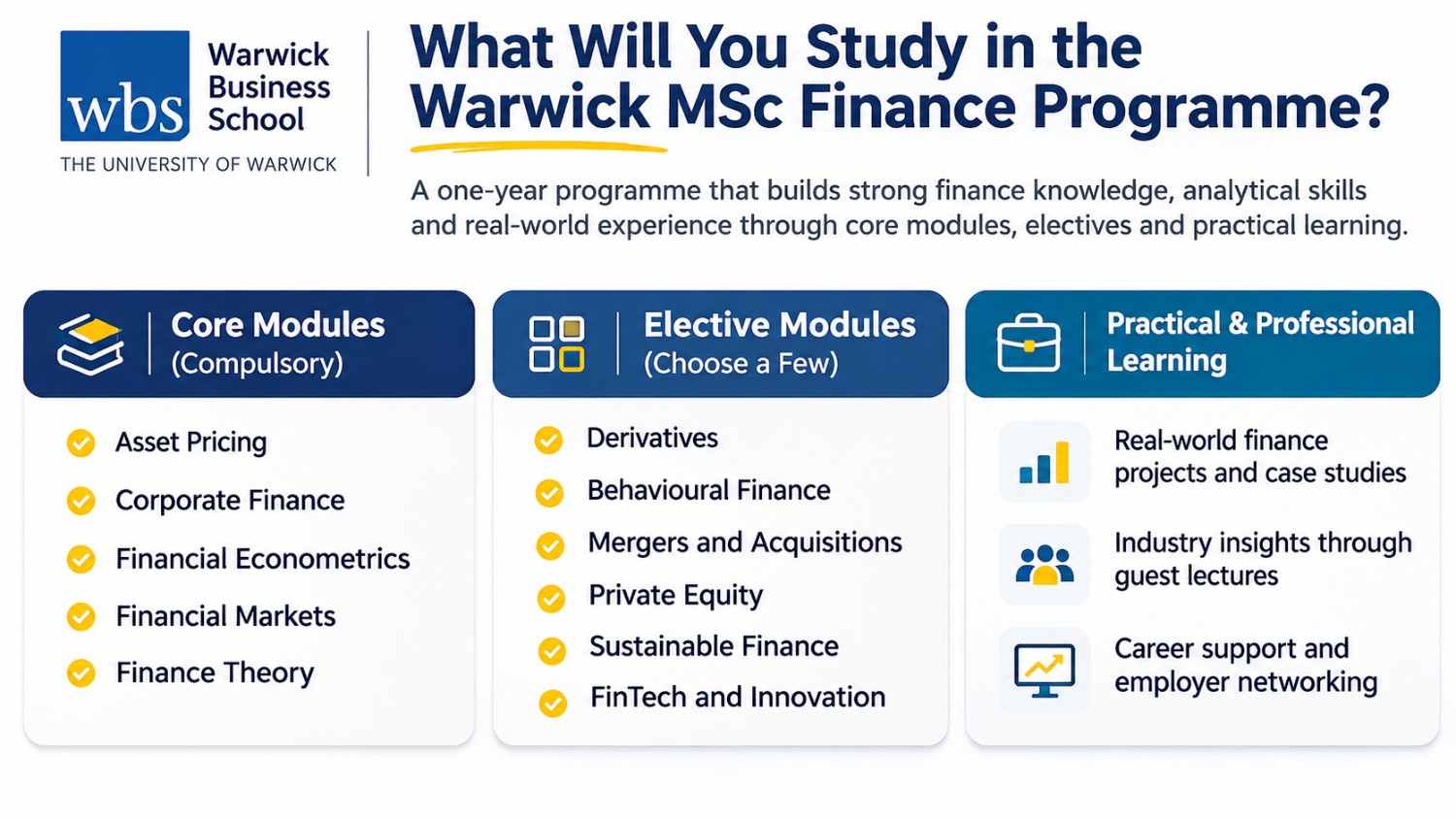
The Warwick MSc Finance curriculum combines financial theory, quantitative analysis and practical applications. Students complete seven core modules and three optional modules across three terms, followed by a dissertation or self-sourced internship.
Core Finance Subjects
The programme builds the technical knowledge needed to understand financial markets and business decisions. Key areas covered include:
- Corporate finance and financial decision-making
- Asset pricing and investment management
- Financial econometrics and quantitative methods
- Financial data analysis and empirical research
- Ethics, financial regulation and corporate governance
Electives and Practical Learning
Students can choose optional modules based on their academic interests and career plans. Warwick also incorporates specialist financial software, analytical exercises and simulations to help students apply what they learn.
Dissertation or Internship
The final stage allows students to complete a dissertation or pursue a self-sourced internship. An internship is not automatically arranged by the university, so students interested in this route should begin researching employers and opportunities early.
What Are the Warwick MSc Finance Admission Requirements?
Warwick MSc Finance applicants need a UK 2:1 undergraduate degree or an accepted international equivalent. The school expects strong quantitative ability. A background in finance, economics or econometrics is helpful, but candidates from other quantitative subjects are also encouraged to apply.
Academic and English Language Requirements
| Requirement | Details |
|---|---|
| Bachelor's degree | UK 2:1 or equivalent |
| Preferred academic background | Finance, Economics, Econometrics or other quantitative subjects |
| IELTS Academic | 7.0 overall, with Warwick's specified component requirements |
| Duolingo English Test | 130 overall, subject to component requirements |
| Reference | One academic or professional reference |
| Work experience | No published minimum full-time experience requirement |
| GMAT/GRE | Not listed as a standard mandatory requirement |
For IELTS, Warwick permits a maximum of two components at the specified lower levels of 6.0 or 6.5, with the remaining components at 7.0 or above. Applicants should check the detailed score rules for their chosen test.
Applying Without a Finance Degree
Students with degrees in mathematics, statistics, physics, engineering, computer science or data science can also be considered. Warwick offers a supplementary finance course for eligible students who have quantitative training but limited prior finance education.
English Language Exemptions
Warwick may accept evidence of recent degree-level education completed entirely in English. Approval depends on the university's eligibility rules, so applicants should not assume that an English-medium undergraduate degree automatically removes the testing requirement.
What Should Indian Applicants Know About Warwick MSc Finance?
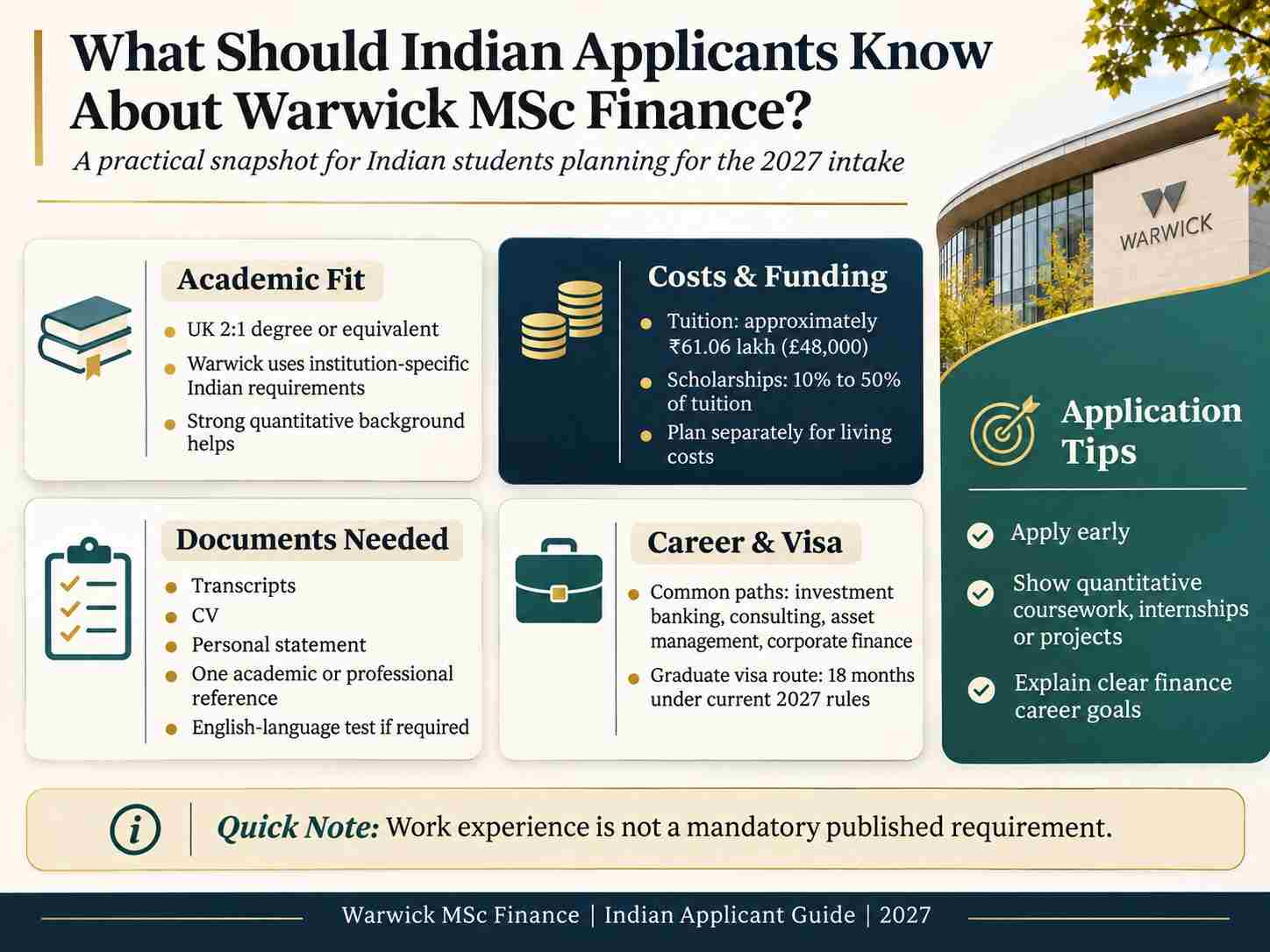
Indian applicants can apply to Warwick MSc Finance with an eligible undergraduate degree from a recognised institution. The university publishes institution-specific Indian entry requirements, meaning the required percentage or CGPA can differ depending on where the applicant studied.
Academic Eligibility for Indian Universities
Warwick's published Indian equivalency guidance uses different thresholds for different institutions. For some recognised institutions, a UK 2:1 equivalent starts at 60%, while other institutions can have higher requirements. Applicants should check their own university's category instead of relying on a universal percentage.
Building a Strong Application
Academic performance matters, but applicants should also demonstrate their readiness for quantitative finance. Relevant coursework, internships, research and practical projects can help explain their interest in the programme.
- Show strong performance in mathematics, statistics or finance-related subjects.
- Include relevant financial modelling, data analysis or investment projects.
- Explain a clear finance career goal in the personal statement.
- Choose a referee who can describe your academic or professional abilities.
UK Graduate Visa Considerations
Under the current UK rules, eligible master's graduates applying for a Graduate visa on or after 1 January 2027 can receive 18 months of permission. This route does not guarantee a job and cannot itself be extended. Students should review the immigration rules before planning their long-term UK career.
Check the official UK Graduate visa guidance for eligibility and any future changes.
How Much Does Warwick MSc Finance Cost in 2027?
The Warwick MSc Finance international tuition fee for September 2027 is approximately ₹61.06 lakh (£48,000). Students must also pay for living expenses, visa-related charges, travel and personal costs. The total budget is therefore higher than the published tuition fee.
Warwick MSc Finance Fees Breakdown
| Expense | Approximate Amount | Notes |
|---|---|---|
| International tuition | ₹61.06 lakh (£48,000) | Official 2027 fee |
| Application fee | ₹9,541 (£75) | Non-refundable |
| Acceptance deposit | ₹3.82 lakh (£3,000) | Included in tuition, not additional |
| Indicative annual living budget | ₹17.34 lakh (£13,632) | Based on Warwick's published guidance |
| Tuition and living budget | ₹78.40 lakh (£61,632) | Before additional expenses |
The annual living figure is a planning estimate, not a fixed university charge. Accommodation choices, lifestyle and exchange-rate changes can increase or decrease the final amount.
Deposit and Payment Planning
Warwick requires successful applicants to pay a deposit within the specified acceptance period, generally four weeks after receiving an offer. The deposit is deducted from tuition. Applicants should also budget for the remaining tuition payments and their initial settlement costs.
For the latest tuition and scholarship information, check the Warwick Business School MSc Finance fees page.
Which Scholarships Are Available for Warwick MSc Finance?
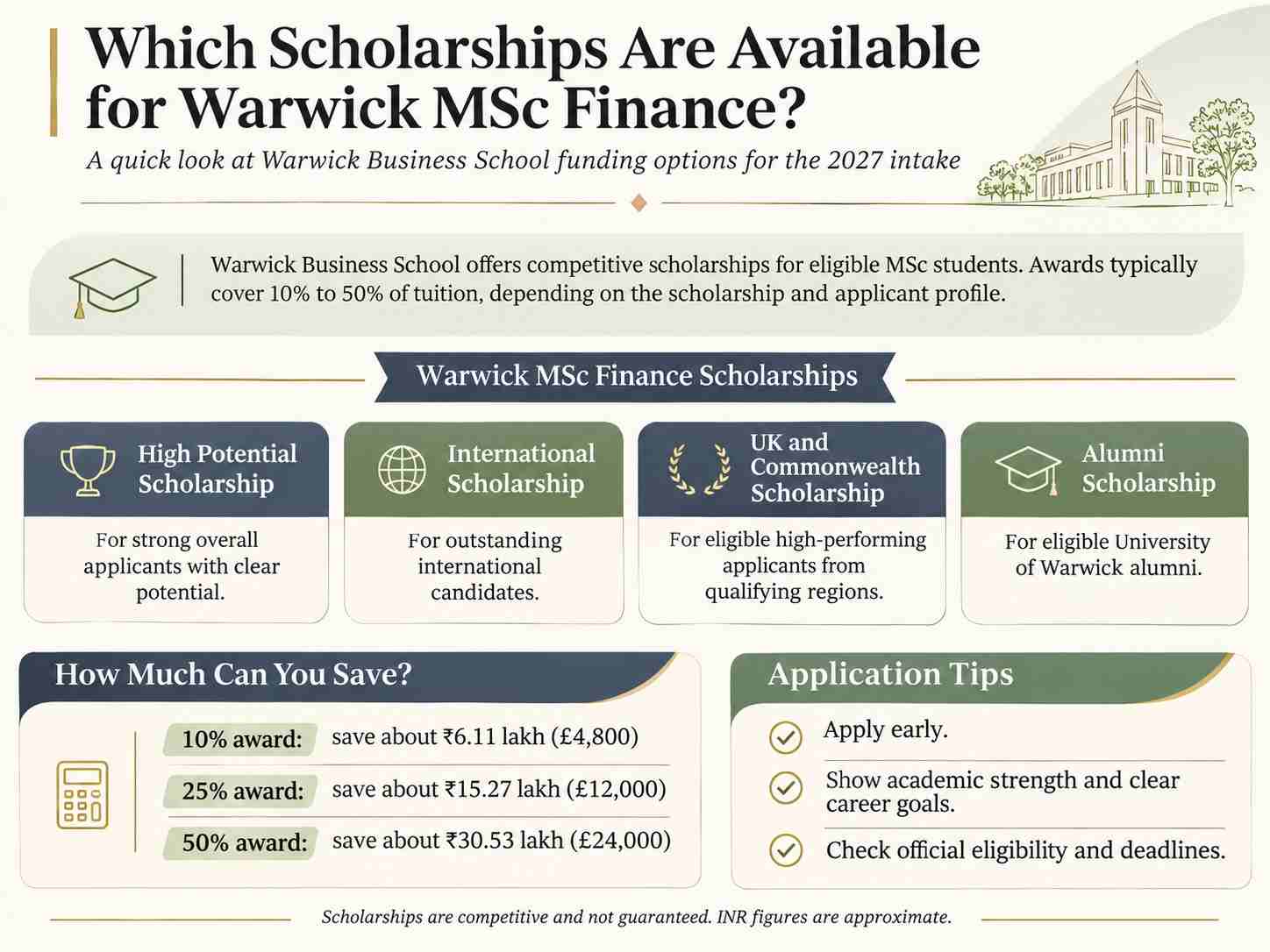
Warwick Business School offers competitive postgraduate scholarships that can cover between 10% and 50% of tuition fees for eligible students. Scholarships are limited, and applicants should not assume they will receive an award simply because they meet admission requirements.
Warwick Business School Scholarship Options
| Scholarship | Who It Supports |
|---|---|
| High Potential Scholarship | Applicants with strong achievements and potential |
| International Scholarship | Exceptional eligible international applicants |
| UK and Commonwealth Scholarship | Outstanding eligible applicants from qualifying regions |
| Alumni Scholarship | Eligible University of Warwick alumni |
How Much Can a Scholarship Save?
Scholarship savings depend on the percentage awarded. Using the September 2027 international tuition fee, the following examples show how funding can reduce tuition costs.
| Scholarship | Approximate Saving | Remaining Tuition |
|---|---|---|
| 10% | ₹6.11 lakh (£4,800) | ₹54.95 lakh (£43,200) |
| 25% | ₹15.27 lakh (£12,000) | ₹45.80 lakh (£36,000) |
| 50% | ₹30.53 lakh (£24,000) | ₹30.53 lakh (£24,000) |
These are mathematical examples, not guaranteed awards. Students should check their scholarship eligibility and funding conditions directly with Warwick.
Education Loans and Personal Funding
Indian applicants may consider education loans, family savings and eligible international loan providers. Compare repayment schedules, interest rates and currency risks carefully. Funding decisions should account for both tuition and living expenses.
When Is the Warwick MSc Finance Application Deadline?
The published on-time application deadline for Warwick MSc Finance starting in September 2027 is 2 August 2027. Warwick recommends applying early because admissions are competitive and international students need enough time for documentation, deposits and visa processing.
Important Application Dates
| Event | Date or Timeline |
|---|---|
| Applications | Open for September 2027 entry |
| On-time deadline | 2 August 2027 |
| Typical processing time | 8–12 weeks after a complete application |
| Programme begins | 27 September 2027 |
Late applications may be accepted, but Warwick does not guarantee that they can be processed in time. Indian applicants should avoid relying on the final deadline as their preferred submission date.
How Do You Apply for Warwick MSc Finance?
.jpeg)
Applicants submit the Warwick MSc Finance application through the University of Warwick's online postgraduate portal. A complete application should explain academic preparation, motivation for finance and future career plans.
Application Documents
Warwick asks applicants to submit the required academic and supporting records. The standard application includes:
- Undergraduate transcripts and qualification details
- Updated CV
- Personal statement
- One academic or professional reference
- English language evidence, where required
- Other documents requested by the admissions portal
Writing the Personal Statement
The personal statement should explain why you selected Warwick, how the programme supports your career goals and what you can contribute to the learning environment. Avoid repeating your CV without explaining the lessons from your experiences.
Application Review and Decision
After submission, Warwick evaluates the application and may issue a conditional or unconditional offer. Students receiving conditional offers must meet the stated requirements before their place is confirmed.
Review the latest official Warwick MSc Finance application guidance before submitting.
What Jobs and Salaries Can Follow Warwick MSc Finance?
Warwick MSc Finance graduates pursue careers in investment banking, financial analysis, asset management, consulting and related sectors. Warwick reports strong employment outcomes, but salaries and job offers depend on individual experience, location, employer and the wider recruitment market.
Latest Published Employment Outcomes
Warwick Business School reports that 100% of responding MSc Finance graduates from the Class of 2025 were employed within six months of completing the programme. This statistic refers to graduates who participated in its employment reporting and should not be interpreted as guaranteed employment for every student.
Career Paths After Graduation
| Career Area | Potential Roles |
|---|---|
| Investment banking | Investment Banking Analyst, M&A Analyst |
| Asset management | Investment Analyst, Investment Specialist |
| Risk and credit | Credit Analyst, Financial Risk Manager |
| Consulting | Consultant, Management Consultant |
| Corporate finance | Finance Analyst, Corporate Finance Analyst |
Employers and Career Support
Warwick identifies employers including Goldman Sachs, JP Morgan and Deloitte among graduate destinations. These are examples of past employment outcomes, not promises of recruitment or placement.
Warwick's CareersPlus service provides career coaching, CV support and interview preparation. Students should use these services early while applying directly to employers.
Average Salary After Warwick MSc Finance
A single verified average salary figure for the latest MSc Finance graduating class could not be established from the official information reviewed for this article. Applicants should avoid treating general Warwick Business School salary figures as programme-specific outcomes.
Salary expectations should be based on the relevant job, location, experience level and employer. The difference between working in London, another UK city or India can substantially change the financial return.
Is Warwick MSc Finance Worth It for Indian Students?
Warwick MSc Finance can be worth considering for Indian students who want specialised finance training and access to international career opportunities. Its value depends on career goals, total borrowing, scholarship support and the ability to secure relevant employment after graduation.
What Makes Warwick Attractive?
The programme's key advantages are its focused finance curriculum, established international reputation, elective flexibility and careers support. Its campus location also provides an alternative to studying directly in central London.
What Are the Main Financial Risks?
The largest concern is the upfront cost. Students using loans should calculate interest, repayment obligations and the possibility that their first job may pay less than expected. Visa conditions and competition for finance roles also affect the decision.
How Should You Evaluate ROI?
Begin with the full cost of tuition, living expenses and financing. Then compare realistic post-graduation earnings against loan repayments and essential expenses. Consider a lower-salary scenario instead of assuming immediate entry into a high-paying investment banking job.
Students comparing Warwick against other UK options can explore our guide to the best Masters in Finance schools in the UK.
What Makes Warwick MSc Finance Different?
Warwick MSc Finance combines advanced finance study with quantitative analysis, industry-facing learning and a choice of research or internship pathways. The programme may appeal to students who prefer a campus-based UK master's with a specialist finance focus.
Quantitative Finance Training
Financial econometrics, asset pricing, investment management and related subjects help students develop analytical skills used across finance careers.
Industry-Relevant Learning
Practical exercises, financial software and simulations connect financial concepts with the types of problems graduates may encounter in the workplace.
Career Development Support
Warwick Business School provides dedicated career guidance through CareersPlus. Students can receive help with applications, CVs and interview preparation while planning their next steps.
Choice of Finance Specialisation
Optional modules allow students to direct part of their learning towards particular interests. Applicants should review the modules available for their intake before selecting the programme.
Conclusion
Warwick MSc Finance is a strong option for students who want to develop specialist finance skills and pursue international career opportunities. Indian applicants should focus on academic fit, programme content, funding and realistic employment goals before deciding. A well-planned application and clear financial strategy will help determine whether Warwick is the right choice.