
 Abhyank Srinet


Table of Contents
- Introduction
- Can You Do a MiM After BCom? What 2027 Applicants Should Know
- Is a 3-Year BCom Accepted for a MiM? Degree Recognition by Programme
- MiM Eligibility for BCom Graduates: Marks, Tests, English and Experience
- Best MiM Programmes for BCom Graduates in 2027
- How to Choose the Right MiM for Your BCom Profile and Budget
- 2027 MiM Admission Strategy for BCom Graduates, Profile by Profile
- MiM Application Timeline for 2027 Intake (October 2026 to September 2027)
- Jobs and Salary After MiM for Commerce Graduates
- Conclusion
Yes, you can pursue a MiM after BCom with a three-year degree from India. Top business schools like HEC Paris, ESSEC, ESCP and INSEAD consider BCom graduates. Admission requirements vary by university, and some schools accept CAT or alternative tests instead of GMAT or GRE. Tuition fees depend on the programme, while career opportunities include consulting, finance, marketing and management. Your academic marks, test scores and overall profile play an important role in admission.
Introduction
Can you get into top business schools like HEC Paris or INSEAD after BCom? Yes! Many top MiM programmes accept Indian students with a three-year BCom degree, but admission requirements vary. If you're planning a MiM after BCom in 2027, this guide covers the best colleges, eligibility, GMAT requirements, fees, scholarships and career opportunities. You'll also learn how to improve your chances of admission.
Can You Do a MiM After BCom? What 2027 Applicants Should Know
A BCom is a natural starting point for a Master in Management. MiMs are pre-experience degrees, built for people who graduated recently and have little or no full-time work behind them. HEC Paris wants applicants with "little to no professional experience". London Business School takes people who graduated within the last two years. IE accepts candidates with "up to three years of experience—or none at all".
That's where most BCom graduates are. Your degree also gives you something engineering and arts graduates have to build from scratch: papers in financial accounting, economics, business statistics, business law and often taxation. Some schools count these explicitly. Mannheim needs at least 36 ECTS credits in business administration. St. Gallen asks for at least 60 ECTS in business or economics plus 6 in maths or statistics.
Where BCom applicants usually struggle is elsewhere:
| What a BCom usually gives you | Where BCom applicants usually need work |
|---|---|
| Business fundamentals on the transcript (accounting, economics, statistics, law) | Proving the three-year degree is acceptable at each school |
| Internship stories that are easy to quantify (audit, tax, banking ops, family business) | Showing quantitative ability beyond Class 12 maths |
| Familiarity with the CAT and exam preparation | Choosing the right test route before deadlines close |
If you're still deciding whether the degree suits you at all, our guide on what a Masters in Management is covers the basics, and is a MiM worth it looks at return on investment. The rest of this article assumes you're leaning towards applying.
Is a 3-Year BCom Accepted for a MiM? Degree Recognition by Programme
It depends on the school. A few publish clear rules for Indian degrees. Many accept "three years" in general terms without mentioning India. Some don't state a degree length at all. One major programme treats three-year Indian degrees as an exception.
The European context helps here. Under the Bologna framework, a first-cycle (bachelor's) degree is defined as 180–240 ECTS credits, so a three-year degree is a full bachelor's in European terms. Indian degrees don't carry ECTS credits, though. Each school decides how to read your transcript.
Schools that publish rules for Indian degrees
- LSE, Master's in Management: LSE's India page asks for "a bachelor's degree (BA, BSc, BCom or BTech) awarded after a minimum of three years of study", with a CGPA of 7.6/10 as its 2:1 equivalent. This is the only page we found that names the BCom.
- Imperial College Business School, MSc in Management: accepts "a three to four-year Bachelor's degree". It asks for 70% or CGPA 8.0/10 from mainstream universities, and 65% or 7.5/10 from a limited list of elite institutions. Students at University of Delhi affiliated or autonomous colleges are held to the higher bar.
- Warwick Business School, MSc Management: sets its 2:1 minimum by institution category: 60% for Category 1 (IITs, IIMs, top NIRF-ranked institutions), 65% for Category 2 (state and central universities) and 70% for Category 3 (private and deemed universities). Distance and online degrees aren't accepted.
- UCL, Management MSc: for 2027/28, a CGPA of 7.5/10 or 60%, with the required mark "dependent on the ranking of the institution".
- Trinity Business School (TCD), MSc in International Management: gives CGPA 6.8/10 as a guide for India.
- University of St. Gallen (HSG), Master in Strategy and International Management: the outlier. Its India rule says "a recognised Bachelor's programme must be at least 4 years long. Three-year programmes can be recognised on the basis of a single assessment." It also needs a NAAC "A" accredited institution and at least 60%.
Schools that accept three years in general terms
HEC Paris, ESSEC, ESCP, INSEAD, EDHEC, emlyon, WHU, Mannheim, Bocconi and Luiss all state a minimum of three years or 180 ECTS. None of them mentions India in that rule. In practice, a recognised three-year BCom fits the wording, but the decision is the school's.
Our advice: for any programme without an India rule, email admissions with your university name and degree, ask whether you're eligible, and keep the reply. It costs nothing and saves an application fee.
Paperwork that affects BCom applicants by country
- Germany: the German Embassy in New Delhi says an APS certificate is "always mandatory, unless" an exemption applies for student visas. There's also a new digital master's test (dMAT) for applicants in certain fields from the summer 2027 intake onwards. The official dMAT operator, g.a.s.t., lists "Commerce, Accounting, Finance, Economics" and "Business / Management" among those fields. APS India's own page still says its updated list "will be announced shortly", so confirm with APS before you book. Either way, a BCom applicant targeting Germany for 2027 should plan for the dMAT. ESMT Berlin warns the extra steps for Indian graduates "can take up to six months".
- Italy: Bocconi may ask for a Declaration of Value or a CIMEA Statement of Comparability for your degree, and doesn't recognise distance-learning degrees.
- France: Grande Écoles admit you directly or through Join a School in France. Campus France's Études en France procedure comes in at the visa stage.
Programmes that look like a MiM but don't suit BCom graduates
- TUM's Master in Management is only open to engineering and natural-science graduates. A BCom isn't eligible.
- Trinity's MSc Management and UCD Smurfit's MSc in Management are conversion programmes designed for non-business graduates. Look at TCD's MSc in International Management and UCD's MSc in International Management / CEMS MIM instead.
| Position | Programmes |
|---|---|
| India rule published | LSE, Imperial, Warwick, UCL, TCD (MSc International Management), St. Gallen (4-year default) |
| General three-year / 180 ECTS rule, India not named | HEC Paris, ESSEC, ESCP, INSEAD, EDHEC, emlyon, WHU, Mannheim, Bocconi, Luiss |
| Degree or grade rule with no length stated | LBS, ESMT Berlin, IE, Esade, UCD (CEMS MIM) |
| Not designed for BCom graduates | TUM MiM, TCD MSc Management, UCD MSc in Management |
Not sure where your university fits? A profile evaluation checks your degree against each school on your shortlist.
MiM Eligibility for BCom Graduates: Marks, Tests, English and Experience
Beyond degree length, four things decide eligibility: your marks against each school's bar, your test route, your English proof, and any experience requirement. Here's how each one plays out for a BCom applicant. For the general requirements that apply to every applicant, see our full guide to MiM eligibility and requirements.
Marks: what your percentage means against published bars
Only a few schools publish a bar for Indian marks. Here's what they say:
| Programme | Published requirement for Indian degrees |
|---|---|
| Imperial MSc in Management | 70% / CGPA 8.0 (mainstream); 65% / 7.5 (listed elite institutions) |
| Warwick MSc Management | 60% / 65% / 70% by institution category |
| UCL Management MSc | CGPA 7.5 or 60%, rising with institution ranking |
| LSE Master's in Management | CGPA 7.6/10 for a 2:1 equivalent (no percentage conversion given) |
| TCD MSc International Management | CGPA 6.8/10 (guide) |
| St. Gallen SIM | 60% minimum, NAAC "A", plus the three-year assessment |
HEC Paris says "there is no minimum GPA requirement", though academic excellence still matters. Bocconi says "no particular scores are required" for undergraduate grades, although its test minimums still apply. London Business School asks for a degree "equivalent to a UK First or 2:1 or a GPA of 3.3 and above" but publishes no Indian conversion. Be wary of anyone who gives you a single percentage-to-2:1 conversion. The schools that publish one each use their own.
GMAT, GRE, CAT or no test: the 2027 routes
This is where BCom applicants have more options than they expect.
- GMAT or GRE required: HEC Paris (the test "cannot be waived"; GMAT, GRE or TAGE MAGE only), INSEAD, LBS, LSE (for anyone without a UK degree), WHU (minimum GMAT 555 or GRE 158 in both Verbal and Quant) and Luiss (GMAT 555 or GRE 157 in each section for 2027/28).
- CAT accepted: ESSEC ("CAT – 1 year – For Indian applicants"), EDHEC ("CAT* for Indian students only") and emlyon ("CAT for students from India only"). ESCP also lists the CAT among accepted tests.
- School's own test as an alternative: ESCP (sat in Berlin, London, Madrid or Turin), emlyon's online test, IE's ieGAT, Esade's TAE, the online Bocconi test, and ESMT's BAT.
- Optional, waivable or not a standard requirement:
- Imperial: "not obligatory if you can provide evidence of good quantitative achievement".
- Mannheim: not an admission requirement, but worth up to 60 ranking points, starting from GMAT Focus 555.
- TCD: "not a standard requirement".
- UCD CEMS: "GMAT is not required".
- ESMT: waivable with quantitative evidence, though "not all students will be granted waivers".
- No test listed: Warwick's MSc Management lists no test requirement.
Where schools publish a reference score, use it as your target:
| Programme | Published score reference |
|---|---|
| HEC Paris | Recommended averages: GMAT Focus 645/655, GRE 320 |
| LBS | Recommends GMAT 555 or above |
| WHU | Minimum GMAT 555 / GRE 158 + 158 |
| ESMT Berlin | GMAT below 600 or GRE below 304 "not considered competitive" |
| Imperial | If taken, at least the 55th percentile; current average 653 (10th edition) |
| Esade | Average around 615 (GMAT Focus) |
| Bocconi | Minimum GMAT 500 / GMAT Focus 485 |
If you'd rather avoid GMAT altogether, our list of MiM programmes without GMAT goes further. If you're preparing, see GMAT prep for MiM.
English tests: why an English-medium BCom may not be enough
Many Indian BCom degrees are taught in English, and students often assume that's enough. It often isn't:
- Warwick's university page limits its English-medium exemption to degrees from majority English-speaking countries recognised by the UK government. That likely excludes India.
- ESCP's admissions leaflet waives the test only for degrees taught in English "in an English speaking country".
- HEC Paris waives it only if your entire degree was taught in English.
- ESSEC waives it after at least three years of English-taught higher education, and Esade only if your bachelor's was taught entirely in English.
Unless a school clearly accepts your Indian degree as proof, plan to take IELTS or TOEFL. Common published bars are IELTS 7.0 overall (Imperial, LSE, Warwick, Esade, IE), 7.5 (WHU) and 6.5 (ESSEC, EDHEC, ESCP, Bocconi), usually with minimum scores per section.
Work experience and internships
Most MiMs require no work experience. The exceptions matter:
- WHU requires at least 12 weeks of practical experience. If you've done no internships, WHU isn't an option until you have.
- LBS accepts at most two years of post-graduation work, and internships don't count towards that.
- Esade directs applicants with more than two years of experience to its MBA.
- LSE says "less than 12 months is ideal".
Best MiM Programmes for BCom Graduates in 2027
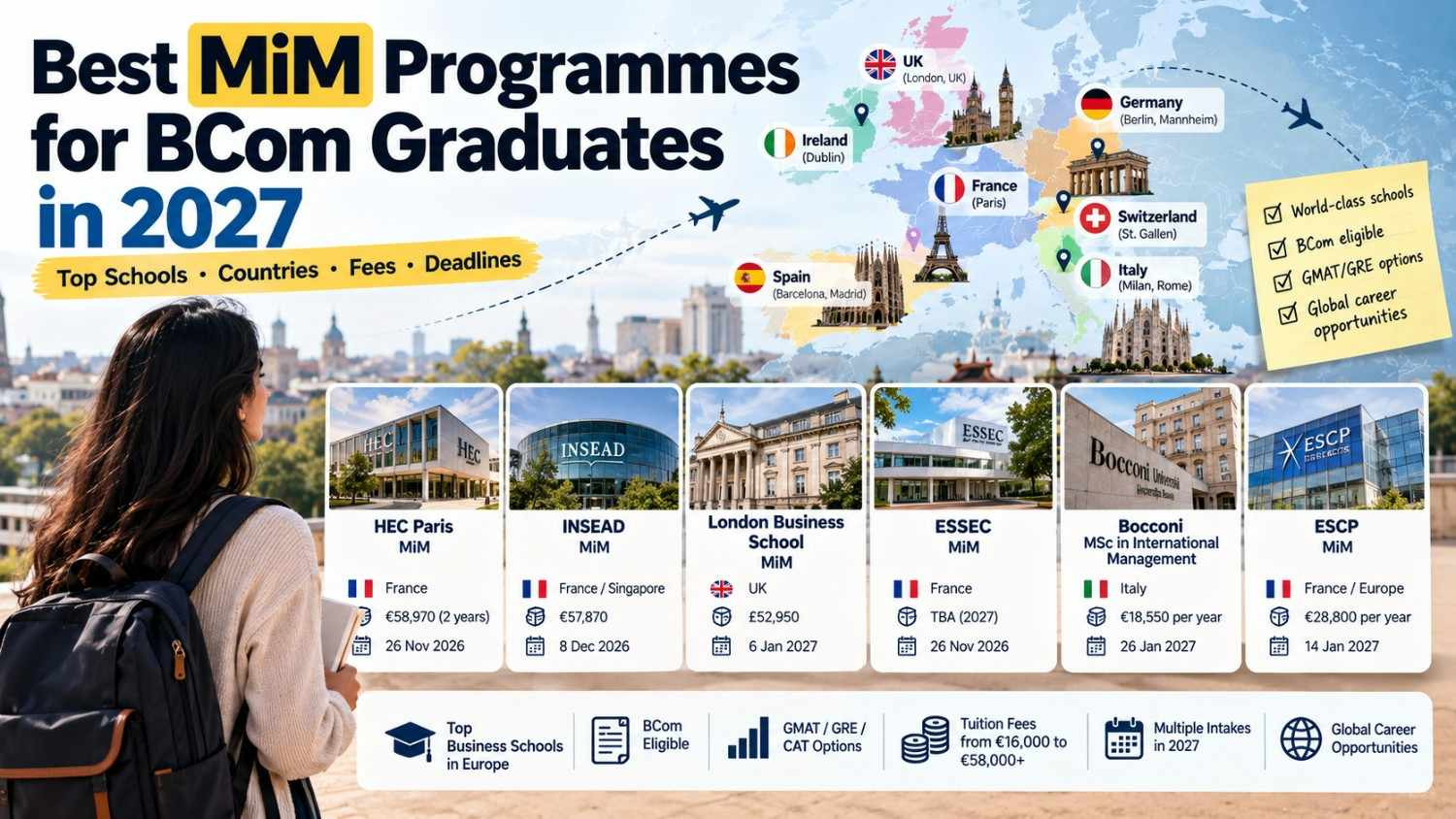
The programmes below are open to a three-year BCom graduate on paper and are genuine pre-experience general-management degrees. We've grouped them as ambitious, competitive and comparatively accessible. These groups are qualitative and depend on your profile. They're based only on published entry bars, test expectations and selectivity signals. They are not admission chances, and no school publishes acceptance rates for Indian or BCom applicants.
| Programme | Country | Three-year / India position | Test route | Tuition as published | Next deadline after late Oct 2026 |
|---|---|---|---|---|---|
| HEC Paris Master in Management | France | General 3-year rule | GMAT/GRE/TAGE MAGE required | €58,970 for 2 years + €2,500 for international students (2027) | 26 Nov 2026 |
| INSEAD Master in Management | France / Singapore | General bachelor's or 180 ECTS | GMAT/GRE required | €57,870 (August 2027 intake) | 8 Dec 2026 |
| London Business School Masters in Management | UK | No length stated (UK 2:1 equivalent) | GMAT/GRE required | £52,950 (2026 intake; 2027 not yet published) | Stage 2, 6 Jan 2027 |
| LSE Master's in Management | UK | India rule names BCom | GMAT/GRE required for non-UK degrees | £44,900 (2027/28) | Rolling |
| Imperial MSc in Management | UK | India rule | Optional with quantitative evidence | £51,000 (2027) | 6 Jan 2027 |
| St. Gallen Master in Strategy and International Management | Switzerland | 4-year default; 3-year by assessment | Test counts 20% of selection | CHF 3,557.50 per semester (Autumn 2026) | Rounds to 30 Apr 2027 |
| ESSEC Master in Management | France | General 3-year rule | Required; CAT accepted | 2027 tuition TBA; €2,000 yearly registration fee published | 26 Nov 2026 |
| ESCP Master in Management | France / Europe | General 3-year rule | CAT accepted; ESCP test option | €28,800 per year, non-EU (2027) | 14 Jan 2027 |
| emlyon Master in Management | France | General 3-year rule | CAT or emlyon online test | €22,600 per year (2027–28) | Rolling to 28 Jun 2027 |
| Bocconi MSc in International Management | Italy | General 3-year / 180 ECTS rule | GMAT/GRE or online Bocconi test | €18,550 per year (2026–27) | 29 Oct 2026, then 26 Jan 2027 |
| Esade MSc in International Management | Spain | No length stated | TAE, GMAT or GRE | €39,000 (2027–28) | 18 Nov 2026 |
| IE Master in Management | Spain | No length stated | ieGAT, GMAT or GRE | €50,000 (year not stated) | Rolling |
| WHU Master in Management | Germany | General 180 ECTS business rule | GMAT/GRE/GTEBS required | €41,200 total (2027) | Early bird 30 Nov 2026 |
| Warwick MSc Management | UK | India rule | No test listed | £41,500 (2027–28) | 2 Aug 2027 (rolling) |
| UCL Management MSc | UK | India rule | No test on 2027 page | £44,400 (2027/28) | 25 Jun 2027 (visa applicants) |
| UCD MSc International Management / CEMS MiM | Ireland | No length stated | GMAT not required | €26,710 (2027/28) | Rolling |
| EDHEC Master in Management | France | General 3-year rule | CAT accepted | €53,050 total, non-EU (2027) | Rolling to 22 Jun 2027 |
| ESMT Berlin Master in Global Management | Germany | No length stated | Waivable with quantitative evidence; BAT option | €38,500 (2027) | 31 Oct 2026, then 15 Dec 2026 |
| Mannheim Master in Management | Germany | General 3-year / 180 ECTS rule | Optional but scored | €1,500 per semester + €194 fee (year not stated) | 1 Apr – 15 May 2027 |
| TCD MSc in International Management | Ireland | India guide (CGPA 6.8) | Not a standard requirement | €25,150 (2027/28) | 31 Jul 2027 |
| Luiss Master's Degree in Management | Italy | General 3-year rule | GMAT 555 or GRE 157 per section | €16,000 first-year fee (2027/28) | Window to 31 Mar 2027 |
Ambitious: HEC Paris, INSEAD, LBS, LSE, Imperial, St. Gallen
These programmes combine high published bars with clear selectivity signals:
- HEC's test can't be waived, and its recommended averages are high.
- LSE received 1,031 applications for 102 places in 2025.
- Imperial publishes the highest Indian grade bar in this set.
- St. Gallen treats a three-year degree as an exception.
You can read more in our reviews of HEC Paris, INSEAD, LBS, LSE, Imperial and St. Gallen.
Competitive: ESSEC, ESCP, emlyon, Bocconi, Esade, IE, WHU, Warwick, UCL, UCD
Strong schools with lighter or more flexible entry rules than the ambitious group:
- Several accept the CAT or their own test, and some have no published minimum score.
- emlyon says roughly one in seven MiM applicants is admitted across its routes.
- WHU has hard score minimums.
- UCD CEMS needs a second language and an interview.
Reviews: ESSEC (plus our guide to the ESSEC MiM acceptance rate), ESCP, Bocconi, Esade, IE, WHU, Warwick and UCL.
Comparatively accessible: EDHEC, ESMT Berlin, Mannheim, TCD, Luiss
These have fewer published hurdles. Each still has caveats:
- EDHEC accepts the CAT and admits applicants with non-French degrees on a rolling basis until June 2027.
- ESMT can waive the test.
- Mannheim charges low state fees, but ranks applicants purely on merit and needs your APS certificate by 15 May 2027.
- TCD's India guide is CGPA 6.8.
- Luiss publishes minimum scores (GMAT 555 or GRE 157 in each section for 2027/28); its binding admission notice is due from November 2026.
See EDHEC, ESMT, Mannheim and TCD. For a wider view beyond BCom-specific fit, see our ranking of the best MiM colleges in the world.
How to Choose the Right MiM for Your BCom Profile and Budget
Apply to six to eight programmes across the three groups, matched to your marks, test status, budget and where you want to work afterwards. Two ambitious, three or four competitive and two comparatively accessible is a sensible spread. Mix countries deliberately, because the paperwork differs (APS for Germany, Declaration of Value or CIMEA for Italy).
By budget
| Tuition band | Programmes (tuition as published, with year) |
|---|---|
| Lower | Mannheim (€1,500 per semester + €194; no year stated), St. Gallen (CHF 3,557.50 per semester; Autumn 2026), Luiss (€16,000 first year; 2027/28), Bocconi (€18,550 per year; 2026-27) |
| Middle | emlyon (€22,600 per year; 2027-28), TCD (€25,150; 2027/28), UCD CEMS (€26,710; 2027/28), ESCP (€28,800 per year; 2027), ESMT (€38,500; 2027), Esade (€39,000; 2027-28) |
| Higher | WHU (€41,200 total; 2027), Warwick (£41,500; 2027-28), UCL (£44,400; 2027/28), LSE (£44,900; 2027/28), IE (€50,000; no year stated), Imperial (£51,000; 2027), LBS (£52,950; 2026 intake), EDHEC (€53,050 total; 2027), INSEAD (€57,870; August 2027 intake), HEC (€58,970 for 2 years + €2,500; 2027) |
Two-year programmes such as ESCP, emlyon and Bocconi charge per year, so multiply accordingly. These are tuition figures only. Living costs, deposits and visa fees come on top. Our breakdown of MiM costs and the list of low-cost MiM colleges go into more detail. For school-level budgets, including living costs, see ESCP MiM fees and LSE MiM fees.
By country and post-study plans
Think about where you want to work after graduating, not just where you want to study. In the UK, the Graduate visa is 18 months if you apply on or after 1 January 2027, down from two years. Anyone starting a one-year UK MiM in 2027 falls under the 18-month rule. France, Germany and Ireland also offer post-study job-search permissions; check the current terms on official immigration sites before you decide.
Language matters too. Consulting and marketing roles in France, Germany, Spain and Italy often expect the local language. If you don't plan to learn it, weigh the UK and Ireland more heavily. Our guides to MiM in Europe, MiM in Germany and MiM in the UK compare countries in more depth.
2027 MiM Admission Strategy for BCom Graduates, Profile by Profile
Your strongest lever depends on your profile. For some it's the test score. For others it's a better story about their internships or a written eligibility check. Find your row below, then read the sections on quant readiness and positioning.
| Your profile | Main strength | Main challenge | First thing to fix | Programmes whose published rules fit |
|---|---|---|---|---|
| 60–70% | Meets Warwick Category 1 and 2 bars, UCL baseline, TCD guide; French and Spanish schools publish no minimum | Below Imperial's 70% mainstream bar; Mannheim ranks on grades | A strong test score and an upward trend in final-year marks | ESCP, EDHEC, emlyon, IE, Esade, Bocconi, ESMT, TCD, UCD |
| 70–80% | Clears Imperial and every Warwick category | Common profile; marks alone don't stand out | One standout achievement and specific career goals | Balanced list across all three groups |
| 80% and above | Clears every published Indian bar | Ambitious schools see many high scorers | Test near HEC's published averages if targeting HEC or INSEAD | HEC, INSEAD, LBS, LSE, Imperial, St. Gallen plus safer options |
| BCom (Hons) | More papers in accounting, economics, statistics | Still a three-year degree | A paper-by-paper credit map for German and Swiss schools | WHU, Mannheim, Bocconi, plus the rest by marks |
| No internships | Most MiMs need no experience | WHU needs 12 weeks of practical experience | Add one documented project or short internship before Round 3 | Programmes open to no-experience applicants; not WHU |
| Finance or accounting internships | Quantifiable, relevant work | Explaining why a general MiM, not an MSc Finance | Show progression from execution to analysis | HEC, ESCP, EDHEC, Bocconi, WHU, Imperial, LSE, UCL |
| No GMAT/GRE | CAT, in-house tests and optional-test schools exist | HEC, INSEAD, LBS, LSE, WHU and Luiss still require a test | Make quant evidence visible on the transcript and CV | ESSEC, EDHEC, emlyon, ESCP, IE, Esade, Bocconi, Imperial, Mannheim, TCD, UCD, ESMT |
| Gap year | Time for a test or real work | Bocconi prefers applicants under two years from graduation; LBS needs graduation within two years | Document the year with letters or certificates | Most programmes; check time-since-graduation rules |
| Non-premier university | Many schools assess individuals without institution lists | Imperial, Warwick, UCL, St. Gallen and WHU weigh the institution | Check NAAC grade, UGC recognition and anabin status; get a class-rank letter | French Grande Écoles, Esade, IE, Bocconi, ESMT, TCD, UCD |
Unsure which row is yours? A short strategy session can help you choose before you spend on fees.
Quant readiness for commerce graduates
This is the gap competitors rarely mention, and admissions teams do look for it. Imperial waives its test only with "evidence of good quantitative achievement". ESMT waives it for applicants whose coursework is "mainly theoretical/quantitative". St. Gallen wants at least 6 ECTS in maths or statistics.
For a BCom student, quant evidence usually comes from three places:
- Your transcript. Business statistics, business mathematics, cost accounting and econometrics papers, with strong marks.
- A test's quant section. A good GMAT Quant or Data Insights score, or GRE Quant, speaks for itself.
- Graded coursework since college. A university-run statistics or financial-maths course with a certificate and grade, or CA/CMA papers with quantitative content.
If your maths stopped at Class 12, address it before you apply, not in the SOP.
Positioning accounting, economics, finance, taxation and internships
Here's how to make a commerce background read as preparation for management, not just book-keeping.
- Accounting: frame it as understanding how businesses measure performance. One line on a variance analysis or a reconciliation that changed a decision is worth more than listing the paper.
- Economics: link micro or macro papers to a market you care about, such as pricing in FMCG or inflation's effect on a client's margins.
- Finance and taxation: show judgement, not just rules. If you worked on GST filings or tax audits, describe a problem you spotted and what you did about it.
- Business studies and law: use them to show breadth, especially for general-management goals.
- CA, CMA, ACCA or CFA progress: state the exact level and date ("CA Intermediate, both groups cleared, May 2025"). If you did articleship, ask each school whether it counts as work experience. Policies aren't always published, and LBS, for example, doesn't count internships.
- Family business: treat it as real work. Give the scale, your role and one measurable change you made.
CV, SOP, recommendations and interview
- CV: one page, reverse chronological, every bullet showing what you did and what changed. Put marks on one line; transcripts are mandatory anyway.
- SOP and essays: answer each school's actual prompt. A strong BCom arc runs like this:
- What drew you to management.
- What your degree and internships taught you, and where they stopped.
- Why a MiM now, rather than finishing CA, doing an MCom or waiting for an MBA.
- Why this programme.
- Your first role after graduating.
- Recommendations: choose people who saw your work closely, such as an internship manager and a professor from a quantitative or accounting paper. Brief them with your CV and specific examples. The letters must be theirs; never draft one for a recommender to sign.
- Interview: formats differ. ESCP's Direct Admissions route weights the interview at 30% of the evaluation, and LBS says all its interviews are currently held virtually. Prepare a 90-second introduction, a clear answer to "why a MiM after BCom?", and four or five short stories about leadership, teamwork, an analytical problem and a setback.
Matching programmes to career goals
- Consulting: show structured problem-solving (case competitions, an improvement project) and comfort with numbers. Published sector data shows consulting shares of 35% at INSEAD (MIM'26) and 23.8% at HEC (class of 2025).
- Finance: CA, CFA or ACCA progress and finance internships carry weight. HEC reports 29.6% of its class of 2025 in financial services. EDHEC reports 36% across all its master's graduates (Class of 2024). If you want deep technical finance, compare the MiM with a specialised finance master's, such as the HEC Paris MFin, before deciding.
- Marketing: bring campaigns or consumer work with results (a college fest, a family-business launch). Expect local-language expectations in continental Europe.
- Business analytics: show data work you've actually done (Excel, SQL, Python, Power BI). If you want a technical analytics career, a dedicated MSc Business Analytics may suit you better than a MiM.
- General management: name a specific first role, such as a rotational graduate programme, rather than "general management". Admissions committees want a credible next step.
MiM Application Timeline for 2027 Intake (October 2026 to September 2027)
If you're starting in late October 2026, you're not late, but the early rounds are closing. Here's what to do month by month. Dates were verified on 23 October 2026; confirm each one before you submit, and skip any round that has already closed.
- October 2026:
- Choose your test route and take a diagnostic test.
- Shortlist six to eight programmes.
- Request transcripts, degree certificates and syllabus documents from your university, because Indian processes can take weeks.
- If Germany is on your list, start the APS application now.
- Late-October deadlines: Bocconi's Round I (29 October) and ESMT's first round with a €3,000 early award (31 October). If these have passed, their next rounds are listed below.
- November 2026:
- Esade's next deadline is 18 November.
- HEC and ESSEC Round 2 close 26 November.
- WHU's early-bird deadline (€3,000 off) is 30 November.
- Finish your CV and brief your recommenders.
- December 2026:
- INSEAD Round 2 closes 8 December and ESMT's second round 15 December.
- Sit your first GMAT or GRE attempt if you haven't, and book your English test.
- January 2027:
- Imperial Round 2 and LBS Stage 2 close 6 January; ESCP Round 2 closes 14 January; Bocconi Round II closes 26 January.
- WHU's second early-bird (€1,500 off) and its Responsible Leader Scholarship close 31 January, as does ESMT's third round.
- Germany applicants: a dMAT session is expected in mid-January (registration hadn't opened when we checked).
- Use this month for a test retake if needed.
- February 2027:
- HEC Round 3, ESSEC Round 3 and an Esade deadline fall on 17 February; INSEAD Round 3 closes 23 February.
- Compare any early offers and scholarship letters.
- March 2027:
- LBS Stage 3 falls on 8 March, the date LBS strongly encourages for scholarship consideration; Imperial Round 3 on 10 March; ESCP and Bocconi on 11 March.
- ESMT, the WHU scholarship deadline and the Luiss window all close 31 March.
- The mid-March dMAT session is the last realistic one for a winter 2027 start in Germany.
- April 2027:
- Mannheim opens 1 April.
- HEC Round 4 and Imperial Round 4 close 28 April; Bocconi 29 April.
- WHU's deadline for applicants needing a visa is 30 April.
- Start visa preparation for any offer you've accepted.
- May 2027: Mannheim closes 15 May, and your APS certificate and test scores must arrive by then; there's no extension. Prepare visa documents and accommodation.
- June–July 2027:
- Rolling programmes close: UCL for visa applicants on 25 June, emlyon on 28 June, TCD on 31 July.
- Submit final transcripts for conditional offers.
- August–September 2027: programmes begin. LBS and INSEAD start in August, HEC in September.
Our page on MiM deadlines in Europe tracks more schools.
Jobs and Salary After MiM for Commerce Graduates
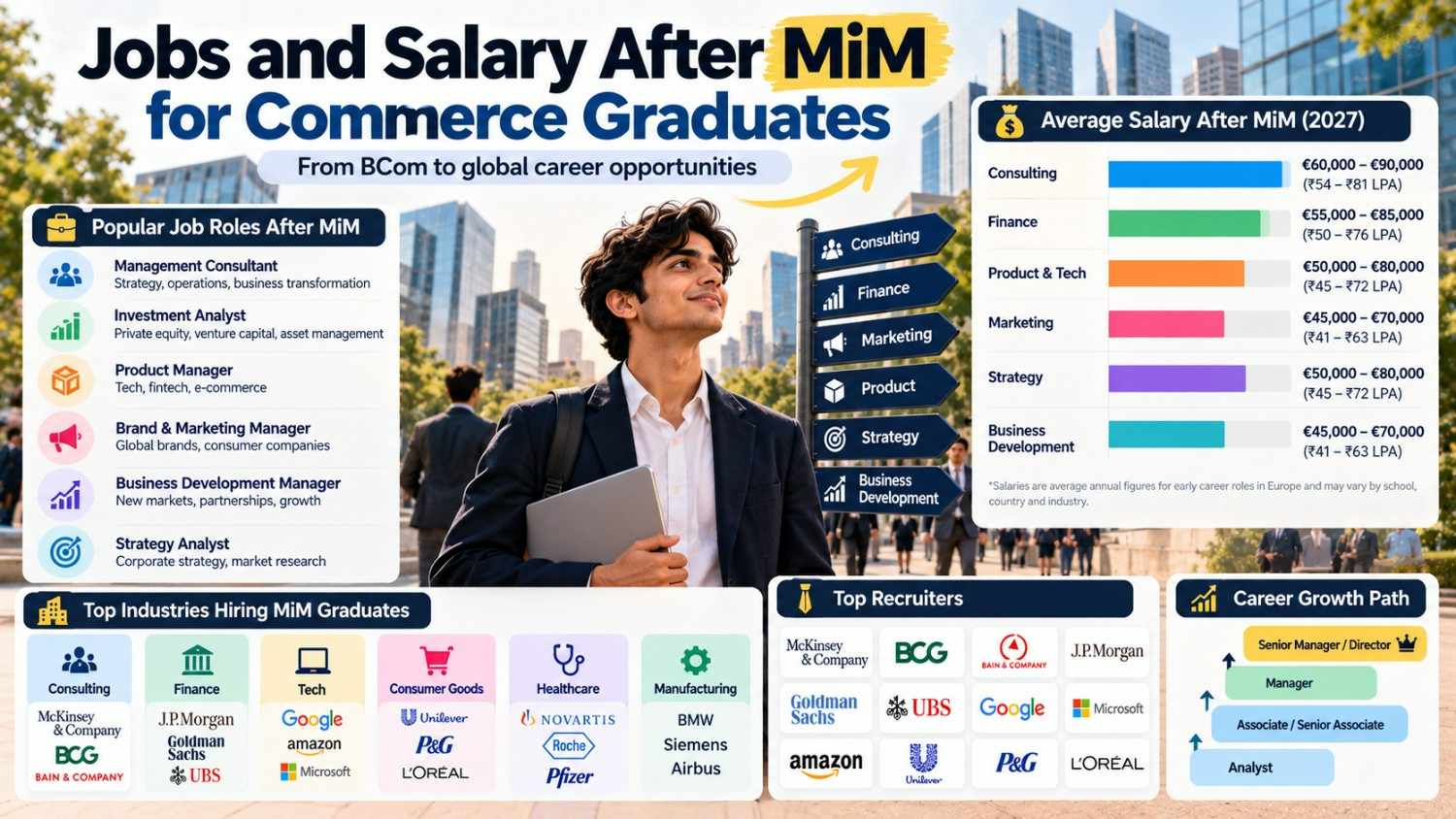
Finance and consulting take a large share of graduates at several of these schools, but always read outcome figures with their year and basis. None of the schools reports what Indian graduates earn back in India, so we don't estimate it.
| Programme | Employment (year) | Salary as published (year) | Sector note |
|---|---|---|---|
| HEC Paris MiM | 99% accepted offers within 3 months (class of 2025) | Average €118,500 three years after graduation (FT 2026 ranking, not a starting salary) | 29.6% financial services, 23.8% consulting (class of 2025) |
| INSEAD MIM | 93% offers within 3 months (MIM'26) | Median starting salary €49,100 (MIM'24) | Consulting 35%, finance 20% (shown with MIM'26 data) |
| emlyon MiM | 93% employed at 3 months (2024 graduates) | Average €59K (2024 graduates, "indicative") | — |
| Esade MSc IM | 91% within 3 months (Class of 2025) | Average base $76,768 PPP (Class of 2025) | 49% found jobs outside their home country |
| Imperial MSc Management | 94% accepted offers within 6 months (Class of 2025, combined with MSc International Management) | Average $65,890 PPP (same) | 56% employed in the UK |
| LSE Master's in Management | Not published | Median £40,000 at 15 months (UK graduate outcomes data, 2019/20–2023/24) | — |
| ESMT Berlin MGM | 95% offers within 3 months (classes of 2022–2024) | Average €59,280 (same) | 73% working in Germany |
| WHU (all MSc programmes) | 92% offers within 3 months | Average €67,149 (Career Entry Report 2021–2025) | Not MiM-specific |
PPP means the figure is adjusted for purchasing power and isn't a direct currency conversion. For more on roles and pay, see our guides to jobs after a MiM and MiM salaries.
Conclusion
Pursuing a MiM after BCom can be a great option for Indian students who want to study abroad and build a career in consulting, finance or management. Top business schools like HEC Paris, ESSEC, ESCP and INSEAD consider BCom graduates, but each has different admission requirements.
If you're planning for the 2027 intake, focus on choosing the right colleges, checking your eligibility and preparing a strong application. Your BCom degree is a good starting point, but your skills, academic performance and career goals will help you stand out.